
It’s not often that a conservative education secretary and a progressive teachers union boss see eye to eye. But such a convergence occurred last year, when Secretary Linda McMahon told a congressional committee that a “four-year college is not for everyone” and, a few months later, President Randi Weingarten of the American Federation of Teachers said almost the same thing in The New York Times. Rather than continuing to push a “college for all” approach, both voiced support for stronger career and technical education to help more young people transition from high school to the workforce.
With bipartisan support from many governors and legislators, career and technical education has also risen on state policy agendas. Leaders have promoted industry-recognized credentials as a tool to validate students’ technical skills and to aid transitions into the workforce. In Ohio, such credentials are used in three principal ways: (1) Students can use them to meet alternative high-school graduation requirements; (2) schools receive credit on the state report card when students earn them; and (3) schools receive extra state funding (currently up to $725 per credential) through the Innovative Workforce Incentive Program (IWIP).
For graduation and report-card purposes, Ohio has approved an expansive list of 693 credentials tied to jobs in 13 career clusters (e.g., agriculture, business, and healthcare). These credentials include anything from basic CPR and job-safety certificates to full occupational licenses. The state’s IWIP credentials are more selective—focusing on fields like IT and advanced manufacturing. Today, just 210 credentials qualify for these funds. Due to this trio of policies encouraging credentials, student participation and attainment have soared: 26 percent of Ohio’s class of 2024 earned credentials during high school, whereas just 2 percent of the class of 2014 did so.[1]
But how beneficial are such industry credentials for those obtaining them in high school? This is a critical question that state policymakers are wrestling with, though few studies have shed light on their value. A prior Fordham Institute report found that credential earning in Texas was associated with modest wage increases in the year immediately after high school; another study, from Florida, linked credentials to college attendance.
Fordham’s new study, College or Career Readiness? Postsecondary and Labor Market Outcomes for Ohio High School Students Earning Industry-Recognized Credentials, is the first from Ohio to examine industry credentials, and alongside a recently published report from Texas, is one of the first nationally to study how they relate to students’ longer-term outcomes. Author Jay Plasman of Ohio State University focuses on postsecondary education and labor market outcomes for students in the high school classes of 2016 to 2022, a span of time that covers cohorts affected by the state’s early rollout of credential policies.
Here are Dr. Plasman’s main findings:
1. Credentials typically provide students with an income boost right after high school, but wage returns weaken over time. In the year immediately after high school, students who earn an industry credential have an average annual income that is 21 percent higher than their non-credential-earning peers of similar demographic and academic backgrounds. However, the wage return on a credential falls to just 5 percent by the time (former) students reach their mid-twenties. That diminution may be partly due to students (without credentials) earning college degrees. It’s also possible that some credentials help young people get their foot in the employment door but don’t help them climb the ladder after that.
2. Some credentials hold value as students reach their mid-twenties—but others do not. As figure A shows, credentials in construction, transportation, and manufacturing are associated with stronger and more enduring wage returns. For instance, the average student attaining a manufacturing credential—e.g., a welding or mill-operating certificate—earned wages at age 25 that were 37 percent higher than a peer who did not attain a credential during high school. Credentials in other career clusters have less certain long-term economic value by the time students reach their mid-twenties.
Figure A: Credentials’ wage returns seven years after high school, by career cluster
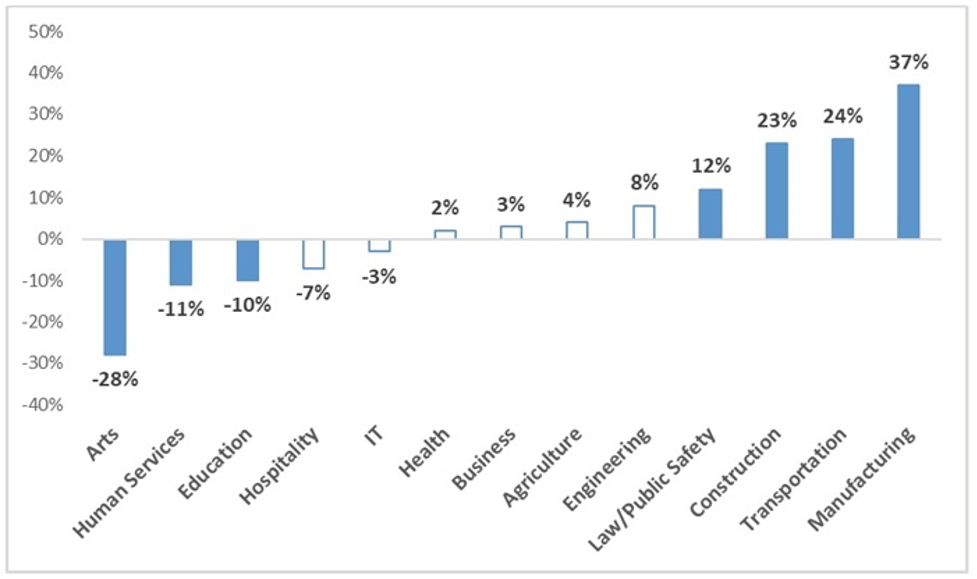
Note: Solid bars indicate statistically significant wage gains or losses. Information about which specific credentials are tied to each career cluster is available here.
3. Young men benefit more from credentials. By their mid-twenties, male credential-earners have annual incomes 23 percent higher than students who have not earned credentials, while female credential-earners enjoy no wage advantage at all (their returns are actually negative). This reflects the fact that males attain far more of the high-value credentials in such industries as construction, manufacturing, and transportation.
4. Credentials are associated with higher wage returns when paired with career and technical education course completion. Students do not necessarily need to complete formal coursework to earn a credential; some credentials can be earned through self-paced learning modules and passing a skills assessment. But those students who combine structured coursework and an industry credential earn higher wages than those who only earn a credential: 18 percent more by their mid-twenties, versus 4 percent for students with only a credential.
5. Earning industry credentials is, on average, negatively associated with college attendance and degree completion. While this finding isn’t entirely surprising, it does contrast with prior studies suggesting that career and technical education might increase college-going. It’s not entirely clear what is behind the negative relationship. Although the analysis includes a rich set of control variables, the results may reflect unobserved characteristics (e.g., less motivation to pursue higher education) that contribute to credential earners’ lower college attendance rates. Credential earning could also be “nudging” students toward the workforce and away from college.[2] There may also be variation in post-secondary outcomes by the type of credential-earned, an issue not examined here but one that warrants further study.
What are the real-world implications of this analysis? Industry credentials should remain an integral part of a robust career-and-technical education system that also includes rigorous coursework and work-based learning. Yet not all credentials hold equal value. With that in mind, the study offers the following recommendations for state policymakers, both in Ohio and elsewhere.[3]
- Be selective about which credentials are approved. Some industry credentials unlock value for students—and Ohio has done a respectable job of identifying those types for IWIP. But many others do not, including some that Ohio has approved for graduation. State leaders should be wary of approving low-value credentials, lest they inadvertently push students away from college or into jobs with little durable payoff.
- Gauge credentials’ economic value based on longer-term outcomes. The study shows the importance of examining credentials over a longer timeframe. To wit, the cosmetology credential is associated with a modest income return immediately after high school, but its value disappears six years after high school. States should prioritize credentials that offer enduring value to students, not just a short-term boost.
- Create high-value credential opportunities for disadvantaged students. The study indicates that economically disadvantaged pupils tend to earn lower-value credentials, a finding that mirrors data presented elsewhere showing that students in urban areas are racking up a great many questionable credentials en route to their high school graduation. In Ohio, we need more programs such as Toledo Public Schools’ new commercial driver’s license program and fewer programs that add little value to students’ career prospects.
- Don’t substitute credentials for academic competence. For graduation purposes, Ohio permits students to substitute credentials for math and reading competency as measured by a state test. This is misguided policy, especially as the state has struggled to evaluate credentials and ensure quality control. Today, thousands of Ohio students exit high school with weak academic skills and credentials whose value will likely evaporate quickly. It’s important to encourage students to develop specialized technical skills and pursue individualized pathways, but not at the expense of basic English and math competency.
Young people should have opportunities to do something they love and to secure jobs that pay enough to support a family—and do all this without having to spend four years in college. That’s a tall order, but rigorous career and technical education can help many students get on the right path. Industry credentials can and should continue to play a key role in the future of career-tech in America. Let’s make sure that they are being used wisely and that they truly pay off for students who earn them.