Formal reading instruction in the United States predates our nation’s founding. Published in the 1680s, The New England Primer—the nation’s first major schoolbook—included spelling and sounding-out exercises that modern science of reading advocates would readily identify as early phonics instruction.
But it was the late nineteenth-century psychologist Edmund Huey who established the roots of the “science of reading” (SoR). Using rudimentary mechanical devices to measure eye movements, he showed that the act of reading was not a smooth process but rather a series of “rapid eye jumps and pauses,” reflecting the complex mental processes involved in decoding and comprehension.
In the decades that followed, a procession of influential scholars—including Edward Thorndike, Rudolf Flesch, Jeanne Chall, Keith Stanovich, and Marilyn Jager Adams—built an empirical foundation on how children learn to read. And in 2000, the National Reading Panel synthesized the best evidence and the takeaways for classroom implementation.
Yet this long research tradition has not produced uniform understanding or practice in today’s literacy classrooms. Instead, we’ve experienced significant bumps, detours, and even reading “wars,” as advocates of effective reading instruction have struggled to make their voices heard.
In 2022, Emily Hanford’s podcast series, Sold a Story, initiated a fresh wave of concern and advocacy, and state and local policies meant to improve reading instruction have proliferated in response. (At least 40 states and counting have enacted science of reading laws.) Whether these efforts ultimately succeed depends in large part on how clearly and consistently they are understood, supported, and enacted by teachers.
To learn more about that, we conducted a nationally representative survey of America’s K–3 reading teachers, with the twin goals of assessing their knowledge of reading science (via a short quiz embedded in the survey) and connecting those results to specific and ongoing “SoR” state implementation efforts. Fordham’s David Griffith and Brian Fitzpatrick co-led the analysis that resulted in our new study, From the teacher’s desk: A science of reading progress report.
Here are their four big findings:
First, at least a third of teachers in high-poverty settings aren’t fully committed to the science of reading.
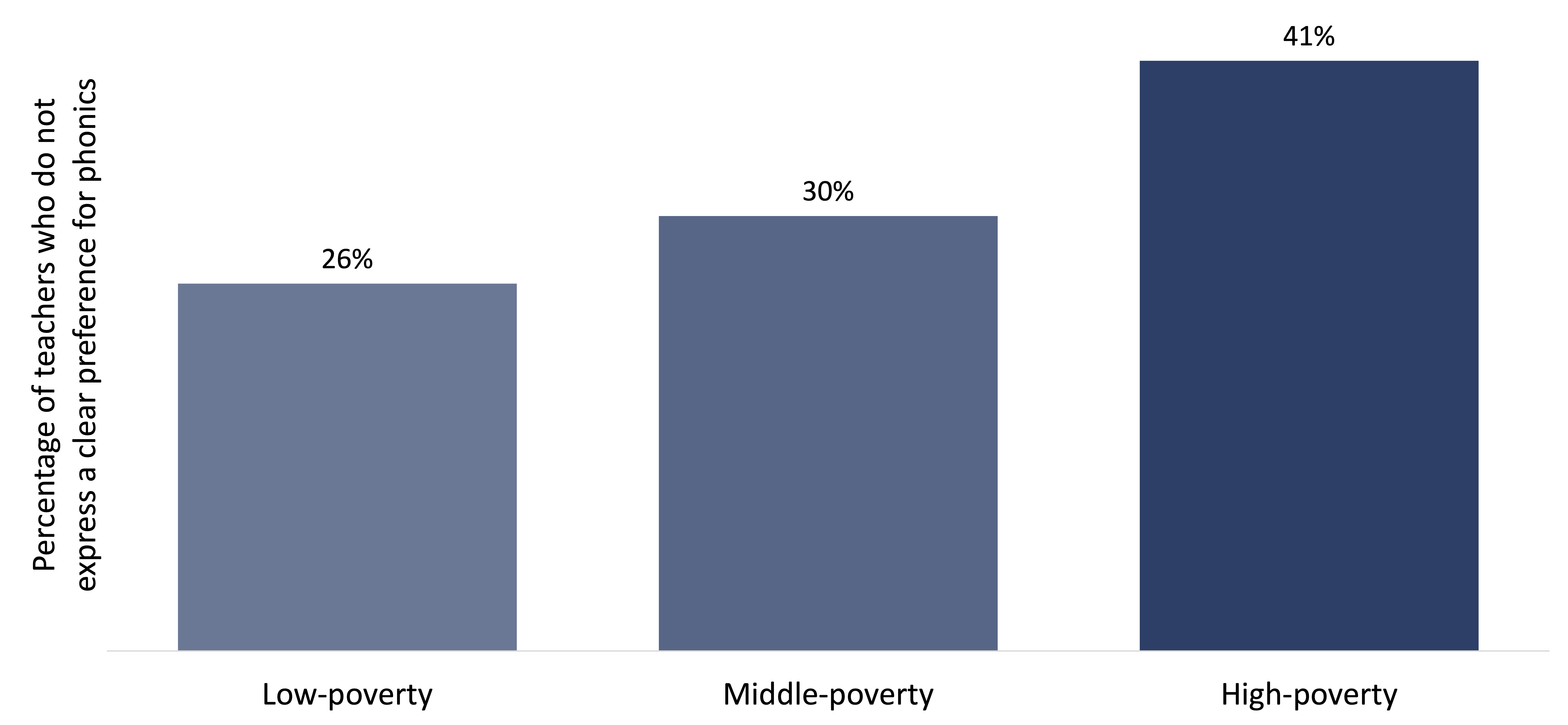
For example, when given the choice between a phonics-based approach to reading instruction and “cueing”—a discredited practice that encourages guessing instead of systematic decoding—a disquieting 41 percent of K–3 teachers in high-poverty settings did not express a clear preference for phonics (Figure F-1).
Figure F-1. Teachers in high-poverty settings are more likely to express ambivalence about phonics-based instruction.
Second, teachers who rely on their preservice training know less about the science of reading than teachers who receive in-service training.
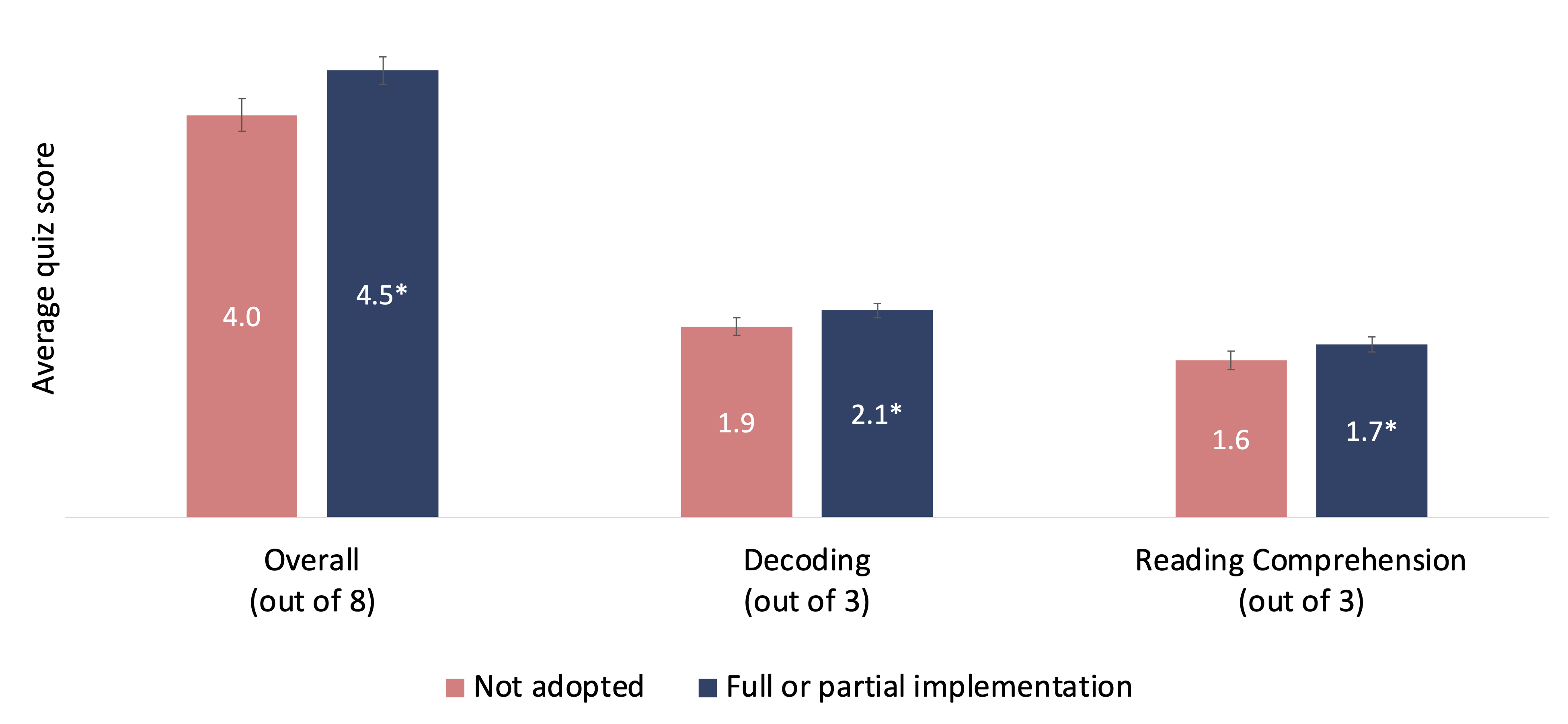
In fact, while receiving science of reading–aligned professional development is associated with more knowledge of reading science, preservice emphasis on the science of reading is associated with less knowledge of the topic (Figure F-2). In other words, whatever literacy instruction teachers receive in schools of education may be actively harmful to their understanding of evidence-based practices.
Figure F-2. In-service literacy training is associated with more knowledge of reading science, while preservice literacy training is associated with less knowledge.

Third, teachers in states with science of reading–aligned licensure tests have a firmer grasp of reading science.
Of the 18 state reading policies we examined, only one—requiring an initial licensure test aligned with the science of reading—is associated with deeper understanding of that science (Figure F-3). Like the previous finding, this one suggests that improving the quality of preservice preparation is perhaps the most fundamental challenge.
Figure F-3. Teachers in states with science of reading–aligned licensure tests have a firmer grasp of the science of reading.
Finally, many teachers are still using questionable reading curricula.
For example, despite facing criticism for their continued inclusion of three-cueing and other unscientific methods, Benchmark Advance and Fountas & Pinnell are still used by 19 percent and 16 percent of teachers, respectively—though in better news, the most popular reading curriculum in America is now the well-regarded UFLI (University of Florida Literacy Institute) Foundations (Figure F-4).
Figure F-4. The most popular reading curriculum among K–3 teachers is University of Florida Literacy Institute (UFLI) Foundations.

Encouragingly, the survey data show that teachers who use UFLI tend to know more about the science of reading than the rest of the sample, as do teachers using CKLA-Amplify. In contrast, teachers who use Benchmark, Fountas and Pinnell, and i-Ready (the nation’s second most popular reading curriculum) tend to be less knowledgeable than their peers.
Based on these findings, our Fordham colleagues urge states to take four steps:
- Require colleges of education and other teacher preparation programs to provide instruction aligned to the science of reading.
- Require that K–3 teacher licensure exams include comprehensive knowledge of the latest reading science.
- Require every K–3 teacher to complete at least one science of reading training in their first 2–3 years on the job.
- Require districts to choose a science of reading–aligned curriculum from a state-approved list in grades K–3.
We wholeheartedly agree with these recommendations and would add one more to the list: policymakers and other stakeholders must do everything in their power to address the emerging science of reading gap.
On average, the survey data suggest that teachers in low-poverty schools are at the 54th percentile of science of reading knowledge and commitment, while those in high-poverty schools are at the 44th—a substantial difference that will have dire consequences for poor students should it persist.
Unfortunately, we can’t say with certainty why this gap exists. For example, despite exhibiting less knowledge of reading science, teachers in high-poverty schools report more exposure to science of reading–aligned trainings such as LETRS (37 percent versus 27 percent) and CKLA (16 percent versus 8 percent) than teachers in low-poverty schools. Similarly, they are more likely to report using the CKLA-Amplify curriculum (27 percent versus 17 percent) – though they are also more likely to use i-Ready (42 percent versus 31 percent), which is generally associated with less knowledge of reading science.
Collectively, these patterns don’t suggest a single, straightforward explanation. But they do highlight the fragmented nature of curriculum adoption and the complexity of translating exposure to science of reading–aligned training into better practice in high-poverty schools. And by that measure, there is still considerable ground to cover.
To be clear, we’ve made real progress in recent years, so the challenge now is to use what we’ve learned to keep moving forward. To us, that means a sustained focus on the things that matter most: stronger preservice programming, deeper professional development, more coherent curricula, and implementation supports that reflect local realities—especially where the need is greatest.
Read the report:
From the Teacher’s Desk: A Science of Reading Progress Report
By David Griffith and Brian Fitzpatrick