Mobile Navigation

  • National
    • Policy
      • High Expectations
      • Quality Choices
      • Personalized Pathways
    • Research
    • Commentary
      • Gadfly Newsletter
      • Flypaper Blog
    • Events
    • Scholars Program
  • Ohio
    • Policy
      • Priorities
      • Media & Testimony
    • Research
    • Commentary
      • Ohio Education Gadfly Biweekly
      • Ohio Gadfly Daily
  • Charter Authorizing
    • Application
    • Sponsored Schools
    • Resources
  • About
    • Mission
    • Board
    • Staff
    • Career
Home
Home
Advancing Educational Excellence

Main Navigation

  • National
  • Ohio
  • Charter Authorizing
  • About

National Menu

  • Topics
    • Accountability & Testing
    • Advanced Education
    • Career & Technical Education
    • Charter Schools
    • Curriculum & Instruction
    • ESSA
    • Evidence-Based Learning
    • Facilities
    • Governance
    • Personalized Learning
    • Private School Choice
    • School Finance
    • Standards
    • Teachers & School Leaders
    • Think Again
  • Research
  • Commentary
    • Gadfly Newsletter
    • Flypaper Blog
    • Gadfly Podcast
  • Events
  • Scholars Program

The Education Gadfly Weekly

Sign Up to Receive Fordham Updates

We'll send you quality research, commentary, analysis, and news on the education issues you care about.
Thank you for signing up!
Please check your email to confirm the subscription.

The Education Gadfly Weekly: You might be surprised which states prioritize higher teacher salaries

Volume 19, Number 17
4.24.2019
4.24.2019

The Education Gadfly Weekly: You might be surprised which states prioritize higher teacher salaries

Volume 19, Number 17
view

You might be surprised which states prioritize higher teacher salaries

It’s one of the great conundrums of American public education: Even when calculated in constant dollars, and even after the Great Recession, we spend dramatically more per pupil than in decades past, yet teacher salaries have barely kept pace with inflation. Where is the money going? And how much could we pay teachers if we had prioritized higher salaries instead? This new analysis compares average teacher salaries to average per-pupil spending—by state, and over time, all in inflation-adjusted dollars. The results aren’t what you’d expect.

Michael J. Petrilli 4.24.2019
NationalFlypaper

You might be surprised which states prioritize higher teacher salaries

Michael J. Petrilli
4.24.2019
Flypaper

The freedom to teach well

Robert Pondiscio
4.24.2019
Flypaper

Federal education R & D: A brief, opinionated history (part II)

Chester E. Finn, Jr.
4.24.2019
Flypaper

Great teachers make for great principals

Aaron Churchill
4.18.2019
Ohio Gadfly Daily

The Education Gadfly Show: Searching for "deeper learning"—and not finding it

4.24.2019
Podcast
view

The freedom to teach well

Robert Pondiscio 4.24.2019
Flypaper
view

Federal education R & D: A brief, opinionated history (part II)

Chester E. Finn, Jr. 4.24.2019
Flypaper
view

Great teachers make for great principals

Aaron Churchill 4.18.2019
Ohio Gadfly Daily
view

The Education Gadfly Show: Searching for "deeper learning"—and not finding it

Michael J. Petrilli, David Griffith, Ph.D., Adam Tyner, Ph.D., Jal Mehta 4.24.2019
Podcast
view

You might be surprised which states prioritize higher teacher salaries

Michael J. Petrilli
4.24.2019
Flypaper

It’s one of the great conundrums of American public education: Even when calculated in constant dollars, and even after the Great Recession, the U.S. is spending dramatically more per pupil than in decades past, yet teacher salaries have barely kept pace with inflation. This raises several key questions: Where is the money going, if not into salaries? And how much could we pay teachers if we prioritized higher salaries instead?

To be clear, I don’t have all the answers. But I do have a fresh look at the data.

Introducing the salary-to-spending ratio

To shed some light on this issue, I decided to compare average teacher salaries to average per-pupil spending—by state, and over time, all in inflation-adjusted dollars.

This is a twist on just looking at average teacher salaries, which can be instructive if you want to understand where teachers have the best argument that they are underpaid (especially if the numbers are adjusted for cost of living differences). That’s important information, especially in this season of teacher strikes and protests, but I was curious about a different question: Which states, if any, have prioritized higher teacher pay over other possible uses for their education funds? To put it another way, as spending rose in recent decades, which states have chosen to put the additional dollars into higher salaries instead of other options, such as smaller classes, employee healthcare and retiree benefits, or additional staff, especially?

That’s because, as my colleague Checker Finn has long argued, if we as a country had chosen better teachers (via higher salaries) over more teachers (via smaller class sizes and more personnel), we might have gotten stronger results.

Keep in mind that changes in average teacher salaries can reflect both changes in teacher pay scales and in teacher “composition.” For example, if the teaching force becomes significantly younger over time, average teacher salaries will drop, even if the pay scale stays the same.

So let’s look at the data, first for the United States as a whole. Again, to keep things simple, we’ll compare the average teacher salary for a given school year to average per-pupil spending, and call it the “salary to spending ratio.” Here’s what that’s looked like from 1990 forward:

Table 1: U.S. average teacher salaries, average per-pupil expenditures, and
salary to spending ratio, 1990–2016 (inflation-adjusted)

table2.3

Source: National Center for Education Statistics, Digest of Education Statistics 2019, tables 211.60 and 236.70.

The average teacher salary has been remarkably consistent over this period, even though spending has increased by 35 percent, and that has dropped the salary-to-spending ratio from 6.2 in 1990 to 4.5 in 2016. If salaries had risen at the same rate as spending, the average teacher salary by 2016 would have been more than $80,000 per year, versus a bit less than $60,000.

Salary-to-spending ratios: State-by-state differences

So the U.S. as a whole now has a salary-to-spending ratio of 4.5. Are there any differences at the state level? That might suggest that some states are making higher teacher salaries a priority. There are indeed differences. Here’s how it looks for 2015–2016.

Table 2: Average teacher salaries, average per-pupil expenditures, and
salary to spending ratios, 2015–16
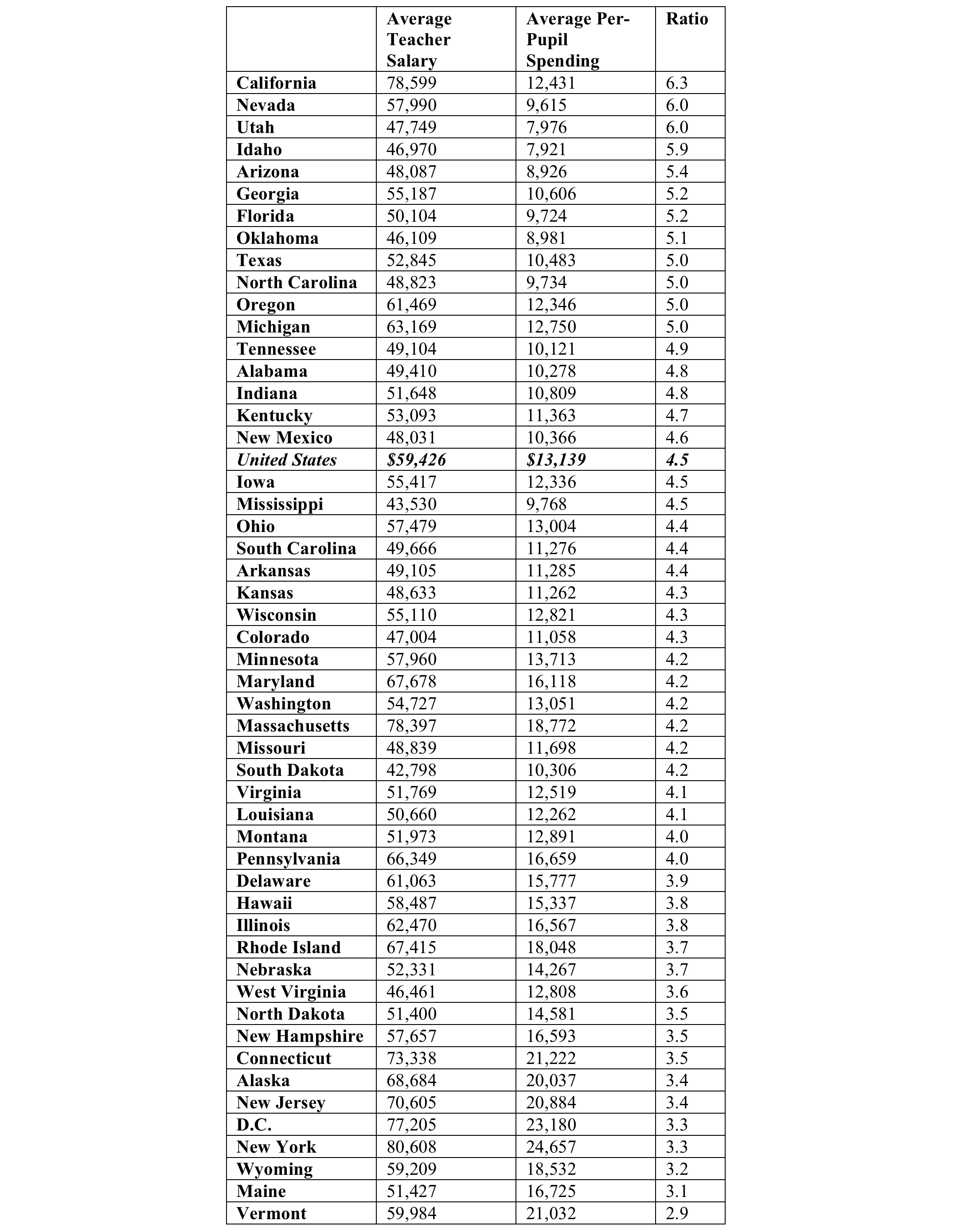
table2.4

It’s hard to know what exactly to make of these data, but a few patterns do jump out. First, many fast-growing, low-spending states, such as Idaho, Arizona, and Georgia, appear to put more of their scarce dollars into teacher salaries. California is not exactly a low-spending state, yet it’s at the top of the list too, presumably because its high cost of living means it needs to pay more to have any chance at recruiting quality teachers.

Many high-spending states, on the other hand, appear to allocate their additional dollars into more staff, or other items, rather than higher teacher salaries. Maybe that’s understandable in low-cost-of-living states, but it sure seems that expensive ones like New York, Rhode Island, and Connecticut should be putting even more of their dollars into higher salaries. If New York’s salary-to-spending ratio matched California’s, for example, it could be paying teachers an average of about $155,000 a year, instead of the actual average of about $80,000.

I also wonder about special education. Many of the states at or near the top of the list, including California, have famously low rates of special education identification, while many toward the bottom, such as New York, have high rates. Is that because some states truly have more kids with disabilities? Or are lower-spending states finding ways to be stingier about who gets identified, thus avoiding the need to hire lots of additional support staff?

State-by-state salary-to-spending ratios over time

Let’s take one more cut at the data, and see if any interesting patterns emerge at the state level over the past quarter century.

Table 3: Average teacher salaries, average per-pupil expenditures, and
salary to spending ratios, by state, 1990–2016 (inflation-adjusted)
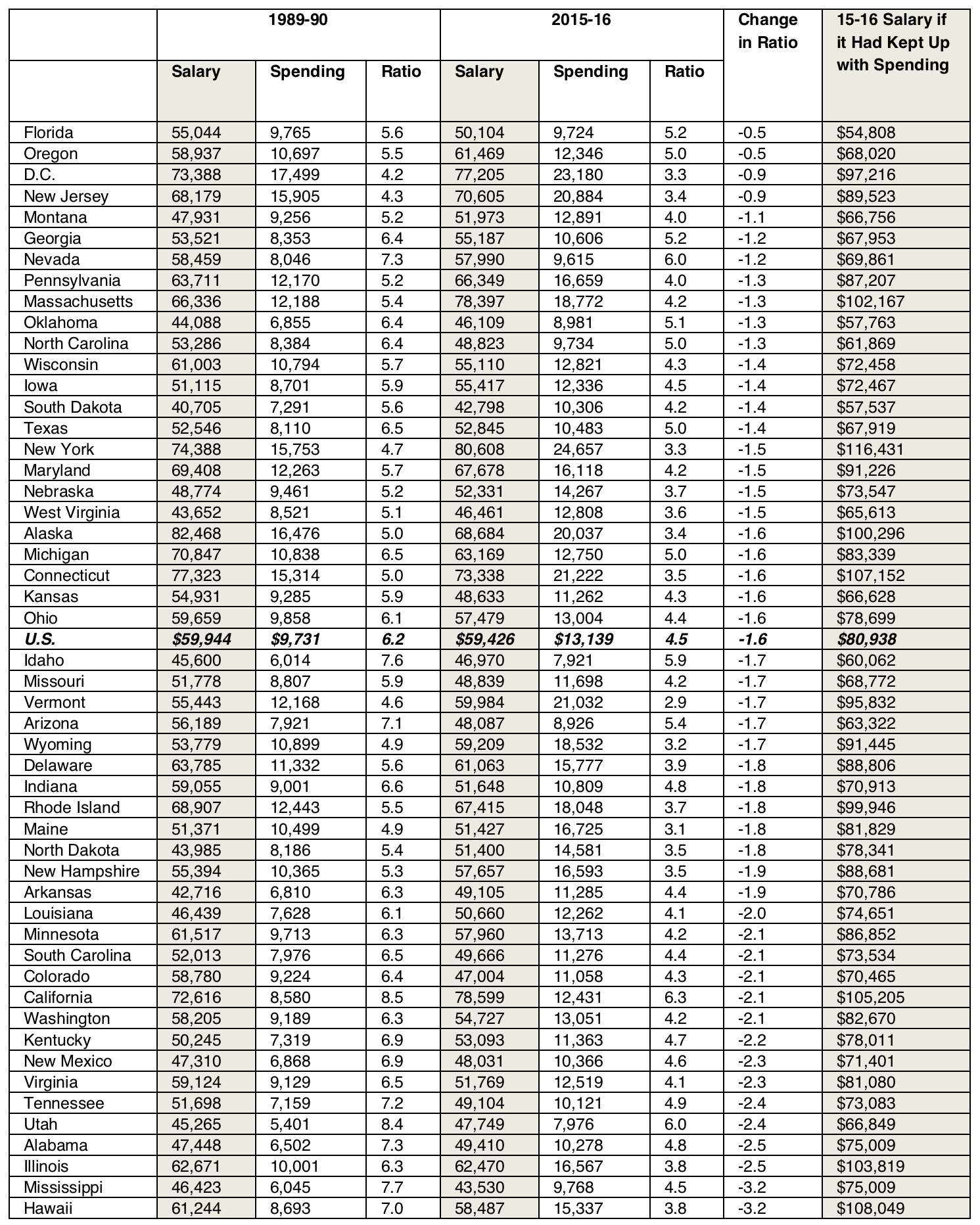
table3.3

Now we have a different way at looking at the issue. It’s notable that the salary-to-spending index decreased in every single state, showing that salaries faced competition from other expenses everywhere. Throughout the economy, health care expenses have eaten into pay, so that’s one likely culprit.

But some states held the line on salaries much more than others.

Florida comes out on the top of this list, though it’s a peculiar case, given that inflation-adjusted salaries there actually declined over this period. But given how flat spending has been in the Sunshine State, it could have been worse had leaders not kept their scarce dollars from going elsewhere.

Better examples are Oregon, D.C., and New Jersey, all of which increased their spending over time, and found a way to drive at least some of the additional dollars into salaries.

At the bottom of the list are states that could have plowed their big spending increases into higher teacher salaries but didn’t. Illinois may be the poster child, with per-pupil expenditures rising from about $10,000 in 1990 to more than $16,500 by 2016. Yet teacher salaries barely budged. If they had instead kept pace with spending (which is what the last column shows), they would have risen from about $63,000 a year to over $100,000.

***

To be sure, this analysis is just scratching the surface. Additional analyses could go much deeper, looking at changes in school expenditures over time, and examining the impact of smaller class sizes; the hiring of additional staff, like teacher coaches; the rising costs of health insurance and pension payments; and other categories of spending, like administration. Breaking all of this out by state would be instructive, as it would help policymakers in a given jurisdiction understand the choices their own schools are making, and start to investigate why that might be.

In the meantime, when someone complains that teacher salaries are not high enough, you should agree with them. But next explain that the problem in most places isn’t overall education spending—it’s how we choose to invest our dollars. And you can really rock their world by saying that schools in Nevada, Utah, and Idaho are prioritizing teacher pay much more so than their counterparts in Vermont, Maine, and New York.


view

The freedom to teach well

Robert Pondiscio
4.24.2019
Flypaper

I used to give a talk about teaching reading comprehension to struggling students, mocking some of the dumb and deleterious techniques I was taught in my teacher training and professional development, and arguing that none of it works as well as ensuring kids have a knowledge-rich core curriculum. When I would give this speech to education reform groups, I’d end with a deliberately puckish twist, pointing out that the overreliance on reading comprehension skill and strategies I’d just called out was the default mode of instruction in many of the high-flying charter schools so beloved by reformers. And how bright, shiny Teach For America corps members were no less likely to use these ineffective techniques as the tired and tenured unionized teachers reformers seemed so eager to blame and replace.

I surely didn’t endear myself to my fellow reformers by noting that, while our movement seemed oddly indifferent to how kids were being taught to read, there was at least one organization that understood the value of a strong, knowledge-rich curriculum: the American Federation of Teachers. Going back to Al Shanker’s time, the AFT has been stalwart in its support of E.D. Hirsch’s Core Knowledge approach to literacy, through the high-profile advocacy of its excellent quarterly, The American Educator, which reaches nearly a million teachers, and has regularly published work by Hirsch, Dan Willingham, Jeanne Chall, Marilyn Jager Adams, and many other leading experts.

Unlike most of my ed reform brethren, I’m not a union basher. I’ve never fully bought into the common complaints that unions are the sum and substance of all that ails education. Mind you, I wouldn’t suggest they’re on the side of the angels (all my chapter leader ever did for me when I was teaching in the Bronx was try to get me fired). But I’m more open than most to seeing unions as possible partners rather than purely a problem.

I offer this all as a preamble before expressing my disappointment with AFT President Randi Weingarten’s speech on “The Freedom to Teach” delivered last week at the National Press Club, in which she lamented the nation’s “disinvestment” in education and the “deprofessionalization” of teaching.

Weingarten delivered her speech from a position of considerable strength. Over the past sixteen months, striking teachers have met with surprisingly consistent sympathy in their states and communities. Ed reform, meanwhile, is rocking back on its heels. So much so that progressives seem determined to make past support for charter schools a dealbreaker for the Democrats’ 2020 presidential candidates, no less a mark of shame than groping underlings or being photographed in blackface. But rather than leverage the moment to lead, Weingarten’s remarks seemed ripped from union boilerplate circa 2002, the standard litany of complaints about funding and working conditions, too much of it playing fast and loose with the facts. While it may be true, for example, that teachers are leaving their classrooms “at the highest rate on record,” teacher churn is a standard feature of tight labor markets, and at current levels still only about one-third of the rate for American workers overall. Comparatively speaking, teaching is still a pretty good gig.

In surveying the diminished state of American education, Weingarten had nothing to say about charter schools or choice, which is unsurprising from a labor leader. But she asked why we aren’t making neighborhood schools “centers of their communities” just weeks after New York City’s ended just such a program after four years, $800 million spent, and nearly nothing to show for it. Weingarten noted that parents don’t want their kids to become teachers anymore and lamented how enrollment in teacher preparation programs is plummeting. “More than 100,000 classrooms across the country have an instructor who is not credentialed,” she complained. “How many operating rooms do you think are staffed by people without the necessary qualifications? Or airplane cockpits? We should be strengthening teacher preparation programs, not weakening teacher licensure requirements, leaving new teachers less and less prepared.” That was all she had to say about teacher preparation. That’s disappointing and misses the mark badly. Teacher preparation programs have simply not done their part to produce the skilled teacher workforce worthy of the respect and autonomy Weingarten thinks should be their due.

Comparing teachers to surgeons and airline pilots elides the obvious and enormous differences in selectivity and training for those jobs. There are about 3.6 million teachers in America. The closest occupations in raw numbers to teachers are food service workers, including fast food, and cashiers. The only larger occupation is retail salespersons. If America employed 3.6 million surgeons and airline pilots and trained them as casually as teachers, we would have a very different relationship to the healthcare and airline industries. No other workforce of a comparable size is regarded as a profession; no other unionized workforce of a comparable size enjoys the level of professional autonomy that Weingarten thinks teachers deserve. In citing only teacher “credentials” and “qualifications,” she missed an opportunity to demand that teacher preparation programs do a better job preparing and elevating her future members.

The past year has seen an unusual spike in interest in how teachers are trained (or not) to teach reading, and a strong outpouring of teacher anger at their lack of preparation. Many of these teachers (probably most) are union members. For a significant subset of them, the frustration and demoralization that Weingarten cited is only worsened by their lack of preparation. Among her prescriptions to “change the culture” of education is “ensuring teachers have real voice and agency befitting their profession.” One of the loudest and clearest messages emerging from that real voice is that teachers are being set up to fail by those charged with preparing them. Weingarten missed an opportunity to lead and be vocal about this.

Make no mistake, teachers are more sinned against than sinners in the state of teacher prep. The AFT could do a world of good for its members—and for children—by throwing its considerable weight behind an effort to demand ed schools be held accountable for graduating teachers prepared for success, armed with the knowledge and expertise to be granted full professional status and esteem. Instead, Weingarten harped predictably on “prepackaged corporate curriculum” and attempts to “standardize teaching to conform with the standardized assessments.” Such efforts are not only “denying teachers’ creativity and expertise, but assuming their incompetence.” But the teachers who are raising their voice in anger don’t seem upset at the assumption they are incompetent. They are angry they have been rendered incompetent by inadequate training and poor curriculum and support. No organization is better positioned to address this than America’s teachers unions, and particularly—with its longstanding advocacy for effective curriculum and pedagogy—the AFT.

The “freedom to teach” Weingarten is demanding presupposes that left to their own devices, teachers would perform capably, and better than under the thumb of regulators and busybodies. This is a winning argument for those of us prone to see overregulation as a drag on performance in any sector. Weingarten’s freedom to teach assumes, contrary to all available evidence, that teachers know what to do and need only to be freed to do it. Yet this is precisely the same mistake made by a generation of ed reform accountability hawks, who assumed that the right incentives would drive schools and teachers to better practices. It has proven disappointing as a reform theory of change. Nothing in Weingarten’s stemwinder of a speech offers any reason to think outcomes will be any different if we do it her way instead.

view

Federal education R & D: A brief, opinionated history (part II)

Chester E. Finn, Jr.
4.24.2019
Flypaper

This essay is part of the The Moonshot for Kids project, a joint initiative of the Fordham Institute and the Center for American Progress. This is the second of two parts. The first gave a brief history of federal education R & D, beginning in the 1970s. Back then the Nixon administration had recognized that more needed to be understood about the mechanisms of teaching and learning and the sorts of interventions that might yield better outcomes. All these decades later, that’s still the goal, led now by the U.S. Education Department’s Institute for Education Sciences. Their efforts have grown far more adept, sophisticated, and determined to conduct education research in ways that yield trustworthy results. But IES remains a stunted little tree among the tall timber of federal research agencies, has very little money, and lacks both visibility and stature among education practitioners and policymakers.

To be sure, Uncle Sam also puts some money into education research through other agencies, especially the National Science Foundation; other parts of the Department of Education support studies and innovations related to their own missions; and a dozen private foundations view education research as an important component—in a few cases the lead item—in their own spending. IES is not the only game in town. And when we look beyond the “R” portion of “R & D” to the “D” part as well, we find many additional sources in agencies scattered about Washington, including some tucked away elsewhere in the Education Department itself.

“Development” in the education sphere can mean many different things, from creating new products, materials, and techniques that never existed before—innovating or piloting, one might say—to the replication, application, and implementation of proven practices. Although the Education Department is barred by law from direct involvement with curriculum, one of history’s best-known examples of education “D” was paid for by the National Science Foundation through an organization that’s still known as the Education Development Corporation: the celebrated “PSSC Physics” curriculum, spearheaded by MIT scientist Jerrold Zacharias in the 1950’s as part of America’s response to Sputnik. A more recent example is the Common Core State Standards for math and English language arts, the development of which was financed by private foundations but the deployment of which by states was “incentivized” with federal dollars (thereby giving rise to great controversy and political maneuvering).

It’s easy for federal development dollars to go for naught, particularly when consumed by organizations with expert lobbyists of their own. The premier example of this in the education space are the Regional Education Laboratories, a collection of (currently) ten entities scattered about the land—each nominally responsible for a “region”—and charged with “putting [education] research into action” in the schools in its area.

Though some members have changed over the years, the “labs” as they’re known have been around since 1966—truly remarkable longevity—and have been funded, year after year, by their friends in the Congressional appropriations process despite repeated efforts by administration after administration to rid the IES budget of this burden—$54 million in 2018, which may be thought a “rounding error” in the vast federal budget, but which actually comprises a sizable portion of total IES funding.

It probably made sense in the sixties, long before websites, the internet, a thousand video sources, webcasting, webinars, and all many of social media, to employ a geographically-based strategy for disseminating and applying the fruits of research to America’s sprawling K–12 system. But it makes scant sense today. And as the Education Department’s Fiscal 2019 budget request politely stated—understated, in my view— “Past surveys and evaluations suggest that the technical assistance currently provided through the RELs may be underutilized or not relevant to State and district needs.”

As the regional labs cling to their line item in the appropriations process, decade after decade, some federal “development” efforts have been far more productive. Most notable is the Education Department’s “Investing in Innovation” (i3) fund, which operated from 2010 through 2016, and continues today as the “Education Innovation and Research Fund,” which received an appropriation of $130 million in Fiscal 2019—and for which the Trump Administration requested $300 million for 2020. Those dollars have gone to create, develop, or expand (“scale up”) a wide array of education improvement projects, including such well-known ventures as the National Math and Science Initiative and the National Writing Project. More than 150 grants were made by 2016, totaling some $1.3 billion in federal dollars and matched—this was a requirement—by hundreds of millions in private philanthropy.

“Development” spending also continues in Washington under other headings, from magnet and charter schools to school safety to the “Teacher and School Leader Incentive Grants” program, funded at $200 million in recent years, which “makes competitive awards to help develop, implement, improve, or expand human capital management systems or performance-based compensation systems.”

A solid—but sadly bobtailed example—of development money doing good when properly deployed was President George W. Bush’s “Reading First” initiative, which directed sizable funds to advance the use of “scientifically based” reading instruction in schools serving poor kids. That venture came to an unhappy end because of an Inspector General finding that some of the Department’s “trainers” had helped create some of the programs they were promoting. Along the way, however, it boosted reading scores in many places—and validated the importance of basing education interventions on strong evidence of their efficacy, which itself helped give rise to the “What Works Clearinghouse,” a federally funded venture to vet such interventions to determine whether, in fact, they can muster convincing proof of their efficacy.

The “Reading First” saga also illustrates one of the hazards of a government that now spends as much time investigating itself and seeking out conflicts of interest as in making things work better: There are only so many experts in the land who are deeply versed in the science of reading—it’s not even taught in many colleges of education—and it’s to be expected that the best of them will also have participated in the creation of effective programs. To bar them from helping schools implement those programs resembles my grandmother’s old saying about “cutting off your nose to spite your face.” That, however, was the lamentable fate of this once-promising venture.

Far beyond the Beltway, and for the most part with little reference to taxpayer dollars, at least in the short run, much development work continues across the sprawling “education industry.” Hundreds of millions of investor dollars are flooding into every sort of technological innovation with the potential to be used somehow, somewhere, in education from early children through postgraduate. All manner of “online” and “blended” learning programs are already on the market. Some 5,000 people from forty-five countries reportedly took part in a big “education and workforce innovation summit” in April 2019 that was sponsored by Arizona State University and an “early stage venture fund.” There’s also much activity and investment in development by traditional curriculum firms, textbook publishers, and big non-profit funders such as the Emerson Collective and the Chan Zuckerberg Initiative.

The field, one might well conclude, is bubbling as well as sprawling. Yet the governmental part lacks scale, and the endeavor as a whole lacks coherence. The prohibition against curriculum puts a major crimp in what the Department of Education can do by way of development in what is arguably still the most important education “technology” of all. And nowhere in the Washington world of education is there anything akin to NIH in magnitude and direction, nor anything like the National Science Foundation (with its quasi-independent governing board) to determine priorities, scan the horizon, and visualize different futures.

IES is the closest thing we have to a focal point for research and development in education in twenty-first-century America. Because its budget is de minimis, however, while its clients are numerous and its political support precarious, it cannot come anywhere close to addressing the ignorance gaps in this key realm of our national life or to developing the education equivalent of “moon shots,” “new weapon systems,” “agricultural revolutions,” or “breakthrough cures.” Today it lacks the capacity, the clout, and the vision.

Can this be changed? Or does education R & D in America need to be reinvented yet again?

view

Great teachers make for great principals

Aaron Churchill
4.18.2019
Ohio Gadfly Daily

Not long ago, we at Fordham collaborated with Public Impact to call attention to school districts’ uneven practices when recruiting and selecting principals. Among other things, our study found that districts often overlooked applicants’ track records in boosting student achievement while serving as teachers. A recent study confirms that districts shouldn’t disregard these data, and should instead aim to hire those with the strongest record of performance.

A team of researchers led by Dan Goldhaber of the University of Washington examines the link between principal effectiveness and their teaching histories. The analysis uses data spanning from 2006–07 to 2016–17 on 3,102 principals, all former teachers, in the state of Washington. About half of the principals taught in the same district, and roughly 20 percent in the same school building. They were more likely to be male and hold a master’s degree than their peers who stayed in the classroom; however, their teacher licensing scores were not significantly different.

For the 355 principals with data gauging their impacts on state math or reading exams while teaching, the analysts use those teacher value-added scores to determine whether they predict greater effectiveness as principals, as measured by value-added models that aim to separate principal contributions to pupil achievement from other school and classroom factors. For principals who formerly taught in grades or subjects that don’t yield value-added data, the study examines whether the absence of such data predicts principal effectiveness.

The main takeaway is that more effective teachers become more effective principals. In reading, those who had higher teacher value-added scores led schools that produced stronger learning gains in that subject than those with lower scores. Similar results emerge in math. Principals lacking value-added data from their teaching days are less effective in raising math achievement than those with who did have such data—perhaps because they never taught math. But the results are largely insignificant in reading.

Lastly, the analysts uncover an intriguing result when it comes to external versus internal hiring: Principals who previously taught in the same school are less effective than those hired outside of the district or from another school within the district. There is logic to hiring internal candidates—they know the culture of the school—but the evidence here suggests that a fresh face might be a stronger option.   

The authors conclude “that policymakers have considerable opportunities to improve the effectiveness of the principal workforce through more purposeful selection of teachers according to their value added.” Fortunately, as a recent RAND Corporation report highlights, a few large districts have moved to more strategic principal selection practices, including data-driven hiring, and seen higher student achievement as a result. This study suggests that more districts would be wise to follow their lead when filling principal vacancies.

Source: Dan Goldhaber, Kristian Holden, and Bingjie Chen, “Do More Effective Teachers Become More Effective Principals?” CALDER Working Paper (2019).

view

The Education Gadfly Show: Searching for "deeper learning"—and not finding it

4.24.2019
Podcast
 

On this week’s podcast, Jal Mehta, an associate professor of education at Harvard, joins Mike Petrilli and David Griffith to discuss his new book about the lack of “deeper learning” in most American high schools. On the Research Minute, Adam Tyner examines the long-term effects of peer characteristics on cognitive and non-cognitive outcomes.

Amber’s Research Minute

Stephen B. Billings and Mark Hoekstra, “Schools, Neighborhoods, and the Long-Run Effect of Crime-Prone Peers,” The National Bureau of Economic Research (April 2019).

Fordham Logo

© 2026 The Thomas B. Fordham Institute
Privacy Policy
Usage Agreement

National

P.O. Box 110
Burke, VA 22009

202.223.5452

[email protected]

Ohio

P.O. Box 82291
Columbus, OH 43202

614.223.1580

[email protected]

Sponsorship

130 West Second Street, Suite 410
Dayton, Ohio 45402

937.227.3368

[email protected]