Mobile Navigation

  • National
    • Policy
      • High Expectations
      • Quality Choices
      • Personalized Pathways
    • Research
    • Commentary
      • Gadfly Newsletter
      • Flypaper Blog
    • Events
    • Scholars Program
  • Ohio
    • Policy
      • Priorities
      • Media & Testimony
    • Research
    • Commentary
      • Ohio Education Gadfly Biweekly
      • Ohio Gadfly Daily
  • Charter Authorizing
    • Application
    • Sponsored Schools
    • Resources
  • About
    • Mission
    • Board
    • Staff
    • Career
Home
Home
Advancing Educational Excellence

Main Navigation

  • National
  • Ohio
  • Charter Authorizing
  • About

National Menu

  • Topics
    • Accountability & Testing
    • Advanced Education
    • Career & Technical Education
    • Charter Schools
    • Curriculum & Instruction
    • ESSA
    • Evidence-Based Learning
    • Facilities
    • Governance
    • Personalized Learning
    • Private School Choice
    • School Finance
    • Standards
    • Teachers & School Leaders
    • Think Again
  • Research
  • Commentary
    • Gadfly Newsletter
    • Flypaper Blog
    • Gadfly Podcast
  • Events
  • Scholars Program

The Education Gadfly Weekly

Sign Up to Receive Fordham Updates

We'll send you quality research, commentary, analysis, and news on the education issues you care about.
Thank you for signing up!
Please check your email to confirm the subscription.

The Education Gadfly Weekly: Teaching virtue in the digital age

Volume 22, Number 26
6.30.2022
6.30.2022

The Education Gadfly Weekly: Teaching virtue in the digital age

Volume 22, Number 26
view
High Expectations

Teaching virtue in the digital age

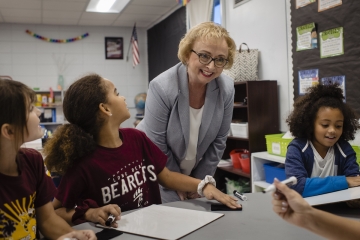
Because of social media’s well-documented risks and harms, we must teach teens to exercise good practical judgment in the challenging circumstances of the online spaces they will need to navigate in our digital age. Parents play an important role. But so should schools, which ought to develop curricula that model how to interact online in ways that meet their general standards and expectations of their student’s social lives.

Jennifer Frey 6.30.2022
NationalFlypaper

Teaching virtue in the digital age

Jennifer Frey
6.30.2022
Flypaper

Exit interview: Carey Wright, Mississippi’s State Superintendent of Education

Robert Pondiscio
6.30.2022
Flypaper

ESSER is fueling one-size-fits-all strategies. Let’s use data to deliver more targeted efforts.

Marguerite Roza | Ellie Roza
6.30.2022
Flypaper

Baked in: School quality and home values

Amber M. Northern, Ph.D.
6.30.2022
Flypaper

Complicating factors: Evaluating a federal program to increase access to dual enrollment

Jeff Murray
6.30.2022
Flypaper

The Education Gadfly Show #826: Research Deep Dive: What we know about gifted education

6.29.2022
Resource

Cheers and Jeers: June 30, 2022

The Education Gadfly
6.30.2022
Flypaper

What we're reading this week: June 30, 2022

The Education Gadfly
6.30.2022
Flypaper
view

Exit interview: Carey Wright, Mississippi’s State Superintendent of Education

Robert Pondiscio 6.30.2022
Flypaper
view

ESSER is fueling one-size-fits-all strategies. Let’s use data to deliver more targeted efforts.

Marguerite Roza, Ellie Roza 6.30.2022
Flypaper
view

Baked in: School quality and home values

Amber M. Northern, Ph.D. 6.30.2022
Flypaper
view

Complicating factors: Evaluating a federal program to increase access to dual enrollment

Jeff Murray 6.30.2022
Flypaper
view

The Education Gadfly Show #826: Research Deep Dive: What we know about gifted education

Michael J. Petrilli, Jonathan Plucker, Amber M. Northern, Ph.D. 6.29.2022
Resource
view

Cheers and Jeers: June 30, 2022

The Education Gadfly 6.30.2022
Flypaper
view

What we're reading this week: June 30, 2022

The Education Gadfly 6.30.2022
Flypaper
view

Teaching virtue in the digital age

Jennifer Frey
6.30.2022
Flypaper

In a recent, much-discussed article in The National Review, Christine Rosen argues for legally enforceable age requirements for consent to social media use, set at a minimum of sixteen. Her argument centers around the well-documented risks and harms of social media use among teens: its addictive nature, its devastating negative impacts on mental health, and its insidious effects on the social fabric of teenage lives.

Precisely because of the dangers Rosen highlights, I do not allow any of my children to use social media platforms prior to age thirteen. And while I am more than happy to entertain a future in which social media is more heavily regulated than it is now, I also recognize that an interim strategy of banning social media altogether has its downsides. The social world of teenagers has moved onto these platforms, and teens can end up feeling unduly isolated and ostracized from their peers when they are unilaterally cut off from the online spaces where, increasingly, social plans are made and executed and bonds are formed. So while I heavily restrict and monitor my teens’ use of social media apps, I have not banned them.

However, I do recognize the need to teach my teens how to interact appropriately online—to clearly communicate what sort of activity is forbidden, what is encouraged, and what is open to personal creativity and interpretation. In short, I try to teach my teens to be not only cyber-savvy and cyber-safe, but also cyber-wise—by which I mean exercising good practical judgment in the challenging circumstances of the online spaces they need to navigate in our digital age.

But I shouldn’t be left to do this on my own. Parents, after all, only have so much influence and control. Schools must also take seriously their duty to teach students how to navigate the online world in positive ways. More specifically, schools must not only have intentional instruction about the inherent dangers and risks of social media use, but must also develop curricula that model how to interact online in ways that meet their general standards and expectations of their student’s social lives. Such an education is important because, even if we raise and enforce a legal age of consent for social media use in the future, teens still need to learn how to interact in complex online spaces. It will not come to them naturally or effortlessly. Like any sphere of human life, online interactions require habituation into a set of beliefs, values, and practices. Therefore, our students need to learn how to be cyber-wise.

Practical wisdom generally is the habit of mind that allows one to make good practical judgments in the circumstances of her everyday life. It is a necessary virtue because having the right general principles about how to live well does not translate into the ability to deliberate and judge well in the particular and complicated circumstances of life. For this, we need practical wisdom. Like all virtues, practical wisdom only develops over time through practical experience where one can learn from those who are living well, learn from their own mistakes, and learn from the mistakes of others in order to become better at practical deliberation (both individual and collective). Cyber-wisdom is the ability to make good judgments in the novel social circumstances we encounter online. The cultivation of this virtue is critical to taking advantage of the unique opportunities afforded us in online spaces, while minimizing online risks and dangers. Since this virtue takes time to develop, instruction in navigating online spaces should begin in middle school at the latest and continue through graduation.

The Jubilee Centre for Character and Virtues, which focuses on virtue education generally, has provided educators with an initial set of resources and a sample curriculum for teaching cyber-wisdom in our schools. In addition to reinforcing the virtue ethics vocabulary and conceptual framework that is the basis of any lesson in a specific virtue, Jubilee’s cyber-wisdom lessons focus on working through real-life scenarios that students are likely to encounter (or to have encountered) online: instances of bullying, threats to the physical or personal safety of oneself or one’s peers, examples of various behaviors that need to be reported to the relevant authorities, etc. The scenario in a lesson might present the student with a moral dilemma, a social problem, or a threat to their well-being. The questions that follow ask students to reflect about what virtues were displayed or lacking and what the appropriate course of action would be. There are also guided questions for discussion and journal reflection, typically asking students to explain what they would do in a given scenario and to justify their action (or inaction). These exercises reinforce virtue concepts by making explicit how they manifest themselves in practice online.

In addition to helping students think through various realistic scenarios, some lessons are more imaginative and focus on the construction of what an ideal online social world would be like. For example, in one lesson, students are asked to identify a digital exemplar—a person whose behavior online they admire and seek to imitate. This is a critical lesson that reinforces the fact that we all rely on exemplars in our practical lives, and we need digital exemplars who model what social flourishing online looks like. Lessons on exemplars invite students to reflect on who they admire and why, which will make them articulate and defend their values and their vision of how social life looks when it is functioning well in online spaces. These lessons also afford schools an excellent opportunity to reflect on their own expectations for their students—and to communicate clear guidelines about online behaviors, such as social threats and bullying.

Regardless of how social media is or isn’t regulated, it’s not going away and is increasingly a part of our public and private lives. We therefore have a duty to teach our students how to flourish online. We cannot simply leave them to fend for themselves.

view

Exit interview: Carey Wright, Mississippi’s State Superintendent of Education

Robert Pondiscio
6.30.2022
Flypaper

One of the most unlikely education stories of the last decade has been the rise of Mississippi as a star of NAEP and a science of reading proof point. When looking for models to follow, researchers and policy wonks usually point to places like Shanghai and Finland, even Massachusetts. But Mississippi? Who saw that coming?

But under Dr. Carey Wright, whose tenure as State Superintendent of Education is coming to an end this week, students in Mississippi have made greater gains than in any other state, making it a national model for both practitioners and policymakers alike, owing to the raft of reforms Wright led, including the adoption of higher academic standards, a focus on teacher training and professional development, and a statewide mandate to retain struggling readers in third grade.

Wright is also among the longest serving state ed chiefs in the country, having been appointed to her position in 2013. She reflected on her work and success in this conversation, which has been edited for length and clarity.

Why are you leaving?

It’s time to go back home and be with my family. I’ve been here eight and a half years. My youngest daughter’s getting married in September, my grandson is turning three, and I’ve been doing a lot of self-reflection about how important my parents were to my children. I am the only grandparent my grandson has. My family all live in Maryland, and that part of my heart was really tugging at me. It will be hard to leave because I’ve loved this job from the moment I took it and love the people I work with.

Usually people in your role shouldn’t buy green bananas; they don’t last long. But you’re one of the longest serving state chiefs. How’d you pull that off?

You don’t do this job alone. I have an amazing leadership team that believes in the same kinds of things that I do about children and the importance of putting children first and foremost. And you’ve got to have a pretty hard shell because you’re going to have your detractors. Since my feet hit the ground I’ve heard, “Why in the world are we hiring somebody who is not from Mississippi? She’s not from around here.” That’s continued to this day. I try to stay out of the politics. I didn’t want to make this job a political football. I knew I wasn’t going to get anything accomplished if I was seen as partisan one way or the other. So I’ve been very clear that my focus is on improving student outcomes in the state and not leaning in one way or the other to either side of the aisle. I think people have respected that.

But surely it’s easier to get things done at the state level when one party is calling the shots.

Well, yes and no. Yes, because my state education committee chairs are very supportive. But no, because not everybody puts a priority on education. There was a culture of low expectations here. We’d been 50th for so long that I think people had just given up on education getting any better. You just have to accept that it’s not at the top of everybody’s priority list. Sometimes when you make decisions based on what’s in the best interest of children, it does not make adults’ lives that much easier. Looking back, I watch the pride that has taken place across the state with our children doing as well as they are. People are like, “Wow, our kids really can achieve more!” I have always believed they could achieve more.

I’ve always been skeptical that state-level policy can really move the needle or shape classroom practice productively. But Mississippi is the outlier. How’d you do it?

People can be resistant to change. But I’ve found that data and accountability will drive the behaviors that you want to see in schools and in classrooms. If you put what’s important to change student outcomes in policy, people are going to pay more attention to it. We put that out in the public so parents and communities and other stakeholders can see what’s happening inside their schools and districts in a very transparent and neutral way. We don’t slant the data. We report the data. Sometimes that’s made people happy, and sometimes that’s made people not so happy. My point is, if you’re not happy with the data, then what are you doing to change it?

But surely Mississippi’s not the only state in the country that worships at the altar of data and transparency?

I think it’s the strategies that we’ve put in place. We’ve been very clear that we are teaching the science of reading and providing a tremendous amount of professional development. I’m a firm believer in building teacher and leader capacity because I think that people want to do the very best that they can, but some come to those classrooms with more gifts than others.

Our coaching strategy has been very strong for us, but unlike [other states], we hire the coaches. I was not going to just give the money to the districts and let them hire the coaches because I feared some principals or district superintendents might use it as an opportunity to move an ineffective teacher out of the classroom and make him or her the literacy coach. We have hired every single coach we have out there.

On the one hand, you paint a picture of a warm working relationship with districts and teachers. On the other, with coaches, you’re saying “Those are my employees, not yours.” Where do you draw the line between being the state authority and having an ongoing, productive working relationship with districts and teachers?

There are times with me that things have to be non-negotiable. When it comes to what I believe, based on research, experience, input, or what’s in students’ best interest, I’m not going to waiver. If I vacillated every time I got pushed back, we’d never get anything accomplished. Like the science of reading. I believed so strongly that was going to be the [focus of] professional development. For some teachers, it was brand new. And so now we were coming in saying, “This is really how you teach reading.” And we had teachers coming out of the professional development who actually were in tears saying, “I feel like I failed all these kids that I’ve had before me.” Our point was, no, move forward. You can’t change the past, but you can affect the future by doing exactly what you need to be doing. So part of it is a give and take. But when it comes to students and what they need, I stand pretty firm on that.

How about your schools of education? In the ed reform era, I feel like we’ve kind of given ed schools a pass. Just kind of assumed there’s not much we can do to improve the preparation that that teacher candidates have when they come to us.

I have found the institutions of higher learning slower to move and change than I think they should be because “this is the way we’ve always done it.” And you’ve got professors at some universities who are still wedded to whole language. You’re right, we’ve heard all, “I’ve got a terminal degree.” And so we’ve tried to work with them over a number of years, and I think we’ve made some progress. Getting back to my policy piece here, I realized, you know what? We have the authority to approve their programs, right? So let’s do that. We’re going to evaluate their programs because we can do that. And everybody came to the table. I think one came kicking and screaming, “How dare you mess with my ed prep program?” But I’ve been pretty public about this. I don’t think it’s fair for students, parents, grandparents, or whoever it is to pay for a four-year degree, and then the state has to come in behind it and pay for more professional development to get them to where they need to be day one. So students coming out of ed prep programs, in order to be licensed in the state of Mississippi, have to pass what’s called a foundations of reading assessment based on the science of reading. I want to find out what’s the first-time pass rate by educator prep program. They don’t want us to publish those data, but to me the data are what the data are. So that’s one thing I’ve been talking to the team about. Let’s figure out how we can get this together and get this published.

Is that going to happen?

I think so.

What was your biggest mistake? Anything you did badly? Or didn’t do and wish you had?

I will be quite frank with you about my biggest mistake. I was very naive, very naive. It was 2016, I think, and I’d been here for a couple of years. The U.S. Department of Education, at the time, would send out what they call these “dear colleague” letters to the states with updates and new pieces of information. Typically, what I did was take these letters and just push them to the districts and say, “Here’s what we’re getting from USED.” No comments about it, just “here it is.” So then I get one that came jointly from USED and the Department of Justice on LBGTQ guidelines, which I sent out. I was not prepared for the response, “How could you put this information out there?” It became the “Bathroom Letter.”[1] Even the governor was asking for my resignation over just passing along this letter. And so that was a lesson to me about just being more conscious of the political environment. But it stunned me. It stunned me because I don’t discriminate where it comes to children.

Outside of being grandma, what are your future plans?

I probably will do some consulting. I can’t imagine myself not doing something in the education realm. I just can’t. I’m now trying to see exactly what that might look like. But not another full-time state chief job.

What’s your parting advice to your forty-nine colleagues?

Stay focused on children, stay focused on their outcomes, and keep looking at the data to make sure that you are doing exactly what you should be doing to give every child access to as many different opportunities as they can. I used to tell my teachers when I was a principal, I want you to treat each day like this is the only day they’ve got, because when the bell rings at the end of the day, you can’t get this day back. And so what are we going to be doing each and every day to make sure we’re doing the best for children?


[1] The letter, dated May 13, 2016, stated that DOJ and DOE “treat a student’s gender identity as the student’s sex for purposes of Title IX and its implementing regulations.” The guidance covered a range of issues, including participation in educational programs and activities, access to facilities, and recordkeeping and privacy.


view

ESSER is fueling one-size-fits-all strategies. Let’s use data to deliver more targeted efforts.

Marguerite Roza | Ellie Roza
6.30.2022
Flypaper

States and districts face no shortage of seemingly overwhelming problems, especially the devastating learning loss among vulnerable students from extended pandemic school closures. But leaders do have money: States and districts got $123 billion in federal emergency (ARP ESSER) relief. While it’s a big number, it’s definitely not enough to do everything, and that makes it incumbent on leaders to figure out how to get the most from the finite dollars that they have.

In the first year, many leaders used relief funds for uniform efforts that essentially delivered the same treatment to every student, classroom, and school on their watch. ESSER funds were used to lengthen the school day, extend the year, reduce class sizes, distribute laptops, fund teacher professional development days, and grant across-the-board pay bonuses. These approaches—while useful for some challenges—are inherently expensive because they treat everyone as having the same needs. And in some cases, they’re not concentrated enough to solve the problem.

As we approach ESSER’s halfway mark, leaders face choices with their finite remaining dollars. Some will double down with heavy investments in more one-size-fits-all approaches. But others will find that a more effective approach is to target investments precisely to the specific students, classrooms, or schools where investments are needed most.

There’s a catch, however, to making targeted investments: It’s only possible when leaders have data. They need data that tell them which students need what and which parts of the system could be working better. And they need to look closely to determine exactly where to target limited dollars.

Take one of the most pressing challenges: reading. For a host of reasons, the pandemic has left some students further behind than others. When districts attempt to apply the same remedy to all students (for example, smaller class sizes or longer school days), the investment is effectively diluted because some of those students don’t need as much help as others. Rather than offer the same services to all, schools can deploy more customized recovery services if they’re armed with data on which students are reading at what level. A narrowed focus could mean coordinating with parents of those struggling the most to ensure that targeted tutoring or summer school investments are designed for and ultimately reach their children.

Sometimes it is parts of the system that need fixing. After finding that some classrooms were using outdated and less effective strategies to teach reading, many states now are working hard to retool reading and confronting the fact that changing teachers’ practice is tough. Sweeping statewide action makes sense for setting uniform policy and purchasing curricula. But we’re seeing one-size-fits-all approaches in other areas, too—like professional development—that could waste precious time and money.

Layering in a more targeted approach may make sense. For example, why pay to put the entire teacher corps through intensive training if some teachers are already up to speed or well on the road to getting there? Why not use data that clearly point to where in the state students aren’t getting what they need, and then direct the dollars to deliver more intensive training to teachers in the schools where the problem is most acute?

Crunching the data is important because it shows where the problems are and helps leaders prioritize interventions. Let’s return to the reading challenge. As a case analysis, we pulled existing data on Washington State’s pre-pandemic (2018–19 school year) reading scores and identified elementary schools that substantially underperform their peers on reading, even after accounting for their student characteristics.

We then surfaced those schools where at least 10 percent more students failed to pass their grade-level state reading test than statistical modeling predicted. For a school of 600 students, that means at least sixty more students failed than would be predicted in the models.

We know that scores tend to be higher for affluent schools than for those serving many high-poverty students. But this statistical modeling accounts for that. And it’s clear that the underperforming Washington schools that we identified aren’t limited to those that are high poverty or that predominantly serve students of color.

Scenic Bellingham, a coastal college town, for instance, has fourteen elementary schools, four of which popped up in the data as way-underperforming on reading. Two are predominantly low-income; the other two are decidedly not. Seattle has eight underperforming elementary schools of varying poverty levels. Tacoma has four, and Bellevue has two.

The data clearly show where there’s a problem. Could there be explanations for these reading outcomes other than outdated curricula and poor instruction? Of course. (And given that these are two-year-old data, some schools may have already shifted course on reading.) But these data do show leaders where to start digging deeper. If it turns out the obstacle isn’t a reading curriculum, teacher training, or implementation issue, then leaders can figure out what else is going on and work to fix it.

When it comes to early reading, the cost of inaction is real for both budgets and student learning. Left unattended, reading struggles can trigger referrals to costly interventions, where learning specialists go back and try to teach students to read after the fact, which—sadly—we know is a very heavy lift. When more students are identified as needing special education services, the expensive legal obligations land on states and districts.

Using data to deliver targeted interventions should extend far beyond reading, however, and leaders urgently need to get measuring, analyzing, and fixing before the relief dollars run out. The pandemic left schools with mammoth challenges. Using data to zero in on problem hotspots makes tackling them much more manageable. Every state and district could—and should—run these types of analyses in order to target relief dollars so that it can start fixing them.

Too often, leaders default to costly one-size-fits-all approaches that spread resources a mile wide and an inch thick. One explanation for the heavy reliance on uniform delivery is that education systems aren’t driven by data. Some leaders eschew measurement, perhaps worried that it brings judgment or punishing accountability.

Yet other sectors systematically tap data to identify and solve problems. Education needs to follow suit. In this case, the goal of using data is to prioritize and target interventions, given that there’s no bandwidth or money to fix everything, everywhere, all at once.

And we need more urgency around deploying data right now, to get kids on track while federal relief money is still on the table. Come 2024, the financial windfall that district and state leaders have at their fingertips runs out—and by then, the usual sources of revenue may be hit hard by changes in the national economy.

States can push their districts to better use data to drive spending decisions. Doing so would make the most of relief funds while they exist and, where students get up to speed, would ease future cost burdens. Now more than ever, we need leaders to use data to point the way.

view

Baked in: School quality and home values

Amber M. Northern, Ph.D.
6.30.2022
Flypaper

If you want to know which schools are good, ask a realtor—so goes the conventional wisdom—and families often do so. Some experts suggest that linkages between home value and school quality are crude or even misleading, but wisdom becomes conventional for a reason. A new report from the Economics of Education Review takes advantage of a unique natural experiment to examine how school quality impacts housing prices through school zoning and rezoning.

In 2013, after years of conflict among various communities, Tennessee’s Memphis City and Shelby County consolidated into one school system, creating one of the largest districts in the country. Then, after a year in and out of the courts, six Memphis suburbs were allowed to—and subsequently voted to—create their own separate municipal districts. Thus the big merger became an even larger splintering of districts. In the process, some homes in the county remained in their original school zones, while some were assigned to different schools. Researchers from Rhodes College (in Memphis) and the University of Southern California used these variations to construct a difference-in-differences model that allows them to disentangle school and neighborhood characteristics and identify the impact of school quality on home prices—independent of who controls the schools or of their demographic composition.

First, analysts were able to verify that the boundary changes created variation in home values that were unrelated to pre-existing trends. Also, critically, for their statistical model to work, houses rezoned to different schools within the same original school catchment area need to be as similar as possible relative to observable and unobservable characteristics. Thankfully, since many homes have been sold multiple times over the eighteen years for which they had property-sale data, analysts could compare the price of the same house in two different school zones before and after the zoning changes (in stats lingo, these are “parcel fixed effects”).

The major findings replicate previous studies in that a 1 standard deviation increase in state test scores increases housing prices by 4 percent. Likewise a 1 standard deviation improvement in ACT scores increases housing prices by 2.6 percent, and the same improvement in graduation rates results in a 1 percent housing increase. These estimates are roughly similar across elementary, middle, and high schools.

As for zoning status, homes in the smaller independent municipal districts sold for 6 to 8 percent more than comparable homes in the large unified district, holding constant school-level performance on standardized tests. The researchers interpret this as buyers’ preference for closer-to-home control of schools versus control by a larger unified district.

Next, they looked at the role of race. A 1 standard deviation increase in school-level racial diversity had a negative impact, resulting in a 1–2 percent decrease in home values, independent of academic performance and regardless of district oversight. Interestingly, there was no difference in demand across schools with varying percentages of non-white students. Looking at each factor separately, the negative impact of racial diversity is similar in magnitude to that of academic quality on home prices but substantially smaller than the impact of school administration by smaller local districts.

The analysts close by asserting that the literature reflects agreement on the “capitalization of school quality” in housing markets, with numerous studies (using a variety of different methods) consistently finding that a 1 standard deviation change in test scores leads to home-value increases or decreases in that market between 2–3 percent. In other words, this is the public’s “willingness to pay for academic performance in public schools.” It’s not surprising, then, that realtors make it a point to include discussions of school quality in their marketing. And that they also bake it into home prices.

SOURCE: Courtney A. Collins and Erin K. Kaplan, “Demand for School Quality and Local District Administration,” Economics of Education Review (June 2022).

view

Complicating factors: Evaluating a federal program to increase access to dual enrollment

Jeff Murray
6.30.2022
Flypaper

In 2016, the U.S. Department of Education launched an offshoot of the Pell Grant program intended to assist low-income high schoolers in accessing college credit through dual enrollment. (Generally, only high school graduates are eligible to receive Pell Grants.) Various forms of dual enrollment were burgeoning at the time, but concerns also persisted that those same students traditionally underserved by Advanced Placement and International Baccalaureate programs were being locked out of this version of early college credit acquisition, especially due to cost. Each state that offered dual enrollment ran its programs differently, including who paid and how much. The federal effort was meant specifically to overcome financial hurdles for low-income students, building off the traditional Pell Grant model. A recent evaluation published in the journal AERA examines participation in the dual-enrollment support program, as well as its impact, after three years of implementation.

Using student level data from ACT, Inc., the researchers look at four states that each had at least one post-secondary institution participating in the Pell Dual Enrollment program (PDE) and that administered the ACT college entrance exam to all high school juniors. They focus on the graduating cohorts of 2017, 2018, and 2019, who would have been eligible to participate starting in their junior year, and they identify a full sample of 1.6 million students who lived in proximity to any dual enrollment-offering institution in those four states during those years. The National Student Clearinghouse provided data on any college course participation during high school and any subsequent postsecondary enrollment of all students in the sample.

Only 2 percent of students in the sample lived within twenty miles of a PDE institution. And while some dual-enrollment programs provided courses at students’ high schools, the researchers assume—based on their interviews with staff at a number of postsecondary institutions—a requirement that students must participate on campus. Thus, while nearly 25 percent of all students in the sample signed up for at least one dual-enrollment course in their high school careers, the vast majority of these were at non-PDE institutions.

They then focused on a subset of the sample whose reported family income was less than $50,000—well below the typical Pell-eligibility threshold of $100,000—to determine whether the students intended to be helped by PDE were taking advantage of it. The treatment group in this case are those Pell-eligible students living near a PDE institution; the control group are Pell-eligible students living near a non-PDE institution.

A difference-in-differences analysis showed that proximity to a PDE institution actually reduced the likelihood of Pell-eligible students’ participation in dual enrollment at all. This effect was most pronounced for students who live in high-poverty zip codes and whose parents did not attend college. They were 9 percentage points less likely to participate in dual enrollment than were their peers living near non-PDE institutions. The PDE program also appeared to have no statistically significant effect on college enrollment after high school graduation for any group.

In looking for mechanisms to explain how an access-support program actually suppressed utilization, the researchers discuss anecdotal evidence gathered from dual-enrollment-offering colleges across the country. As noted above, the varying state rules for dual enrollment often related to families’ cost. Some states already provided full financial support through K–12 funding, some left payment up to interested families, some included books and lab fees in that support, others just tuition. The value of the PDE support was effectively different for families in different places, thus creating a useful support for some while leaving insurmountable hurdles for others. College officials interviewed also pointed the finger at high school staffers—especially guidance counselors—for either misconstruing dual enrollment as “free credits” to everyone when it wasn’t or for not telling eligible students about the PDE support at all, leading to applicants who could not afford to follow through or PDE beneficiaries being entirely unaware of the opportunity.

Additionally, colleges with established dual-enrollment programs (and experienced staffers dedicated to that work) who could potentially wade through the minefield of confusing information on behalf of students were less likely to offer PDE programs. A number of institutions visited by the researchers started offering dual enrollment because of the new federal incentive but were unfamiliar with many of the difficulties already surmounted by their peer institutions. The analysts conclude from this evidence that federal requirements—including FAFSA completion and other income verification paperwork—were onerous and were largely left to families to manage. If college officials were available to help, anecdotal evidence suggests more Pell-eligible students were able to surmount these and other bureaucratic roadblocks.

The report ends with a tiny bit of hope: As high schools and colleges gain more experience with the PDE program, more students intended to be aided by it will be able to access it in 2020 and beyond. However, PDE was actually cancelled in 2021 due to the low utilization rates that were observed by the researchers, which persisted beyond their analysis period. Be it availability or proximity or money or a paperwork burden, any one or a combination of factors could have served to deter a Pell-eligible student’s participation in dual enrollment, thus dooming the effort. Evidence strongly suggests that adding the additional layer of federal bureaucracy did nothing but increase the difficulty for students who were already being locked out of dual enrollment.

SOURCE: Eric P. Bettinger, Amanda Lu, Kaylee T. Matheny, and Gregory S. Kienzl, “Unmet Need: Evaluating Pell as a Lever for Equitable Dual Enrollment Participation and Outcomes,” AERA (May 2022).

view

The Education Gadfly Show #826: Research Deep Dive: What we know about gifted education

6.29.2022
Resource

On this week’s Education Gadfly Show podcast, we present the sixth edition of our Research Deep Dive series. Jonathan Plucker, professor at Johns Hopkins University and past president of the National Association for Gifted Children, joins Mike Petrilli to discuss how gifted education has become a hot political topic, how to identify students who need gifted services, what those services should look like, the debate over tracking versus ability grouping, and exam schools. Also check out our other deep dives on teacher effectiveness, school discipline, school closures, urban charters, and school voucher programs.

Recommended studies referred to in this episode: 

  • David Card and Lauren Giuliano, "Can Tracking Raise the Test Scores of High-Ability Minority Students?" NBER Working paper #22104 (March 2016).
  • Saiying Steenbergen-Hu, Matthew C. Makel, and Paula Olszewski-Kubilius, "What One Hundred Years of Research Says About the Effects of Ability Grouping and Acceleration on K-12 Students’ Academic Achievement: Findings of Two Second-Order Meta-Analyses," Review of Educational Research (December 2016).
  • Paula Olszewski-Kubilius et al., "Minority Achievement Gaps in STEM: Findings of Longitudinal Study of Project Excite," Gifted Child Quarterly (October 2016).
  • Scott J. Peters et al.,“Effect of Local Norms on Racial and Ethnic Representation in Gifted Education," AERA Open (May 2019). 
  • Jonathan Plucker and Carolyn M. Callahan, “The evidence base for advanced learning programs,” Phi Delta Kappan, 102(4), 14-21 (November 2020).
  • Jonathan Plucker and Carolyn M. Callahan, “Research on Giftedness and Gifted Education: Status of the Field and Considerations for the Future,” Exceptional Children (June 2014).
  • Jonathan Plucker and Carolyn M. Callahan (eds.), Critical issues and practices in gifted education: What the research says, Prufrock Press Inc. (2008).
  • Jonathan Plucker and Carolyn M. Callahan, “The evidence base for advanced learning programs,” Sage Journals (November 2020).
  • Jonathan Plucker and Sasha A. Barab, “The Importance of Context in Theories of Giftedness: Learning to Embrace the Messy Joys of Subjectivity,” Conceptions of Giftedness, Second Edition (2005).
  • Del Siegle, et al., “Barriers to Underserved Students’ Participation in Gifted Programs and Possible Solutions,” Journal for the Education of the Gifted (Apr. 2016).

Feedback welcome: 

Have any feedback on our podcast? Send them to our podcast producers Pedro Enamorado at [email protected] or Lilly Sibel at [email protected] 

view

Cheers and Jeers: June 30, 2022

The Education Gadfly
6.30.2022
Flypaper

Cheers

  • “Lowell High School admissions will return to merit-based system after S.F. school board vote” —San Francisco Chronicle
  • A bill in Arizona makes education savings accounts available for all K–12 students statewide —Wall Street Journal
  • An endorsement of three books about the Black experience, including one by Ian Rowe, a member of Fordham’s board, titled Agency: The Four Point Plan (F.R.E.E.) for ALL Children to Overcome the Victimhood Narrative and Discover Their Pathway to Power. —John McWhorter

Jeers

  • “Alabama to vote on lower Praxis score for teacher certification requirement” —AL.com
view

What we're reading this week: June 30, 2022

The Education Gadfly
6.30.2022
Flypaper
  • ​​​​​Covid-19 caused “the biggest disruption in the history of American education.” —The Atlantic
  • A call for “a fundamental shift in state accountability systems, in which states primarily hold districts accountable for the coherence of their instructional program and its continuous improvement.” —Michael Cohen and Laura Slover
  • Maine creates a new barrier between religious schools and state tuition programs by requiring such schools to follow antidiscrimination laws with respect to LGBTQ students, families, and educators. —Associated Press
  • NYC struggles to maintain advances in restorative justice programs after the pandemic. —Chalkbeat New York
Fordham Logo

© 2026 The Thomas B. Fordham Institute
Privacy Policy
Usage Agreement

National

P.O. Box 110
Burke, VA 22009

202.223.5452

[email protected]

Ohio

P.O. Box 82291
Columbus, OH 43202

614.223.1580

[email protected]

Sponsorship

130 West Second Street, Suite 410
Dayton, Ohio 45402

937.227.3368

[email protected]