Mobile Navigation

  • National
    • Policy
      • High Expectations
      • Quality Choices
      • Personalized Pathways
    • Research
    • Commentary
      • Gadfly Newsletter
      • Flypaper Blog
    • Events
    • Scholars Program
  • Ohio
    • Policy
      • Priorities
      • Media & Testimony
    • Research
    • Commentary
      • Ohio Education Gadfly Biweekly
      • Ohio Gadfly Daily
  • Charter Authorizing
    • Application
    • Sponsored Schools
    • Resources
  • About
    • Mission
    • Board
    • Staff
    • Career
Home
Home
Advancing Educational Excellence

Main Navigation

  • National
  • Ohio
  • Charter Authorizing
  • About

National Menu

  • Topics
    • Accountability & Testing
    • Advanced Education
    • Career & Technical Education
    • Charter Schools
    • Curriculum & Instruction
    • ESSA
    • Evidence-Based Learning
    • Facilities
    • Governance
    • Personalized Learning
    • Private School Choice
    • School Finance
    • Standards
    • Teachers & School Leaders
    • Think Again
  • Research
  • Commentary
    • Gadfly Newsletter
    • Flypaper Blog
    • Gadfly Podcast
  • Events
  • Scholars Program

The Education Gadfly Weekly

Sign Up to Receive Fordham Updates

We'll send you quality research, commentary, analysis, and news on the education issues you care about.
Thank you for signing up!
Please check your email to confirm the subscription.

The Education Gadfly Weekly: The lessons we’re not learning from Nikole Hannah-Jones

Volume 26, Number 39
10.1.2026
10.1.2026

The Education Gadfly Weekly: The lessons we’re not learning from Nikole Hannah-Jones

Volume 26, Number 39
view
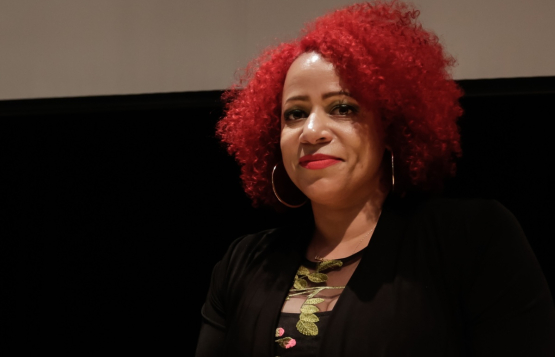
Nikole Hannah-Jones
High Expectations

The lessons we’re not learning from Nikole Hannah-Jones

I’m going to be impatient and blunt: Nikole Hannah-Jones’s daughter did not fail to learn fractions because she and her classmates were Black. Her teacher did not repeatedly fail to show up to work because the school was segregated. Neither did her assignments go ungraded because affluent children attended school elsewhere.

Robert Pondiscio 10.1.2026
NationalFlypaper

The lessons we’re not learning from Nikole Hannah-Jones

Robert Pondiscio
10.1.2026
Flypaper

Bans aren’t the answer

Emily Freitag
9.28.2026
Flypaper

How Ohio’s brand-new advanced math policy will work

Aaron Churchill
9.29.2026
Ohio Gadfly Daily

Do dual enrollment students still benefit despite failing college courses?

Jeff Murray
10.1.2026
Flypaper

The uneven ground of the no-zero grading policy landscape

Kennedy Sundberg
10.1.2026
Flypaper

School discipline: A new rulebook (again) | Episode 1036 of The Education Gadfly Show

9.30.2026
Podcast
view
Teacher and student with a laptop

Bans aren’t the answer

Emily Freitag 9.28.2026
Flypaper
view
Advanced math blog image

How Ohio’s brand-new advanced math policy will work

Aaron Churchill 9.29.2026
Ohio Gadfly Daily
view
F grade

Do dual enrollment students still benefit despite failing college courses?

Jeff Murray 10.1.2026
Flypaper
view
Rocky terrain

The uneven ground of the no-zero grading policy landscape

Kennedy Sundberg 10.1.2026
Flypaper
view

School discipline: A new rulebook (again) | Episode 1036 of The Education Gadfly Show

Kimberly Richey, Michael J. Petrilli, David Griffith, Ph.D., Amber M. Northern, Ph.D. 9.30.2026
Podcast
view
Nikole Hannah-Jones

The lessons we’re not learning from Nikole Hannah-Jones

Robert Pondiscio
10.1.2026
Flypaper

I’m going to be impatient and blunt: Nikole Hannah-Jones’s daughter did not fail to learn fractions because she and her classmates were Black. Her teacher did not repeatedly fail to show up to work because the school was segregated. Neither did her assignments go ungraded because affluent children attended school elsewhere. The report cards and grades she received that concealed her elementary-level deficiencies were not caused by insufficient funding. These failures—all of them—were evidence of incompetence.

The injustice in Najya’s story is not that her school enrolled mostly poor minority children. It is that a school serving these children—an astonishingly well-funded school—was permitted to function this poorly.

A competently managed school puts a qualified teacher in front of children every day. When that teacher is absent, it has a plan for maintaining instruction. Teachers are expected to assign work, examine it, and provide feedback to students. They assess what children know and can do. Grades and report cards convey meaningful information to students and parents. When a child falls behind, someone notices and intervenes. Principals are responsible for making sure those things happen.

All of this should be obvious, yet has gone almost entirely unremarked upon in the voluminous response to Hannah-Jones’s recent essay about her daughter’s education. The piece has renewed arguments about integration, school choice, hypocrisy, parenting, and whether Hannah-Jones deserves credit for admitting that the decision she defended so passionately and aggressively harmed her daughter. But we should make sure not to lose sight of two more important lessons. The first concerns the stunning degree to which debates about education take institutional competence for granted. The second concerns a generation of education reformers who, whatever their overconfident mistakes, would have recognized instantly the failures Hannah-Jones describes and refused to excuse them.

The response to Hannah-Jones’s essay has been remarkably generous. She has been praised effusively for the candor and courage required to admit that the choice she made for her daughter was a mistake. The praise is undeserved. Bravery requires more than confessing error after its consequences become impossible to ignore. Hannah-Jones did not merely make a private decision about her own child. She used her considerable influence to turn that decision into a moral argument. For years, she mocked, condescended to, or condemned parents and education reformers who believed disadvantaged children should not have to wait for some larger social transformation before receiving a decent education. She treated parents who sought out better schools for their own children as not merely making a different choice, but perpetuating inequities.

She was explicit about her moral stance. “I don’t think she’s deserving of more than other kids,” Hannah-Jones said of Najya in a 2017 NPR interview. “I think that we can’t say ‘This school is not good enough for my child’ and then sustain that system. I think that that’s just morally wrong.”

To be very clear: The revised story she now tells is not a mea culpa or an act of bravery. It seeks to be exculpatory yet is devastating to her theory of change. But avoid at all costs the temptation to take a victory lap lest you repeat her mistake.

Let me ask an awkward, impertinent question: Do you earnestly believe that America’s teachers want three-fourths of students to read and do math below proficiency? Is it your assumption that principals, superintendents, school boards, education professors, and even teachers union leaders welcome these mediocre results? This is the first lesson Hannah-Jones’s experience should force upon both her critics and admirers. We argue ad nauseam about what schools believe, what incentives they face, how much money they receive, who attends them, who governs them, and what curriculum they adopt. But all of these arguments elide a question we refuse to ask: Do the people and institutions responsible for educating children actually know how to do the work well?

Hannah-Jones had a theory of change. She believed that segregated schools suffered because well-off families took their influence, expectations, resources, and social capital elsewhere. In her original account of enrolling Najya at P.S. 307, she wrote that she had seen how “the presence of even a handful of middle-class families made it less likely that a school would be neglected.” She believed her family would help integrate the school economically and that “we would be able to make up for Najya anything the school was lacking.”

Hannah-Jones understood even then that there was a risk to her daughter. “I had moments when I couldn’t ignore the nagging fear that in my quest for fairness, I was being unfair to my own daughter,” she wrote. She worried whether she had made the right decision for Najya, but she concluded, “I knew I made the just one.”

That sentence deserves attention. Hannah-Jones consciously weighed what might be best for the child in front of her against what she believed justice required. Her theory of change resolved the conflict: Families like hers could make the school less neglectful, while her own family could compensate for whatever deficiencies remained.

She put that theory to an unusually favorable test. Her family is educated, affluent, politically sophisticated, and deeply engaged with considerable professional and social capital. They advocated, organized, complained, and supplemented. They did virtually everything the theory asked of them. And still the school failed their daughter.

Where did you get that idea?

This should be a cautionary tale, not a victory lap. Every education movement becomes enamored of a theory of change and assumes that if we get the structures, incentives, resources, or policies right, results will follow. For years, at education-reform meetings and conferences, I’ve challenged this assumption with an impolite question: “You have this idea that schools and teachers know what to do and all you need to do is hold them accountable. Where’d you get that idea?”

This was the great unexamined assumption of the education-reform era. Standards would tell schools what children should know. Tests would reveal whether they had learned it. Accountability would create incentives for adults to improve. School closures would impose consequences for persistent failure.

All of these ideas had merit. Testing and accountability in particular performed an essential function: They made it harder for schools to tell parents their children were doing fine when they weren’t. Najya’s story is a vivid reminder of why that mattered. She received reassuring grades while accumulating academic deficits that became painfully obvious when she finally entered a more demanding school.

There is a bitter irony here. Hannah-Jones once characterized No Child Left Behind as an abandonment of integration. Instead of integrating schools, she said, the Bush administration had effectively decided, “We’re going to make these poor Black and Latino schools equal to White schools by testing and accountability.”

Najya’s experience does not prove that testing and accountability can make a bad school good. It demonstrates something more modest but essential: Parents need honest information about whether their children are learning. Najya did not suffer because adults tested her too much. She suffered because report cards and grades told her family she was succeeding when she wasn’t. But accountability could tell us that a school was failing without telling the people inside it how to improve. It could create urgency; it could not create expertise.

More recently, I have revised this lesson in speaking to rooms full of my fellow school-choice advocates. “You have this idea that there’s all this talent and dynamism just waiting to be set free from bureaucrats and union domination. Where’d you get that idea?”

Choice changes incentives. It changes governance. It allows families to escape schools that fail them and entrepreneurs to create alternatives. These are considerable virtues. But none of it fixes the competence problem. Responding to Hannah-Jones’s essay in The Wall Street Journal, Roland Fryer described this problem clearly. “Choice advocates make the opposite mistake by assuming choice is enough,” he writes. “Choice can provide an exit from a bad school; it isn’t a production function for creating a good one.”

Precisely. Will an ineffective teacher suddenly become competent merely because we change the person who signs her paycheck? Structural reforms can create conditions for improvement, but they do not guarantee it.

The assumption hiding inside our theories of change

Once you notice the assumption of competence, you see it everywhere.

Social justice theory says that concentrating disadvantaged children in the same schools concentrates disadvantage. Change the mix of students and families, and resources, expectations, peer effects, and social capital should improve. Maybe so. But someone still has to teach fractions.

School-finance theory says money can purchase smaller classes, better materials, tutoring, specialists, higher salaries, longer school days, and any number of potentially useful things. But someone has to know what to purchase, whom to hire, how to organize the work, and whether it’s improving instruction and student outcomes.

Accountability theory says adults and institutions respond to incentives. Measure outcomes, make results transparent, reward success, and impose consequences for persistent failure. But someone still has to know what to do differently on Monday morning.

Even when it comes to the reforms I strongly support, the competency problem does not disappear. Take curriculum. A district can purchase an excellent knowledge-rich curriculum, deliver materials to classrooms, train teachers, align assessments, and require implementation. None of that ensures that the teacher understands the material well enough to explain it, recognize misconceptions, ask productive questions, or determine whether children have learned it. They may adapt it or even decide not to implement it at all.

Or take the science of reading. States can ban three-cueing, mandate phonics, adopt screening assessments, and require teacher training. But legislators cannot look over a child’s shoulder, hear the particular error she is making, diagnose its source, and decide what to do next. We change everything around the classroom and assume that what happens inside it will change too. Where did we get that idea?

The black box

What if schools don’t know how to improve? This is a less satisfying political problem or culture-war issue because it implicates nearly everyone: schools of education, districts, state agencies, curriculum providers, professional-development organizations, unions, reformers, philanthropists, and policymakers. But it has one great virtue as an explanation: It takes seriously the enormous variation we see among schools serving similar children.

Fryer observed that “resources alone can’t explain disparate outcomes among schools serving similar children with similar budgets.” Right again, but that ought to make us curious. If two schools serving broadly similar children with comparable resources produce dramatically different results, we have a duty to understand what is happening inside them.

What are the teachers doing? What curriculum are they using? How much instructional time is protected? What happens when children don’t understand something? What does the principal do all day? What happens when a teacher chronically fails to perform? What information do parents receive? Does an A on a report card mean a child has mastered the material, or merely that she completed her assignments?

These questions lack the grandeur of debates about segregation, markets, democracy, and social justice. But they are where the work of education actually happens.

What the reformers got right

There is a second lesson in Hannah-Jones’s story that deserves to be stated just as clearly.

For all its mistakes and excesses, the education-reform movement that arose roughly a quarter-century ago began with a proposition that now seems almost radical in its simplicity: Black and Hispanic children are capable of much higher achievement than the public education system was producing. Adults and institutions had to accept responsibility for the results.

Of course, poverty mattered. Segregation mattered. Racism mattered. Family circumstances mattered. But none of that was an excuse for giving a child a poor education.

It is difficult to read Hannah-Jones’s account of her daughter’s education without being struck by how completely the failures she describes violated that ethos. A Black child from Brooklyn could not do fractions? Her teachers owned that failure. An honors student got an A in algebra without possessing elementary mathematical knowledge? The school owned it. A third-grade teacher repeatedly failed to show up and children were farmed out to other classrooms? The principal owned it. Parents were repeatedly reassured while their children accumulated enormous academic deficits? The system owned it.

To be clear, ed reformers of the bygone era did not have all the answers. They were too confident that standards, tests, accountability, choice, new governance structures, or closing bad schools and opening new ones would cause better practice to emerge. But we should not allow criticism of the movement’s solutions to obscure the moral authority of the problem it set out to solve. Education reform put student achievement—particularly the achievement of poor Black and Hispanic children—at the center of the national conversation. It demanded honest information about whether children were learning. It rejected the idea that miserable academic outcomes should be accepted, contextualized, or explained away because children were poor, Black, Hispanic, or disadvantaged.

The best charter schools served overwhelmingly poor Black and Hispanic populations and sometimes achieved results dramatically different from neighboring institutions serving similar children. That did not prove poverty was irrelevant, segregation didn’t matter, or every charter school was good. It proved that schools matter. What adults do matters.

Hannah-Jones’s story should occasion some reconsideration of the reform era’s reputation. The failures she describes are a functional catalog of what those reformers warned against: low expectations disguised as compassion, grades that concealed rather than communicated, adults explaining failure instead of correcting it, and disadvantaged children who paid the price.

These, then, are the two lessons I take from Hannah-Jones’s story. The first is competence. Changing a school’s demographics, increasing its funding, holding it accountable, changing its governance, giving parents choice, adopting a better curriculum, or mandating better instructional practices can all create conditions for improvement. None of it eliminates the need to ensure adults know how to teach, lead, assess, diagnose, intervene, and improve.

The second is about responsibility. In correcting the excesses and shortcomings of the education-reform era, we should not discard its most important insight: Schools have an obligation to educate the children in front of them, and poor outcomes for disadvantaged children are not inevitable facts of nature to be shrugged at or waved away. Children should not have to wait for America to solve poverty, racism, segregation, inequality, or any other social problems before receiving a decent education.

Those two lessons belong together. Responsibility without competence produces frustration, churn, and disillusionment. Competence without responsibility permits institutions to become complacent and excuses to proliferate. Good schools require both.

The next task for education reform is therefore not merely helping parents identify good schools. It is understanding what makes schools good—and figuring out how to make effective practice routine rather than exceptional. The next generation of reform should begin with two questions: Are we willing to hold schools responsible for whether children learn? And do the adults responsible for educating them know how?

The reform generation understood the first question better than its critics sometimes acknowledge. Its mistake was underestimating the second.

A theory of change needs to answer both.

Editor’s note: This was first published on the author’s Substack, The Next 30 Years. And a shorter version of this argument appeared previously in The Wall Street Journal.

view
Teacher and student with a laptop

Bans aren’t the answer

Emily Freitag
9.28.2026
Flypaper

I have heard a number of leaders start discussions about AI with the question, “Are you for or against AI?”

I suspect there are many points in history where similar questions have been posed: In 1889, “Are you for or against electricity?” In 1953, “Are you for or against atomic energy?” In 1995 (this one I remember), “Are you for or against the World Wide Web?” I wonder how long it took for the question to change from “Are you for or against?” to “What are the risks and benefits we need to manage at the same time?”

I am in a small club of people who have seen a number of AI-powered products in classrooms and talked to hundreds of users. What I have learned prevents me from choosing one camp or the other—AI is both a huge opportunity for learning and a huge risk to learning at the same time. AI in schools is not one thing; it is a source of power to do many things—some great, some horrible. My speculations about what will be good or bad are often wrong; I have learned that we have to observe real use to see what adds value and what undermines learning.

The biggest risk to learning I saw on the tour came from a tool that few people would call “AI”: Google Search. I didn’t see students turning to ChatGPT or Gemini in school often (though I heard a lot about students using these tools at home). But I did regularly see students open their search browser, ask a question, and copy the “AI Overview” summary without questioning it or—as far as I could tell—usually even reading it. I have seen screenshots of computers in New York and L.A. (where most AI is banned in K–12 schools) that show the AI summary in Google Search still alive and active. The bans do not seem to have ruled out the biggest risk to learning I saw on the tour.

But the bans do seem to have ruled out some remarkably helpful uses of AI that I saw. Based on test scores and reports from educators, we are not preparing kids to be great writers. To become a great writer, a student needs a lot of practice and a lot of feedback, which is constrained by the time and effort it takes teachers to grade. I saw targeted instructional tools use AI to give students massively more practice and feedback on their writing than the most industrious human teacher could deliver in a week. It didn’t eliminate the need for teachers to also read and provide feedback on student work, but it did give teachers a huge assist in a laborious instructional job.

Foundational reading skills are essential for student opportunity. I saw targeted tools use speech recognition and AI analysis to pinpoint the letter sounds that students were struggling with and give them immediate instruction on those learning needs. These tools did not eliminate the need for teachers to hear students read, but they did give teachers a much better way to increase foundational-skills practice during station rotations than relying on static worksheets.

As I see policy efforts to try to regulate AI in schools emerge, I worry we are headed toward a quagmire. It is hard to come to a consensus definition about what AI even is. Even if you could get large groups of people to agree on definitions, the technology is changing so rapidly that they’d need near-constant revision. Different types of AI are increasingly being integrated into everything (e.g., the new iPads have AI-powered features in the keyboard). It is becoming (or maybe has already become) virtually impossible to isolate and completely expel AI from all the different types of technology that most kids interact with.

Rather than focusing on whether or not AI is present as the approach to regulation, we’ll do better for students if we look at the types of interactions we want technology involved in and the types we don’t. As a parent, I want the tech my kids use to be safe and their data to be secure, but I’m less interested in the particular technology in the tool (e.g., is this predictive AI or generative AI?) than the job the tool is trying to do—and how effectively it does it. I want the very best technology available to help my kids get practice and get feedback on writing, but I don’t want any technology giving them spiritual counsel. I want my civic and educational leaders to focus less on whether AI is good or bad or whether or not AI should be allowed. I want them to wade into the specific kinds of interactions and uses we want to encourage and discourage.

Like our forebears had to do with electricity, finding the right guardrails will require all of us to be learners and to watch for both access and safeguards at the same time. By 1930, nearly nine in ten urban homes had electricity, but only one in ten farms did because private utilities saw little profit in running lines to rural families. It took the Rural Electrification Administration in 1935 to begin closing a gap the market had left open for half a century. Private markets did not manage for equal access to a major enabler of quality of life. Safety lagged in ways that were harmful: New York strung live wires overcrowded streets for years before a series of electrocutions in 1889 forced the city to bury them. The rules that made a difference came from watching real use: the National Electrical Code, first published in 1897—many years after cities began introducing electricity—grew out of close study of the fires and failures that actually happened in homes and factories.

Policymakers should act quickly on what we know about safety and data privacy, but when it comes to instruction, we have a lot more to learn before we know how to regulate. What policymakers can do is set up a framework that will support that learning. They can make sure that school leaders and product leaders are in classrooms actively watching how product use is going and use those observations to drive improvements. They can make sure that state leaders and district leaders are carefully studying innovations and sharing what they are learning.

I have been in about 1,000 classrooms over the last decade. Those observations have shown me just how hard it is to teach. Kids have a lot of learning needs right now, and we need every tool in our toolkit to deliver great learning to them. What I saw on the tour convinced me that AI-powered products can offer a lot of value alongside the risks and that we have a lot more to learn to know how to navigate it.

Editor’s note: This was first published by Instruction Partners.

view
Advanced math blog image

How Ohio’s brand-new advanced math policy will work

Aaron Churchill
9.29.2026
Ohio Gadfly Daily

Education systems often fail to challenge our very brightest students. The unfortunate result is that too many high achievers lose their edge and fall short of their potential. The problem is especially acute for high-achieving, low-income students who are commonly overlooked for advancement throughout their K–12 education. The lack of equitable access to more challenging coursework and instruction robs them of downstream opportunities to compete for selective colleges.

To their credit, state lawmakers recently took an important step forward to support Ohio’s high achievers. Enacted earlier this summer, Senate Bill 19 includes “automatic enrollment” provisions that require schools to provide high-achieving math students with advanced learning opportunities the following year. The requirements begin in elementary school and are designed to enable all high-achieving students to complete algebra I by the end of eighth grade. Successful completion of this gateway course in middle school opens doors to advanced math and science courses during high school—the very type of coursework that many four-year colleges expect.

With implementation starting soon—spring 2027 math scores will inform 2027–28 advancements—it’s worth reviewing the policy details. This piece first covers how students qualify for advanced math. It then turns to what advancement looks like in elementary and middle schools.

Student eligibility for advanced math

Students qualify for advanced math based on their state test scores. Those who score “advanced” in math—the highest achievement level on state exams—are automatically enrolled in advanced math the following year. Students who score one notch below—“accomplished”—qualify as well but must also receive an A or B in their math course or earn a satisfactory score on a diagnostic math test.[1] The link to state assessment results is critical: The tests are taken universally, so high-achievers from all backgrounds can be identified. It also means that math advancement decisions are based on objective standards (accomplished and advanced indicate being on-track for college) rather than subjective judgments alone. Because the eligibility criteria are tied to state tests, these provisions cover only fourth through eighth graders.[2]  

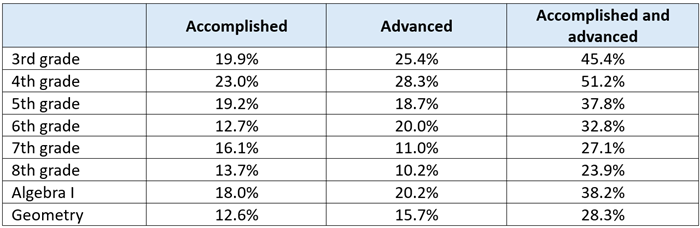
How many students are likely to qualify based on these criteria? As shown in Table 1, approximately half of third and fourth graders would likely score high enough to qualify for automatic advancement if current numbers hold. The number of high achievers in math starts to decline in fifth grade and by sixth grade—a pivotal year for algebra I placement (as discussed below)—just one in three students may qualify for automatic enrollment. This, however, would still represent a substantial increase in the number of students taking algebra I in eighth grade, as only 20 percent of Ohio students completed the course in eighth grade or earlier in 2024.

Table 1. Percent of Ohio students scoring accomplished or advanced on state math exams, 2025–26

Advanced math blog Table 1
Note: The advanced category includes a small fraction of students who score “advanced plus,” a category that represents students who achieve “advanced” on an above-grade-level assessment.

Advanced learning opportunities—fourth through sixth grade

If students qualify in fourth through sixth grade, schools must provide “advanced learning opportunities.” These may be either:

  • An above-grade-level math course. Schools selecting this option could, for instance, place qualifying fourth-grade students in math classrooms with mainly fifth graders. Another possibility is a self-contained, fifth-grade-level math class that serves all qualifying fourth graders (rather than mixing students of different ages).

  • “Services or curricula modifications” that provide “additional rigor or challenge.” This more open-ended option allows schools to enhance a conventional, grade-level math program through enrichment or differentiated instruction to serve qualifying students.  

Ohio rightly calls for early action, with advancement starting in fourth grade based on third-grade scores. Although the two service options outlined above provide districts with flexibility, they could also result in uneven advancement opportunities for students. Placement in an above-grade-level math course is more likely to ensure that students are challenged daily because the rigor is built into the coursework. The “services or curricula modifications” option, on the other hand, is just vague enough to open the door for lower-quality programs (e.g., sporadic “enrichment” or lackluster online modules). Moving forward, state officials should monitor how elementary schools implement “advanced learning opportunities,” which should include collecting data to help identify gaps in the types of opportunities elementary students receive.

Building to algebra I—seventh and eighth grade

As noted above, sixth grade is pivotal in Ohio’s advanced math framework. Sixth graders who score advanced or accomplished (and also earn an A/B or pass a diagnostic test) are automatically enrolled in a compacted math course that includes both seventh- and eighth-grade content.[3] Seventh graders who complete this accelerated course take the eighth grade state math exam at the end of the year and are automatically enrolled in algebra I if they achieve a score of “proficient” or above.[4] Compacted courses are common in schools that have traditionally offered algebra I in eighth grade. In those schools, only minor programmatic adjustments may be needed. Schools that have not offered compacted math courses, on the other hand, will need to overhaul their middle school programs. To its credit, the Ohio Department of Education and Workforce (DEW) has already developed some resources on advanced middle school math pathways. They’re a good first step, but more will surely be needed to effectively assist middle schools that must revamp their offerings.

* * *

Following in the footsteps of North Carolina and Texas, Ohio is now among the states that have adopted automatic-enrollment math policies. The change is a good one, as it promises to help ensure that all high achievers are challenged to reach their potential. But as with all policy reforms, implementation will be key to delivering on the promise of both expanded opportunities and stronger student outcomes. Ohio lawmakers have established an admirable advanced math framework. Now it’s time to start the work of implementing these policies well.


[1] Schools may also advance any student, regardless of test performance, at their discretion. SB 19 also includes an opt-out provision if parents believe advanced math is not the right placement for their child.

[2] State math assessments are given in grades 3–8 and algebra I and geometry. SB 19 contains no further advancement provisions prior to fourth grade or after algebra I.

[3] At this juncture, schools no longer have an option of providing “services or curricula modifications” to qualifying students; they must enroll students in the compacted seventh grade math course.

[4] “Proficient” is one achievement level below “accomplished.”

view
F grade

Do dual enrollment students still benefit despite failing college courses?

Jeff Murray
10.1.2026
Flypaper

Dual enrollment (DE) programs allow students to take college courses for credit—usually at no cost—while still in high school. Students must pass the course in order to earn credit. Efforts to increase DE access mean more high schoolers than ever are taking college courses. This has many upsides, but also increases the likelihood that unprepared students will enroll in them and fail. A recent report tries to uncover what happens to students who don’t pass. Could participating in DE still hold value for them?

A group of researchers from WestEd looked at data on more than 1.7 million California public high school students[1] who entered ninth grade between 2015–16 and 2018–19. The current DE framework in the state dates to 2016 and was meant to expand access to college-level coursework—particularly for low-income students, students of color, and first-generation college-goers—by reducing previously identified barriers to DE participation. Features include removing a number of academic prerequisites, focusing on community college coursework, and bringing instruction directly to high schools rather than requiring teenagers to travel to campuses. The majority of the full sample (55 percent) was Hispanic, and 73 percent were from low-income families, reflecting California’s overall student demographics. The researchers broke sample students into one of three groups: those who never enrolled (Never DE), those who enrolled and never failed a course (Passed DE), and those who took and failed at least one course (Ever Failed DE).

Perhaps surprisingly, the vast majority of California high schoolers (1.6 million, or 94 percent) never took a single DE course in that time.[2] Of the remainder, just over 93,000 took and passed their DE courses, while approximately 18,700 (17.1 percent) failed at least one such course. Students in the Passed DE group were demographically similar to the full sample, but students in the Ever Failed DE group were disproportionately Hispanic (65 percent) and from low-income families (83 percent). Students in the Ever Failed DE group were also lower achieving on average than their peers (46th vs 61st percentile in math). While low-income status was a strong predictor of DE course failure, the researchers note that the better prepared a low-income student was before attempting DE—i.e., higher performance on the state’s eighth grade math assessment—the weaker the influence of family income.

Because DE enrollment is not random, the researchers used inverse probability weighting to approximate the impact of failing one or more DE courses on a student’s likelihood of enrolling in college after graduation. They found that students in the Ever Failed DE group are 10–12 percentage points less likely to enroll in college within 18 months of high school graduation compared to their peers in the Passed DE group. The more courses failed, the higher the college enrollment “penalty.” There was no difference in these outcomes between students in different socioeconomic groups. However, the average student in the Ever Failed group was still 6 percentage points more likely to enroll in college than the average student who never attempted DE at all.

All of this is consistent with similar findings around students who take and fail AP tests, with a spokesperson saying that “studying hard, preparing for the exam, following through — can change the way students see themselves and raise their ambitions for college.” The WestEd researchers (and other analysts) conclude from their findings that efforts to remove barriers to DE participation for lower-income students and students of color provide value for those students, regardless of whether they pass their college courses. This appears to be modestly true when college enrollment is the only outcome under scrutiny, but that should not be the end point of the discussion. The more academically prepared DE students are, the likelier they are to pass their courses and accrue credits that will be valuable in persistence and completion and, perhaps, in reducing college costs along the way. In other words, high schools should give more of their students access to DE, but they should also make sure that they are academically ready for the work before they start.

SOURCE: Jenna Howard Terrell, et al., “Course Failure in Dual Enrollment and the Impact on College-Going,” Annenberg Institute at Brown University (July 2026).


[1] The term “district” is used throughout the report and there is no indication whether charter school students are included in the analysis.

[2] There is no formal discussion in the report as to why this number is so high, but Advanced Placement (AP) and International Baccalaureate (IB) participation is longstanding and widespread in California. For comparison, 13 percent of Ohio high school students took at least one DE course in 2022–23.

view
Rocky terrain

The uneven ground of the no-zero grading policy landscape

Kennedy Sundberg
10.1.2026
Flypaper

The push for no-zero grading policies, which prohibit assigning zeros for class assignments or tests, began during a broader “equitable grading” movement arising from the view that traditional grading is rooted in bias and discourages students. Critics counter that such policies inflate grades in ways that demotivate students and that higher standards produce better long-term outcomes.

This debate extends beyond policy circles. Multiple Fordham Institute studies show that teachers and students share concerns about no-zero grading policies. Eighty-one percent of teachers say giving partial credit for assignments that are never turned in harms academic engagement. Similarly, high school students report that weak grading standards, along with widespread AI-driven cheating, diminish their learning experience. Yet despite such findings—and a dearth of empirical evidence supporting the practice—no-zero grading continues to spread. About 27 percent of teachers nationally report working in a school with some form of no-zero policy.

In a working paper, Dan Goldhaber, Maia Goodman Young, and Luke Caldwell at the National Center for Analysis of Longitudinal Data in Education Research (CALDER) aim to map out the no-zero grading policy landscape in one state. They examined 295 traditional school districts in Washington State, covering 2015–16 through 2024–25, and collected documents ranging from board policies to school-level student handbooks.

Using AI[1], the team created a system[2] to determine what counts as a no-zero policy and identified 68 districts with such policies. To better understand what types of districts are more likely to adopt no-zero policies, the CALDER team estimated the probability of adoption in a given year, controlling for district size, location, test proficiency rates, as well as student demographics. They also looked at variation across schools within the same district.

The study finds that no-zero grading policies increased by 110 percent over ten years across the school districts examined. These policies are most common at the elementary level, but high schools had the fastest growth rate: 350 percent since 2016. Many of these no-zero policies predate the Covid-19 pandemic, with nearly half of the elementary-level policies’ adoption dates predating the 2015–16 school year.

The results also reveal enormous variation in how districts write and implement no-zero policies. Sixteen percent of those with such policies have contradictions between board policy and school handbooks. For example, one source established a no-zero policy while another permitted zeros. There is a particularly wide range when it comes to enforcement. Some districts require students to redo their assignment with mandatory structured support sessions, while others exclude the assignment from the gradebook. Some districts assign a partial score, while some policies vary by assignment type.

Perhaps the most striking finding is an equity paradox. While these reforms are typically framed as equity tools, Washington districts with more low-income students were less likely[3] to have a no-zero policy. At the elementary level, districts serving more special education students were also less likely to have no-zero policies. Among high schools, suburban districts were more likely to adopt such policies than city districts of similar size and student population.

The study is limited, of course—to a single state and to published policy documents. It cannot capture how teachers implement these rules in the classroom. Yet it exposes the unevenness of no-zero grading policies, which are hard to find and often inconsistent even within the same district. This may favor privileged students in multiple ways. Families with more education and institutional savvy may, for example, be better positioned to advocate for their children when rules are unevenly applied. And because high-poverty districts have fewer no-zero policies to begin with, this gap could give wealthier students a GPA advantage in college admissions. No-zero policies are framed as equity tools, yet their distribution doesn't match their intent. The landscape seems most uneven for the students these policies were designed to benefit.

SOURCE: Dan Goldhaber, Maia Goodman Young, and Luke Caldwell, "Where Have All the Zeros Gone? The Landscape of No Zeros Grading Policies," CALDER Working Paper No. 345-0826 (August 2026).


[1] The method they used is called retrieval-augmented generation. It uses large language models to search and classify documents, grounding the response in verified source material. The LLM’s response is pulled only from the source material rather than from the LLM’s training data. The CALDER team completed this process using two LLMs: Sonnet 4.6 and Claude Opus 4.7.

[2] It was a “typology system” that examined the following in each policy document: the source of the policy, what the policy applies to, how zeros are structurally eliminated, and how missing or plagiarized work is handled.

[3] A 10 percentage point increase in a district’s low-income student share is associated with a 0.93 percentage point decrease in the likelihood of no-zero policy adoption.

view

School discipline: A new rulebook (again) | Episode 1036 of The Education Gadfly Show

9.30.2026
Podcast
 

Kimberly Richey, Assistant Secretary for Civil Rights at the U.S. Department of Education, joins Mike Petrilli and David Griffith to talk about the latest federal guidance on school discipline and Title VI. What does the Department’s new approach to racial disparities in discipline mean for schools? Can the new guidance stick, or will the rules continue to change every time a new administration takes control of the White House?

Then, on the Research Minute, Amber Northern reviews a new NWEA study examining whether schools are getting Algebra I placement right, and why students should be allowed to take algebra as soon as they are ready.

Recommended content:

  • Dear Colleague Letter: Guidance on Pupil Discipline and Compliance with Title VI —U.S. Department of Education
  • Toward a durable compromise on discipline disparities? —Michael J. Petrilli, SCHOOLED
  • Doing educational equity right: School discipline —Michael J. Petrilli, Thomas B. Fordham Institute
  • Groundhog Day for school discipline —David Griffith, Thomas B. Fordham Institute
  • Getting Algebra Placement Right: Expanding Opportunity and Strengthening Preparation —Megan Kuhfeld, Daniel Long, and Scott J. Peters, NWEA (August 2026)

Feedback Welcome: Have ideas for improving our show? We would love to hear them. Send them to [email protected]


Transcript

This transcript was generated with the assistance of AI and lightly edited for clarity and readability

Introduction

Mike Petrilli [00:00]

Welcome to The Education Gadfly Show.

I'm your host, Mike Petrilli of the Thomas B. Fordham Institute.

This week, Kimberly Richey, Assistant Secretary for Civil Rights at the U.S. Department of Education, joins us to discuss new federal guidance on school discipline and Title VI.

What does the Department's new approach to racial discipline disparities mean for schools?

Then on the Research Minute, Amber Northern reviews a new NWEA study examining whether schools are getting Algebra I placement right and why students should be allowed to take Algebra as soon as they're ready for it.

All that and more this week on The Education Gadfly Show.

Mike Petrilli [00:59]

Hello, this is your host, Mike Petrilli of the Thomas B. Fordham Institute, here at The Education Gadfly Show and online at FordhamInstitute.org.

And now please welcome today's special guest, Kimberly Richey.

Kim, welcome to the show.

Kimberly Richey

Hey, Mike. So good to be with you all today. Thanks so much for having me. I really appreciate it.

Mike Petrilli

Yeah. Well, Kim is a special guest.

She is the Assistant Secretary for Civil Rights at the U.S. Department of Education.

Boy, we had a congressman on a few weeks ago. Now you're just raising the bar, I tell you.

Kimberly Richey

Super, super excited to be here with you today. It really is an honor, and to talk about something that's so important is exciting.

Mike Petrilli

Yes.

Well, let me welcome in my co-host as well, David Griffith.

David, welcome to the show.

David Griffith

Hey, always a pleasure, Mike.

Mike Petrilli

Yeah.

Well, Kim, we did invite you here to talk about one of my, I wouldn't say favorite topics because it's a tough topic, but I think one of the most important topics, something I've certainly written a lot about and care a lot about, which is the topic of school discipline and, in particular, racial discipline disparities.

This has been a big controversy for multiple administrations now.

You recently put out new federal guidance on school discipline, and we would love to talk about it.

So let's do that on Ed Reform Update.

Ed Reform Update: School discipline and Title VI

Mike Petrilli [02:25]

All right, so Kim, oh, and I should say, how can I not say this?

First of all, it's Kim's birthday as we're recording today.

So happy birthday, Kim.

Kimberly Richey

Thank you so much. What a great day to be here. Thank you.

Mike Petrilli

And people watching on YouTube can see in the background, there are some birthday flowers and a birthday crown.

Amazing.

So I'm glad to see there is celebrating going on.

Kimberly Richey

And for those who can't see, I am not wearing the crown right now. It is here in spirit.

Mike Petrilli

Yes, exactly.

I do remember my time as an appointee over there at the Department of Education, and people would take birthdays very seriously.

Kimberly Richey

Very seriously.

Mike Petrilli

Any excuse, actually, to have a party, to have cake, but there were strict rules. You know, people had to pitch in. Could not put that on the taxpayer dime.

Kimberly Richey

That's right. And the entire team has confirmed for me this morning that we are in full compliance with all of those rules.

But we did, in full disclosure, we did have birthday cake at about 10 o'clock this morning, so I'm feeling the sugar rush.

Mike Petrilli

Yeah.

Hey, there's no regulation against that.

But speaking of regulations, all right.

So let's start here, Kim, especially for folks who have not been following every twist and turn of this debate around discipline disparities, especially with respect to federal civil rights enforcement.

Let's start by just, like, the basics, because I just want to be clear.

It is certainly the case that it is still the law of the land that schools cannot discriminate against students on the basis of race, including when it comes to discipline.

Right?

This idea that, you know, if a white kid breaks a rule, they only get a slap on the wrist. A Black kid breaks the same rule but gets suspended. That would be discrimination.

That's illegal.

That's the kind of thing that your office would investigate and, if possible, hold folks accountable for, right?

So what is this debate about when we're talking about discipline disparities?

Kimberly Richey [04:19]

Thank you for starting there, Mike.

I want to say at the outset that there's nothing about the July regulation that OCR published. There is nothing contained in the August guidance that changes the legal requirements for race discrimination under Title VI of the Civil Rights Act of 1964.

Title VI, for those who may not know, is the federal law that prohibits schools from discriminating against students, against employees, on the basis of race, color, or national origin.

And so those provisions remain unchanged.

Schools cannot treat students differently on the basis of race, color, or national origin, and OCR will continue to vigorously enforce Title VI to ensure that schools are not doing that.

I think that's a really important place to start.

I think for those who are coming to this new or who may not be familiar with this either as a legal issue or as a policy issue, as you all know, and I'm preaching to the choir, but really we've been dealing with this issue of race and discipline since 2010.

I would say it's been a prevalent policy and political and, frankly, legal issue. All three.

This started in about 2010 when the Obama administration made the decision to prioritize this as an enforcement matter.

I think it was back in 2010 when they opened really five very large, comprehensive compliance reviews to look at school districts across the country and how they were disciplining students to see if schools were treating students differently and disproportionately impacting students on the basis of race at any point through the discipline process.

Shortly thereafter, in 2014, the Obama administration issued a Dear Colleague letter that really, I would say, changed the way that OCR enforced Title VI in school discipline cases.

OCR has always had provisions within its regulations that allowed for the examination of disparate impact.

And what the Obama administration said in 2014 is, we're going to look at these cases. We're going to look for different treatment. We're going to look to see if you are treating students differently, but we're also going to look to see if your policies might be having a disparate impact on certain students.

And for those that may not know what disparate impact is, we try to talk about that without sounding too attorney-like or too legalistic.

But essentially, what OCR began doing is they began investigating cases and going into school districts and starting with data analysis and looking at nothing but a school district's discipline data.

And what began happening is that OCR would look at a case, they would look at a school, and they would look at the policies.

They would say, okay, there's no evidence that you had intent to discriminate. You are fairly enforcing your policies. That means you're not treating students differently.

You're applying your policies evenhandedly. Your policies are not discriminatory. You're applying them across the board the way that you should.

But they would nonetheless hold schools in violation of Title VI for no other reason than the data did not look right.

And what I mean by that is they were disciplining certain groups of students at higher rates than they were compared to other students.

[Brief gap in the source transcript.]

Mike Petrilli [08:56]

And can I just say, Kim, that, you know, and when we say data, I mean, my understanding is they were just looking at it by, say, race, right?

And we do know that...

[Brief gap in the source transcript.]

It is the case that we know that that matters a lot.

Poverty matters a lot.

And tragically, Black students in America today are still way more likely to be poor than white students.

They're way more likely to be consistently poor, to be extremely poor. I mean, they are much more likely to face disadvantage in lots and lots of areas.

And there are reasons in the discipline case to expect that a kid growing up in poverty and growing up in maybe a dangerous neighborhood, maybe going to a school that's not as safe as we would like, for a lot of reasons, that child may be more likely to act out, may be more likely to get into a fight.

There are surveys. The federal government has asked teenagers, you know, have you gotten into a fight? And Black students are more likely to say yes.

Right?

So I remember once at a conference, I tried to explain all this.

I said, look, it's not because of race. It's because of class that we see these disparities.

And yes, I think there's reasons to believe that Black students misbehave at higher rates than white students, not because they are Black, but because they are so much more likely to face all these disadvantages.

You know, the audience kind of gasped. I mean, like, how can you say this out loud?

Which, again, I get. These are not happy conversations to have.

But if that's the underlying issue, right, the students, there's a disparity.

All we see with the discipline data is how schools responded. We don't see the underlying misbehavior.

And, you know, we can imply it. There's some studies that are trying to get closer to it.

And look, it still could be the case that some of these disparities are being driven by discrimination.

Right?

But we can't assume that all of it is being driven by discrimination.

And then we've got to worry about, as you have, Kim, what are the unintended consequences?

Kimberly Richey

That's right.

Mike Petrilli

Do schools start to discriminate against white students in order to make the discipline data look right?

Do they start lying about their discipline data and being on the forms?

Right?

Kimberly Richey

I think that's right.

Yeah. And I think you really are hitting the nail on the head, Mike, because discipline is one of the most complex areas of civil rights law that we deal with in OCR.

And it's because, exactly what you said, there are so many factors that can go into why a particular student is disciplined.

And so to reduce it to data, or to reduce it to race, to take such a complex issue and to try to apply such a singularly focused solution to it has just ended up, you know, with catastrophic results.

And I think that that's what we've seen over the last twenty years.

These policies have not been effective.

They are reducing everything to race. They're reducing everything to the color of a student's skin.

And, you know, I hear from teachers all the time: I was told that I could not discipline African American students at all. I was told that I could only refer white or Asian students.

And, you know, in 2026, those are just not acceptable answers.

And even more importantly, they are completely inconsistent with what the Constitution requires and with what Title VI allows.

And so I think that, just to recap, I gave you a lot of background. I'm sorry.

But so what the Trump administration has done, what we've done, is earlier this summer in July, we first started with the regulations, which is what I was referring to.

We amended the Department's regulations to remove disparate impact provisions from the regulations.

That's obviously more broad than discipline, but the Constitution requires it.

We believe the Supreme Court has been clear that Title VI prohibits intentional discrimination, not unintentional discrimination, not disparate impact.

So we've taken the very significant step of aligning our regulations with both the Constitution and the statutory requirements of Title VI.

And we followed up with that about a month later with what we're here to talk about today, some very important guidance that provides clear direction to schools on what the law requires throughout the discipline process.

And the bottom line is that Title VI prohibits any type of discrimination on the basis of race, color, or national origin.

Schools cannot take race into account at any part during the discipline process, at any part of the discipline process.

And this idea of racial balancing, which is what these policies have resulted in, is not allowed under Title VI.

It's certainly not required, and I would argue that it's not permissible.

And so what we're doing within OCR right now is we are enforcing Title VI, and we have launched two directed investigations.

I think that schools, you know, dating all the way back to the Obama administration, schools that have adopted these social justice policies, these restorative discipline policies, we have reviewed so many of those where it is clear that schools are taking race into account.

Those are extremely problematic under Title VI.

And so we are going to pursue those investigations.

We are really trying to reorient and reset on Title VI.

I think, you know, you've written extensively on how difficult this has been for schools, and I've written on that as well.

But what has essentially happened is with every change in administration, the pendulum swings back and forth.

Mike Petrilli

And I want to talk about whether we can fix that.

But let me push a little bit, Kim.

I'm thinking, okay, there's been forever debate. Let's say I remember famous debates about Shaker Heights, Ohio, a diverse suburb outside Cleveland, right, where there was a lot of time this question of, hey, you know, it was a diverse suburb, a lot of professors and the like.

And it seemed like both upper-middle-class, or at least middle-class, Black students and white students, and yet the white students were outperforming the Black students in terms of achievement.

And so there were studies and task forces to try to understand that.

What's going on? Can we do something about it?

It seems like on the discipline front, you could have a similar circumstance.

Let's say there's a district. Let's say they do like I've been calling for and they have controls for socioeconomic status, and they still find there's a gap, that Black students are getting in trouble at higher rates than white students.

And they want to try to understand why. They start digging into it.

And maybe they start having some initiatives that focus on providing support to Black students to help them steer clear of violence or whatever's causing them to get in trouble.

I mean, if they consider race at all, are you saying that's starting to cross legal lines?

They can't do that kind of analysis? They can't have those kinds of initiatives?

Kimberly Richey [16:46]

Yeah.

So I think that, you know, this is where, this is the area where OCR will focus over the next several months on providing additional guidance to schools.

I think that there is a difference, Mike, between telling a school district, you cannot take race into account throughout the discipline process. You cannot have the end goal of racial balancing in your discipline data.

There's a difference between saying that and saying it's okay to track your data. It's okay to know what your discipline data looks like.

I think my position and the position of the Department is that, and this is the difference between how Title VI has been enforced before and how it's being enforced now, the data is the starting point.

So if I'm looking at discipline data and I'm seeing discrepancies, I 100 percent agree with you that schools have an obligation to dig at that point.

They have an obligation to look at their policies. They have an obligation to look at their practices.

They still have to ensure that they are not violating Title VI. They still have to make sure that they're not treating students differently at any point throughout the discipline process.

And so I think that there's nothing in this letter that tells schools that they can't look at data, that they can't ensure compliance.

If I were in charge of a school, or if I were representing a school, or if I were on a school board and I saw discrepancies in data numbers, it would be my sign to do some additional digging.

It would be my sign to dig into the policies, to dig into the practices, to figure out what was going on in the classroom.

The difference is that under the 2014 discipline letter, everything stopped at an analysis at the data.

Nobody went any further than that.

So they looked at the data. They said there's a discrepancy. Boom, you're in violation of Title VI.

There was no additional digging. There was no inquiry as to why or what may be contributing to that.

And data alone does not cause a Title VI violation.

It should be a sign to schools to dig more.

Mike Petrilli

Right. Right.

You know, so much of this has been about the legal rules, and it has to be, right? This is a civil rights law.

But like you say, it's complicated.

And at the end of the day, this is an educational issue, too.

David, why don't you get in here, as I bring you out every once in a while as our former high school teacher at a challenging charter school.

I mean, how do we make sure that we intersect all the legal requirements with, like, the classroom reality and the goal?

The goal is to help students meet high expectations when it comes to their behavior.

Right?

The goal is for kids to misbehave less. The goal is to have safe and orderly classrooms.

So how do we do it?

I mean, what's on your mind, David?

David Griffith [19:39]

Yeah, well, I will attempt to distill what I've been trying to say for the last ten years, which is that I would encourage everyone, regardless of how you feel about what has been said here, to try to keep the two issues separate.

One issue is: What are the sources of these disparities that we've been talking about, harping on?

That's a really important question.

Another really important question is, basically, what is the best approach to discipline?

Right?

I think that discipline reformers, certain kinds of discipline reformers, sometimes I even count myself as one, make very valid points about the risks associated with, you know, at-risk kids essentially being on the street.

Right? Like, that's not particularly satisfactory.

Mike Petrilli

Because we suspend them or expel them.

David Griffith

Yeah, because they're... right.

Right.

I mean, nobody should really want an at-risk fifth grader or eighth grader, pick your age, it doesn't matter, right, we shouldn't really walk them out of school onto the street.

That is an entirely legitimate end of public policy to ask, can we reduce that?

Are we sure we're getting the tradeoffs right?

We have this need to maintain order in schools and classrooms, and we have this concern that if we put kids out of the classroom, we don't really know what's happening to them.

There are really difficult tradeoffs there.

It is entirely appropriate to talk about that.

I think we should try to keep that conversation as separate from race as we can, because they are two separate questions.

And I mean, frankly, I just think that it is not helpful to the conversation to mix these two questions, because this question of what is the best discipline policy or the best approach to discipline is really slippery, even if you don't inject race into it.

It's actually quite a slippery question on its own.

You can find schools and districts that seem to have successfully reduced out-of-school suspension, replaced it with in-school suspension.

You can find places where it doesn't seem to have gone well.

I think that will keep us pretty busy, honestly.

And I would encourage people, maybe who don't agree with Kimberly on this one, right, to focus their efforts on making that case sort of on the merits and on getting that balance right.

Because that is actually what I think we should be talking about.

Mike Petrilli

No, and I like that.

And, you know, Kimberly, you mentioned the pendulum swinging.

I mean, I raised this a few weeks ago in my SCHOOLED Substack.

You know, this is really hard on district officials and educators.

Cory Turner, NPR, did a great story on this when your guidance came out.

I mean, it's the ping-pong game. It's going pretty extreme.

You know, the Obama and the Biden administrations say you must look at your data and you must act on it.

And as you explained, you know, even if you're not doing anything unfair to treat kids unfairly, you still have to keep going, right?

And then you're saying, well, basically that, no, if you do anything that's racial balancing, then we're going to hold you accountable.

I mean, sometimes I feel like, is there some way to just, like, maybe discipline is too complicated to be in this whole civil rights frame at all?

Or can we just maybe have a rule that says, look, all we're going to do at OCR is we're going to pick up the phone if somebody calls us and says, hey, I think my child was treated unfairly when it came to discipline because of their race.

And we will respond to those individual complaints.

Or what else?

I mean, how do we stop the ping-pong match from happening?

Kimberly Richey [23:14]

Yeah, you know, honestly, Mike, I think that when we published our final rule in July and we removed the disparate impact provisions from our Title VI regulations, I believe that that is going to help a lot with what you're referring to as far as the continuous, every time a new administration comes in, the policy changes and schools don't know what might violate Title VI from one school year to the next.

And more importantly, families and kids don't know either. Teachers don't know, right?

But I think that with OCR's removal of the disparate impact provisions from our regulations, that was the legal basis for these decisions.

That was the legal basis for OCR to go in and to focus exclusively on data.

And so I think, from my perspective, removing those provisions from OCR's regulations will finally start to add some continuity.

And we actually talked a lot about that in the publication of the final rule, and it was one of our justifications for the regulatory action, to provide more clarity to schools, to provide more clarity to parents, so that everyone would know, once and for all, when it comes to enforcement of Title VI, what actually violates the law and what does not.

Mike Petrilli

And are you hopeful then that if, let's say, the Democrats win the White House in 2028, that the next administration isn't going to just go back to what we had before?

Kimberly Richey

Yeah, you know, I mean, I'm not a bettor or a tea-leaf reader.

I don't know what's going to happen, you know, as far as what any future administration might do from a regulatory perspective.

But I think that we made a persuasive legal argument.

You know, the Supreme Court has spoken on what type of discrimination Title VI prohibits, that it's intentional discrimination.

It does not cover situations where there might be some type of unintentional discrimination or where there might be some type of disparate impact on a particular group.

And so I think that it would be difficult to roll back this initiative in the future.

But I will say, I've worked with schools all across the country.

I've worked at three different state departments of education. So I've worked with schools a lot in Oklahoma, Virginia, and Florida.

I can tell you that when you tell a school any discrepancy in your data means that you violated Title VI, they are going to make the data look right.

They're going to do whatever they have to do to make the data satisfy OCR's inquiry, whether that means disciplining on the basis of race, whether that means racial bias...

[Brief gap in the source transcript.]

Data looks good.

That's not good for anybody.

That's not good for teachers. That's not good for school safety. That's not good for classroom behavior.

And it's certainly not good for kids.

And what this has really done is tied the hands of local leaders to the point where they cannot respond to misbehavior. They cannot respond to school violence.

And so I think that there are broader, serious implications here about what this policy has done.

We are not better off than we were in 2014.

Outcomes have not increased. Schools have not gotten safer. Behavior has not improved.

And I'm really proud of the work that we're doing to rethink these policies.

Mike Petrilli [26:55]

All right.

We will leave it there.

Kimberly Richey, the Assistant Secretary for Civil Rights at the U.S. Department of Education.

We appreciate it. And again, happy birthday.

Kimberly Richey

Thank you so much. Great to be with you all today.

We'll see you soon. Bye-bye.

Mike Petrilli

All right. Thank you, Kim.

Now it's time for everyone's favorite, Amber's Research Minute.

Research Minute: Are schools getting Algebra I placement right?

Mike Petrilli [27:16]

Amber, welcome back to the show.

Amber Northern

Thank you, Mike.

Mike Petrilli

We just had a really good, interesting talk with Kim Richey.

I understand you worked together in Virginia.

Amber Northern

Oh, we did a little bit. Had a little bit of overlap. Not much.

But yes, knew her from Virginia, other folks that we met, and yeah, had a little bit of overlap when I got to the Department.

So she's great.

Mike Petrilli

I mean, David, like I was saying there, I just wish sometimes we could just take the whole discipline thing out of the civil rights frame because it doesn't fit well.

I mean, look, I get it that we need to worry about kids getting discriminated against, and you should be able to file a complaint if you think your kid was discriminated against.

But, you know, looking at data, I mean, it's like imagine if we said, okay, the Office for Civil Rights is going to take it upon themselves to investigate any time there's a racial achievement gap in a school or school district.

They would be investigating all the time, everybody, everywhere.

Right?

I mean, we don't do that.

David Griffith

Yeah, that's right.

And as I keep trying to say, I just, you know, I guess we're going to have to keep having this conversation because we can't avoid the topic.

Right?

But I think the more we can talk about the other question, which is, what is the right approach to discipline, the more constructive the conversation is.

Right?

Because, you know, if you're concerned about kids being out of school, you don't need to motivate your policy...

You don't need to go there. You don't need to talk about racial disparity.

You can just say, look, I'm concerned that we're suspending kids too much, right?

I'm concerned, you know, and you're not going to have a bulletproof case there either because it's really complicated when you dig into the data.

But you can at least have a, I don't know, a constructive conversation about when can we replace OSS with ISS and how do we know, right?

And kind of how good are our ISSs and how good are our other alternative schools, and what can we do about this?

Right?

Is it possible to do better?

And it's just, it's a completely different conversation than the one we've just been having.

I don't know.

It's also important.

Mike Petrilli

No, it's the difference between, you know, the educators talking and the lawyers talking.

And look, everybody plays an important role.

David Griffith

They do. They do.

Mike Petrilli

We're being nice here. We won't throw the lawyers under the bus.

All right.

Well, Amber. So, yeah, that was a good one. You should go back and listen to it.

Amber Northern

I will. I will.

It sounds like a good one.

But, you know, what I really thought you were going to ask me about was Bruno Mars, which is why I had to miss a podcast.

Mike Petrilli

Yes.

Amber got to go see Bruno Mars, who, by the way, did one of the best Super Bowl shows ever, I remember.

Amber Northern

Best Super Bowl ever.

Sold-out crowds everywhere.

He stayed onstage for three hours without a break, sweated his behind off, and just totally delivered.

So anyway.

Mike Petrilli

Love it.

All right.

Well, are we going to talk about research today?

Amber Northern [30:14]

Well, we should.

We have a new research brief from our friends at NWEA, just always using their MAP data to answer interesting questions.

So this time they are looking at math education policy via the lens of this study that asks, one, are students who are ready for eighth-grade algebra actually enrolled in it?

And two, does taking algebra in eighth grade rather than waiting until ninth grade actually improve student outcomes?

Which seems like questions we need answers to.

So they are looking specifically at whether there's a disadvantage to delaying algebra until ninth grade for students who are already ready by the end of seventh grade.

And for students who are not ready by the end of seventh grade, does waiting until ninth grade actually help them?

Okay, so they're using nationwide MAP Growth data for 55,000 middle schoolers.

Just love how they get these N sizes with their data.

They have seventh-grade MAP Growth scores and eighth- or ninth-grade MAP Growth and algebra.

Those are the two data sets they're looking at.

They're defining readiness using a seventh-grade spring RIT benchmark of 237.

What does that mean?

It means that RIT is a score from NWEA's MAP Growth test, and it shows where a student is performing academically regardless of grade level.

That's my layman's way of explaining that.

So in this case, they're saying a score of 237 is the point at which students are considered likely to be ready for Algebra I based on these prior studies that they've done that connect MAP Growth scores to students' odds of reaching proficiency on state Algebra I end-of-course exams.

Okay, couple quick caveats.

First, that benchmark I just mentioned is derived from linking studies they've done to EOC algebra tests in Texas, Ohio, Georgia, and North Carolina.

So that means they're looking at median cut scores across those states.

So it might not generalize to every state accountability condition or context.

And then second, the researchers are comparing algebra outcomes for students who were ready by spring of seventh grade but waited until ninth grade to take it.

And then they are looking at those who were ready to take it and took it, okay?

So those two groups.

And we know that there may be unobservable reasons why kids end up in eighth-grade versus ninth-grade algebra beyond what these MAP scores are capturing.

So there is some selection here, okay?

All right, with that in mind, key finding one: About one-quarter of seventh graders are ready for early algebra.

According to this benchmark I just told you about, unfortunately, 42 percent of schools don't offer eighth-grade Algebra I.

So that's an access problem.

But then beyond the access problem, they say even among the ready students attending schools that do offer eighth-grade algebra, still about one-quarter of those kids wait to enroll until ninth grade, even though they're ready.

Key finding number two: For higher-achieving kids, taking algebra in eighth grade generally produces better outcomes than waiting.

This advantage, they looked at across the upper half of the achievement distribution. They saw it throughout that upper half of the distribution, but it was largest among seventh graders in the top decile.

So specifically, students in that top decile who took algebra in eighth grade scored five points higher than those who took it in ninth grade.

Again, these are all the kids who got that magic readiness score.

And that's roughly equivalent, I'm like, okay, what's five points? It's roughly equivalent, they say, to two-thirds of a year of growth for the average student in algebra.

And then for lower-achieving students who weren't yet ready by the end of seventh grade, the timing didn't seem to matter.

So they remain below proficiency, below the proficiency benchmark, regardless of when they took the course.

So simply delaying the course until ninth grade wasn't enough to improve outcomes for those kids.

And they say, you know, the takeaway for me anyway was we shouldn't use one group who's not ready as a reason to hold up another group that is ready.

And I think we've got to do more to get all kids ready and do more to get the ready kids in the more advanced math course.

So that's what I've got.

Mike Petrilli

And maybe one more takeaway would be that some of these automatic enrollment policies that states are adopting, that these are good ideas, right?

Because you say basically, okay, if you score well on the state test, how it usually works, could be on NWEA or i-Ready, you know, then we're going to automatically place you into the advanced math course.

And therefore, we don't worry about teacher bias or making parents request that you get in or other kinds of things like that.

The default is if they show they've got the potential on this test to do well, they go in there.

Of course, the parent can always opt them out, but that seems unlikely to happen.

And what we've seen is, I believe in North Carolina and Texas especially, is that that has a big impact on getting lots more kids, especially disadvantaged kids, into these classes that they can do quite well in and they were not in previously.

Amber Northern

Yeah.

But I guess that only works if their school has the class.

And I couldn't believe it, that you've got middle schools out here across America still in 2026 that do not have eighth-grade algebra.

It said 42 percent, which seemed a little high to me, too.

David Griffith

I also picked up on that.

That's unbelievable.

I mean, I don't know that there's a middle school in America, I mean, I'm sure there are, but the number of middle schools that do not have at least one student, and probably more than one student, who is ready for eighth-grade algebra is extremely small.

I mean, even in poor areas, there are kids who are ready for algebra in eighth grade.

What are we doing?

I don't get it.

Also, what are we doing?

I mean, is it just six years of pre-algebra?

I mean, somebody with older kids explain to me, like, what is happening in all these years if they're not getting to algebra?

I know we do fractions in, like, third grade and fourth grade and then just more fractions and...

I don't quite understand what it is that we think we're doing for all of middle school if it's not algebra.

I mean, calculus is hard. Algebra is doable if you can benefit from the tracks, in my opinion.

Mike Petrilli

We do introduce algebraic concepts in elementary school under the college standards, but yeah.

Look, no, that's shocking.

I mean, it used to be the case that you'd find a lot of high schools that didn't have a single AP class, but I thought we've largely fixed that, right?

I mean, still plenty of progress to be made, but I think you'd have to work hard at finding an American high school, traditional comprehensive high school, that does not have at least a few AP courses.

But you can still find 42 percent of middle schools without algebra in the eighth grade.

No wonder the kids aren't working all their way into AP Calculus.

No wonder that the College Board came out with AP Precalculus.

Goodness gracious.

David Griffith

I'm really struggling to formulate a counterargument here.

I mean, honestly, right?

If there's any, if there's any...

Mike Petrilli

Oh, you got one?

Oh, it's that tracking. It's terrible.

Tracking.

It's racist. It's classist. It's terrible. It's blah, blah, blah, blah, blah.

That's the counterargument.

David Griffith

Yeah, that's pretty crazy, honestly.

If we're just talking about, I mean, no, I mean, it is.

Like if we're talking about letting kids go further ahead, particularly when kids in other schools and districts are probably doing that, right?

I don't know.

I don't know.

It's pretty crazy. I'm sorry.

Is there an actual counterargument that I'm missing other than, you know, we should let kids move on to the next math class when they're ready?

That seems like a pretty intuitive concept to me.

I don't know.

I'm struggling to come up with a version of equity that I believe in that, I don't know, in any way challenges that idea.

I guess I would hope that we can rally around that and make it happen, right?

It's sort of shocking, honestly, that it isn't already happening, right?

It's such a common-sense policy that it's hard to understand why we can't make it happen.

Amber Northern

Well, you guys may recall I covered the Washington State study that Dan Goldhaber and friends did, and they found large numbers of parents opting out, right?

Even when we did automatic enrollment.

So to me, it's partly some parental education is another piece of this when they do have the policy, right?

Because it didn't fix it either. They didn't see the numbers that they wanted to see.

David Griffith

Yeah, somebody said that to me. I'd forgotten that.

I don't get it.

I mean, nobody's asking parents to do anything, right?

Other than let their kid move ahead.

I really am struggling to understand that intuition on the part of parents.

What do they think is going to happen?

Mike Petrilli

Maybe their kids don't want to take a harder math class.

I think it might be that simple.

Let's not ever complicate it.

David Griffith

Yeah.

I mean, that's demoralizing, but it has the ring of truth, right?

I don't know.

Mike Petrilli

Yes, that could be our tagline.

Demoralizing, but has the ring of truth.

I like that.

Let's try that.

That sounds good.

All right, everybody, that is where we've got to leave it.

That is all the time we've got for today.

So until next week.

David Griffith

I'm David Griffith.

Mike Petrilli

And I'm Mike Petrilli of the Thomas B. Fordham Institute, signing off.

Fordham Logo

© 2026 The Thomas B. Fordham Institute
Privacy Policy
Usage Agreement

National

P.O. Box 110
Burke, VA 22009

202.223.5452

[email protected]

Ohio

P.O. Box 82291
Columbus, OH 43202

614.223.1580

[email protected]

Sponsorship

130 West Second Street, Suite 410
Dayton, Ohio 45402

937.227.3368

[email protected]