
Education systems often fail to challenge our very brightest students. The unfortunate result is that too many high achievers lose their edge and fall short of their potential. The problem is especially acute for high-achieving, low-income students who are commonly overlooked for advancement throughout their K–12 education. The lack of equitable access to more challenging coursework and instruction robs them of downstream opportunities to compete for selective colleges.
To their credit, state lawmakers recently took an important step forward to support Ohio’s high achievers. Enacted earlier this summer, Senate Bill 19 includes “automatic enrollment” provisions that require schools to provide high-achieving math students with advanced learning opportunities the following year. The requirements begin in elementary school and are designed to enable all high-achieving students to complete algebra I by the end of eighth grade. Successful completion of this gateway course in middle school opens doors to advanced math and science courses during high school—the very type of coursework that many four-year colleges expect.
With implementation starting soon—spring 2027 math scores will inform 2027–28 advancements—it’s worth reviewing the policy details. This piece first covers how students qualify for advanced math. It then turns to what advancement looks like in elementary and middle schools.
Student eligibility for advanced math
Students qualify for advanced math based on their state test scores. Those who score “advanced” in math—the highest achievement level on state exams—are automatically enrolled in advanced math the following year. Students who score one notch below—“accomplished”—qualify as well but must also receive an A or B in their math course or earn a satisfactory score on a diagnostic math test.[1] The link to state assessment results is critical: The tests are taken universally, so high-achievers from all backgrounds can be identified. It also means that math advancement decisions are based on objective standards (accomplished and advanced indicate being on-track for college) rather than subjective judgments alone. Because the eligibility criteria are tied to state tests, these provisions cover only fourth through eighth graders.[2]
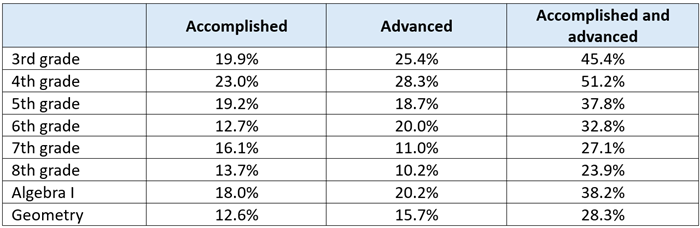
How many students are likely to qualify based on these criteria? As shown in Table 1, approximately half of third and fourth graders would likely score high enough to qualify for automatic advancement if current numbers hold. The number of high achievers in math starts to decline in fifth grade and by sixth grade—a pivotal year for algebra I placement (as discussed below)—just one in three students may qualify for automatic enrollment. This, however, would still represent a substantial increase in the number of students taking algebra I in eighth grade, as only 20 percent of Ohio students completed the course in eighth grade or earlier in 2024.
Table 1. Percent of Ohio students scoring accomplished or advanced on state math exams, 2025–26
Advanced learning opportunities—fourth through sixth grade
If students qualify in fourth through sixth grade, schools must provide “advanced learning opportunities.” These may be either:
- An above-grade-level math course. Schools selecting this option could, for instance, place qualifying fourth-grade students in math classrooms with mainly fifth graders. Another possibility is a self-contained, fifth-grade-level math class that serves all qualifying fourth graders (rather than mixing students of different ages).
- “Services or curricula modifications” that provide “additional rigor or challenge.” This more open-ended option allows schools to enhance a conventional, grade-level math program through enrichment or differentiated instruction to serve qualifying students.
Ohio rightly calls for early action, with advancement starting in fourth grade based on third-grade scores. Although the two service options outlined above provide districts with flexibility, they could also result in uneven advancement opportunities for students. Placement in an above-grade-level math course is more likely to ensure that students are challenged daily because the rigor is built into the coursework. The “services or curricula modifications” option, on the other hand, is just vague enough to open the door for lower-quality programs (e.g., sporadic “enrichment” or lackluster online modules). Moving forward, state officials should monitor how elementary schools implement “advanced learning opportunities,” which should include collecting data to help identify gaps in the types of opportunities elementary students receive.
Building to algebra I—seventh and eighth grade
As noted above, sixth grade is pivotal in Ohio’s advanced math framework. Sixth graders who score advanced or accomplished (and also earn an A/B or pass a diagnostic test) are automatically enrolled in a compacted math course that includes both seventh- and eighth-grade content.[3] Seventh graders who complete this accelerated course take the eighth grade state math exam at the end of the year and are automatically enrolled in algebra I if they achieve a score of “proficient” or above.[4] Compacted courses are common in schools that have traditionally offered algebra I in eighth grade. In those schools, only minor programmatic adjustments may be needed. Schools that have not offered compacted math courses, on the other hand, will need to overhaul their middle school programs. To its credit, the Ohio Department of Education and Workforce (DEW) has already developed some resources on advanced middle school math pathways. They’re a good first step, but more will surely be needed to effectively assist middle schools that must revamp their offerings.
* * *
Following in the footsteps of North Carolina and Texas, Ohio is now among the states that have adopted automatic-enrollment math policies. The change is a good one, as it promises to help ensure that all high achievers are challenged to reach their potential. But as with all policy reforms, implementation will be key to delivering on the promise of both expanded opportunities and stronger student outcomes. Ohio lawmakers have established an admirable advanced math framework. Now it’s time to start the work of implementing these policies well.
[1] Schools may also advance any student, regardless of test performance, at their discretion. SB 19 also includes an opt-out provision if parents believe advanced math is not the right placement for their child.
[2] State math assessments are given in grades 3–8 and algebra I and geometry. SB 19 contains no further advancement provisions prior to fourth grade or after algebra I.
[3] At this juncture, schools no longer have an option of providing “services or curricula modifications” to qualifying students; they must enroll students in the compacted seventh grade math course.
[4] “Proficient” is one achievement level below “accomplished.”