Mobile Navigation

  • National
    • Policy
      • High Expectations
      • Quality Choices
      • Personalized Pathways
    • Research
    • Commentary
      • Gadfly Newsletter
      • Flypaper Blog
    • Events
    • Scholars Program
  • Ohio
    • Policy
      • Priorities
      • Media & Testimony
    • Research
    • Commentary
      • Ohio Education Gadfly Biweekly
      • Ohio Gadfly Daily
  • Charter Authorizing
    • Application
    • Sponsored Schools
    • Resources
  • About
    • Mission
    • Board
    • Staff
    • Career
Home
Home
Advancing Educational Excellence

Main Navigation

  • National
  • Ohio
  • Charter Authorizing
  • About

National Menu

  • Topics
    • Accountability & Testing
    • Advanced Education
    • Career & Technical Education
    • Charter Schools
    • Curriculum & Instruction
    • ESSA
    • Evidence-Based Learning
    • Facilities
    • Governance
    • Personalized Learning
    • Private School Choice
    • School Finance
    • Standards
    • Teachers & School Leaders
    • Think Again
  • Research
  • Commentary
    • Gadfly Newsletter
    • Flypaper Blog
    • Gadfly Podcast
  • Events
  • Scholars Program

The Education Gadfly Weekly

Sign Up to Receive Fordham Updates

We'll send you quality research, commentary, analysis, and news on the education issues you care about.
Thank you for signing up!
Please check your email to confirm the subscription.

The Education Gadfly Weekly: Eva Moskowitz on the needs of high-flying students

Volume 19, Number 20
5.13.2019
5.13.2019

The Education Gadfly Weekly: Eva Moskowitz on the needs of high-flying students

Volume 19, Number 20
view
High Expectations

Are educators neglecting the needs of high-flying students?

Good teachers are warm and compassionate people, and like parents, they tend to love all their kids equally. Nevertheless, they also have a special tenderness for the students who struggle in their classrooms and feel a particular urgency about meeting their needs. This often means less attention paid to high flyers. Educators tend to believe these children will be fine no matter what. But they’re are their own “high-needs” subgroup because they’re at the greatest risk for extreme boredom.

Eva Moskowitz 5.13.2019
NationalThe High Flyer

Are educators neglecting the needs of high-flying students?

5.13.2019
The High Flyer

Local norms improve equity in gifted identification

5.14.2019
The High Flyer

New American Schools: A short, opinionated history, part II

Chester E. Finn, Jr.
5.15.2019
Flypaper

What we know about early learning

Robert Pondiscio
5.15.2019
Flypaper

Examining high school student credential attainment compared to workforce demand

Jessica Poiner
5.15.2019
Flypaper

The Education Gadfly Show: Can we really transform district schools?

5.15.2019
Podcast
view

Local norms improve equity in gifted identification

Scott Peters, Karen Rambo-Hernandez, Matthew Makel, Michael Matthews, and Jonathan Plucker 5.14.2019
The High Flyer
view

New American Schools: A short, opinionated history, part II

Chester E. Finn, Jr. 5.15.2019
Flypaper
view

What we know about early learning

Robert Pondiscio 5.15.2019
Flypaper
view

Examining high school student credential attainment compared to workforce demand

Jessica Poiner 5.15.2019
Flypaper
view

The Education Gadfly Show: Can we really transform district schools?

Michael J. Petrilli, David Griffith, Ph.D., Amber M. Northern, Ph.D., Donald P. Nielsen 5.15.2019
Podcast
view

Are educators neglecting the needs of high-flying students?

5.13.2019
The High Flyer

Good teachers are warm and compassionate people, and like parents, they tend to love all their kids equally. Nevertheless, it is my experience that teachers have a special tenderness for the students who struggle in their classrooms and, in their planning and instruction, feel a particular urgency about meeting their needs. I would like to make the case that high-flyers—those who always excel, significantly outperforming their classmates—deserve a similar degree of compassion and urgency.

When it comes to high-flyers, educators tend not to feel much concern. They assume they will be fine and rarely make them the objects of special attention. But in fact, high-flyers are their own “high-need” sub-group: They are the students who are at the greatest risk for extreme boredom.

It’s not simply that high-flyers can master even more rigorous content and curriculum, it’s that they have a significantly faster rate of learning. They grasp new ideas, texts, and problems quickly and are ready for more. But instead of getting more, they are asked to help their classmates or to sit quietly until the rest of their peers figure it out. Since they’ve already had their “aha!” moment, they look for other avenues of amusement—and can be disruptive to the class. At worse, they end up disengaging from school completely.

I have some personal experience with this phenomenon. One of my three children was an accelerated learner, and a typical evening conversation in our household went like this: “How was school today?” “Boring.” “What did you learn?” “Nothing.” Next would come the calls from the teacher: “Your child is daydreaming in class.” And when I would explain that my child was “daydreaming” (in fact, he was thinking about how gravity worked) because he had already done the work or figured out the math problem, the response was frosty. Teachers do not like to hear that they are low-balling kids.

This experience was all the more frustrating because it was happening at my own school, Success Academy, which my son has attended since Kindergarten (he’s now a sophomore in high school!). Having to listen to his griping about boredom when he was young kept me intensely focused on ensuring that our schools were designed to meet the needs of quick learners as well as the needs of kids who struggle.

We have done this in several ways. First off, we pitch high. I firmly believe that if you pitch your curriculum and instruction to the top quartile of the class, everyone learns more. The reality is that some proportion of students in any given class are above grade level and teachers regularly underestimate them. At Success, we constantly test the ceiling of our scholars’ capacities: making problems more challenging; pushing them to grapple with more complex questions. While strugglers may learn only half the material when first presented in a lesson geared toward the top students, that 50 percent contains more learning than 100 percent of a lesson pitched to the bottom. And by grouping students throughout the day with others at their level, we are able to provide the customized support each student needs for mastery.

To gauge intellectual growth among the high-flyers, we include a subset of questions on assessments that we know will challenge them. If they answer them correctly, they receive an “Exceeds Expectations” score. If they don’t, we know their growth has been neglected. “Exceeds Expectations” is also an accountability metric for school leader bonuses, giving them a concrete incentive to work with teachers on moving kids beyond proficiency and into the realm of exceeding.

Even these measures are not enough for some kids. Each year, we skip ahead approximately 5 percent of scholars in Kindergarten through second grade who consistently get perfect marks across subjects and show signs of growing bored or impatient with the pace of learning. In elementary and middle school, for students who are exceeding but are not quite ready to go to the next grade entirely, we do special book club groups in literacy and advanced mathematics groups. At our high school, we have a STEM Honors Academy, where, in addition to the traditional courses, students take electrical, mechanical, and biomedical engineering and computer science; and we have a Humanities Academy where students take advanced poetry, art history, and writing courses.

Making sure that the most capable students are continually challenged and engaged ultimately helps all students because it gives them access to engaging, rigorous content that will stretch them to reach their fullest potential. Unfortunately, across the country, we are failing at this goal. Most schools have halted the policy of skipping accelerated learners ahead and a recent report found that even when schools and districts give a nod to accelerated learners with so-called “gifted” classes and schools, the materials taught are no more accelerated than those in regular classrooms.

This neglect of exceptionally bright learners is an egregious oversight: International tests demonstrate again and again that compared to many other countries, a far smaller percentage of U.S. students reach the most advanced levels of achievement. And like everything else in education, low-income children are the ones who suffer most from our failings: Their parents are less able to afford extra classes to supplement their learning or to move them to a more rigorous school. Principals and system leaders constantly insist that their teachers “differentiate” to serve every learner, but the evidence speaks for itself: We are systematically neglecting high-flyers. It is the responsibility of educational leaders to put in place countermeasures that ensure we are delivering a schooling experience that challenges and engages every child, no matter their skills, talents, and abilities.

Editor’s note: This article originally appeared in a slightly different form on Linkedin.

The views expressed herein represent the opinions of the author and not necessarily the Thomas B. Fordham Institute.

view

Local norms improve equity in gifted identification

5.14.2019
The High Flyer

Almost every article on gifted education highlights inequity as an issue for the field. Indeed, inequity and large excellence gaps are among society’s most vexing educational problems, and scholars have proposed a variety of approaches to address them.

Universal screening and the use of local norms are prominent among these recommendations. Under local norms, gifted students don’t have to be in a high-performing school, they need to be high performing in their school. Local norms have been controversial, with critics arguing—often in the absence of solid evidence—that moving to local norms may not appreciably advance the cause of equity in gifted program participation rates. But a recent study we authored in AERA Open found that local norms do matter, and they matter a lot!

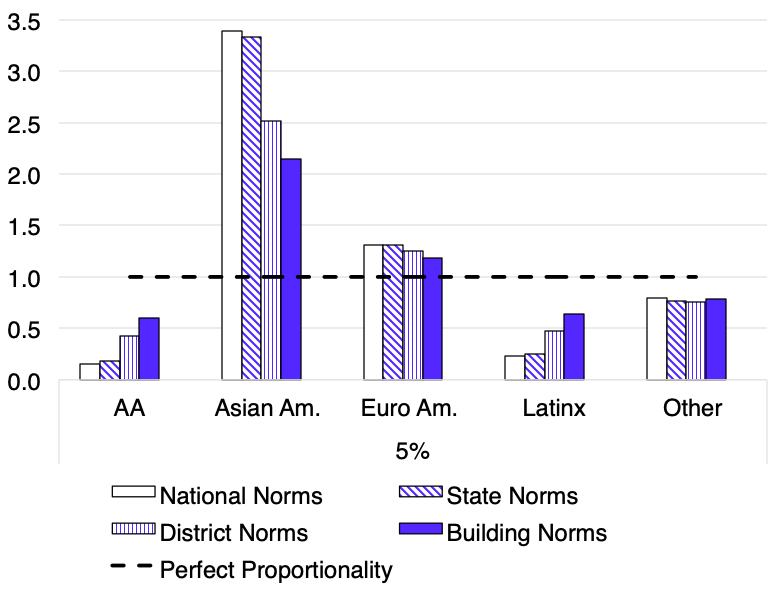
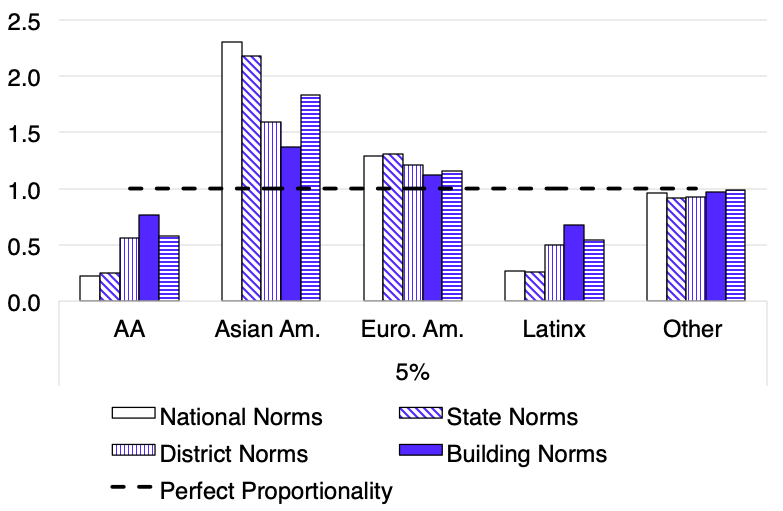
Local norms find advanced students hidden in plain sight. The purpose of our study, which used data from a ten-year period and from ten states, was to investigate the degree to which using different norms (national, state, district, or building) would influence racial and ethnic representation rates in gifted education. For context, a representation index (RI) of 1.0 translates to perfect proportionality of a group in the population identified as gifted.

We found that using building-level local norms would dramatically increase racial and ethnic equity in gifted programs. For example, as shown in the following figures, when the criteria for gifted is set at the top 5 percent of a school instead of the top 5 percent of the nation, we observed a 300 percent and 170 percent increase in African American and Hispanic student representation, respectively, in math. In reading, these increases were 238 and 157 percent, respectively. Although these students were still underrepresented, building norms resulted in a large increase in the number of them identified as gifted.

Some have correctly pointed out that using building-level norms could result in similarly-dramatic decreases in Asian American and European American identification rates under building norms (see the New York City specialized high school controversy). In fact, our study found evidence that this concern is well-founded (although we note students from these groups would still be disproportionally well represented). If the concern persists, there are other options, such as identifying students based on national or building norms, that moderate changes in representation. Of course, expanding services addresses this problem; in other words, rather than divvy the same pie of services up differently, creating winners and losers, create a bigger pie of services, creating only winners.

Figure 1. Representation indices (RI) by race and norm group in math, top 5 percent

lnf1

Figure 2. Representation indices (RI) by race and norm group in reading, top 5 percent

lnf2

An immediate challenge is that not every building has services to provide even if they all implemented local norms tomorrow. According to a new study published in Gifted Child Quarterly that used data from the Office of Civil Rights, over 42 percent of U.S. schools have zero students identified as gifted. This points to a major implication of what we propose: All schools would need to proactively plan for how they would challenge their most advanced learners. When educators examine performance relative to peers’ performance within each individual school building, gifted identification is about determining which children are not being challenged by the existing “grade level” instruction provided in a specific school setting. Every building has kids who could do more, and every building needs to proactively identify and serve those kids.

Local norm comparisons also are consistent with the definition of giftedness first advanced in the influential U.S. Department of Education “National Excellence” report, which recommended identifying student abilities only in comparison “with others of their age, experience, or environment.” Today, many schools draw their students from local neighborhood attendance zones that commonly are segregated by income, race, and ethnicity. This is why local norms work. By identifying talent in every building, gifted populations get closer to mirroring the larger student population.

Local norms are not a panacea, and they don’t result in perfect proportionality. But our analyses demonstrate that they represent a tremendous leap in the direction of better equity. Additionally, they are relatively easy to implement and carry almost no additional cost to students or schools. Local building-level norms are an early stage in the race to equity; they are not the finish line. Their use is an effective strategy for getting a more diverse student body served by the kinds of challenging programming and learning opportunities that will enable them to perform to their potential. Although there may be other strategies to help achieve greater equity in gifted identification and participation rates, we can’t imagine any that offer the same immediate impact as the local norms approach.

Scott Peters is Professor of Educational Foundations at University of Wisconsin-Whitewater, Karen Rambo-Hernandez is Associate Professor of Educational Psychology at West Virginia University, Matthew Makel is the Director of Research at the Duke University Talent Identification Program, Michael Matthews is Professor of Education at the University of North Carolina-Charlotte, and Jonathan Plucker is the Julian C. Stanley Professor of Talent Development at Johns Hopkins University.

view

New American Schools: A short, opinionated history, part II

Chester E. Finn, Jr.
5.15.2019
Flypaper

This essay is part of the The Moonshot for Kids project, a joint initiative of the Fordham Institute and the Center for American Progress. This is the second of three parts. The first ran last week, and the third will appear in the next issue of the Education Gadfly Weekly.

Part I explained how educators and ed reformers have long been tantalized by the dream of “reinventing” the school. “If only we could break away from this industrial-style arrangement,” goes the usual refrain, “with its boxy classrooms, batch-processed students, and rigid bell schedule, and create totally different schools that are better suited to modern times and to children’s needs.” A second powerful impulse animating education reformers in recent decades has been the desire to design a “coherent” model of schooling that would meld the best evidence of practices that work and thereby put research into practice in holistic rather than piecemeal fashion. The appetites for school reinvention and holistic reform came together in the early 1990s in a major R & D (mostly D) initiative. The vehicle was a new nonprofit entity named the New American Schools Development Corporation—known as NASDC, commonly referred to simply as New American Schools, sometimes NAS. The conception was magnificent, but of course reality would prove something less than that.

Bush and Alexander were soon out of office and, while the Clinton team wasn’t hostile, it was more interested in what government could do to help attain those ambitious national goals (which then-Arkansas governor Bill Clinton had played a large role in formulating) than in a private sector venture funded and initially led primarily by wealthy Republicans. Moreover, as NASDC ramped up, it needed staff, procedures, credibility, and other imperatives that destined it to resemble a large nonprofit organization more than a nimble venture-capital firm.

The original plan evolved into a still-ambitious “design competition” whereby NASDC would fund design teams that would develop break-the-mold school plans that the teams themselves would then, in effect, advertise to communities and states. When a team found a taker for its plan, it would provide much technical assistance to the client district so that the novel design might be properly implemented.

Additional federal funds might one day flow for this purpose—and eventually they flowed generously—but the public-education market would decide, which at the time meant that traditional school districts would be the main customers for those teams. (The country’s first charter school opened in 1992.) NASDC would underwrite development of the new models and help publicize them, thereby seeking to build some interest, but the teams that created the supply would have to become entrepreneurial in connected what they designed to places with the desire and the means—political and fiscal—to put it into practice. As Jeffrey Mirel noted, “at some point these design teams would need to become self-sustaining, taking fees from school districts in return for their expertise.”

The competition to become a NASDC-funded designer proved to be quite a big deal, attracting nearly 700 initial applicants, which reviewers ultimately winnowed down to eleven winners, nine of which received multi-year financial support for their work.

Although Mirel reports that “The popular and media response to the NASDC initiative was generally upbeat and positive,” there was also criticism. Some came from the left, “primarily from liberal critics of the Bush administration,” asserting that this was the work of “right-wing ideologues and privatization advocates” and/or that needy children, poor districts, and minorities would be neglected. “You can bet,” cautioned former U.S. education commissioner Harold (“Doc”) Howe II, “that, when these parties get together, they will spend little time in making a diverse society work.”

Education historians David Tyack and Larry Cuban, whose acclaimed book, Tinkering Toward Utopia, came out in 1995, fretted that New American Schools would turn out to be yet another of the many “reinvention” efforts over the years that turned out to be “shooting stars that spurted across the pedagogical heavens, leaving a meteoric trail in the media but burning up and disappearing in the everyday atmosphere of the schools.”

From the right came a different concern that Mirel says proved more “prescient”: that the RFP and selection processes were “skewed to ensure the choice of safe rather than break-the-mold designs,” would reward experienced grant-writers, and would wind up funding established organizations that would not, in the end, do anything that was truly novel or that would produce dramatically different results.

The winning designs, for the most part, did indeed come from established outfits headed by familiar education names and, says Mirel, “were notable mainly for their use of progressive rhetoric in describing their approaches.” His summary of their plans is replete with concepts and terms that remain much in vogue a quarter century later, from “interdisciplinary,” “authentic,” and “community based” to “learner centered,” “active inquiry,” and “multicultural.” Several designs sought to replace traditional age-based, year-at-a-time grade progressions with multi-age groupings and plans to move students forward when ready.

If fully and skillfully implemented as designed and at scale, most of these designs would have, if not exactly shattered the mold, certainly placed children in schools that were different from the norm of the 1990’s—and from the vast majority of today’s schools as well. Contrary to concerns raised from the left, the teams focused on disadvantaged, urban communities and on helping kids whose achievement needed a major boost. When RAND conducted a three-years-into-implementation review of seven designs, it noted that their teams had “partnered with schools and districts that are characterized by a host of problems related to poverty, achievement, and climate characteristics.” In other words, they weren’t headed to cushy suburbs or other places where the going would be easy!

The focus on disadvantaged youngsters and their schools, while morally justified and politically appropriate, did raise the long-standing question of whether “progressive,” child-centered education such as most of the NAS teams were committed to is an optimal approach for addressing the education needs of such kids. A robust line of research suggests that students who don’t get a lot of structure and systematic knowledge outside school tend to do better with structured, sequential, knowledge-rich curricula and instruction—hence the impressive success of “no-excuses” charter schools and their ilk, such as New York City’s Success Academy—while more progressive pedagogies may work better with children who have plenty of order in their lives, books in their homes, etc. In other words, it’s possible that the school designs emerging from most of the NASDC-supported teams were less than perfectly suited to their target audience. (It also strikes me, in retrospect, that the educational needs of disadvantaged youngsters would better have been met by enrolling them in traditional Catholic schools than by “breaking molds” and “innovating.”)

In any case, the very elements that made the targeted schools and communities needy and deserving of help also meant that, in RAND’s phrasing, “To scale up the designs or replicate implementation in these sites is extremely difficult.”

Unlike charter schools, which were only just coming into view, and unlike the original plan for Chris Whittle’s Edison Project (another privately financed initiative—this one profit-seeking—to “break the mold” in K–12 education), which concentrated on creating brand new schools, the NASDC teams were bent on transforming existing, district-operated public schools. And that’s always a heavy lift, whether the existing schools are educational successes or basket cases. In the former situation, “it ain’t broke,” so why change it? In the latter situation, it’s tantamount to taking an education sow’s ear and striving to turn it into a silk purse. That’s hard under any circumstance; harder when resource levels are level and the staff remains in place; and hardest in schools and districts that may not be particularly well led, probably not well financed, and most likely shackled by politicized school boards, turbulent communities and rigid union contracts.

Stay tuned for part III.

view

What we know about early learning

Robert Pondiscio
5.15.2019
Flypaper

To a degree most of us would prefer not to acknowledge, classroom practice tends to run less on research and empirical evidence than on some combination of philosophy, faith, or personal preference. But for those committed to a vision of teaching based on what we know about learning instead of habit or what we might wish to be true, Deans for Impact has produced a brisk and accessible guide for teachers, parents, and caregivers involved in early childhood education, which the report defines as spanning birth to age eight. It’s a worthy successor to the group’s touchstone 2015 report, The Science of Learning.

Written for “anyone who is interested in our best scientific understanding of how young children develop control of their own behavior and intentions, how they learn to read and write proficiently, and how they develop the ability to think mathematically,” The Science of Early Learning puts under one cover a summary of current research across three “domains”—literacy, numeracy, and “agency.” One dozen “key questions” are posed (e.g., “How do young children learn to count?” and “How do young children learn to self-regulate their behavior?”), each addressed on a single page with a list of “principles from learning science” that inform the answers—plus a set of “practical implications” suggested by the research. For example, on developing independence, one principle is “the need for independence is essential to human growth and learning.” The practical implication or guidance is that teachers “can help young children develop their independence by providing opportunities to make choices and decisions (within limits), and allowing them to experience the consequences of their choices.” Another cautions against “doing things that may inhibit young children from developing independence—such as offering incentives like sticker charts or rewards for good behavior—because the prize becomes the goal more than learning.”

One good sign is that the phrase “developmentally appropriate” (or inappropriate) appears not once in the brisk and efficient twenty-page report. Nor will you find false dichotomies between “play-based” and “academic” early childhood education in its pages, which overflow with helpful insights from avoiding long wait times between classroom activities (which tax little kids’ ability to self-regulate their behavior) to advice on helping children progress from concrete representations of numbers, to visual representations, to abstractions. Given the recent groundswell of concern over scientifically sound reading practice, the report is particularly strong on early childhood literacy, stressing the benefits of reading aloud to children, the development of print concepts (e.g., text goes from left to right across the page; matching spoken words to written ones), and mastering the alphabetic code in the earliest years. “Most children will not ‘naturally’ learn that the letters in the English alphabet represent specific sounds,” warn the authors, who include a pair of practicing teachers (Dylan Kane and Callie Lowenstein, Rachel Robertson of Bright Horizons, and a trio of academics, Daniel Ansari, Stephanie Carlson, and Anne Castles). “Systematic phonics instruction is the most effective, evidence-based way to ensure that young children learn letter-sound relationships.” The report also authoritatively dispatches any number of persistent myths about reading comprehension. “Children should read texts that are rich in content, not just about familiar, daily life contexts,” it notes. “Even young children benefit from learning about science, history, geography, and other cultures, and from reading classic stories that may be referenced in other works.” Somewhere, E.D. Hirsch, Jr. smiles.

When it comes to addressing—and hopefully, someday, reversing—the nation’s mediocre education performance, all roads lead to early childhood. It is there that the battle is mostly won or lost. Brisk and economical, but authoritative, the greatest strength of The Science of Early Learning is the extensive sourcing: Each “domain” is linked to over sixty studies inviting further reading, or you can just run with the principles and practical implications. In short, this is the very model of what it looks like to make educational research both understandable and actionable. More of this please, and bravo, Deans for Impact.

SOURCE: “The Science of Early Learning,” Deans for Impact (March 2019).

view

Examining high school student credential attainment compared to workforce demand

Jessica Poiner
5.15.2019
Flypaper

“Credentials Matter,” a new report released by the Foundation for Excellence in Education and Burning Glass Technologies, joins other recent studies in offering an in-depth look at the industry-credential landscape by examining how states collect data on attainment, employer demand, the types of credentials that high school students earn, and whether demand aligns with credentialing supply.

The report defines credentials as third-party verifications of an individual’s qualification or competence in skills. It further defines industry recognized credentials as those that are sought by employers and preferred or required for recruitment, screening, hiring, retention, or advancement purposes. Most credentials available to high school students are offered as part of career and technical education (CTE) programs, and the report identifies five types: license, certification, software, general career readiness, and CTE assessment. Although the report considers all available credentials reported by states, it does not assess the value of specific credentials beyond employer demand. It also does not assess the postsecondary attainment of industry credentials, since too few states provided postsecondary data, or the relationship between attainment and CTE program quality. 

To analyze the supply side of the credential landscape, the Foundation for Excellence in Education asked each state to answer questions about data collection. They report using varying methods, though nearly all of them rely on self-reported data by schools or districts. That’s troublesome, since self-reported data have an increased chance of being incomplete or inaccurate. There are four states—Tennessee, Indiana, Michigan, and North Carolina—that have data-sharing agreements with credential vendors, a more reliable source for the information. States were also asked by analysts to provide data on credentials earned by public K–12 and two-year college students through CTE programs. As of the 2018–19 school year, twenty-eight states collect quantitative data on attainment, and twenty-four of them provided data for this report. Overall, their dataset includes over 780,000 credentials earned from 367 unique vendors.

Across states, there is considerable variation in which credentials students earn among the five identified types. In Mississippi, for example, 100 percent are certifications. Utah, on the other hand, reports that only 12 percent are certifications and 78 percent are software credentials. Nationally, almost half are certifications. These can provide entry-level and advancement opportunities, but their overall alignment is poor. Only two—Automotive Service Excellence and ServSafe Certifications—are on both the top-supplied and top-demanded lists. Licenses, meanwhile, are the least common credential, and are mostly misaligned with industry demand due to both an “extreme oversupply” of those associated with low-wage occupations and an undersupply of licenses for middle- and high-wage jobs. 

To analyze employer demand, Burning Glass Technologies, a software company that offers job market analytics, used its database of more than 150 million unique online job postings. Its focus was limited to postings that were localized in states; requested specific credentials, occupations, or skills; matched the same year as supply data; and paid a living wage, defined as $15 per hour. Results show that, although certifications and licenses are the credentials most likely to be required, employers often neglect to specifically request them in job descriptions. This manner in which employers communicate their needs and requirements to potential employees—known as employer signaling—is one of the key areas where states need to improve.

None of the twenty-four states with available data were highly aligned in terms of supply and demand. Twelve were rated as having moderate alignment, while the other half had low alignment. The most significant source of misalignment comes from an oversupply of credentials that are not in demand in the labor market: Only 19 percent of credentials earned by K–12 students in this analysis are actually demanded by employers. In fact, of the top fifteen most commonly earned credentials, ten are oversupplied. They include W!SE Financial Literacy Certification, NCCER Core Curriculum, and Basic First Aid. Despite the common oversupply problem, states must address misalignment on an individual basis because labor markets are vastly different from state to state.

The report includes several recommendations for a variety of stakeholders. For states, it’s important to establish statewide definitions for industry recognized credentials, codify processes to identify which credentials are valued by employers, and establish data-sharing agreements between state and credentialing agencies. Schools must improve alignment between CTE offerings and workforce demands. Businesses should better their employer signaling by clarifying the required credentials and skills needed for jobs. And credentialing entities should provide data that can be used to improve program quality—such as attempts to earn credentials, raw scores on credentialing assessments, employee placement, and wages.

In the coming months, the two authoring organizations plan to continue their partnership and add to their research. In the meantime, policymakers and advocates would be wise to give their report—and interactive website—a close look.

SOURCE: “Credentials Matter,” ExcelinEd and Burning Glass Technologies (May 2019).

view

The Education Gadfly Show: Can we really transform district schools?

5.15.2019
Podcast
 

On this week’s podcast, Donald P. Nielsen, program director of the Discovery Institute’s American Center for Transforming Education, joins Mike Petrilli and David Griffith to discuss the feasibility of empowering school administrators, and whether it’s feasible in district schools. On the Research Minute, Amber Northern examines efforts in Boston to scale up successful charter schools. 

Amber’s Research Minute

Sarah Cohodes et al., “Can Successful Schools Replicate? Scaling Up Boston’s Charter School Sector,” National Bureau of Economic Research (May 2019).

Fordham Logo

© 2026 The Thomas B. Fordham Institute
Privacy Policy
Usage Agreement

National

P.O. Box 110
Burke, VA 22009

202.223.5452

[email protected]

Ohio

P.O. Box 82291
Columbus, OH 43202

614.223.1580

[email protected]

Sponsorship

130 West Second Street, Suite 410
Dayton, Ohio 45402

937.227.3368

[email protected]