Mobile Navigation

  • National
    • Policy
      • High Expectations
      • Quality Choices
      • Personalized Pathways
    • Research
    • Commentary
      • Gadfly Newsletter
      • Flypaper Blog
    • Events
    • Scholars Program
  • Ohio
    • Policy
      • Priorities
      • Media & Testimony
    • Research
    • Commentary
      • Ohio Education Gadfly Biweekly
      • Ohio Gadfly Daily
  • Charter Authorizing
    • Application
    • Sponsored Schools
    • Resources
  • About
    • Mission
    • Board
    • Staff
    • Career
Home
Home
Advancing Educational Excellence

Main Navigation

  • National
  • Ohio
  • Charter Authorizing
  • About

National Menu

  • Topics
    • Accountability & Testing
    • Advanced Education
    • Career & Technical Education
    • Charter Schools
    • Curriculum & Instruction
    • ESSA
    • Evidence-Based Learning
    • Facilities
    • Governance
    • Personalized Learning
    • Private School Choice
    • School Finance
    • Standards
    • Teachers & School Leaders
    • Think Again
  • Research
  • Commentary
    • Gadfly Newsletter
    • Flypaper Blog
    • Gadfly Podcast
  • Events
  • Scholars Program

The Education Gadfly Weekly

Sign Up to Receive Fordham Updates

We'll send you quality research, commentary, analysis, and news on the education issues you care about.
Thank you for signing up!
Please check your email to confirm the subscription.

The Education Gadfly Weekly: The college gender gap begins in kindergarten

Volume 21, Number 40
10.7.2021
10.7.2021

The Education Gadfly Weekly: The college gender gap begins in kindergarten

Volume 21, Number 40
view
High Expectations

The college gender gap begins in kindergarten

A recent Wall Street Journal article set off a pundit-palooza on the topic of the female advantage in higher education, with many suggesting that young men have “given up on college.” But American students who are academically well-prepared for college continue to matriculate and graduate. It’s just that many more of them are female. The reason for that starts in kindergarten.

Michael J. Petrilli 10.7.2021
NationalFlypaper

The college gender gap begins in kindergarten

Michael J. Petrilli
10.7.2021
Flypaper

Critical race theory distracts from academic underachievement

Bob Woodson | Ian Rowe
10.7.2021
Flypaper

Do experts share responsibility for pitchfork-wielding mobs?

Adam Tyner, Ph.D.
10.7.2021
Flypaper

Researchers test a simple method to reduce suspensions for Black students

Jeff Murray
10.4.2021
Ohio Gadfly Daily

A national look at charter school enrollment trends during the pandemic

Jessica Poiner
10.4.2021
Ohio Gadfly Daily

Education Gadfly Show #790: Why boys flail

10.7.2021
Podcast

What we're reading this week: October 7, 2021

The Education Gadfly
10.7.2021
Flypaper
view

Critical race theory distracts from academic underachievement

Bob Woodson, Ian Rowe 10.7.2021
Flypaper
view

Do experts share responsibility for pitchfork-wielding mobs?

Adam Tyner, Ph.D. 10.7.2021
Flypaper
view
Mitigating the Black-White suspension gap SR image

Researchers test a simple method to reduce suspensions for Black students

Jeff Murray 10.4.2021
Ohio Gadfly Daily
view
Charter enrollment trends SR image

A national look at charter school enrollment trends during the pandemic

Jessica Poiner 10.4.2021
Ohio Gadfly Daily
view

Education Gadfly Show #790: Why boys flail

Michael J. Petrilli, David Griffith, Ph.D., Amber M. Northern, Ph.D., Richard Whitmire 10.7.2021
Podcast
view

What we're reading this week: October 7, 2021

The Education Gadfly 10.7.2021
Flypaper
view

The college gender gap begins in kindergarten

Michael J. Petrilli
10.7.2021
Flypaper

It’s often said that “college readiness begins in kindergarten,” which is generally meant as a call to arms for K–12 schools to help their students set their expectations high right from the start, and to make sure they get the excellent teaching that would allow them to reach this lofty goal.

But when I say that the college gender gap begins in kindergarten, I mean it literally. Not fourth grade. Not eighth grade. Certainly not twelfth grade. Kindergarten! And that has implications for what’s causing the gender gap and what might be done to address it.

A recent Wall Street Journal article about the latest college enrollment trends set off a pundit-palooza on the topic of the female advantage in higher education. “At the close of the 2020–21 academic year,” the Journal reported, “women made up 59.5 percent of college students, an all-time high, and men 40.5 percent, according to enrollment data from the National Student Clearinghouse.” Furthermore, “in the next few years, two women will earn a college degree for every man, if the trend continues.”

The Journal article, as well as several of its imitators, imply that this is yet more evidence of young men “giving up on college.”

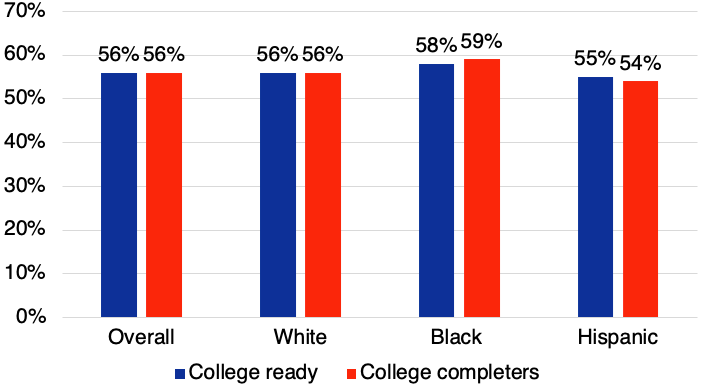
And while that may be the case for certain guys out there, it doesn’t capture what’s really going on. In the aggregate, at least, virtually all American students who are academically well-prepared for college continue to matriculate into college and then go on to graduate. It’s just that many more of these students are young women instead of young men. In other words, the college readiness gap is perfectly predictive of the college completion gap.

Let’s take a close look at the most recent data we have on college degree attainment. In 2020, 35 percent of all American men ages twenty-five to twenty-nine had earned at least a four-year degree, versus 44 percent for women. If you assume a 50/50 gender split for the cohort writ large, and do the math, that means approximately 56 percent of college completers in their late twenties are female.

Now roll back the tape. This cohort of students would have graduated from high school from about 2009 through 2013. For the high school graduating class of 2013, the National Assessment of Educational Progress (NAEP) tells us that 33 percent of male students scored at the proficient level in reading, versus 42 percent of females. According to NAEP analyses, scoring proficient in reading is a very good predictor of college preparedness—meaning that, by this one measure, 33 percent of males and 42 percent of females were college-ready at the end of high school. Work the numbers and that means that approximately 56 percent of college-ready students were female.

Notice a pattern?

This holds when we break down the data by race, too.

Figure 1. The percentage of college-ready and college-degree-earning students who are female
1

Note: “College ready” is defined as proficient on the grade 12 NAEP reading exam. College completion data are from 2020 and come from the U.S. Department of Education’s Digest of Education Statistics.

What about math?

To be sure, reading isn’t everything when it comes to college readiness. Non-cognitive skills matter, too, and even within the academic domain, math is also extremely important, not to mention writing or other subjects like history and science. Sadly, though, we don’t have reliable, national college-readiness data for anything but reading. A National Assessment Governing Board analysis did identify a score on the twelfth grade NAEP math test that is predictive of college readiness, and on the 2019 exam, 37 percent of students overall reached this level—the same as in reading. But unfortunately, subgroup data have never been released to the public on this measure, including by gender. (Unlike in reading, where NAGB determined that NAEP proficient equates to “college prepared,” in math, the college-prepared number falls in between NAEP basic and NAEP proficient.) Given that young men show a slight advantage in math on NAEP—in average scores and at the 75th and 90th percentiles—it’s quite likely that they have a slight advantage in college readiness in math, too.

Still, if we had to pick one subject to define college-readiness, reading would be an excellent choice. As E.D. Hirsch has long argued, analyses of the AFQT exam used in the armed forces have long shown reading scores to be twice as predictive of positive long-term outcomes as math scores. It’s hard to do college-level work without being able to do college-level reading. And more young women than young men are reaching college-ready reading levels by the end of high school.

When does the gender literacy gap begin?

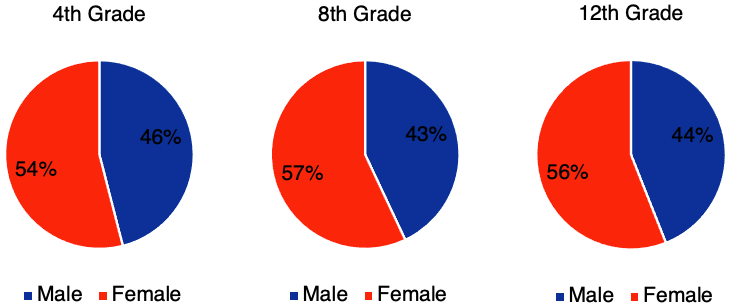
So maybe this gender gap opens up in high school? Nope. When the class of 2013 was in eighth grade, 57 percent of students who scored at NAEP proficient in reading were female. High schools may not be doing much to close the gender gap, but they don’t appear to be creating them.

So is middle school the problem? Well, go back to when the class of 2013 was in fourth grade, and we find that the 54 percent of students who scored at NAEP proficient in reading were female. That’s a bit closer to parity—but we can still say that about two-thirds of the college gender gap was already apparent by the end of the fourth grade.

Figure 2. The gender gap among NAEP proficient readers over time for high school class of 2013
2

Source: NAEP Data Explorer.

Alas, our NAEP way-back machine doesn’t travel any further than the fourth grade. But we can look to another federal data source, the Early Childhood Longitudinal Study (ECLS). This ambitious data collection program followed two waves of students, one group that started kindergarten in 1998 and graduated high school in 2011, and another that started school in 2010 and will graduate high school in 2023. The kids in the study took tests every year from grades K–5, and their parents and teachers filled out extensive surveys as well. We know a lot about these students.

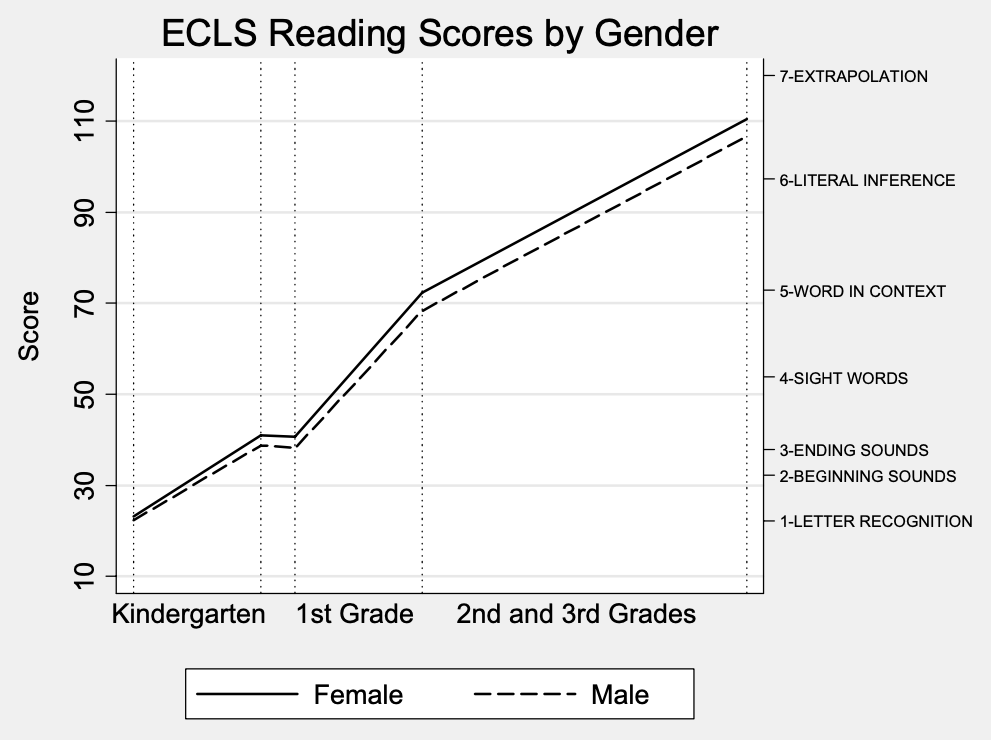
And one thing we know—from analyses by Laura LoGerfo, Austin Nichols, and Duncan Chaplin (for the first wave) and Emma Garcia (for the second)—is that the gender gap in literacy at kindergarten entry is quite small. In the first wave, it was calculated to be less than one point. But girls made significantly more progress in kindergarten and first grade, and somewhat more progress in second and third grades, so that by the end of third grade, they were four points ahead.

Figure 3. Differences in reading learning rates over time by gender for students who were kindergartener in 1998
3

Source: Laura LoGerfo and Austin Nichols, “Gender Gaps in Math and Reading Gains  During Elementary and High School  by Race and Ethnicity,” Urban Institute (September 2006).

The boys later made up some ground (in line with those somewhat-better fourth-grade NAEP scores), before falling behind again in early adolescence. But regardless of the zigging and zagging, it’s clear that boys are playing catch-up the whole time, especially after making so little progress in kindergarten and first grade.

What’s causing the gender gap in literacy?

So why might girls be zooming ahead in the first few years of school? In an excellent article that also points to elementary schools as the birthplace of the gender gap, Richard Whitmire suggests that the reforms of recent decades have pushed literacy instruction earlier, and boys, with their slower-developing brains, can’t keep up. Maybe.

But let’s return to those ECLS studies. Remember that we have both test scores and teacher surveys for every child in the study, meaning that scholars can compare students’ literacy abilities as judged by the tests with teachers’ perceptions of each child’s skills. That’s exactly what Joseph Paul Robinson and Sarah Theule Lubienski did in an a great, oft-overlooked study. And guess what. Teachers systematically underestimated little boys’ reading abilities—both at kindergarten entry and as they made their way through elementary school. Previous studies indicate that this might be because of the “good girls” theory: Teachers think little girls are better readers because they tend to behave better, and think squirrely little boys are poor readers, even when they aren’t. Furthermore, teachers tended to believe that their best readers were disproportionately girls, even when the literacy assessments themselves did not show that to be the case.

As the authors explain, that perception gap could have serious real-world repercussions for boys, as they are placed in lower reading groups than they qualify for, and are handed less challenging books than they can handle.

Indeed, we know from a growing literature that teacher expectations can have a big impact on student outcomes—and that when expectations vary by race, it can contribute to the racial achievement gap. So it is with gender.

So what might we do? As Whitmire says, in part we need to keep working to ensure that all teachers understand and are ready to use the “science of reading” in the early grades. But we should also make sure they are aware of any anti-little-boy biases they might harbor. Using formative assessments like NWEA’s MAP or Curriculum Associates’s i-Ready can help, as they provide hard data about kids’ current reading abilities, which might contradict teachers’ own perceptions, perhaps in a good way. Those data might encourage teachers to place more boys in the higher reading groups—and encourage them to assign them tougher books, too.

It surely would also help if more early-elementary teachers were male. It would be hard to do worse on this particular gender gap, as a whopping 89 percent of elementary school teachers are female. A famous study by Tom Dee found that eighth grade boys benefitted greatly from being assigned to male teachers. That would likely be the case for younger boys, as well. 

—

None of this is to say that we shouldn’t also worry about larger social issues that might be leading to bad outcomes for boys and men. Growing up in a single parent family, in particular, appears to have hugely detrimental impacts for boys.

But as Whitmire argues, there’s not much our schools can do about that problem, and it’s not super clear that other institutions in our society can do much, either. Helping boys get off to a good start in school, however, especially by helping them become stronger readers, is squarely within our control. And there’s good reason to believe that if we keep the reading gender gap from opening up in grades K–3, we could eventually close the college gender gap, as well.


view

Critical race theory distracts from academic underachievement

Bob Woodson | Ian Rowe
10.7.2021
Flypaper

With a new school year underway, parents, teachers, and children anxiously return to classrooms amidst an ongoing coronavirus pandemic.

But this year, school board members, teachers, academics, politicians, and parents continue to argue over critical race theory and how to enact its version of equity.

Last week, the U.S. Conference of Mayors adopted a resolution to support the teaching of critical race theory in public K–12 schools. The resolution initially listed among its sponsors liberal mayors like Chicago’s Lori Lightfoot, Portland’s Ted Wheeler, and Louisville’s Greg Fischer.

Over the summer, Oregon governor Kate Brown suspended a requirement for students to demonstrate reading, writing, and math proficiency in order to receive a high school diploma, in a supposed effort to build “equity.” The governor’s office said the new standards for graduation would aid the state’s “Black, Latino, Latinx, Indigenous, Asian, Pacific Islander, Tribal, and students of color.”

These efforts by politicians to push critical race theory distracts from a real analysis of educational achievement in their states and cities. The real issue in American education is a failure to enable the majority of students—regardless of race—to achieve academic excellence or even, in many cases, basic skills.

We have a national crisis of education that most Americans aren’t paying attention to. Our school systems produce a small group of high-achieving students at the top and a massive group of low-achieving students at the bottom.

America has fallen into a multi-generational crisis of illiteracy. In terms of raw numbers, more white students are reading below grade level than Black students. Of the 1.8 million students who took the ACT in 2019, 36 percent did not achieve college readiness in any of the four subjects. That means about 650,000 American students, despite spending thousands of hours in school, were not prepared for college-level work in a single subject. And that number does not include the millions of students who did not take the ACT. Even worse, 19 percent of American high school graduates are functionally illiterate, unable to read well enough to manage daily tasks.

Framing American educational failure in terms of critical race theory or systemic racism alone ignores the long history of Black American educational excellence. After the abolition of slavery, Black Americans took an incredible leap from illiteracy to literacy, from 20 percent in 1870 to nearly 70 percent by 1910, and many segregated schools, such as all-Black Dunbar High School in Washington, D.C., sent higher percentages of their students to college than comparable White schools did.

While racial disparities do exist, closing them typically means achieving universal mediocrity. In West Virginia, for example, only 18.7 percent of Black male eighth graders were proficient in reading on the 2013 National Assessment for Educational Progress; for White eighth graders, that number was 19.7 percent. If we closed that “racial achievement gap,” we would still be failing to educate 80 percent of Black and White students.

Meanwhile, the voluntarily segregated Rosenwald Schools, built by Booker T. Washington and Julius Rosenwald in the early 1900s—dramatically increased educational outcomes among Blacks when racism was enshrined in law.

Instead of seeing the world solely through a racial lens, we would do better to address the underlying causes of America’s widespread and race-blind battle with illiteracy. It’s much easier to hire another equity consultant than it is to teach all kids effectively.

By deceptively characterizing educational underachievement as a “Black” problem, CRT advocates have both unhelpfully stereotyped Black students, whose levels of college access continues to rise, and lulled White parents into a false sense of security. In each year since the Nation’s Report Card was first administered in 1992, less than half of the nation’s White students in the fourth, eighth, and twelfth grades scored proficient in reading.

Contrary to CRT ideology, several factors far outpace race in determining educational success. These include family stability, parental involvement, a school and home culture that supports effective study habits, and elementary school curricula that prioritize broadening students’ knowledge base.

Consider the Piney Woods School in Mississippi, the nation’s oldest Black boarding school. More than 98 percent of Piney Woods’ graduates go on to attend college because it offers, in the words of the school’s mission, an “exceptional academic model which supports the tenet that all students can learn, develop a strong work ethic, and lead extraordinary lives through academic achievement and responsible citizenship.” Rather than obsess over race, the school aims to promote love, integrity, faith, excellence, and empowerment as core values.

Imagine if this type of education were available for every American family.

Our biggest problem today isn’t the achievement gap between Black and White students; it’s the distance between current illiteracy rates among all students and true academic excellence.

Closing this achievement gap will take a cultural sea change in the way America approaches schooling. Yes, debate critical race theory, but let’s keep our eyes on the prize. We should spend far more time in the pursuit of excellence—implementing reading instruction that would improve literacy outcomes for kids of all races. That would erase the stain of racism far more than endlessly debating critical race theory.

Editor’s note: This was first published by Newsweek.

view

Do experts share responsibility for pitchfork-wielding mobs?

Adam Tyner, Ph.D.
10.7.2021
Flypaper

Angry citizens, enraged over everything from mask mandates to “critical race theory,” have been storming school board meetings, threatening members, and driving some to quit, reports a recent AP article. “It’s my constitutional right to be as mean as I want to you guys,” one rabble-rouser declared. After a series of violent incidents, the National School Boards Association is petitioning the federal government for help protecting local meetings. Meanwhile, NBC reports that supporters of the QAnon conspiracy theory are making a push to take over school boards peacefully, via low-turnout local elections.

Sane people know perfectly well that overwhelming school boards with threats of violence and conspiratorial nonsense isn’t going to make anything better. But the underlying public anxieties about what is being done in our schools aren’t happening in a vacuum. In some places, fretful citizens may be prompted by legitimate concerns that school policy and practices are moving in a dangerous direction, such as reports that teachers have been asking students apologize for their race. In other cases, the uproar is clearly ill-conceived, a product of the online misinformation, social media echo chambers, and negative partisanship that have supercharged the incivility of even the reasonable objections while cultivating all kinds of zany new ideas and fears.

Worse yet, experts, whose job it is to help the public combat misinformation by offering reasoned and informed perspectives, are too often exacerbating the problem themselves.

The “original sin” of the pandemic era’s experts was, of course, the “benevolent” misinformation that masking wouldn’t help people avoid contracting Covid-19. No doubt Dr. Fauci and the U.S. surgeon general believed the public would be better off if the “personal protective equipment” were reserved for health professionals, but we’ve been inundated with conspiracies and misinformation about masks and Covid-19 ever since. Fogged by data, statistical models, and ideas about nudging the public towards better behavior, experts sometimes fail to reckon with common sense or the fact that the people who need their guidance have access to many other sources of information and advice. During the summer, scientists were quoted admitting that their colleagues wouldn’t discuss the theory that the Covid-19 virus leaked from a Chinese lab because they didn’t want to be seen to agree with former President Trump. Those with common sense were always at least open-minded to the lab-leak hypothesis, but now it’s not crazy for us to wonder: If Trump had won reelection, would the scientists still be keeping quiet?

The folks shouting down their local school boards are aware of this stuff, and their distrust of leaders and experts informs their reaction to education policy issues like the teaching of “critical race theory” and “social and emotional learning.” After all, does any field have a richer history of “benevolent lies” or a more well-worn revolving door for euphemistic BS than education? From the fears of a “deficit lens” to unease with terms as anodyne as “learning loss,” the education world has long been rife with denial and worse.

As a case in point, a recent article in Education Week declared in a large-font subtitle that the reason Black students, on average, receive more suspensions than other student groups is “not because they misbehave more.” This claim, at least to those with common sense, is obviously false. Given the differences in poverty rates and rates of children being raised by single parents—not to mention prejudice faced by Black students—how could there not also be differences, on average, in how they behave?

(Those who need statistical proof might consider that Black students are more than twice as likely to report having recently gotten in a fight at school as their White classmates, according to federal surveys. Every survey of administrators and teachers I’ve ever seen points in this direction, as well.)

Whether education experts actually believe this stuff is anyone’s guess. Presumably ideology--and education elites skew left—is part of the story, meaning that people who lean right aren’t crazy to view expert advice with an extra dash of skepticism. But like the early advice on using masks to combat the spread of Covid-19, it’s possible that the experts know the facts about learning loss, student misbehavior, or other issues, but just think the public would be better off not knowing them. The problem with such “noble lies” should be obvious: For there to be any chance that the policies we design will work, we need good information on which to base them. When the people who read education magazines can’t be trusted to have an honest discussion about what the problems of our education system really are, it shouldn’t be a surprise when the policies they develop backfire.

The other problem with the noble lie should also be obvious: Everyone now has the internet. When regular people can’t trust the experts to give it to them straight, they go elsewhere to look for answers. And what they find doing their own “research”—whether more accurate than what the experts say or not—will inevitably lead some of them to pick up a pitchfork.

view
Mitigating the Black-White suspension gap SR image

Researchers test a simple method to reduce suspensions for Black students

Jeff Murray
10.4.2021
Ohio Gadfly Daily

Is it possible to reduce the number of out-of-school suspensions experienced by Black students in America by means of a small tweak in school practices, such as adding a simple activity to some school days? As improbable as it may sound, a new research paper provides evidence that one such intervention can shrink the number of suspensions by at least half.

A team of researchers, replicating an earlier experiment, added a “self-affirmation writing exercise” to the school day for two successive cohorts of seventh graders in Wisconsin’s Madison Metropolitan School District. More than 2,140 pupils were asked to complete a writing exercise during class with neither teachers nor students aware of the details of the experiment. Half the students were female, 53 percent were White, 19 percent were Black, 17 percent were Hispanic, and 11 percent were Asian. Those in the (randomly-assigned) treatment group were given a list of values, items, and attributes (such as friends, family, sports, and creativity) and asked to choose three that were most important to them. Then they were asked to explain why each was important to them. They were given no time or word limit and were assured that no aspect of what they wrote—length, spelling, grammar, etc.—would be graded. Control group students received the same criteria and freedoms but were given a “neutral, nonaffirming” exercise which asked them to choose three items from the list that were not important to them personally but to explain why they might be important to others. Students who were not part of the study were given an unrelated but similarly-structured writing task, the results of which were not analyzed.

The research team looked at the numbers of suspensions recorded for treatment and control students across the three years of middle school in Madison—sixth, seventh, and eighth grades—and controlled for what they term “outlier cases,” or the handful of students with excessive numbers of suspensions.

Their first analysis showed a half-of-a-suspension per year reduction for Black students in the treatment group, approximately 50 percent less than the average pre-treatment rate. Non-Black students in the treatment and control groups experienced no statistically significant changes in their suspension rates, leading to a reduction in the Black-White suspension gap for treatment group students of approximately two-thirds. Positive effects were even stronger among Black students who had experienced higher numbers of suspensions in sixth grade (i.e., pre-treatment). Results were similar the following year when students were no longer actively participating in the intervention.

Further analysis compared treatment and control group students for lesser disciplinary actions such as being sent to the principal’s office. Here, again, there was significant gap closing. Unfortunately, the study recorded no positive academic impacts associated with lower suspension rates, though this was not a major focus of the research design.

The stated goal of the self-affirmation writing exercise was to “help students access positive aspects of their identities less associated with troublemaking in school”—such as being a family member, enjoying sports, being creative, or having a sense of humor. This makes sense in the abstract, but the mechanisms by which the writing exercise induced these effects cannot be determined from the available data. In fact, it is unclear from the report whether teachers read the students’ written responses to the exercises, which could be a pathway to reducing race-based stereotyping of students in the first place. It must also be reiterated that the most-disruptive students were excluded from the analysis so the results apply only to the occasionally-disruptive, occasionally-misbehaving middle schoolers. The researchers properly note that identifying the mechanisms should drive further investigation.

But the findings are striking for such a simple intervention. How simple? The writing exercises were given just three times in each school year. Pencils, paper, and one hour of time spread out over seven or eight months—even doable virtually. It’s hard to get much simpler than that. Why wouldn’t schools want to jump on this even while the mechanisms at work here are being evaluated?

SOURCE: Geoffrey D. Borman, Jaymes Pyne, Christopher S. Rozek, and Alex Schmidt, “A Replicable Identity-Based Intervention Reduces the Black-White Suspension Gap at Scale,” American Educational Research Journal (September 2021).

view
Charter enrollment trends SR image

A national look at charter school enrollment trends during the pandemic

Jessica Poiner
10.4.2021
Ohio Gadfly Daily

A recent, state-level report from the National Alliance for Public Charter Schools (NAPCS) seeks to shed some light on how many families made a school change during the pandemic. Comparing enrollment numbers from various states can be difficult as each jurisdiction has its own reporting protocols. For the sake of this analysis, NAPCS used statewide enrollment figures that were either generated or verified by state education agencies. Seven states—Kentucky, Montana, Nebraska, North Dakota, South Dakota, Vermont, and West Virginia—don’t have charters and thus were not included. Two states that do have charters, Tennessee and Kansas, were excluded due to missing or unusable data. That left forty-two states, including the District of Columbia, with usable data.

The findings indicate that, from 2019–20 to 2020–21, charter enrollment increased while traditional public school enrollment decreased. Charter schools gained nearly 240,000 students, a 7 percent increase. Other public schools, meanwhile, suffered a 3.3 percent loss to the tune of more than 1.45 million students. All forty-two states saw decreases in public district school enrollment, but only Illinois, Iowa, and Wyoming saw drops in charter school enrollment.

In terms of percentage changes between 2019–20 and 2020–21, four states had charter enrollment increases over 20 percent: Oklahoma (nearly 78 percent), Alabama (65 percent), Idaho (24 percent), and Oregon (20 percent). Decreases in district school enrollments were much smaller and ranged from 0.1 percent in Missouri to 6.9 percent in Oklahoma. Fordham’s home state of Ohio fell somewhere in the middle on both counts. Charter enrollment in the Buckeye State rose by 11 percent, while district enrollments dropped by almost 4 percent. In Arizona, an 8 percent increase in charter enrollment combined with a 6 percent drop in district enrollment was enough to make it the first state other than D.C. to have 20 percent of its public school students enrolled in charter schools.

Examining the absolute numbers brings a few other states to the foreground. Oklahoma is still the top charter enrollment gainer with an increase of nearly 36,000 students. But four other states also had significant surges: Texas (29,030 students), Pennsylvania (22,696), Arizona (18,429), and California (15,283). Drops in district enrollment were much larger. California’s district schools lost the most students—a whopping 175,761—and Texas wasn’t far behind with a loss of 151,393. Twenty-one states saw district enrollment losses of more than 25,000 students.

The researchers didn’t conduct a school level analysis, but they did find that, in some states, charter growth was primarily driven by enrollment in virtual schools. Oklahoma, for example, gained tens of thousands of new charter students thanks in part to virtual enrollment. But that wasn’t the case everywhere. Texas had the second largest number of new charter students, but its growth wasn’t attributable to full-time virtual schools. The maturity of a state’s charter sector didn’t seem to affect charter enrollment, either. Some of the nation’s most mature sectors, like D.C. and Louisiana, had only modest growth, while other mature markets like New York posted significant gains. It’s also worth noting that, although we don’t yet have new school openings data for 2020–21, it’s reasonable to assume that fewer startups opened their doors during the pandemic. If that is indeed the case, families seem to have maximized what was available.

Overall, the authors were careful to note that it’s still too early to draw any firm conclusions about why enrollment in charters increased. But one thing is for certain: Charter schools continue to be a critical part of the public school ecosystem, and the pandemic made them even more so.

Source: Debbie Veney and Drew Jacobs, “Voting with Their Feet: A State-level Analysis of Public Charter School and District Public School Enrollment Trends,” National Alliance for Public Charter Schools (September 2021).

view

Education Gadfly Show #790: Why boys flail

10.7.2021
Podcast
 

On this week’s podcast, education writer Richard Whitmire joins Mike Petrilli and David Griffith to discuss how boys’ education failure starts in the earliest grades. On the Research Minute, Amber Northern examines districts’ plans for remote learning during the pandemic.

Amber's Research Minute

Melissa Kay Diliberti and Heather L. Schwartz, "The Rise of Virtual Schools," RAND Corporation (September 2021).

view

What we're reading this week: October 7, 2021

The Education Gadfly
10.7.2021
Flypaper
  • The science of reading is strong, but not unassailable, and would benefit from some healthy skepticism. —Education Week
  • Stories are how humans find meaning and identity. Has America lost its story? —Law and Liberty
  • The NSBA’s open letter to Biden asks for help against what they term “domestic terrorism” at school board meetings. Such rhetoric adds fuel to the culture wars fire. —Andrew Rotherham
  • Does detracking promote equity, or does it fail to serve students with different needs? —Tom Loveless
  • Biden’s universal pre-K plan has a few problems, especially the lack of choice for parents. —Education Week
  • “Boys of color were hit hard by the pandemic. What do they need now?” —Chalkbeat Chicago
  • Will pandemic learning pods live on after Covid? —The 74
Fordham Logo

© 2026 The Thomas B. Fordham Institute
Privacy Policy
Usage Agreement

National

P.O. Box 110
Burke, VA 22009

202.223.5452

[email protected]

Ohio

P.O. Box 82291
Columbus, OH 43202

614.223.1580

[email protected]

Sponsorship

130 West Second Street, Suite 410
Dayton, Ohio 45402

937.227.3368

[email protected]