Mobile Navigation

  • National
    • Policy
      • High Expectations
      • Quality Choices
      • Personalized Pathways
    • Research
    • Commentary
      • Gadfly Newsletter
      • Flypaper Blog
    • Events
    • Scholars Program
  • Ohio
    • Policy
      • Priorities
      • Media & Testimony
    • Research
    • Commentary
      • Ohio Education Gadfly Biweekly
      • Ohio Gadfly Daily
  • Charter Authorizing
    • Application
    • Sponsored Schools
    • Resources
  • About
    • Mission
    • Board
    • Staff
    • Career
Home
Home
Advancing Educational Excellence

Main Navigation

  • National
  • Ohio
  • Charter Authorizing
  • About

National Menu

  • Topics
    • Accountability & Testing
    • Advanced Education
    • Career & Technical Education
    • Charter Schools
    • Curriculum & Instruction
    • ESSA
    • Evidence-Based Learning
    • Facilities
    • Governance
    • Personalized Learning
    • Private School Choice
    • School Finance
    • Standards
    • Teachers & School Leaders
    • Think Again
  • Research
  • Commentary
    • Gadfly Newsletter
    • Flypaper Blog
    • Gadfly Podcast
  • Events
  • Scholars Program

The Education Gadfly Weekly

Sign Up to Receive Fordham Updates

We'll send you quality research, commentary, analysis, and news on the education issues you care about.
Thank you for signing up!
Please check your email to confirm the subscription.

The Education Gadfly Weekly: A better way to improve literacy among Black and Hispanic children

Volume 21, Number 35
9.2.2021
9.2.2021

The Education Gadfly Weekly: A better way to improve literacy among Black and Hispanic children

Volume 21, Number 35
view
High Expectations

Addressing constructive criticisms of Fordham’s report on state civics and U.S. history standards

Our recent study of states’ U.S. history and civics standards attracted some constructive criticism from both the left and the right. It was, after all, explicitly bipartisan. Here are our responses to four critiques.

David Griffith, Ph.D. 9.2.2021
NationalFlypaper

Addressing constructive criticisms of Fordham’s report on state civics and U.S. history standards

David Griffith, Ph.D.
9.2.2021
Flypaper

A commonsense alternative to critical race theory bans

Robert Pondiscio | Tracey Schirra
9.2.2021
Flypaper

A better way to improve literacy among Black and Hispanic children

Ian Rowe
9.2.2021
Flypaper

A downbeat assessment of students’ mental and social-emotional health in the Covid era

Jeff Murray
9.2.2021
Flypaper

NWEA measures the impact of the pandemic on student achievement and growth

Jessica Poiner
9.2.2021
Flypaper

The Education Gadfly Show #785: Helping students fight disinformation online

9.2.2021
Podcast

Cheers and Jeers: September 2, 2021

The Education Gadfly
9.2.2021
Flypaper

What we're reading this week: September 2, 2021

The Education Gadfly
9.2.2021
Flypaper
view

A commonsense alternative to critical race theory bans

Robert Pondiscio, Tracey Schirra 9.2.2021
Flypaper
view

A better way to improve literacy among Black and Hispanic children

Ian Rowe 9.2.2021
Flypaper
view

A downbeat assessment of students’ mental and social-emotional health in the Covid era

Jeff Murray 9.2.2021
Flypaper
view

NWEA measures the impact of the pandemic on student achievement and growth

Jessica Poiner 9.2.2021
Flypaper
view

The Education Gadfly Show #785: Helping students fight disinformation online

Michael J. Petrilli, David Griffith, Ph.D., Amber M. Northern, Ph.D., Peter Warren Singer 9.2.2021
Podcast
view

Cheers and Jeers: September 2, 2021

The Education Gadfly 9.2.2021
Flypaper
view

What we're reading this week: September 2, 2021

The Education Gadfly 9.2.2021
Flypaper
view

Addressing constructive criticisms of Fordham’s report on state civics and U.S. history standards

David Griffith, Ph.D.
9.2.2021
Flypaper

As of June, Fordham’s recent report on The State of State Civics and U.S. History Standards had received 15,881 page views, 107 media hits, and personal thank you notes or requests for additional guidance from officials in twenty states. Yet, despite this overwhelmingly positive reception, the report has attracted some criticism from both the left and the right.

That’s not terribly surprising. After all, we intentionally recruited a bipartisan team of external reviewers and advisors, and the politics of civics and U.S. history education are closely tied to the politics of—well, pretty much everything else.

So what did our critics find troubling? (And, since the need for civic discourse is a primary theme of the report, do any of them have a point?)

Criticism 1: The report’s vision for civics and U.S. history is insufficiently inclusive.

Overall, I’m happy to report that we’ve received very few complaints about our treatment of historically marginalized groups. Still, we failed to satisfy one of our external advisers for the report, iCivics’s Louise Dube, whose comments are among those included in the foreword. In her words:

The stories we tell should reflect the students we teach and be selected to help students understand today’s world. The report is not sufficiently explicit regarding these issues, and the evaluation criteria would have benefitted from the inclusion of specific criteria about whether racism, equity, inclusion, and diversity issues are adequately covered in state standards.

Clearly, this is an important criticism to consider. But the connotative challenges multiply as the list of weighty terms grows. For example, “equity” can be horizontal or vertical, race- or gender-specific, fiscal or rhetorical, and so forth. And of course, even if one achieves clarity on such fronts, there is the question of how much of whatever we’re talking about is “enough” in a country that will always be more diverse than its history.

Perhaps, in hindsight, we could have handled the need for a reasonably inclusive, diverse, and equitable history the way our civics criteria handle “freedom, justice, and equality”—that is, by recognizing that “these ideals mean different things to different people and are sometimes in tension with one another.” But if the goal is to define essential historical content, such a statement would provide little practical guidance. And in the current climate, it could be misinterpreted to mean that students of color needn’t learn about Thomas Jefferson or James Madison (which they should).

Hence our decision to be as specific as possible, since insisting that students know about Martin Luther King and the Ku Klux Klan leaves less room for misinterpretation than insisting on “equity.” But of course, taking this approach creates its own challenges, not the least of which is the sheer number of historically disadvantaged groups whose stories should arguably be included and must therefore be negotiated. For example, I do think the report should have been more explicit about the need for more LGBT history, which is still neglected in many places, including but not necessarily limited to the Lavender Scare, Stonewall, and Harvey Milk, as well as Lawrence v. Texas and Obergefell v. Hodges. But of course, not everyone will agree with that assessment.

Criticism 2: The report’s approach to U.S. history encourages epistemic closure.

This one also comes from one of our external advisers, Harvard’s Meira Levinson. In her words:

I don’t believe “the” American story exists, nor do I believe we should be teaching U.S. history as if there were one story (no matter how inclusive that story may be) rather than a cacophonous multiplicity of stories. This is not a postmodern claim. Rather, it is a claim that the United States, in all its gorgeous and ghastly complexity, has always had too much going on to capture in a single telling. In my opinion, it is a profound historical and civic mistake to teach children that they can master the story of our country. Americans should learn about some events, institutions, processes, phenomena, and people deeply, and through that deep inquiry, also learn that virtually everything we think we know about the U.S. is incomplete, and that one element of good citizenship is being curious about the stories, interpretations, and new discoveries of which we were formerly unaware.

At a philosophical level, there’s much to agree with here. And, per the foreword, there’s certainly a sense in which we’re searching for a unified storyline that’s neutral enough to satisfy left and right. But the pedagogical case for a “comprehensive” pass through U.S. history is grounded in the belief that “cultural literacy” is essential to citizenship and upward mobility. (There’s a strong link between the background knowledge students acquire in history and civics classes and reading comprehension, which is essential to most other forms of comprehension.) So, at least in principle, our insistence that standards start with “knowledge” of the essentials—things like the Constitutional Convention and the Civil War, plus a lot of other stuff that shouldn’t be controversial—is entirely consistent with a pedagogical approach that recognizes the incompleteness of our understanding, as well as the potential for bias and inaccuracy (even in widely accepted narratives). In other words, the report doesn’t take the view that what’s typically thought of as U.S. history is written in stone by an omniscient narrator, or that students shouldn’t have the opportunity to “go deep” on subjects that interest them.

In hindsight, perhaps we should have made those points more explicitly.

Criticism 3: The report does a disservice to the early grades (i.e., K–2).

In addition to our external advisers’ comments, we’ve also received feedback from other quarters. For example, in a recent column, education journalist Natalie Wexler accuses Fordham of embracing “baseless and harmful assumptions about what our youngest students are capable of learning” by endorsing “the same old superficial pap” for grades K–2, instead of insisting they be exposed to substantive civics and U.S. history from day one.

Like the other criticisms, this one contains a grain of truth. But let’s not forget that our reviewers pushed for “two full passes” through U.S. history and praised states that give kids an early start on content they can manage—in both history and civics. For example, we specifically praised Tennessee for its K–2 civics content and covering the slave trade in third grade.

Because so many states’ civics and U.S. history standards are indefensibly vague or unambitious, we felt that it was important to highlight the states that were doing the best job in these subjects. But it’s also true that even the best state standards could do better in the early grades. And in general, I suspect that our reviewers agree with Wexler about the limitations of “context-free lists of significant individuals” and the importance of including some real U.S. history in the early grades. In her words:

The K–2 years present a unique and currently wasted opportunity to introduce children not just to history but to knowledge of the world in general. At this stage school is still new and exciting, kids’ curiosity is insatiable, and they absorb information like sponges. But rather than enabling them to soak up rich content, we give them superficiality and abstractions—on the puzzling theory that they’re too young to understand stories about the past but well equipped to grasp abstract concepts like “symbols” and “chronology.”

In general, this strikes me as a fair critique of the K–2 standards I’ve had the misfortune of reading.

Criticism 4: The report engages in tactical advocacy for “action civics.”

Or at least, so says David Randall of the National Association of Scholars, in a deferential and perhaps over-lengthy critique.

According to Randall, action civics “generally consist of three overlapping practices”: group projects, internships, and political activism. Yet, as he surely knows, the words “group project” don’t appear in our report. Nor does the word “internship.” Nor do the words “political activism,” although the foreword I co-authored with Chester Finn, Jr. does include the following passage:

And now imagine that, in addition to taking courses in civics and U.S. history, every high school senior was also required to write a capstone paper on the historical background of a current social or political problem, the costs and benefits of potential solutions to it, and possible means of addressing it—for example, through legislation or advocacy.

To Randall, this is evidence that Fordham has gone soft. In his words:

We imagine rather that teacher bias will limit students’ options as to which advocacies they will be permitted to sketch in their capstone papers. But we need no exercise in speculation to know that the Hirschian Fordham Institute of old would have ascribed equal or greater value to a capstone paper that explored the best arguments for all sides of a conflicted current issue rather than advocating for just one, or which explored a historical issue rather than a contemporary one.

For the record, the need for students to explore “the best arguments for all sides of a conflicted issue” is more or less what Finn and I were getting at with “the costs and benefits of potential solutions.” But frankly, I’m more interested in the suggestion that twelfth grade students, after making at least two full passes through U.S. history and receiving a thorough grounding in the nuts and bolts of U.S. government, shouldn’t have the opportunity to apply the knowledge they’ve acquired to at least one current issue.

As a former civics teacher, I’m not sure how to respond to this claim except by noting that, after they graduate, high school students will be asked to form opinions on numerous deceptively complex problems, even as politicians and other actors tempt them with seductively simple solutions. To many people, this suggests the need for at least one practice round, so the kids can start cultivating the essential skills and dispositions outlined in our review criteria. Yet for Randall, the report’s occasional use of terms such as “effective citizenship” and “informed participation” is just further proof of our “tactical advocacy for action civics,” which is “also known by names such as civic engagement, community engagement, and project-based civics.”

Alas, there is nothing tactical about our desire to see students become effective citizens or participate informedly. Nor, one is tempted to add, is there much hope for our constitutional democracy if the assiduous weaponization of the English language has made even that a controversial proposition.

Let’s hope it hasn’t.

view

A commonsense alternative to critical race theory bans

Robert Pondiscio | Tracey Schirra
9.2.2021
Flypaper

There are good arguments to be made in favor of so-called critical race theory “bans” that have now been considered in some form by more than half of all US states. The more sophisticated versions of these laws would offer important protections against compelled speech, such as the Idaho bill that prohibits schools from “compel[ling] students to personally affirm, adopt, or adhere” to tenets including that “individuals should be adversely treated on the basis of their sex, race, ethnicity, religion, color, or national origin.” While some have noted that civil rights law renders many of these practices already illegal, AEI’s Max Eden has pointed out that does little good if those civil rights protections go unenforced.

It’s hyperbolic to claim, as many have, that CRT bans forbid teachers to talk about racism and sexism. At the same time, critics on the left aren’t wrong to be concerned that the laws could still have a chilling effect on teachers, making them reluctant to touch important issues in history and civics such as slavery and Jim Crow laws. No one wins if students don’t have the opportunity to grapple with controversial topics in the classroom and to develop the critical thinking skills that are an essential outcome of a sound K-12 education.

The question, then, is how to keep pernicious, neo-racist ideologies out of the classroom, without prohibiting teachers from engaging students with important, difficult topics. As it turns out, sometimes the solution to a public policy dilemma is hiding in plain sight. In a piece for RealClearPolicy, we looked at how the recent firing of a Tennessee teacher points at a way forward that seems not to have been widely considered — one that changes not laws, but classroom practice.

Matthew Hawn, a high school contemporary issues teacher and baseball coach in Sullivan County, Tennessee, was dismissed from his school, ostensibly for assigning a politically charged essay by Ta-Nehisi Coates and a poem about white supremacy. The case made national news because it was widely assumed the teacher was the first casualty of a state CRT ban. But, in fact, Hawn was dismissed for violating Tennessee’s “Teacher Code of Ethics,” which requires teachers to provide students access to varying points of view on controversial topics — a requirement Hawn allegedly failed to follow.

As it turns out, Hawn’s actions also violated a local-level rule: his school district’s “controversial issues” policy, which requires teachers to “ensure that differing sides of an issue are explored in order to help students develop their own critical faculties” when “the subject matter being taught involves conflicting opinions, theories, or schools of thought.” Had Hawn followed this policy, he likely never would have run afoul of the state code.

Readers will be forgiven if they assume that such commonsense policies or codes of conduct are already part of the teaching profession. It seems that stretching student thinking with multiple perspectives should be standard practice, not just in civics and history but across the curriculum.

Surprisingly, though, there’s no clear evidence about how many of the nation’s 13,800 public school districts have “controversial issues” policies similar to Sullivan County’s. The National School Boards Association doesn’t currently track such data. The Council of the Great City Schools suggests most of their member districts have these sorts of policies, but couldn’t offer a concrete number. Neither could the National Association of State Boards of Education shed light on which state boards have controversial issues policies in place, or whether any offer model examples or guidance for local districts that might wish to adopt one.

Even where such policies and codes of conduct exist, they don’t amount to much if teachers aren’t aware of them, if they’re not effectively enforced, or if teachers receive mixed signals from ed schools, professional development, or unions about their professional obligation to respect and reflect viewpoint diversity in their classrooms.

As we note in the RealClearPolicy piece, policies designed to encourage viewpoint diversity are unlikely to satisfy ideologically committed culture warriors on either side of the critical race theory debate, but a majority of fair-minded Americans would likely accept and even appreciate classrooms where students are afforded the opportunity to grapple with contentious issues without their teachers privileging their own personal or political views. It’s just good teaching. No less than basic literacy and numeracy, the ability to discuss and debate controversial topics is an essential outcome for public education, the founding ideal of which was preparation for responsible self-government and citizenship. Carefully written and enforced teacher codes of conduct or controversial issues policies can help ensure our school systems deliver on that promise.

Editor’s note: This was first published by the American Enterprise Institute.

view

A better way to improve literacy among Black and Hispanic children

Ian Rowe
9.2.2021
Flypaper

For the last half-century, if you read the mission statement of virtually any education reform organization, you will find earnest language about closing the racial or class achievement gaps. Unfortunately, not only have gaps failed to narrow during this multi-decade obsession, overall achievement levels have also remained mostly static. Indeed, a widely read 2019 Education Next study by Eric A. Hanushek, Paul E. Peterson, Laura M. Talpey, and Ludger Woessmann found that “the opportunity gap”—the relationship between socioeconomic status and achievement—has not changed over the past fifty years.

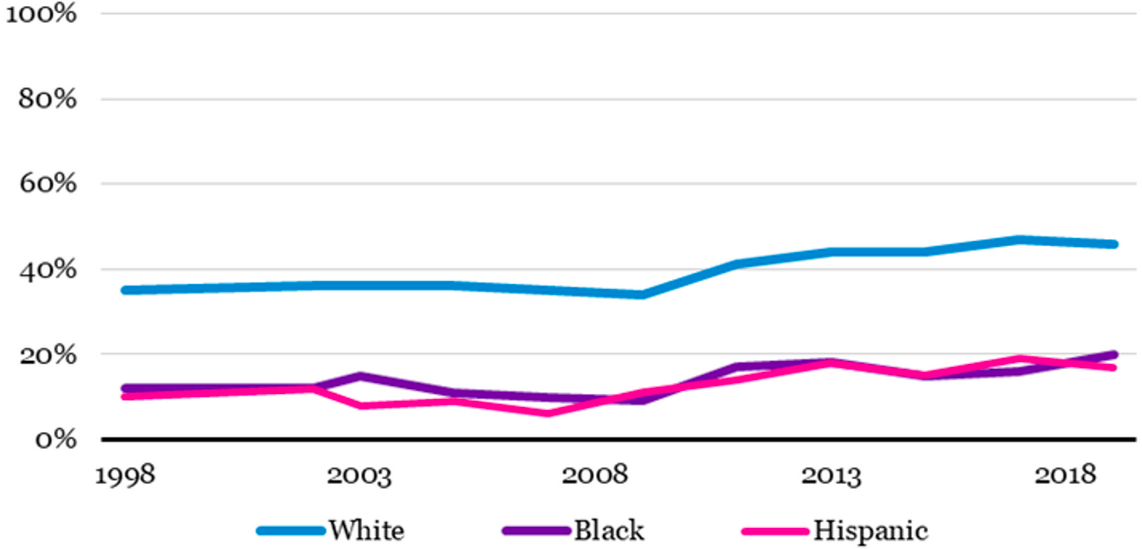
These macro results are not surprising. In May 2021, I was invited to provide testimony for the Rhode Island State Board of Education on how to improve educational outcomes. In preparation for the testimony, I pulled eighth grade NAEP reading proficiency scores for Rhode Island students since 1998. As is the case with most other states, in each year since the Nation’s Report Card was administered in Rhode Island in 1998, less than half of Rhode Island’s White eighth graders scored at NAEP’s proficient level in reading. As figure 1 shows, the racial achievement gap has essentially remained over that time. The sad irony is that closing the Black- or Hispanic-White achievement gap in reading, without improving outcomes for all students, would mean growing Black and Hispanic outcomes from sub-mediocrity to full-mediocrity.

Figure 1. Reading proficiency among eight graders in Rhode Island, by race, 1998–2018

1

Source: NAEP Data Explorer

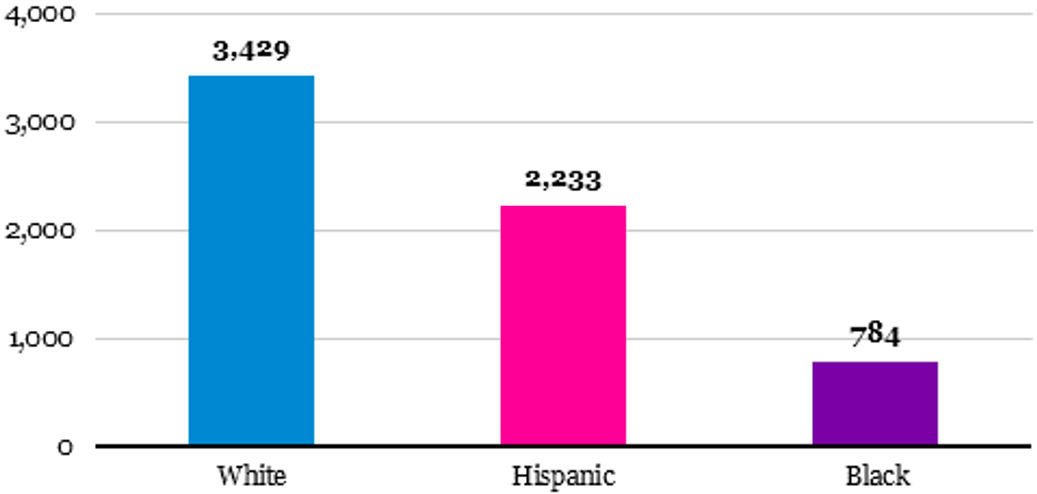
Also, in raw numbers, far more White students are failing. In 2019, nearly 3,500 White eighth grade students, 2,200 Hispanic students, and 784 Black students did not read at NAEP proficiency, based on the 2019 exam. (See figure 2.) Obviously White students make up a much larger segment of the overall population, and this explains their larger amount. But it is important to look at both proportional rates of success and actual student counts.

Figure 2. Number of Rhode Island eighth graders reading below proficiency, by race, 2019

2

Sources: NAEP Data Explorer and Rhode Island Department of Education

These data on reading proficiency—both in raw numbers and proportional rates by group—underscore our nation’s massive collective failure to effectively teach literacy and build verbal proficiency across all races and classes.

It also shatters the accepted truth that there is any sole or even primary cause of low proficiency rates among Black and Hispanic Americans. For example, systemic racism is unlikely the cause of such poor performance among White students. In my view, the multi-decade obsession with closing achievement gaps by certain categories has done something even worse: ushered in a mono-causal type of thinking that crowds out the ability to identify solutions across categories. If one believes systemic racism is the sole or primary cause of racial disparities, that tends to lead to a narrow universe of solutions that are focused mostly on race, as well. But that incomplete set of solutions has clearly not worked.

There is an alternative approach. Instead of a race- or class-based gap approach, imagine if the strategy was what some call “Distance to 100.” This would emphasize that the gap between 100 percent proficiency for all students and current performance levels is the gap that should be our dominant focus. Indeed, this approach would start with the question of why it is that barely one-third of all American students are reading at proficiency. To be sure, this isn’t to suggest that 100 percent is realistically attainable. Rather this is a lens through which we can view proficiency levels and measure how many children are behind where they should and can be. And that Distance to 100—almost 70 percent—is more than double the class and race-based achievement gaps.

If we adopted this approach, we would quickly discover that White students read below grade level for many of the same reasons Black and Hispanic students do. For decades, education researchers from E.D. Hirsch to Dan Willingham to Natalie Wexler have made the case that a lack of a focus on building knowledge in early reading instruction has had a devastating impact on all of America’s children. Natalie Wexler outlines the dilemma well in her book The Knowledge Gap: The Hidden Cause of America’s Broken Education System—And How to Fix It:

American elementary education has been shaped by a theory that goes like this: Reading—a term used to mean not just matching letters to sounds but also comprehension—can be taught in a manner completely disconnected from content. Use simple texts to teach children how to find the main idea, make inferences, draw conclusions, and so on, and eventually they’ll be able to apply those skills to grasp the meaning of anything put in front of them.

In the meantime, what children are reading doesn’t really matter—it’s better for them to acquire skills that will enable them to discover knowledge for themselves later on than for them to be given information directly, or so the thinking goes. That is, they need to spend their time “learning to read” before “reading to learn.” Science can wait; history, which is considered too abstract for young minds to grasp, must wait. Reading time is filled, instead, with a variety of short books and passages unconnected to one another except by the “comprehension skills” they’re meant to teach.

As far back as 1977, early-elementary teachers spent more than twice as much time on reading as on science and social studies combined. But since 2001, when the federal No Child Left Behind legislation made standardized reading and math scores the yardstick for measuring progress, the time devoted to both subjects has only grown. In turn, the amount of time spent on social studies and science has plummeted—especially in schools where test scores are low.

And yet, despite the enormous expenditure of time and resources on reading, American children haven’t become better readers. For the past twenty years, only about a third of students have scored at or above the “proficient” level on national tests. For low-income and minority kids, the picture is especially bleak: Their average test scores are far below those of their more affluent, largely white peers—a phenomenon usually referred to as the achievement gap. As this gap has grown wider, America’s standing in international literacy rankings, already mediocre, has fallen.

All of which raises a disturbing question: What if the medicine we have been prescribing is only making matters worse, particularly for poor children? What if the best way to boost reading comprehension is not to drill kids on discrete skills but to teach them, as early as possible, the very things we’ve marginalized—including history, science, and other content that could build the knowledge and vocabulary they need to understand both written texts and the world around them?

If we had a frame around “Distance to 100,” then we would focus on what’s required to improve everyone’s achievement and those transcendent factors that truly are holding all kids back—lack of access to content-rich curricula, unstable family structures, lack of school choice, and ineffective strategies to teach reading—which have a far greater cumulative impact than the sole factor of race or class.

As Hanushek et al. state, “The stubborn endurance of achievement inequalities suggests the need to reconsider policies and practices aimed at shrinking the gap. Although policymakers have repeatedly tried to break the link between students’ learning and their socioeconomic background, these interventions thus far have been unable to dent the relationship between socioeconomic status and achievement. Perhaps it is time to consider alternatives.”

Distance to 100 for everyone may be that empowering alternative.

Editor’s note: This was first published on Bellwether Education’s Eduwonk blog as part of a conversation between Ian Rowe and Sharif El-Mekki about what we’re actually talking about when we talk about race in the classroom.

view

A downbeat assessment of students’ mental and social-emotional health in the Covid era

Jeff Murray
9.2.2021
Flypaper

It is no exaggeration to say that very little good can likely come from a global pandemic, especially in the short term. And while the “term” of the current pandemic seems to lengthen every day, we are still firmly in the realm of the immediate when discussing impacts. Thus the current series of reports coming to us from the Center for Reinventing Public Education (CRPE) under the “Evidence Project” banner are more downbeat table setting than faits accomplis. Their recent gathering of evidence on Covid-19’s effects on the mental health and social-emotional well-being of K–12 students follows that pattern.

The data in this report come from hundreds of studies from across the country—including fact-based accountings of how schools and districts responded to closures, remote learning models, grading, and the like, as well as detailed surveys of students, parents, and teachers. Eight panelists from higher education, non-profits, and student support organizations worked together to analyze and summarize the studies to provide a “coherent baseline” of all that is known and as-yet unknown regarding the state of students’ mindset after more than fifteen months of pandemic disruption to their education.

The summary findings are, as expected, overwhelmingly negative. Between 30 to 40 percent of young people have experienced negative impacts on their mental or social and emotional health during the pandemic, with students who learned remotely for long periods of time, and historically marginalized students, more likely to experience these negative effects. Rates of anxiety and attempted suicides, already on the rise pre-pandemic, appear to have increased among all students, especially girls. Even if some students reported faring well initially—including those who thrived without the distractions and stressors of in-person schooling—those positive effects did not appear to last. Negative effects for students increased over time.

Schools and districts also largely lacked systems to track student well-being and strategies to address and improve it where such effects could be found. This was especially apparent in rural areas without a strong social-service infrastructure outside of the school system. Data on students with disabilities and younger students up to ten years old were lacking, too. As were specifics on which aspects of mental and social-emotional health were the most impacted.

While assuming universally poor outcomes seems prudent at this point in the crisis, it is to be expected that many students will, out of necessity or just out of normal human striving, eventually report a boost in such skills as self-direction and time management. Some teachers reported a concerning lack of student motivation and engagement in learning. But it is also true that there has been no keener test of grit and perseverance in those students’ short lifetimes. Many will ultimately and actively battle their way through the storm.

The CRPE report takes pains to point out all of the information that is still to be collected and assessed, most of it related to specifics of how different types of students responded to education disruption for both better and worse, and what mix of supports and interventions are actually working to help students recover and regain their mental and social-emotional health. In short, we await the less obvious and longer gestating good to balance the immediate and more visible bad.

As stated within, the Evidence Project reports, including this one, are meant to be a first step. All of the data and snapshots will be combined into a “Profile of the American Student” that will “provide a rigorous and nuanced assessment of 1) how extensive student needs and inequities are across a variety of dimensions, 2) how student needs vary across different dimensions and what that implies for policy and practice, and 3) what promising solutions and innovations are emerging to meet students’ needs.” And even that ambitious product will only be a baseline so that future profiles can “track progress toward repaying every student the educational opportunities they are owed after this traumatic and disruptive period.” The downbeat assessment of students’ social and emotional well-being and mental health provided here is, hopefully, the bottom of the ladder.

SOURCE: Laura Hamilton and Betheny Gross, “How Has the Pandemic Affected Students’ Social-Emotional Well-Being? A Review of the Evidence to Date,” Center for Reinventing Public Education (August 2021).

view

NWEA measures the impact of the pandemic on student achievement and growth

Jessica Poiner
9.2.2021
Flypaper

Researchers at NWEA have been using data from their MAP Growth assessments to predict and analyze learning losses since the start of the pandemic. Their most recent brief examines results from reading and math tests administered to approximately 5.5 million public school students during the fall, winter, and spring of the 2020–21 school year.

To measure the impact of the pandemic on academic progress, NWEA researchers compared 2020–21 results to those from the 2018–19 school year, which they identified as a “typical” year. It’s important to note that, based on prior and additional research conducted by NWEA, there are demographic differences “across subjects and grades in the representation of student groups in fall 2020 compared to fall 2019.” For example, researchers found that students of color were more likely to be missing from data gathered during the pandemic. In addition, the majority of fall 2020 MAP Growth assessments were administered remotely. These and other factors indicate that the impacts of the pandemic on the achievement and growth of various student groups could be underestimated.

Given the myriad disruptions of the pandemic, the results aren’t surprising. In math, students entered the 2020–21 school year behind where they would have started during a normal year. They also exhibited academic gains that were, on average, 8 to 12 percentile points behind the gains made during a typical year. The results were better in reading, but only slightly: Students entered 2020–21 at approximately the same level as usual, but ended the year an average of 3 to 6 percentile points behind.

To measure achievement, NWEA uses 2020 MAP growth norms—a nationally representative set of norms based on testing data from 2015–16 through 2017–18—and compares median end-of-year achievement percentile rankings. These rankings can be used to identify how a student’s score in a particular grade and subject area compares to other same-grade students across the country. When compared to the results of a typical year, student achievement in the spring of 2021 was lower in both math and reading in all grade levels. The size of these declines varied by grade and subject level, but was largest in math. For example, the biggest drop in reading results was in third grade, where scores were 6 percentile points lower in spring 2021 than in the spring of 2019. In math, on the other hand, the largest drops were in third and fifth grade, where scores were 12 points lower.

NWEA found that spring achievement declines between 2019 and 2021 were the largest for minority and economically disadvantaged students. In reading, Black and Hispanic students in grades three through five experienced the greatest drops in achievement. These same students experienced the greatest declines in math, but were joined by students who identified as American Indian and Alaskan Natives. To determine pandemic impacts on students living in poverty, NWEA compared the percentile rankings for high-poverty schools (those where more than 75 percent of students experience poverty) and low-poverty schools (those where less than 25 percent of students experience poverty). In low-poverty schools, the percentile point difference in math between spring 2019 and spring 2021 ranged from 6 points lower in fourth grade to 9 points lower in seventh grade. In high-poverty schools, however, the declines were nearly twice as large. The percentile point difference between 2019 and 2021 ranged from 6 points lower in seventh grade to a whopping 17 points lower in third grade.

NWEA closes their brief by offering six overarching recommendations for how state, district, and local leaders can use achievement and growth data—as well as the unprecedented amounts of federal relief funding that’s available—to reshape education to better serve all students. These recommendations include re-engaging students in school (especially those who have been historically underserved); continuing to support access to remote learning; meeting the physical, social, and mental health needs of students and families; measuring student progress, rethinking assessment systems, and using data to support recovery efforts; supporting and training teachers and leaders; and reimagining accountability and school improvement systems. These are complex recommendations, but NWEA offers plenty of detail about how to implement them effectively. State and local leaders would be wise to consider them. 

SOURCE: “Informing Covid-19 recovery: Insights from NWEA’s MAP Growth assessment and policy recommendations,” NWEA (July 2021).

view

The Education Gadfly Show #785: Helping students fight disinformation online

9.2.2021
Podcast
 

On this week’s podcast, Peter Warren Singer, strategist and senior fellow at New America and defense policy expert, joins Mike Petrilli and David Griffith to discuss the Cyber Citizenship Initiative, which helps build students’ resilience to digital misinformation. On the Research Minute, Amber Northern examines how different teacher preparation programs impact graduates’ classroom effectiveness.

Amber's Research Minute

Emanuele Bardelli, Matthew Ronfeldt, and John Papay, "Teacher Preparation Programs and Graduates' Growth in Instructional Effectiveness," retrieved from Annenberg Institute at Brown University (August 2021).

If you listen on Apple Podcasts, please leave us a rating and review - we'd love to hear what you think! The Education Gadfly Show is available on all major podcast platforms.

view

Cheers and Jeers: September 2, 2021

The Education Gadfly
9.2.2021
Flypaper

Cheers

  • “How this after-school program achieved a high vaccination rate in a Black neighborhood where most young adults are unvaccinated.” —Washington Post
  • D.C.’s teacher evaluation system is retaining teachers, raising starting salaries above those of all fifty states, and helping improve NAEP scores. The charge that it’s racially biased is unfounded. —Matthew Yglesias
  • Schools across the nation saw record attendance in summer school as they approached it with a new goal: reminding students that in-person learning can be fun. —Washington Post

Jeers

  • The Philadelphia Department of Public Health has reversed course after initially supporting a school policy that used testing instead of immediate quarantines in order to minimize student absences. —Philadelphia Inquirer
  • Cecily Myart-Cruz, head of the L.A. teachers’ union, bafflingly suggests that “learning loss” is a fake crisis propagated by assessment purveyors and dismisses parent demands for reopening as “unexamined privilege” as she resists returns to in-person learning. —Los Angeles Magazine
  • Devotees of the conspiracy movement QAnon want to run for school boards to combat mask mandates and fight culture wars. —NBC News
view

What we're reading this week: September 2, 2021

The Education Gadfly
9.2.2021
Flypaper
  • “Are schools quarantining too many students?” —Education Week
  • New books by Michael Sandel and Adrian Wooldridge discuss whether the Western world’s move toward meritocracy has been a net negative or positive, but Wooldridge’s use of history makes for a stronger case. —Jay P. Greene
  • “CDC: An unvaccinated teacher took off their mask to read aloud. Half the class got Covid.” —Education Week
  • This year’s Education Next poll of over three thousand parents found that support for reforms such as school choice and free college is falling as parents yearn for a return to normalcy. —Education Next
  • A decade of data on high-school-to-college transition interventions for struggling students finds mixed results. —Brookings
Fordham Logo

© 2026 The Thomas B. Fordham Institute
Privacy Policy
Usage Agreement

National

P.O. Box 110
Burke, VA 22009

202.223.5452

[email protected]

Ohio

P.O. Box 82291
Columbus, OH 43202

614.223.1580

[email protected]

Sponsorship

130 West Second Street, Suite 410
Dayton, Ohio 45402

937.227.3368

[email protected]