Given our moniker as “The Education Gadfly,” we at the Thomas B. Fordham Institute are not accustomed to lavishing praise on education leaders. That’s OK, considering how rarely they deserve it. But when someone in a position of authority demonstrates leadership, courage, and common sense, it’s important for us gadflies (and reformers) to say so.
So here goes: Montgomery County Public Schools (Maryland) superintendent Thomas Taylor deserves plaudits for tightening up the district’s policies and practices around grading, discipline, and cell phone use. These are critical elements of the “tough love” agenda we’ve encouraged all schools to embrace, including those in MCPS, and I’m especially happy to see such progress in the system that serves my own teenaged children.
But no, the reforms don’t go far enough, and yes, there’s a lot more for Dr. Taylor and his team to do!
Grading reform
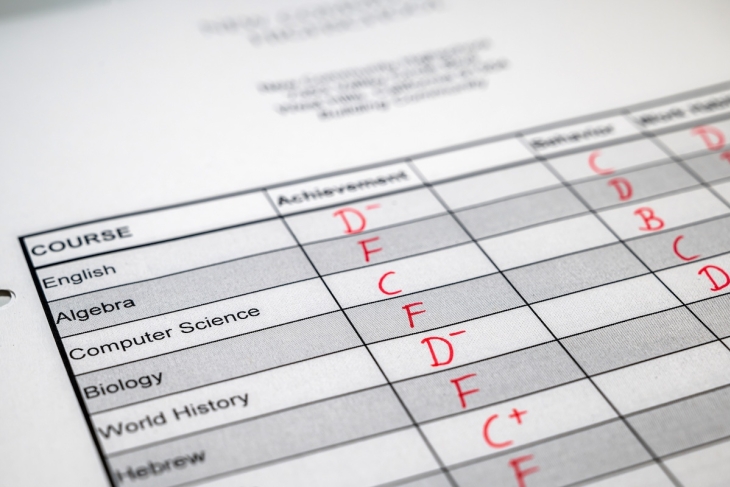
Let’s start by celebrating the simple but powerful changes they’ve launched in Montgomery County middle and high schools around student grading. Previously, the district mandated that teachers give students 50 percent, rather than zero, for missed assignments and bombed tests as long as they “showed effort” (a vague and low bar). It also required teachers to allow essentially unlimited retakes for tests and quizzes. Perhaps most ridiculously, it determined that semester grades (the ones that count and show up in transcripts) would result from combining—and rounding up—quarter grades. For example: an A- in the first quarter and a B- in the second quarter would result in an A for the semester. (No joke.) Even worse: An A in one quarter and a D in another would result in a B (!!!).
Like so-called grading “reforms” elsewhere, these practices were sold as being pro-“equity.” Yet as anyone could see, they were really anti-student effort. Why would adolescents study for a test when they knew they could bomb it and retake it? Why do more than go through the motions on assignment if the worst mark you could get was 50 percent? Why work hard during the second quarter if a first quarter grade of an A- almost assured that your semester grade would be an A?
As a new national survey by the Fordham Institute found, teachers hate policies like these, especially the “no zeros” rule (or what one teacher deliciously called “the gifty 50”). And a blockbuster article in Bethesda Magazine last year indicated that Montgomery County teachers are frustrated by this stuff, too. One (former) teacher told reporter Amy Halpern:
…the first year she taught AP literature at one of the county’s top high schools, she was called into the department chair’s office and told she wasn’t doling out enough A’s. “I said, ‘Wait … just let the students adjust to my standards and the A’s will come,’” she says. It turns out the students did rise to the challenge, she says, “but I had to ask for that faith.”
While educators might want some flexibility to figure out how to motivate kids who start the semester with a string of bad grades, forcing them to give 50 percents and endless retakes removes the few tools in their toolbox that might get kids to put in effort. And student effort is where it’s at.
Going forward, Montgomery County will determine semester grades by averaging the numeric grades for each quarter. So a 91 percent in the first quarter and an 81 percent in the second will result in a semester grade of an 86 percent—a B rather than an A, as before.
Meanwhile, teachers will only be required to give the “gifty 50” if students show “evidence of making progress toward standards” on a given assignment or test. And retakes will be limited to two per assignment, which must happen within two weeks.
This is not as far as I would have gone, but still, hooray!
Discipline
As with the loosey-goosey grading policies, Montgomery County (like many districts) had also embraced a soft approach to student discipline. Again the rationale involved “equity,” particularly the concern that Black students are more likely to be sent to the office, suspended, or expelled than their peers.
In its new student code of conduct, the system retains its five levels of severity for punishments. As Ashlyn Campbell of Bethesda Magazine explained:
“Level one consequences are ‘teacher-led’ and could include detention, restorative practices, and/or guardian outreach. Level four consequences are “administration supported and short-term out of school exclusionary responses,” and could include a student and guardian conference, in-school suspension, or a behavioral intervention plan.
What’s changed is that some infractions have been elevated to higher-level punishments, including:
…drug possession and distribution, theft, bomb threats, and attacks on students and staff. For example, students accused of making a bomb threat now face consequences ranging from level one through five. Under the revision, students would face consequences at levels four and five.
That’s right: Previously, making a bomb threat could have resulted in nothing more than a reprimand from a teacher. There’s more. Under the former code:
…students who attack a teacher or support staffer would face consequences ranging from level one to five, “meaning that you’re communicating to a teacher or supporting service member…that if they were to be attacked by a student, it would be appropriate for them to respond themselves,” [Peter Moran, MCPS chief school leadership officer] said. “That’s not the way that our system should run and demonstrates extremely low expectations for the character that we want to see out of our students.”
Darn straight!
Moran said infractions subjected to level four consequences were expanded to include recording and posting school fights on social media—an issue MCPS has had to navigate in recent years—among others.
None of these new policies seems particularly draconian. What’s nuts is how lax the previous behavior expectations were. And the district remains committed to “restorative practices,” which many teachers, among others, find dubious. Still, progress!
Phones
Here’s where Taylor’s reforms are most modest. After piloting a bell-to-bell ban in some middle schools and classroom bans in some high schools last year, officials are mandating the changes districtwide. Elementary students are to keep their phones in their lockers or backpacks all day long. It’s the same with middle school students, though it’s up to their principals whether they can use them at lunch. And high school students have to keep their phones in their pockets (or in classroom “phone cubbies”) during class, but can use them in the hallways, at lunch, etc.
I would have gone much farther. Elementary school students should be prohibited from bringing phones to school, period. And middle school and high school students should have to turn in their phones (and watches and laptops) when they enter the building. These should be locked up, then returned at the end of the day. Such “bell to bell” bans are the only proven way to actually get phones out of classrooms—and not slide back into a regime that forces teachers to fight a daily battle to get kids to keep their devices away. Such total bans are also the only way to get kids talking to each other again during class breaks and at lunch. But taking kids’ phones can be logistically challenging and unpopular with parents. I do hope MCPS does it eventually.
What’s next for Montgomery County
What these three sets of reforms have in common is that they are popular with teachers. Dr. Taylor is no dummy—as a newish superintendent in a deep-blue district, he’s ensuring that there’s no daylight between himself and his teachers (and, importantly, their union). It’s not just these classroom practices. He also proposed a gargantuan, teacher-pleasing increase in his first budget, one the county largely funded.
All well and good, but I hope he’s building up goodwill with the teachers (and union) because he knows he’s going to need it when he tackles even tougher issues—like paying teachers in high-need schools much more than those in affluent ones; moving ineffective instructors out of the classroom; and totally overhauling the system’s expensive and unnecessary retiree healthcare benefits.
So two cheers for Dr. Taylor! Now back to work.