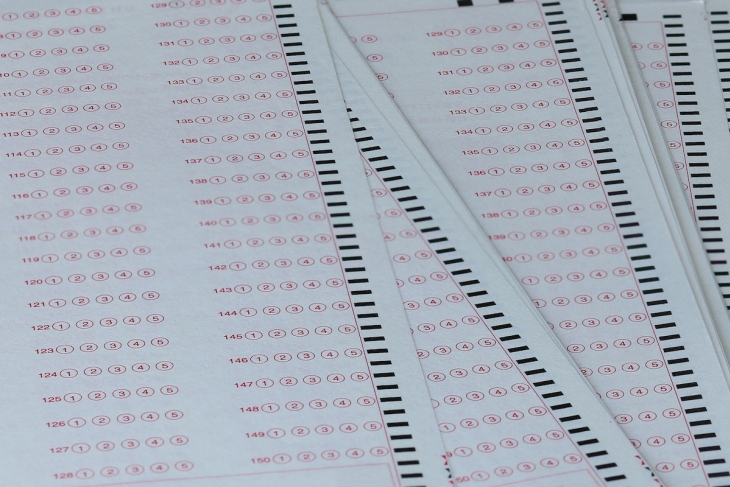
Next month, my 11-year-old will join her classmates to take the state assessment. Like nearly every student across the country, she’ll do so on a school-issued Chromebook—a device that has become nearly ubiquitous in K–12 classrooms. Paper-and-pencil testing, once the staple of state accountability systems, has largely vanished. The transition to screen-based assessments began in earnest in the mid-2010s, accelerated by the rollout of Common Core–aligned exams from PARCC and Smarter Balanced. At the time, the shift seemed sensible. Computers eliminated the need to print and ship test booklets, allowed for adaptive questions, and made more complex item types possible. But given everything we’ve learned about screens, attention, and technology in schools, is it worth asking whether the move away from paper was a mistake?
Sonja Santelises, the CEO of Baltimore City Schools, certainly seems to think so. As part of an effort to reduce screentime in classrooms, the district is trying to scale back student device use. But third graders will still receive their own laptops because state assessments are administered digitally, and she doesn’t want Baltimore students at a disadvantage. Santelises isn’t happy about it, though. She has called it “absolutely absurd” to have “eight- and nine-year-olds with their earphones on, sitting and plugging into a computer to be able to tell whether they read or not.” State education agencies often defend digital tests as a way to return results faster, yet nationwide, scores routinely take longer to reach families today than they did in the paper-and-pencil era.
If there’s one certainty in education, it’s that assessment drives instruction. As David Coleman, the CEO of the College Board, once put it:
Teachers will teach towards the test. There is no force strong enough on this Earth to prevent that. There is no amount of handwaving. There is no amount of saying, “They teach to the standards, not the test”… The truth is teachers do. Tests exert an enormous effect on instructional practice, direct and indirect.
When state exams moved onto screens, that pull extended far beyond the spring testing window. Schools felt pressure to make sure students were comfortable reading, writing, and navigating tasks on a computer—often starting at very young ages. This dynamic is further amplified by the fact that the gold-standard NAEP is also administered digitally. The irony is hard to miss. At a time when national reading scores are falling—and literacy experts suspect screens play a role—our major reading assessments are themselves delivered on screens. Taken together, these forces have created a subtle but powerful incentive structure that nudges instruction onto digital devices.
Indeed, the shift to computer-based testing helped fuel the massive push for 1:1 device programs. In a recent piece for Education Next, my colleague Meredith Coffey traced the meteoric rise of the ed tech boom:
By 2016, half of K–12 schools had given students 1:1 devices. Many other schools, including the one where I was teaching English language arts, offered access to carts of shared laptops or tablets. Another 12.6 million devices⸺enough for a quarter of that year’s public-school student population⸺shipped to K–12 buildings. Apple offered an astonishing 80,000 “educational” apps. By the following year, the New York Times was sounding alarms about the “Googlification of the classroom,” and educational technology investments reached $9.5 billion.
Districts bought laptops and tablets not only to administer state tests but also under the promise of personalized learning and preparation for 21st-century skills. A vicious cycle ensued. The more instruction and assessment happened on screens, the more schools felt compelled to integrate technology into everyday learning. Today, that reliance is baked in: Roughly half of teachers report that their school’s core curriculum requires students to complete assignments online. Now, with artificial intelligence entering the classroom, that digital grip feels even harder to loosen.
Could states realistically reverse course and return to paper-and-pencil testing? The short answer is not easily. Much of the infrastructure that once supported large-scale paper testing—secure printing contracts, distribution logistics, and trained personnel—has atrophied, and rebuilding it would be costly and time-consuming. Even if logistics weren’t a barrier, switching back would slow everything down: Testing windows would be longer, scores would take more time to compile, and the potential for manual processing errors would increase. A return to paper would also feel like a step backward, a move toward Luddite-style resistance to technology that many educators and policymakers would likely resist. And beyond the practical challenges, there’s the political calculus. There is little constituency for slower, pricier tests simply to improve the student experience.
Even assuming states could overcome these hurdles, any academic gains would likely be modest. Research on “mode effects” suggests that students, on average, perform slightly better on paper than on screens, but the improvements are small and uneven. Yet the potential second- and third-order effects—reduced screen time and fewer technological frustrations—could benefit students’ mental health and help rewire schools for belonging and achievement.
Ultimately, reverting to paper-and-pencil testing would not solve these problems on its own. The logistical and political hurdles are enormous, and the immediate effect on test results would likely be small. But the discussion is worth having because it surfaces a broader issue, which is: What kind of learning environment do we want for our children? Even small changes in how and where students engage with assessments can ripple through instruction, classroom culture, and student well-being. As Santelises warned, “Technology eats executive functioning for breakfast, but we’re giving it to kids every day.” While few are likely to call for a return to the days of analog testing, the growing attention to screentime suggests that educators and policymakers are concerned with creating calmer, less device-dominated school days. Whether these efforts will be enough to slow—or even halt—the march toward digital everything without rethinking digital assessments remains an open question.