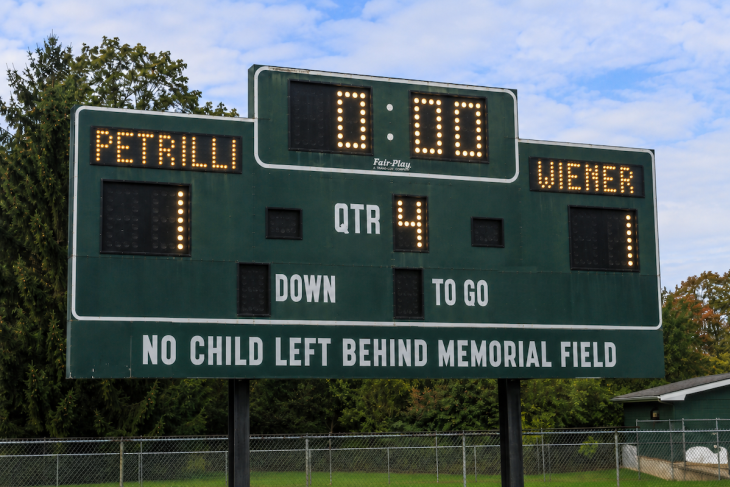
As Americans are discovering during this summer’s World Cup, soccer often produces an outcome that is unsatisfying to our domestic sports sensibilities: a tie. One team controls possession while the other creates better scoring chances. Both leave the pitch claiming vindication, but neither gets to declare victory. That was my reaction in a nutshell to this week’s education policy match pitting reform veterans Ross Wiener and Mike Petrilli, both of whom I esteem greatly, against each other over the legacy of No Child Left Behind.
Writing in The New York Times, Wiener, the former policy director at the Education Trust who later played a leading role at the Aspen Institute, lamented his past support for ed reform’s accountability movement and questioned whether the high-stakes testing regime ushered in by NCLB ultimately helped schools. It was a mistake “to treat test scores as the purpose of public schools rather than as partial proxies for what a good education actually delivers,” Wiener wrote, adding that “test-based accountability policies were not sufficient decades ago. They are even less adequate now.”
On Substack, Petrilli responded by defending accountability as one of the most successful education reforms of the last quarter century. Wiener “is simply wrong about the lack of progress in the consequential-accountability era, especially in reading,” he insisted. “Ross thinks we reformers are too enamored with testing. I fear that Ross may have given up on academic achievement.”
After reading both pieces, I’m inclined to call it a 1-1 draw. Here’s my game summary:
Wiener scores
The accountability era promised more than it could deliver. The theory behind No Child Left Behind seemed straightforward enough: establish standards, measure performance, identify and target failure, and attach consequences. Schools would respond to incentives by improving instruction, and achievement would rise. The first half worked. The second half proved far more complicated.
Accountability systems became very good at identifying struggling schools. They were far less successful at helping schools improve, or even understand how to improve. And nowhere was this more evident than in reading. For years, schools responded to accountability pressures by doubling down on mindless test-prep and instruction in “reading strategies.” Ad nauseam, students practiced finding main ideas, making inferences, identifying author’s purpose, and answering multiple-choice questions. Testing pressure functionally encouraged teachers to treat reading as a set of transferable skills that could be directly taught and practiced.
The problem, then and still, is that reading simply doesn’t work that way. Decoding (phonics) is a necessary skill, but reading comprehension leans heavily on vocabulary, background knowledge, and familiarity with language structures and conventions. It is not a transferable “skill” in the way that your ability to ride one bike transfers to nearly every other bike. The student who knows more about history, science, literature, and the world generally understands more of what he reads; the student who doesn’t struggles. Yet state reading tests, the coin of the accountability realm, enshrined an impoverished view of reading achievement and functionally demanded poor practice, thereby encouraging schools to focus on skills-and-strategies lessons rather than the systematic accumulation of knowledge. There’s an undeniable mismatch between what schools believed (or were encouraged to believe) would raise student scores and what actually leads to stronger readers. While this may have been an unintended consequence, it’s one that accountability advocates must nonetheless own.
The central flaw of the accountability era was mistaking measurement for a theory of improvement. Wiener scores with his clear-eyed diagnosis that accountability gave “unprecedented authority to the idea that standardized test performance is the most important outcome schools produce and made it the organizing principle of American schooling.”
1-nil, Ross Wiener.
Petrilli equalizes
But then Wiener fails to get back on defense. It is one thing to recognize that test scores do not capture everything that matters. It is another to conclude that schools should focus primarily on goals such as helping students find “meaning and purpose” in their education, goals that are difficult to define, influence, or measure. “Do we really believe it’s impossible to do that in schools that are also trying to help students make year-to-year progress in reading, writing, and math?” Petrilli asks.
I share Mike’s concern. The history of American education is littered with high-minded aspirations: self-esteem, creativity, critical thinking, social-emotional growth, student agency, and now “belonging.” Many of these goals are worthwhile, well-intentioned, even noble. But they’ve often functioned as substitutes for academic achievement rather than complements to it. Reading, writing, and mathematics are among the few outcomes that schools can—and must—be expected to shape at scale. The danger, which Wiener omits or elides, is not that schools will stop caring about reading and math. It’s that they will convince themselves that success can be defined without them.
It’s worth remembering why the appetite for accountability emerged in the first place. It wasn’t because policymakers suddenly fell in love with standardized tests. It was because indisputable quantitative evidence revealed that vast numbers of students—especially poor children and children of color—were not mastering basic academic skills. Those uncomfortable facts supplied the moral oxygen and bipartisan political force behind the education reform movement. Without these facts, it becomes easier to mistake good intentions for good outcomes.
The growing tendency to treat No Child Left Behind as a cautionary tale—or worse, a policy failure—is its own form of revisionist history. Before accountability, achievement gaps were easier to ignore. States routinely reported averages that concealed enormous disparities between affluent students and their less advantaged peers. Before mandatory state-level NAEP reporting, states could set standards so low that they—and their schools—could proclaim success while large numbers of children could not actually read (or cipher). For all its shortcomings, No Child Left Behind changed that.
For the first time, schools were required to pay attention to the performance of all students, including low-income children, English language learners, and minority students whose outcomes had often been buried inside aggregated data. Mike is right: The achievement gains of the early 2000s were real. Achievement gaps did not disappear, but they narrowed. Progress was uneven and incomplete, but it was progress nonetheless. Petrilli notes, for example, that “Hispanic and Black fourth graders respectively gained 20 and 21 points on NAEP reading from 1994 to 2015.” Of equal, even paramount importance, accountability established a principle that should remain non-negotiable: Schools should be expected to produce academic results.
That may sound obvious, but it wasn’t always. It’s increasingly common today to hear schools judged by their climate, culture, student engagement, social-emotional supports, or any number of worthy goals. Those things matter. But measuring whether students can read, write, and do mathematics is not a distraction from that holistic mission, it’s central to it. On this point, Petrilli scores.
The final score is 1-1
Let me offer some post-game analysis. The deeper lesson of this debate, to my mind, is that both Ross and Mike are arguing about the last match rather than applying its lessons to the next one. The real story of the past 25 years is not accountability vs. anti-accountability. It is—or ought to be—understanding that accountability alone cannot produce excellence.
The reform era focused primarily on incentives, as if schools knew what to do and rewards or punishments would make them do it. If schools were made to care enough about results, policymakers assumed (at least tacitly), improvement would follow organically. What we underestimated or overlooked was the difficulty of the work itself.
How should reading be taught? What knowledge should students acquire? What curriculum should schools use? How should teachers be trained, coached, and supported? What organizational structures make effective instruction possible? Those questions turned out to matter at least as much—and frankly more—than the accountability systems designed to measure outcomes.
The states and districts showing the strongest results today are not those that abandoned accountability. Nor are they those that relied on accountability alone. They are the ones that paired accountability with coherent instructional strategies, high-quality curricula, teacher support, and a clearer understanding of how children learn. Mississippi’s literacy gains did not emerge from testing by itself. Neither did the progress seen in places like Louisiana or, more recently, Houston. Accountability provided urgency and focus. It did not provide the instructional playbook. That distinction matters. In sports, the scoreboard can only tell you whether you’re winning. It does not tell you how to score. For too long, education reformers conflated the two.
Game summary: Ross Wiener is right that accountability could not deliver everything its advocates promised. Mike Petrilli is right that abandoning accountability would solve nothing. Twenty-five years after No Child Left Behind, the final score is 1-1.
But the next match isn’t just about accountability. It’s also—even more—about the quality of instruction.