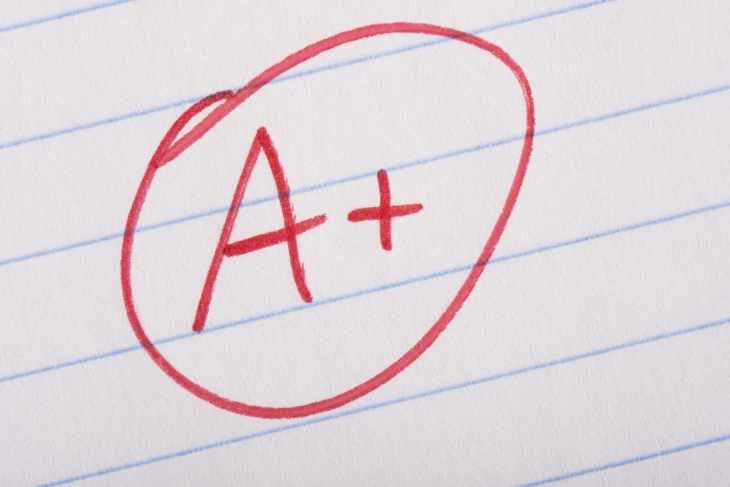
Grade inflation is having a bit of a moment. The most recent round of recriminations came via the scandal at the University of California-San Diego, when the math department reported that one in eight incoming students needed remediation—sometimes at the grade school level—even though those students got A’s in their high school math classes.
Then, a few weeks ago, Jeff Denning published a new study, featured in the Hechinger Report, showing the negative long-term consequences of low grading standards. As grading got easier, students learned less, they graduated at lower rates, and even earned less as adults.
None of this is news to those of us at the Thomas B. Fordham Institute, as grade inflation is a topic with which we’ve been obsessed for many years. Way back in the pre-Covid days, we commissioned a couple of great studies from academic superstar Seth Gershenson. One looked at high school grade inflation trends over a ten-year period, and another looked at the relationship between teachers’ grading standards and student achievement.
What Seth found, in line with other studies, is that grading is indeed getting easier over time, and that teachers who are tougher graders help their students learn more—not just in their own classes, but even when those students move on to the next grade level.
(This, by the way, points to two different definitions of grade inflation. Once is about changes over time—how it’s gotten easier to get, say, an A than before. The other is about low grading standards in general—that it’s simply too easy to get an A.)
And Seth’s studies were before the Covid-era craze around “grading reform,” a.k.a. “grading for equity,” which brought some bonkers practices to thousands of American schools, like the “no zeros” policy (giving students 50 out of 100 even if they didn’t turn in an assignment or show up for a test), or eliminating points for homework or class discussion, or giving kids unlimited exam retakes. All of which can easily lead to inflated grades unless implemented with (rare) countervailing reforms to keep grading standards high.
None of this is good for kids. If it’s super easy to get an A, most students won’t put in much effort (despite what the ridiculously naïve “intrinsic motivation” people might tell you). And if it’s too easy to get at least a D, some students won’t put in any effort at all. And effort is most of the ball game when it comes to student learning. During class, when doing homework, and when studying for tests, kids have to actually try and exert intellectual muscle. It’s a cliché to say that learning doesn’t happen by osmosis, but it happens to be true.
Nor is this a happy situation for teachers. Those who become known as tough graders are rarely rewarded for it. If anything, they will hear complaints from students and parents, which might lead to complaints from administrators. We don’t want to hurt our snowflakes’ chances at getting into top colleges! Or, at the other end of the academic spectrum, we don’t want to keep marginal students from graduating from high school at all. “Just go ahead and give the kid an A, just go ahead and pass the kid”—so teachers say they hear too often from their principals.
Is this a solvable problem?
We know from Seth’s analyses that the big variation in grading standards is not school to school, but teacher to teacher. It’s akin to variations in teacher effectiveness writ large, with the greatest disparities happening in classrooms right next to each other, rather than across schools or across the state.
What that means, then, is that school and district leaders are well positioned to do something about this issue. They can set very clear standards for how grading should work schoolwide and districtwide. They can have teachers grade papers and tests and assignments of their peers’ students, and vice versa, to encourage more honest, accurate, and tougher grading. They could look at data from teacher to teacher and school to school to see if grading standards are being applied evenly and consistently (by comparing student scores on external test with student grades).
But if you are a governor, a state superintendent, or a legislator and you want to do something about this problem, what levers do YOU tug?
This gets harder.
Of course, there’s testing. Many of us reformers believe that test scores are the antidote to grade inflation because at least those scores can be trusted and are less susceptible to inflation. (Unless states decide to make their own tests easier or give most schools an A or B in their accountability system, which, unfortunately, is also becoming common. So states should start by not doing that!)
But test scores are not as effective as we’d like to believe when it comes to communicating to parents how well their children are learning. Years of research by Learning Heroes demonstrates that parents simply trust grades more than test scores. So even if the state reports that their child is not proficient, parents tend to think their son or daughter is doing fine as long as they are getting good grades from teachers. And most parents don’t know that, because of grade inflation, a B is no longer all that high a grade—or a sign that their kid is on grade level or on track.
So what else might states do about grade inflation?
-
One idea is to get rid of any incentives in state policy that might encourage inflated grades. I’m thinking about college scholarships that are based primarily on student GPAs, as happens in Florida and Georgia. Or direct admission policies that admit students directly into state universities based only on their high school GPAs. These are undoubtedly well intended, but they create clear disincentives for schools and teachers to be tough graders.
-
Another idea would be to ensure that teacher evaluation systems, where they still exist, credit teachers for being tough graders.
-
There’s also transparency. Cincinnati Public Schools recently adopted a policy, for example, that will show students’ test scores next to their grades on their report cards. Maybe this will at least help parents know about and notice discrepancies. Perhaps states could mandate that all districts do this or offer incentives to systems to try it.
-
States might do the same thing for teachers, sending them data showing how tough a grader they are compared to other teachers teaching at the same level or teaching the same courses at the school, district, and state level. I bet a lot of teachers aren’t even aware that they are easy graders.
-
And states could try to ban “no zeros” policies and the like, though I’m not really sure how that would work. But at minimum, they could put out guidance to schools districts about the importance of high grading standards. And when intervening in chronically-low-performing schools, such as the bottom 5 percent of schools identified under ESSA, they could make sure that the school’s grading standards are something their teams look at.
Grade inflation is a large and growing problem, one that’s readily understandable by parents and the public but needs attention and effort if we’re going to turn it around.
Editor’s note: This was first published on Mike's Substack, SCHOOLED.