
One of the best kept secrets in education policy is that Ohio policymakers have set achievement goals for Buckeye State students. These math and reading targets—and whether students meet them—almost never make headlines, largely because they are buried in a bureaucratic document appended to the state’s federally-required ESSA Plan. Under federal law, every state must establish “ambitious” annual goals for students statewide, as well as designated subgroups (race/ethnicity, economically disadvantaged, students with disabilities, and English learners).
These goals shouldn’t fly under the radar or be deemed a mere paperwork exercise, as they remain crucial to the state’s improvement efforts. They should be a motivating tool that encourages Ohio schools to help students reach higher levels and be touted as a regular checkup on whether the state is making progress against its own expectations. They are also used in the state’s report card system, as districts and schools receive credit (or not) within the Gap Closing component based on whether students meet these targets. If students are falling short, state policymakers and school officials shouldn’t just shrug their shoulders and hope no one notices. Instead, they ought to seek ways to drive the achievement gains needed to meet them.
With that in mind, around this time last year, I took a look at whether Ohio had achieved its achievement goals for the 2021–22 school year. Given the serious academic setbacks during the pandemic, the results were astonishing. Ohio students—including student groups across the board—topped state goals for the year.
The twist: Prior to the release of those test scores, state policymakers substantially lowered Ohio’s achievement goals. As allowed by federal officials, this “recalibration” of the state’s original math and reading goals—established back in 2017—aimed to set more realistic targets in light of pandemic-era learning losses. But with an academic crisis raging, policymakers seem to have eased expectations a bit too much, at least for that year.
Fortunately, Ohio’s achievement goals do escalate over time, somewhat like a balloon mortgage. For the purposes of goal-setting, the state relies on performance index scores, a composite measure of achievement on all state exams. Statewide, the performance index goal increased by 3.2 and 2.4 points in math and English language arts (ELA), respectively, from 2021–22 to 2022–23. Depending on student group, goals rose by about 1–3 points.
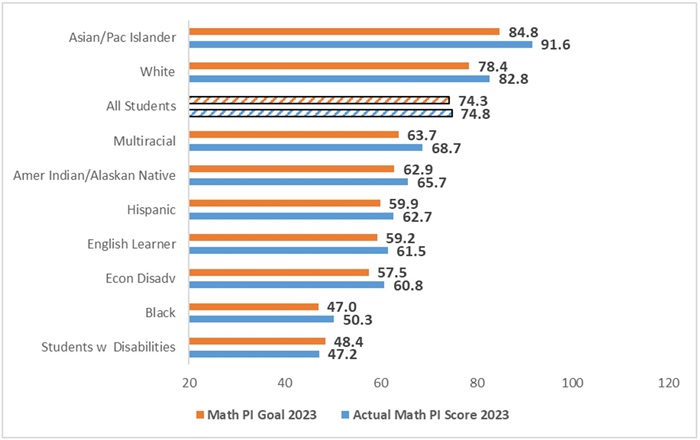
How did Ohio students do against the state’s slightly higher 2022–23 goals? As figures 1 and 2 display, students once again fared well against these targets. In math, the overall statewide goal for the year was a score of 74.3, and students narrowly exceeded that target (74.8). Every student group save for one (students with disabilities) outperformed their respective math goal for the year.
Figure 1: Math performance index scores versus state goals, 2022–23
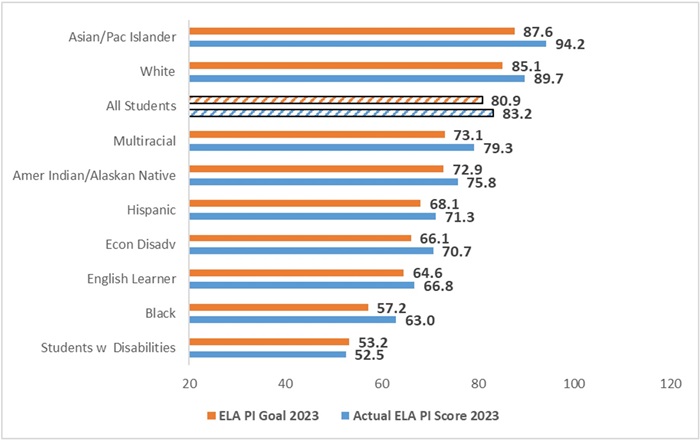
A similar story emerges in ELA. Statewide and across every group—again with the exception of students with disabilities—students outperformed state goals in 2022–23. The results versus goals were slightly more impressive in ELA, likely reflecting the more robust post-pandemic recovery in ELA compared to math. Statewide, for instance, students surpassed the state’s overall goal by 2.3 points in ELA versus just 0.5 points in math.
Figure 2: ELA performance index scores versus state goals, 2022-23
While students continue to exceed state goals, no one should be resting on their laurels. For one, the goals for the past year were still very low—in math, for example, the state set a goal that Black students would score 31.4 points below their White peers in math. That’s an enormous gap and is much larger than Ohio’s original expectation for 2022–23, which was that the Black-White performance index gap would be 18.9 points. Moreover, none of the 2022–23 goals expected any student group to achieve at their respective pre-pandemic levels from 2018–19. And, reflecting the persistent effects of the pandemic, no student group actually outperformed their pre-pandemic counterparts in math or ELA (those comparisons are available in this table).[1]
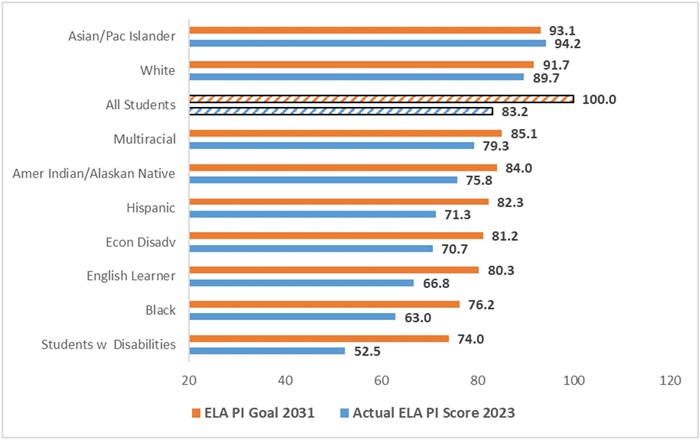
Another indication of just how far students—especially disadvantaged subgroups—still need to go is to compare current performance to the state’s long-term achievement goals. As noted above, Ohio’s goals escalate each year, and the long-term targets are thankfully more ambitious. For example, Ohio will need to boost the math performance index scores of students with disabilities by 24.1 points by 2030–31 to meet its long-term goal;[2] for Black students, the necessary increase is 20.3 points. There is also a long way to go to achieve the statewide goal of 100 on the performance index (as context, the highest-performing district scored 111.6 last year). Those are sizeable increases that will take serious effort to achieve.
Figure 3: Math performance index scores versus long-term state goals
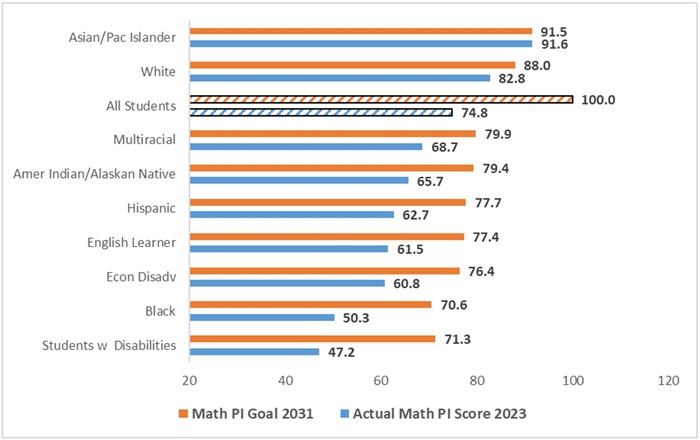
Figure 4: ELA performance index scores versus long-term state goals
* * *
With Covid-era disruptions in the rearview, achievement has ticked upward from the pandemic nadir, and students are—for now—meeting state performance goals. But most students still haven’t fully recovered lost ground, and state performance targets are about to get more challenging moving forward. As we start making resolutions for the new year, let’s once again resolve to make higher student achievement our top priority.
[1] In a related issue, the soft performance index targets for 2021–22 and 2022–23 help explain the high Gap Closing ratings that districts and schools have received on their report cards over the past two years (schools receive credit in the Gap Closing calculations when a student group meets the state’s goal).
[2] Ohio’s amended ESSA plan goals end at 2030–31.