NOTE: Today, the Ohio Senate Education Committee held its fifth hearing on the education provisions of House Bill 96, Ohio’s biennial operating budget. Fordham’s Vice President for Ohio Policy was invited to provide interested party testimony before the committee. These are his full written remarks.
Chair Brenner, Vice Chair Blessing, Ranking Member Ingram, and members of the Senate Education Committee, thank you for the opportunity to testify today.
This testimony is necessarily comprehensive. House Bill 96 contains an extraordinary number of policy provisions with direct implications for students, schools, and the future of education in our state. This breadth reflects not only the size and complexity of the state budget but also the fierce urgency to make continued progress. Too many students remain unprepared for whatever path they choose to follow after high school, and we must act boldly to change that.
Funding Formula: Students Deserve a Fair and Sustainable System
The current model—well-intentioned though it may have been—continues to spiral in cost, largely because it allows outside forces, including local and federal funding outside of the formula, to influence the pace of spending. This is an unsustainable way to fund a statewide education system. The legislature, not the federal government or local districts, must reclaim its constitutional authority to determine how—and how much—we invest in public education.
Digging into formula specifics, we support the governor’s proposal to fully phase in the Cupp-Patterson formula and to not update the inputs that, again, include spending that occurred above and beyond the school funding formula. We do recommend that the Senate increase the base cost by a specific percentage (say 1.5 percent) annually for FY26 and FY27 to account for inflation.
On the matter of Disadvantaged Pupil Impact Aid (DPIA), the current approach is bordering on the absurd. One-third of the students deemed “economically disadvantaged” aren’t because of quirks in how Ohio uses data from a federal meals program. The result is an inability to target resources where they are most needed. We strongly recommend shifting away from funding students based on their free and reduced priced lunch status to “direct certification” based upon enrollment in other means tested aid programs. It offers a more accurate, honest count of truly low-income children. By making this shift, we could significantly increase the DPIA base amount from $422 to $775 per pupil and drive more funding to where it is most needed.
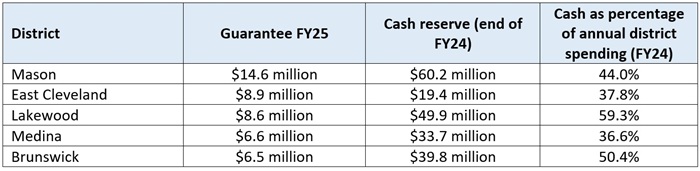
Then there’s the issue of guarantees—a euphemism, frankly, for handing out money to districts that are losing students or growing wealthier. Guarantees undermine funding formulas. They intentionally send more dollars to schools than the formula calculates that they should receive. As such, we commend Governor DeWine for proposing a starting point to begin phasing out guarantees. Unfortunately, the House functionally created a mammoth statewide guarantee ensuring that no schools receive fewer dollars than the year before. We strongly recommend that the Senate build on Governor DeWine's proposal--perhaps being a little more aggressive and reducing guarantees to 90 percent in FY26 and 80 percent in FY27, and eliminating “supplemental targeted assistance” that gives money to districts because students have decided to attend other types of schools. This shift would send a clear and necessary message: taxpayer dollars must follow students, not prop up outdated or inefficient structures.
None of these recommendations are radical. In fact, they are modest in fiscal terms—$53 million more in FY26 and $127 million in FY27 than the governor’s proposal. But they represent a major step forward in policy coherence and fiscal discipline; and most importantly, they help ensure dollars go to where the students are and the needs greatest.
Charter Schools: Addressing Chronic Inequities and Maintaining Accountability
HB 96 takes significant strides to level the playing field for public charter schools, which continue to operate with less funding and less facility access than their district counterparts. The bill rightly:
- Increases facilities aid from $1,000 to $1,500 per pupil
- Maintains performance-based high-quality charter funding of up to $3,000 per pupil
- Continues the charter equity supplement of $650 per pupil
- Embeds these programs into statute to reduce the likelihood of future policy reversals
Most critically, and most controversially, the governor proposed some changes to increase the enforceability of Ohio’s unused facilities statute. Charter schools—public schools educating tens of thousands of students—should not be forced to fight for access to taxpayer-funded buildings that sit vacant. The governor’s proposed changes, including clearer definitions and broader access, ensure that the law functions as intended. These updates respond directly to years of documented noncompliance, where districts have sidestepped their obligations and withheld facilities from high-performing public charter schools. Clear enforcement mechanisms and broader eligibility will help rectify these inequities and ensure that all public school students, regardless of the type of school they attend, benefit from access to educational infrastructure. Given some of the concerns voiced by districts, we have crafted some commonsense guardrails that will ensure that the pendulum doesn’t swing too far the other direction and hurt districts.
Finally, I’d be remiss not to mention several ongoing discussions and recent House amendments that we believe would significantly weaken Ohio’s post-HB 2, decade long focus on quality within the charter school sector. Three issues in particular stand out.
First, the House has included language in HB 96 to broaden the definition of a high-quality charter school in a way that would allow lower-performing schools to access funding that is currently—and rightly—reserved for those that meet high performance standards. We urge this committee to consider changes to the definition of high quality only if they are rigorous and apply to schools that can’t be evaluated under the current criteria.
Second, there are ongoing discussions around overhauling the sponsor evaluation system and many involved would like to downplay the role of academic performance in gauging a sponsor’s success. We strongly urge you to resist these efforts. The Department of Education and Workforce has proposed important changes to the sponsor evaluation system that we believe would make it fairer, more relevant, less time consuming, and--importantly--not reduce the role of academics. While we would be even bolder than DEW, we support their efforts. It’s critical that we don’t dilute accountability and reduce pressure on authorizers to ensure that the schools they oversee are delivering strong outcomes for students. Moreover, it’s also essential that the sponsor evaluation system begins operating again. Many Ohio sponsors have not been rated in five years.
Third, SB 127—which we have testified on and support many aspects of—could inadvertently lower the bar for school closure. The most recent data that I've seen suggests that very few charter schools would be identified under the proposed criteria. If you do move forward with it, we recommend making sure that the bar being set is high enough to identify low-performing charter schools. Under current law, 14 charter schools are in either year 1 or year 2 of the closure protocol.
Taken together, these changes risk reversing a decade of hard-earned progress and would send the wrong message about our commitment to excellence in public charter schools. Now is the time to lean into what’s working, not back away from policies that have delivered results for Ohio students.
Foundational Learning: Strengthening Literacy and Numeracy with Urgency
The as-introduced version of HB 96 includes several transformative steps to strengthen early literacy and numeracy—the building blocks of academic success. Governor DeWine’s budget proposal rightly expands on the 2023 science-of-reading initiative by calling for universal screeners in both reading and math for grades K–3. This would replace the current patchwork of district-selected assessments with a standardized approach that ensures early detection of learning gaps. The House removed this provision; the Senate should restore it to bring greater rigor, consistency, and accuracy to early diagnostics.
Transparency is also essential. We support the governor’s proposal to require districts to publicly report the curricula they use. We urge the Senate to take one additional step and require DEW to review math curricula and create a list of high-quality instructional materials that are aligned to Ohio’s math standards. While this is similar to the literacy list developed under the science-of-reading initiative, we don’t believe that districts should be required to use a curriculum from the list. Rather, this would help districts make informed, evidence-based purchasing decisions without mandating a one-size-fits-all solution.
To ensure elementary educators are equipped to teach foundational math effectively, HB 96 should include a minimum passing score on the math subsection of the licensure content exam be attained before a new teacher is allowed to provide math instruction. This common-sense measure would close a loophole that currently allows teachers without demonstrated math competency to teach math which could compromise students' early numeracy development.
Finally, the Senate should build on the language introduced by the governor related to students advanced in math by requiring districts to have a pathway for high achievers to have accelerated math opportunities culminating in the automatic enrollment of successful students into Algebra no later than 8th grade. This would ensure that students capable of excelling in advanced math—especially those from historically underserved backgrounds—have access to rigorous coursework that can open doors to STEM opportunities and college readiness down the road. For too long, readiness has been overlooked or undervalued, and this provision represents a critical correction.
These changes are largely included in Substitute SB 19. We’d encourage you to include those provisions in HB 96.
Career-Connected Learning: Expanding Opportunities with Evidence
Ohio has made important progress in expanding access to career pathways, but real challenges remain in ensuring that students are equipped with the knowledge, credentials, and experiences needed to thrive in a competitive workforce. House Bill 96 offers a crucial opportunity to build on recent momentum and adopt several meaningful improvements recommended by leading education and business groups, including Ohio Excels.
The Senate should restore the governor’s proposal to overhaul the flawed industry-recognized credential (IRC) system. The current point-based model permits low-value credentials to serve as graduation requirements, encouraging schools to pursue compliance over rigor. Instead, credentials should be categorized based on their connection to workforce demand and earnings potential. To count for graduation, IRCs should provide genuine preparation for in-demand jobs.
Next, we support Governor DeWine’s push for career plans for students and believe they could be even more comprehensive. Plans should include students’ postsecondary goals and outline how coursework and experiences will help them meet those goals. But meaningful career planning starts before high school. All middle school students should be required to complete a structured career exploration course. This would ensure that students begin thinking about their interests and potential futures early enough to align their high school experiences accordingly.
To support this important work, the Senate should also restore dedicated career exploration funding that the House removed. Without this investment, districts will struggle to implement the very programming needed to make career planning effective for all students.
Additionally, Ohio needs a more disciplined approach to data governance that allows the state to link workforce outcomes to specific training programs. This linkage will provide a much clearer picture of which programs are delivering strong results and which need to be improved or reformed.
Finally, the Senate should increase support for the Innovative Workforce Incentive Program (IWIP), which helps incentivize high-quality credentialing programs. Under current funding levels, incentive grants are being pro-rated, diminishing the program’s impact. A stronger financial commitment would allow IWIP to support more students and more schools, helping scale programs aligned to Ohio’s workforce needs.
Together, these actions would build a more coherent, transparent, and effective career-connected learning system—one that truly prepares all Ohio students for life after high school.
Teacher Workforce: Understanding the Scope of the Issue
We cannot fix what we don’t measure. Governor DeWine proposed that Ohio’s Department of Education and Workforce collect and publish annual data on teacher vacancies. The House removed this provision. The Senate should restore it and go further by requiring disaggregated data by school, district, and subject area. Without this information, we’re flying blind as we try to solve one of the most pressing challenges in education.
Private School Choice: Adjust Don’t Transform
Ohio has seen sweeping changes to its private school choice landscape in recent years. Most notably, EdChoice has been expanded to become a universal program—allowing every family in the state to access a scholarship to attend a private school of their choosing. This shift represents a milestone in school choice policy and dramatically increases educational opportunity for thousands of families across the state.
With this major expansion now in place, the focus should be on stabilizing and refining Ohio’s choice programs—not layering on untested changes. We encourage lawmakers to maintain the current EdChoice scholarship structure, including the sliding scale that determines award amounts based on income. This approach allows Ohio to continue offering broader access to school choice while prioritizing more generous support for the families that need it most.
We also recommend providing Disadvantaged Pupil Impact Aid (DPIA) funding to low-income students who use EdChoice or other state scholarships. Low-income students—regardless of whether they attend district, charter, or private schools—often need additional academic support. By extending DPIA to scholarship students, Ohio would take a step toward funding students based on need, rather than sector.
In addition, the state should align funding for special needs scholarships—namely, the Jon Peterson and Autism scholarships—with the formula used for charter schools. While the funding framework is generally similar, certain groups of students receive less money when they use a voucher. Ensuring full alignment would help improve services and equity for students with special needs.
Finally, we strongly urge the Senate to reject the House-passed provision that would create an Education Savings Account (ESA) for students attending nonchartered, non-tax supported private schools. These schools have chosen to operate outside of the state’s accountability and funding systems, based on deeply held religious convictions. While they should be respected for that choice, they have done so knowing that they would not receive taxpayer funding. Creating a new ESA program that diverts public dollars to these schools—without corresponding oversight or transparency—is not in the best interest of Ohio taxpayers.
The state has made remarkable strides in expanding educational options for students. Let’s take the time to implement these changes thoughtfully, focus on students most in need, and ensure the long-term quality and sustainability of Ohio’s private school choice programs.
Conclusion
The Senate has an opportunity to ensure that House Bill 96 delivers on its promise. That means more than just tweaking numbers on a spreadsheet. It means finishing what the governor started, restoring what the House removed, and holding the line against proposals that would take us backward.
From stabilizing our funding formula and preserving rigorous charter accountability, to accelerating foundational learning and building out career pathways, this budget can do more than spend—it can lead. It can say, with clarity and conviction, that Ohio will invest in what works, fix what’s broken, and always put students first.
Now isn’t the time to lower standards or chase shiny distractions. It’s time to double down on policies that have moved the needle for kids. Let’s not waste that momentum.
Thank you for your leadership and your commitment to the future of Ohio’s students. I’d be happy to answer any questions that you may have.