It’s state budget season, which means Ohioans are being inundated with an abundance of confusing numbers. Most have dollar signs attached. But here are a few that don’t, courtesy of Ohio’s results on the 2024 National Assessment of Educational Progress (NAEP).
- In reading, just 32 percent of fourth graders achieved proficiency. Only 31 percent were proficient in eighth grade.
- In math, less than half of fourth graders (43 percent) were proficient. In eighth grade, only 32 percent met the proficiency benchmark.
- The achievement of Ohio's lowest performing students got even lower over the past decade. Analysts view a ten-point change in scores as roughly equivalent to a grade level. And in fourth grade math, students scoring at the bottom 10 percent have experienced a fourteen-point loss. In fourth grade reading, they’ve dropped a whopping twenty-one points. In eighth grade, scores have declined fourteen points in math and eleven points in reading.
These numbers are grim. They suggest that tens of thousands of students march annually from grade to grade and receive diplomas without mastering the literacy and numeracy skills they need to succeed in college or the workforce. The pandemic certainly exacerbated the issue. But achievement was declining long before Covid, and if policymakers don’t act, these bleak numbers are likely to grow even worse.
Identifying struggling students as early as possible and providing them with support and intervention before they fall further behind is critical to ensuring that all students exit high school ready for their next step. But Ohio's current early-identification policies are too feeble to get the job done. For example, state law requires schools to administer a diagnostic reading assessment to all students in grades K–3. The Department of Education and Workforce (DEW) has developed an assessment for this purpose. But schools aren’t required to use it. Instead, they’re free to choose from more than a dozen screeners, some of which don’t effectively identify struggling readers (more on this below). Meanwhile, schools aren’t expected to screen children in grades K–3 for math deficiencies at all. DEW is required to develop math diagnostics for grades one and two, but districts aren’t required to use them.
To boost student achievement, Ohio needs to strengthen its early identification efforts. Governor DeWine took an important first step in his budget proposal by calling on DEW to adopt diagnostic assessments in both reading and math for each grade K–3. Under his plan, public schools would be required to administer these screeners beginning in the 2026–27 school year.
But then, inexplicably, the House removed these provisions from its version of the budget. It also eliminated the state’s long-running and extremely informative Kindergarten Readiness Assessment (KRA), which public schools have used for years to gauge children’s school readiness across four areas, including literacy and math. With universal diagnostics and the KRA gone, Ohio wouldn’t just fail to move forward—it would move backward.
Now it’s up to the Senate to tackle Ohio’s academic crisis. There are three reasons that lawmakers in the upper chamber should act decisively to restore DeWine’s proposed universal diagnostics and the KRA.
First, doing so would ensure more accurate early identification of struggling students. As noted above, districts may now use more than a dozen different state-approved diagnostics in reading. Local officials claim that such flexibility is necessary for the sake of their teachers and students. But some of these exams aren’t effectively identifying struggling readers.
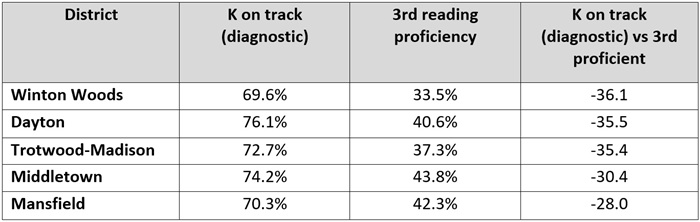
Table 1 illustrates serious discrepancies in early literacy data among some Ohio districts. Dayton Public Schools, for example, identified 76 percent of its kindergartners as “on track” in reading based on its self-selected diagnostic. But only 40 percent of third graders were proficient in reading on the state exam. In Winton Woods, the district diagnostic identified more than two-thirds of kindergarteners as on track. But in third grade, only one-third were proficient on the state exam. And in Trotwood-Madison, the district diagnostic also identified more than two-thirds of kindergarteners as on track, but only 37 percent of third graders achieved proficiency on the state test. It’s true that the kindergarten and third grade results reflect two separate cohorts of students. But historical data show similarly large disparities, which suggests a consistent mismatch between on-track identification and third-grade proficiency—an inconsistency that is likely rooted in a low-rigor kindergarten diagnostic.
Table 1. Districts with large discrepancies in kindergarten on-track rates (fall) and third grade reading proficiency rates, 2023–24.
Second, more accurate identification would help ensure that struggling students receive extra support. When students are identified by a diagnostic as “off track” in reading, state law requires schools to work with parents to create a reading improvement and monitoring plan (RIMP). These plans outline the instructional services that students must receive based on their unique reading difficulties, with the goal of helping them improve. Students who are identified as on track, meanwhile, are exempt from the RIMP and parental notification requirements.
When districts identify large percentages of students as on track, they significantly reduce the number of RIMPs they must create and the extra services they must provide. And if all those students were genuinely on track, that would be fine. But as Table 1 demonstrates, large portions of students who were supposedly on track in kindergarten aren’t reading proficiently by third grade. These students should have received intensive services to help them improve their reading skills. Their parents should have been notified that they were reading below grade level. But because they were identified as on track by the district diagnostic, neither of those things happened.
The third reason the Senate should adopt a universal diagnostics proposal is because Ohio desperately needs to improve its numeracy outcomes along with reading. Unlike literacy, where Ohio’s robust policy ensures that at least some struggling students are identified, there is no state-level expectation for schools to identify and support students who are struggling in math. One would hope that schools are doing it anyway, since it’s good practice. And in some places, that’s likely true. But Ohio’s lackluster achievement in math suggests that there are plenty of schools that aren’t identifying and intervening with students.
Ohio’s disappointing NAEP results prove that we’re failing our lowest-performing students. To better serve them, the state must establish a robust early identification and intervention policy. A universal screening requirement would ensure that every academically struggling student in Ohio is identified. And that identification—along with the instructional support that should follow—could mean the difference between catching up with peers and slipping through the cracks.