
Fund students, not systems. That’s a basic tenet of fair and efficient school finance policy. In some regards, Ohio follows this principle, most notably by ensuring that state dollars (though not local) follow students when they choose to attend public charter or private schools. On the other hand, Ohio has long struggled to create a student-centered framework for traditional school districts.
One reason is Ohio’s addiction to “guarantees,” a mechanism that shields districts from reductions in state aid, even if they shed enrollment. Instead of funding districts based on actual headcounts—i.e., strict adherence to a student-driven formula—guarantees override those prescriptions and pay districts based on some historical level. This school year, Ohio is funneling $313 million to 203 districts—about one in three—through the two main guarantees in the system.[1]
Let’s look at how the guarantee works and how it distorts the system. Figure 1 illustrates the issue by using data from one of the state’s largest beneficiaries of the guarantee, East Cleveland. Based on actual FY25 formula prescriptions that use current enrollments, the district should receive $18.3 million in state aid. Instead, it receives $27.2 million—an extra $8.9 million, amounting to an astounding 49 percent bump—to reach the amount it received in FY20, the baseline year for calculating the state’s primary guarantee. This practice circumvents the state’s own formula, ignores enrollment declines (down 38 percent), and causes East Cleveland’s state aid to soar to an astronomical $24,740 per pupil—way out of line with other districts’ state funding.
Figure 1: East Cleveland’s guarantee, FY25

Given the unfairness exemplified by guarantees, lawmakers have tried to remove them from the funding system. The state’s current formula, championed by former Speaker Bob Cupp and Representative John Patterson, promised to fund schools based on their actual enrollments. That seemed to foreshadow an end to guarantees. Yet they still remain. Earlier this year, Governor DeWine took a swing at guarantees by proposing some modest reductions to them in his budget. But the House inexplicably went the opposite direction and recommended a gargantuan guarantee that ensures no district receives less than it does this year, despite declining enrollment statewide.
The ball is now in the Senate’s court, and word is that President McColley is no fan of guarantees. That’s encouraging, but the upper chamber will face immense political pressure to keep them intact. With that in mind, let us review the reasons why guarantees need to go away.
- Guarantees undermine the state funding formula. Ohio has a formula based on student enrollment and measures of local wealth. Guarantees, however, short-circuit that system by providing excess dollars the formula says districts do not need. In the case of the aforementioned House plan, the guarantee takes away dollars from other districts, which may be growing in enrollment, but whose funding is “capped” (they don’t receive the full formula amount).
- Guarantees are unfair to Ohio taxpayers who foot the bill for “empty desks.” No one believes that taxpayers should fund hospitals for patients they don’t see or pay unemployment to people with steady jobs. Nor should taxpayers be asked to subsidize schools for students they don’t educate.[2]
- Guarantees are handouts given to certain districts but not others. Guarantees are simply “pork”—special political favors that some districts enjoy when the formula produces a result that might upset the apple cart.
- Guarantees discourage districts from streamlining and operating more efficiently. Guarantees relieve districts from making hard but necessary adjustments to their budgets. This promotes government inefficiency—think underused facilities and bloated staff counts—exactly the opposite of what fiscally responsible policymakers should be working towards.
- Guarantees soak up money that could be used in better ways. Guarantees are an expensive “extra”—dollars above the formula—yet serve no clear educational purpose. The $300 million currently spent on guarantees could be used for math and reading acceleration, beefing up CTE, or improving teacher quality. Any of those initiatives would surely generate a higher ROI than throwing money at empty desks.
- Guarantees were never intended to be a reliable, permanent funding stream. The two main guarantees are technically called “temporary transitional aid” and “formula transition supplement.” This language clearly signals that guarantees are meant to sunset, and that districts, which advocated for the current formula, should not be surprised by efforts to phase them out.
Despite the strong, principled case to remove guarantees, they linger on and on. Setting aside the politics, the most oft-heard argument for maintaining them is that districts “need” the excess money because they face significant “fixed costs” that cannot be reduced. Here, it’s important to remember a few things:
- Most costs are not fixed, even in the short run. A nationwide study by economist Ben Scafidi estimates that just 36 percent of schools’ costs are fixed in the short run (things like building expenses or interest payments), while the rest are “variable” costs that districts have the power to adjust right away. As economists will tell you, all costs are variable over the longer term as organizations, including schools, can adjust costs to align with revenues, given time.
- Guarantees assume districts are helpless. Crying “fixed costs” presupposes that district leaders are helpless or incompetent at managing costs, including their labor and capital expenses. In fact, it’s something of a self-indictment of their own leadership when the argument comes from school boards and administrators.
- Public charter and private schools aren’t given guarantees to cover fixed costs. Lawmakers don’t give special handouts to cushion charters and private schools when their enrollments decline.[3] They expect these schools to right-size immediately—more like a business—even though they also face some fixed costs in the short run.
- Fixed costs only seem to apply when discussing enrollment declines. Almost no one makes a fixed/variable cost distinction when talking about districts with increasing enrollments. We simply say the school should receive aid that covers the “full” cost of educating an additional student—for instance, $8,500 per pupil—not just the fractional amount that covers the variable cost (e.g., $5,000 per pupil). Somehow fixed costs only exist in declining districts but not in growing ones.
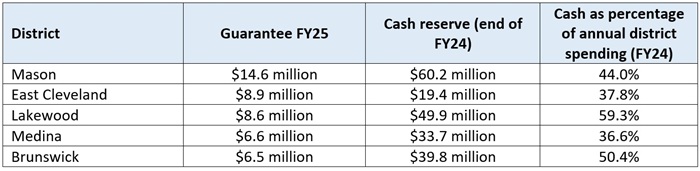
Finally, let me add this: If guarantees are so urgently needed, how is it that districts have so much cash in reserve? Just consider the five largest recipients of the guarantee this year. Mason is receiving almost $15 million from the state in guarantees, while it had a whopping $60 million on hand at the end of last year. That is almost a half year of cash. East Cleveland is hardly cash-strapped with almost $20 million in reserves, while Lakewood has 50 million smackers in reserve. Are these guarantees truly needed, or are they just padding bank accounts at taxpayer expense?
Table 1: Cash reserves of districts receiving the largest guarantees in FY25
There’s a kid’s song titled the “Song That Doesn’t End.” Guarantees are much like this obnoxious tune—they never go away, despite all the efforts to press stop. It’ll take some political courage, but let’s hope, for everyone’s sanity, that lawmakers put a fork in guarantees and start following a formula that funds students where they attend school.
[1] This includes the temporary transitional aid and supplemental transition supplement, but does not include several other guarantees (supplemental targeted assistance, transportation, and staffing minimums).
[2] Another reason why districts may be on the guarantee is due to rapidly increasing local wealth per pupil. That raises the question of whether the state taxpayers should be on the hook for paying districts extra money, on top of the formula, when they have additional local wealth (income and property values) to tap into.
[3] There is one minor exception for charter schools in the current formula: They are eligible for the “formula transition supplement.” Only eighteen schools receive these dollars which amount to just $4.6 million in FY25.