Ohio needs to wrest control of public schools from the teachers’ unions
In a recent New York Times column, David Brooks brought more national attention to the “Southern surge”—the rising educational performance of states such as
In a recent New York Times column, David Brooks brought more national attention to the “Southern surge”—the rising educational performance of states such as Alabama, Louisiana, and Mississippi. Coincidentally (or not), one thing that sets apart the deep South is its aversion to unionization. In these staunchly conservative states, teachers unions have never gotten a foothold, allowing state and local leaders to mold public education in ways that prioritize student learning over adult interests.
Despite its red-state status, Ohio has allowed teachers unions to flourish. How did we get here, and how have the unions shaped Ohio schools? How could state lawmakers get control of public education back into the hands of parents, communities, and education leaders—where it belongs—and working to advance the interests of students?
Amid a nationwide push for public sector unionization, Ohio lawmakers in 1983 enacted the Public Employee Collective Bargaining Act. The legislation—still codified in statute—allows teachers (and other public employees) to unionize, at which point a school district must bargain with the union over wages, hours, and “terms and other conditions” of employment. The Act also permits teacher strikes (overturning prior law), and creates the State Employment Relations Board to implement its provisions.
The legislation threw open the schoolhouse door to the unions. And sure enough, they have had an outsized influence on education policy and school operations ever since. What has that accomplished?
Reining in teachers unions won’t be easy. When former Governor John Kasich tried to dial back union power—not only the teachers’ but other public employees, as well—the effort was overturned via statewide referendum. That may have been a “win” for the unions, but public schools and the students they serve are still no better off.
An extended look at how to constrain unions would take pages, but a good starting point is Wisconsin, a traditionally strong-union state that rolled back union-friendly laws. Unlike Ohio’s wide-ranging effort, Wisconsin’s Act 10 (passed in 2012) focused more narrowly on teachers unions—firefighters and law enforcement were exempt—likely making the bill more politically acceptable. Since its enactment, the legislation has indeed curtailed the unions (reduced membership and revenue) and re-empowered district leaders. More importantly, research led by Yale University’s Barbara Biasi has shown that the reforms have helped schools retain effective teachers and has driven student learning gains.
Wisconsin Act 10 contains three key elements—all of which Ohio should consider adopting:
1. Dramatically narrows the scope of collective bargaining. Rather than opening nearly all aspects of operation to negotiation—salary, vacation, evaluation, discipline, etc.—the Act limits collective bargaining to base salary only, i.e., the minimum amount a teacher can receive in a district.[2] Limiting negotiation to base wages allows school leaders, should they choose, to adopt flexible compensation systems, including ones that incorporate merit-based pay. Enterprising Wisconsin districts have indeed used this newfound flexibility to attract and retain talented early-career teachers. Beyond salary, a narrowed scope of bargaining now allows school leadership to set workplace expectations and rules—likely set forth in an employee handbook—rather than having their authority “given away” to the unions during the negotiation process.
2. Requires annual union certification by a majority of teachers. In states like Ohio, a school district must negotiate with a union if teachers have certified it as their “exclusive representative.” This means that all teachers—even if they disagree with the union—must be covered under the union-negotiated employment contract. One of the problems with this arrangement is that the certification process may have occurred long ago, well before most teachers currently working in a district were around to vote. Wisconsin Act 10 changes this. Instead of giving unions permanent “exclusive representation,” the legislation now requires a majority of district teachers to annually recertify the union.[3] This restores teachers’ “voice” on whether they want representation in the first place, and teachers in many (though not all) Wisconsin districts have chosen not to recertify the local union.
3. Makes teacher strikes illegal. Wisconsin Act 10 outlawed teacher strikes, a policy consistent with dozens of other states (but not Ohio, which still allows them). The ability to strike, or the threat of it, is a formidable tool that unions can wield to gain concessions from districts and raise the cost of education. Unlike private companies, a school district cannot respond to a strike (or threat of it) by hiring non-union workers or moving elsewhere. It’s forced to negotiate, on terms likely more favorable to the union when it’s permitted to strike. While prohibiting strikes does not foreclose their possibility—“sickouts” can still happen—it does make the tactic more costly to unions, as they would be illegal and could result in fines or negative publicity.
* * *
Back in 2006, Stanford University’s Terry Moe, a renowned scholar of unionization, wrote:
The unions now shape the public schools from the bottom up through collective bargaining agreements that affect virtually every aspect of school organization and operation. They also shape the schools from the top down by influencing the education policies of government and blocking reforms they find threatening to their interests.[4]
Two decades have passed, and another generation of Ohio students have trudged through public schools that remain thoroughly shaped by the unions. Some have succeeded despite the union stranglehold, but many more have fallen through the cracks. It’s time for Ohio to move away from the collectivist, assembly-line model of education promoted by the unions, and bring excellence, merit, and personalization back into public schools—the very ingredients that are most apt to put Ohio on a new trajectory towards national leadership in public education.

[1] In actual dollars, Ohio’s per-pupil spending was $4,531 in 1990. This amount was adjusted to 2024 dollars, using the consumer price index.
[2] Even here, Act 10 restricts bargaining over base salary by limiting an increase to the inflation rate.
[3] Importantly, Wisconsin Act 10 requires a majority of all educators in a bargaining “unit” to certify the union—not just those who are union members or those who vote in the election.
[4] Quoted in Collective Bargaining in Education, ed. Jane Hannaway and Andrew J. Rotherham (p. 229).
This fall marks the third year that the EdChoice Scholarship program has been universally available to all families to cover private school tuition, regardless of family income. Initially, the universal expansion attracted mostly families whose children already attended private schools. After all, these families already had seats in the school they wanted and were well acquainted with renewal paperwork, uniform requirements, the tuition-payment grind, and other details. This was a reasonable and expected initial response to increased voucher eligibility.
However, voucher expansion is also intended to attract new students from families who have wanted a private option but who simply couldn’t afford it. This is a harder lift given all the hoops involved in applying to a private school and registering for the state voucher. For some families, it was likely complicated further by a dearth of schools or the lack of available seats in extant schools or in desired grade levels. If the voucher expansion is going to have a significant impact, it will require previously-non-participating schools to begin accepting vouchers, participating schools to expand their capacity, and the establishment of new private schools. Anecdotal evidence suggests that all three of these things are underway in the Buckeye State.
During the 2011–12 school year, the list of private schools accepting EdChoice Scholarship funds across the state comprised 322 buildings from kindergarten to twelfth grade. In 2023–24, that number was 450. This year, the final number will be above 500. Of all the private schools my wife and I considered for our children in Franklin County in 2011, none of them accepted the EdChoice voucher. By 2023, all but one had changed course. This is game changing for many Columbus-area families, and newsworthy all by itself. But wait. There’s more!
News reports show a slew of expansion activity at existing private schools across the state over the last few years. Schools are renovating to add more classroom and lab space, constructing whole new wings for things like grade level expansion and enhanced gym and arts programming, and even purchasing closed district or private school buildings to expand their space in one fell swoop. Controversially, the state is even helping to pay part of the cost of some of these expansions, using a tiny fraction of the funding provided in the state capital budget that nonprofits and traditional school districts use to build their playgrounds and science labs and other community-improving facilities. There is little doubt, however, that private schools are as integral to their neighborhoods and communities as many of these other recipients and funding such projects extends benefits far beyond school walls, whoever receives it.
The final piece of good news: New schools are also sprouting. It takes a lot to start a school from scratch, so this would be a lagging indicator of the impact of EdChoice expansion. But it’s clearly happening. A quick comparison of the rosters of private schools from 2022 to 2024 shows more than two dozen new schools established in the last two years. Not all of them accept vouchers, but most do; and more are coming. The newcomers run the gamut from church-based schools of many faiths to classical academies to nonsectarian schools. Most appear small and community-centric and seem to be focusing on younger grades to start.
News coverage of these start up efforts reveals dedicated educators embracing creative learning models aimed at specific populations of students whose families are likely looking for something different than a one-size-fits-all district school. And at least one is swinging for the fences in terms of the difference it aims to make in the lives of long-underserved students in Fordham’s home town of Dayton. Kudos to venture philanthropists like The Drexel Fund, whose support allowed the opening of Dreams Academy in Akron this year—a school for Black boys in grades K–2 intended to start them early on a positive and productive life path. Thanks to them, Dreams Academy is opening this month as a new voucher-accepting private school option for these families instead of the charter school model originally envisioned which, the founder says, would have taken several more years to launch. Drexel Fund’s Ohio portfolio includes half a dozen other schools, including the expansion of a longstanding Catholic program in northeast Ohio focused on serving students with special needs.
As good as all this news is, it does not represent the end of the story. That one private school my wife and I considered back in the day that still doesn’t take vouchers now? It is one of the most prestigious schools in the area, as well as a rare and sought-after non-religious one. Their reasoning for not participating in EdChoice is likely the same now as it was back then: that voucher amounts are not high enough to make a difference between families affording and not affording to attend. And they are not alone. But how do they know it won’t make a difference until they change their policies and see who shows up? And how can they be convinced to give it a try? A conundrum indeed, but universal voucher eligibility is a key starting point.
There are also many rural areas of the state with few or no private school options. These will be the slowest to experience the positive impacts of voucher expansion. But small schools are more likely to appear there now than ever before, thanks to universal vouchers, and hopefully other education catalyzers will—like the Drexel Fund—recognize the new opportunities across all parts of the state. Additionally, looming over all of this potential is the specter of student transportation—a longstanding horror for school-choice-using families in Ohio who must depend on districts to deliver their kids to and from school even though districts don’t want to and often aren’t very good at it even for their own students.
There is plenty of evidence that private school capacity has grown in Ohio in the wake of universal voucher eligibility. The next big leap forward for private school growth will begin as soon as the General Assembly finally takes the necessary steps to make transportation student- and choice-centric and allocate resources to the schools families really want and are actually attending. Our school choice ecosystem is blossoming, with more promise just ahead.
Nearly a decade ago, state leaders banded together to announce Ohio Attainment Goal 2025, a statewide objective for 65 percent of adult Ohioans to have a degree, certificate, or other postsecondary credential of value by 2025. According to the most recent state report, we’ve made significant progress since then. Ohio’s overall statewide attainment rate of 52.3 percent is its highest since data collection efforts began. But it’s also nearly 13 percentage points short of the 2025 goal and 2 percentage points lower than the national average.
In the recently passed state budget, lawmakers called for a new attainment target to be set by December 31. As state officials debate where to set this new benchmark, they’ll need to consider how Ohio plans to meet it so we don’t fall short again. One source of untapped potential is Some College No Credential (SCNC) adults. Ohio, for example, has a SCNC population of nearly 1.4 million. That’s more than the estimated 1.3 million adults who needed to earn credentials to meet the state’s initial 2025 goal.
Investing in and improving outreach and education programs aimed at helping these adults obtain credentials would be a great place to start. But addressing the root causes of why so many Ohioans start but don’t finish postsecondary education is the only way to permanently fix the problem. Academic readiness—or, rather, the lack thereof—is likely the biggest contributing factor. Boosting student achievement, especially in reading and math, will help improve attainment. But there are other contributing factors, too. And one of the easiest to address is how many Ohio students graduate without a well-thought-out plan for their next step after high school.
Each year, thousands of students graduate with no idea how to pursue their interests or even what they’re interested in. They know little, if anything, about careers or the job market. Many don’t realize that earning a postsecondary credential doesn’t have to mean a traditional four-year degree. Those enrolled at a college or university can take advantage of the career services offered by their institutions. But high school graduates who go straight into the workforce don’t have that option, and neither do the students who drop out and become SCNC adults. If Ohio did a better job of offering in-depth career exploration and guidance to students before they graduate from high school, then tens of thousands of Ohioans would be better off.
To his credit, Governor DeWine has attempted to address the lack of career exploration and guidance available to Ohio’s secondary students. When he released his budget recommendations in February, he included a requirement for students’ graduation plans to identify career goals and align students’ high school experiences to those goals. This would have been a huge step forward. Unfortunately, the proposal wasn’t included in the final budget. An updated attainment goal did make the cut. But if policymakers actually want to meet that goal, they need to take career exploration in middle and high school seriously.
Other states certainly are. In Utah, college and career awareness is a required middle school course for students in seventh or eighth grade and is taught by career-tech teachers, school counselors, and work-based learning coordinators. Idaho also requires seventh and eighth grade students to complete one or more career exploration courses. Students in Washington have “high school and beyond” plans that are informed by a career interest and skills inventory that’s administered by seventh grade and informs eighth grade course-taking. And in neighboring Kentucky, students develop an Individual Learning Plan within the first ninety days of sixth grade that includes exploring careers and identifying which ones match their skills and interests.
The Kentucky Department of Education notes that its plans are “changing how students prepare themselves for their future.” To keep up with other states—and to do right by students and families—Ohio needs to change how its students prepare for the future, too. Lawmakers should revisit Governor DeWine’s proposal for incorporating career planning into students’ graduation plans. And to ensure those plans aren’t just box-checking exercises, lawmakers should also require a career planning course in middle school.
Like the old adage says, there’s more than one way to cook an egg. But if Ohio leaders actually want to meet the state’s attainment goal this time around, they should probably get cracking on career exploration.
Schools are heavily segregated by income, primarily because higher-income families choose to live in more affluent districts. Economic segregation matters because social connections between higher and lower income kids—particularly connections forged in schools and churches—improve educational outcomes and economic mobility for poor kids. The research is clear: Policies that promote economic connectedness in schools help drive the American dream.
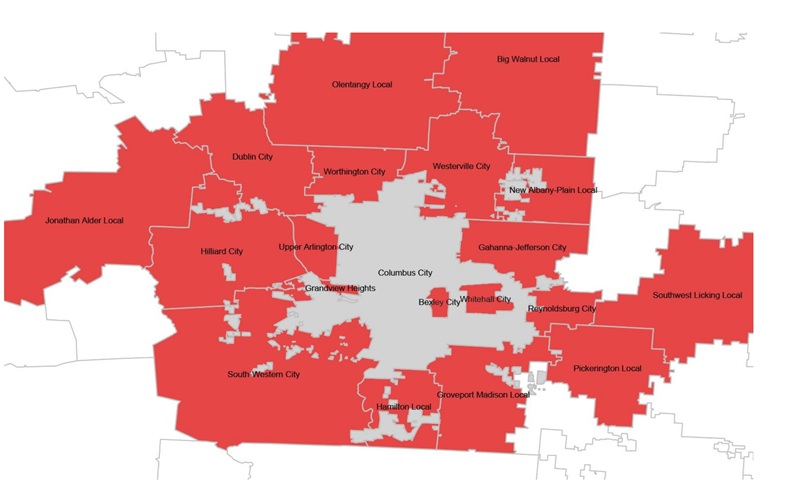
Yet many Ohio districts—particularly high-income suburban districts near major cities—are those most intent on keeping low-income kids out. They signal this intent loud and clear by refusing to participate in Ohio’s open enrollment program, which allows students from nearby districts to attend their schools when space is available. Figure 1 presents a map we’ve seen before: Ohio’s largest urban districts (labeled and shaded gray) surrounded by districts with policies that bar open enrollment (shaded red). Beyond those fortified suburban districts is a sea of districts that participate in (and families who make use of) Ohio’s open enrollment program, but those districts are generally too distant for city dwellers.
Figure 1. Ohio’s urban centers and districts that disallow open enrollment

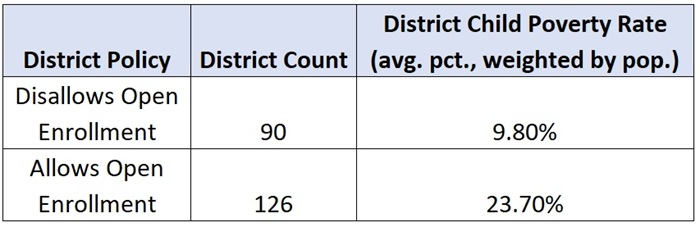
The kids kept out of the nearby suburban districts (in red) are disproportionately low income. Table 1 presents federal poverty estimates for school-age children in Ohio’s 216 city and suburban districts, comparing the 90 districts that disallow open enrollment (the red districts in Figure 1) and the 126 districts that allow it. Among the latter districts, which include Ohio’s eight large urban districts, 23.7 percent of children live in households below the poverty line (2024 household income of $32,255 for a family of four). The poverty rate is a much lower 9.8 percent in districts that forbid open enrollment.
Table 1. Poverty in city and suburban districts that do and do not allow open enrollment

Note that districts that don’t participate in Ohio’s open enrollment program may accept students from lower income districts, provided their families pay tuition or the district has an exemption, such as when a district employee resides in a different district (see ORC 3313.64(F)(8)). In other words, these fortified districts lower their drawbridges for relatively high-income, tuition-paying families who reside in surrounding low-income districts—or for the children of their own employees—but generally not for poor families. And the wealthier a district is, the more it charges. For example, Orange City Schools, a wealthy suburb outside Cleveland that forbids open enrollment, charged open enrollees a whopping $25,610 for the 2024-25 school year. Avon Local—a less wealthy Cleveland suburb that also does not participate in the open enrollment program—charged $10,032.
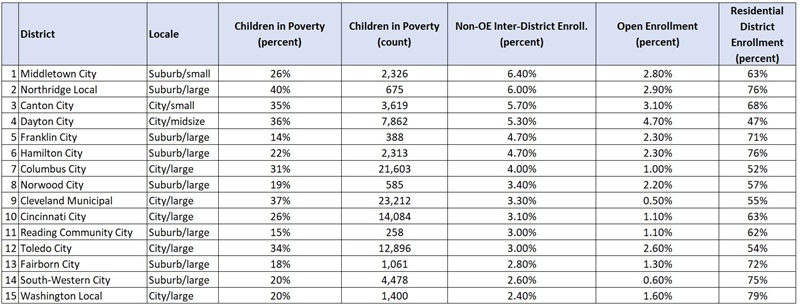
Unfortunately, there are no public data indicating how many parents pay these tuitions. But there are data on how many school-age district residents attend schools in other districts without the aid of open enrollment. One might characterize a district as “blocked” if its residents participate in interdistrict choice at higher rates without the aid of Ohio’s open enrollment program than they do with the aid of the program, as this roughly indicates family demand for schools in another district but a relative inability to access them for free. Table 2 lists the fifteen blocked districts in Ohio that have the highest share of school-age residents who attend schools in other districts without the aid of open enrollment (“Non-OE Interdistrict Enrollment”).
Table 2. “Blocked” districts where residents are most likely to enroll in another district

Six of Ohio’s eight large city districts are in the top fifteen, but so are several suburban districts. Notably, Middletown City (Vice President Vance’s childhood home, between Cincinnati and Dayton) and Northridge Local (adjacent to Dayton) come in first and second, respectively, with about 6 percent of their residents attending schools in another district without the aid of the open enrollment program. These districts adjoin some districts that participate in Ohio’s open enrollment program, but a greater share of their residents attend schools without the aid of the program. Not surprisingly, in all fifteen of the “blocked” districts, there are also high rates of participation in other school options (homeschooling, charters, and vouchers) as evidenced by the low share of school-age residents enrolling in district schools (see last column of Table 2).
Another noteworthy finding in Table 2 is the presence of South-Western City, as it also refuses to participate in Ohio’s open enrollment program. As Figure 2 reveals, with respect to open enrollment, its residents are kept out of adjacent districts Hilliard City and Hamilton Local. Hamilton Local has a child poverty rate nearly identical to South-Western City’s (and ranks twentieth on the “blocked” list), but Hilliard City is a more affluent district. South-Western City illustrates how even districts with high poverty rates may seek to fortify themselves against pupils from districts with even higher rates (e.g., Columbus City Schools).
Figure 2. Fortified districts in and around Columbus

***
District efforts to keep their schools exclusive and property values high mean they have strong incentives to keep out lower income kids. This is done by refusing to participate in Ohio’s open enrollment program and charging lofty tuitions to families from other districts. Policymakers could require districts with excess capacity to let in students from other districts, or they could create strong countervailing incentives to change these districts’ calculus. For example, if state funding per open enrollee were sufficiently high, then even wealthy districts might be willing to bring in low-income kids.
Unfortunately, as the Fordham Institute’s Aaron Churchill has explained, Ohio’s funding policy now provides minimal incentives for high-income districts to participate in the program. State payments per open enrollee are the same as state aid for the receiving district, which means wealthy districts get relatively little compensation. The incentives would be much stronger if, for example, per pupil aid from a student’s home district followed them when they open enrolled. Students from Ohio’s poorest districts could suddenly become coveted students to fill open seats. And my own research has demonstrated that this would likely improve their academic outcomes.
Helping students recover from pandemic learning loss is a vital, ongoing job with a ticking clock. Many students impacted by school closures, ineffective remote education practices, inconsistent reopening policies, and long-term chronic absenteeism have already graduated or dropped out. Those who remain deserve the best possible methods and efforts teachers and school leaders can employ to help them catch up. A new working paper looks at the difference in academic performance between charter school and traditional district school students—the second such statewide analysis after Fordham’s own work in Ohio—to determine who is doing the best job so far of getting their kids back on track.
Student-level data come from the Tennessee Department of Education and cover the 2017–18 to 2022–23 school years. 2020–21 is considered “during the pandemic,” the years following are considered “post-pandemic,” and the years before are used to set test score baselines for the purposes of the analysis. A unique student identifier includes the schools students attend, their grade levels, and their test scores from the state’s math and English language arts (ELA) assessments in grades 3–12. The trio of researchers, including Fordham/AEI EEPS scholar Adam Kho, include only schools that were open for all the academic years under study and exclude all students who made nonstructural school switches in that time (that is, changing schools for reasons other than moving from elementary to middle or middle to high school), as well as all students who switched school type after the start of the pandemic. Students in magnet, virtual, alternative, and optional enrollment schools are also excluded.
Kho and his colleagues compare the test score performance of charter school students to that of closely-matched peers attending traditional district schools, with several robustness checks to ensure that the two groups are as similar as possible. The results are reported statewide, by school type (elementary, middle, and high schools), and in the two metro areas—Nashville and Memphis—where the majority of charter schools are located. Those results show that charter and district students performed comparably during the pandemic in 2020–21, relative to baseline, with only one statistically-significant difference (Nashville-area charter students outperformed their district peers in ELA). Post-pandemic, however, charter school students consistently outperformed their district peers—statewide and in the Nashville area—in both math and ELA over both school years studied. The statewide effect estimates, all statistically significant, ranged from 0.05 to 0.14 standard deviations (SD), while estimates from the broader Nashville region ranged from 0.06 to 0.17 SD. In the Memphis area, charter students outperformed district students in math (0.08 SD) and performed similarly to their peers in ELA. These positive impacts were concentrated in elementary and middle schools, while charter and district high school students performed similarly.
The researchers note that charter schools in Tennessee largely mirrored the pandemic-era closing and opening protocols utilized by the districts in which they were located, including allowing parents to choose virtual or in-person options and periods of closure where in-person students switched to virtual instruction based on disease surge data. Thus, all indications are that Tennessee charter schools specifically upped their game considerably in the post-pandemic period in response to the fear of learning loss for their students, even before any data were available to illustrate such a loss. Kho and his colleagues suggest that the autonomy and flexibility inherent in the charter school model—as compared to larger, more rigid, more bureaucratic traditional school districts—were key to their relatively quick success in boosting student achievement.
The Education Scorecard concurs that Tennessee has made some strong strides in recovery overall, recently ranking third among all the states in math recovery and ninth in reading between 2019 and 2024. But Volunteer State students are still not out of the woods yet. Whatever these charter schools are doing needs to be defined, replicated, and expanded in all schools, stat.
SOURCE: Adam Kho, Shelby L. Smith, and Ron Zimmer, “From Disruption to Recovery: Charter School Performance During and After the COVID-19 Pandemic,” Annenberg Institute at Brown University (July 2025).