Improving educational opportunities for inner-city kids was originally a bipartisan endeavor. Conservatives and urban Democrats both championed public charter schools and private-school vouchers—primarily for large, densely populated, and economically segregated urban areas. That approach made practical sense, as that’s where a great number of low-income kids reside and where population density makes school transportation feasible and competition most beneficial. Indeed, both charters and vouchers have brought considerable benefits to Ohio’s low-income urban students.
But many high poverty communities (those with poverty rates in the top 10 percent) are not in big cities, and the exercise of school choice looks different in those areas. As one moves out from cities toward rural areas, families increasingly enroll their kids in districts other than their own (primarily via Ohio’s open enrollment program) or pursue self-funded options such as homeschooling and private schools that do not participate in the state’s voucher programs.
The use of inter-district open enrollment is encouraging, as that program has yielded considerable benefits for low-income students. But extensive homeschooling and self-funded enrollment in private schools means that these kids’ educational outcomes are not reflected in Ohio K–12 data, making it difficult to assess their educational trajectories. These “off-grid” schooling options pose a challenge for community members concerned that all Ohio families have access to a high-quality education, though recent state and federal efforts to expand private-school funding could help with that.
Ohio’s high-poverty communities are not primarily urban
Table 1 compares high-poverty Ohio districts—where Census-based poverty estimates for school-age residents are in the top 10 percent statewide—to the rest of Ohio school districts. The typical high-poverty district is indeed larger (median of 2,403 school-age residents as opposed to 1,771). Predictably, in part because of their higher child poverty rates (31 percent instead of 12 percent), test scores in district schools are near the bottom. The default educational option in these high-poverty communities—the residential district school—has average test scores at the 12th percentile of Ohio districts.
Table 1. Comparing Ohio’s highest poverty districts to other Ohio districts
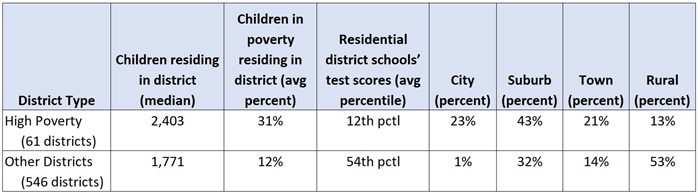
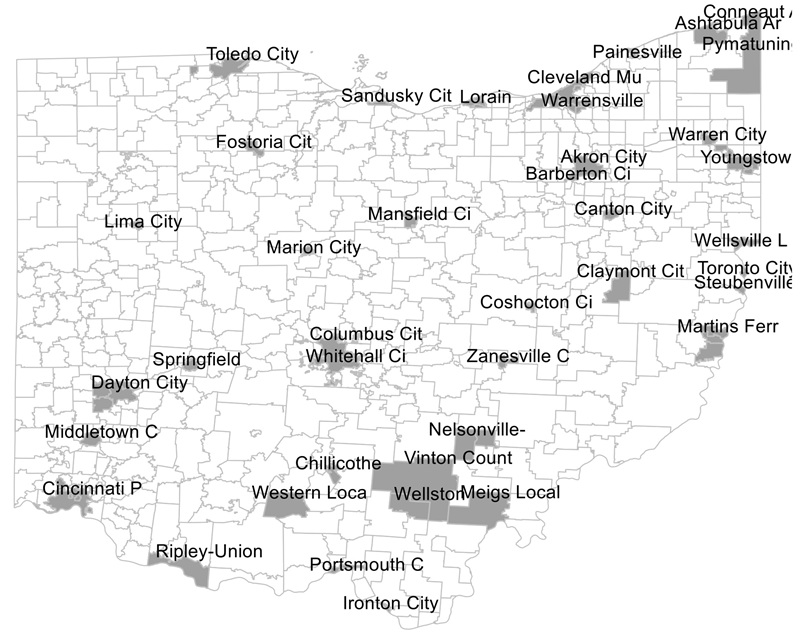
Perhaps the most striking takeaway from the table, however, is that less than a quarter of high-poverty districts are in cities, reflecting that there aren’t all that many city districts in Ohio. The modal high-poverty district is a suburban district (43 percent), and over one-third are towns or rural communities (21 and 13 percent, respectively). The map below (Figure 1) illustrates the geographic distribution and labels some of these districts. (A full list of the high-poverty districts, along with their NCES locales, appears in the first of three supplemental tables at the bottom of this post.) The geographic spread of high-poverty districts is remarkable.
Figure 1. Communities with the highest child poverty rates
School choice is prevalent outside of city districts, but it takes a different form
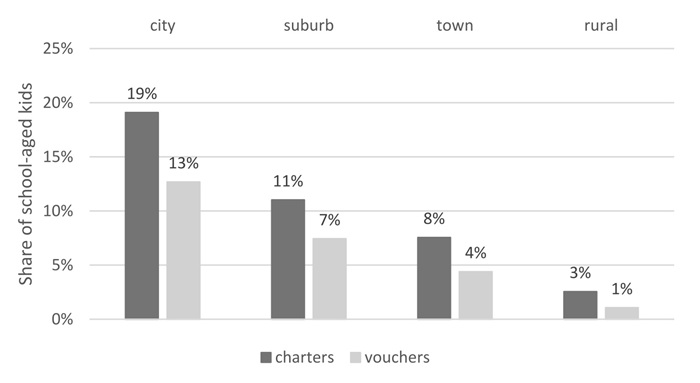
School options like charters and private-school vouchers benefit from residential density. Thus, one should expect the use of these options to decline as one moves from cities to less populated suburbs, towns, and rural areas, respectively.[1] Figure 2 (below) demonstrates exactly that. Among Ohio’s high-poverty city districts, 19 percent of school-age kids are enrolled in charter schools and 13 percent receive scholarships to attend private schools. Figure 2 indicates that these percentages steadily decline as one moves from cities to rural areas, where 3 percent of children attend charter schools (a decline of 16 percentage points from 19 percent) and 1 percent use private-school vouchers (a decline of 12 percentage points from 13 percent). Note that most rural charter school students (2 of the 3 percent) attend online virtual charter schools.
Figure 2. Voucher and charter use across locales
Without access to brick-and-mortar charter schools or private-school scholarships—or the financial means to relocate to another district—families in high-poverty districts can enroll in online charter schools (which, interestingly, they do at slightly lower rates than their city-dwelling peers). But they can also participate in a form of choice unavailable to many city residents: inter-district open enrollment. That is because Ohio’s city districts are surrounded by suburbs that generally do not allow students from other districts to enroll if they have seats available (unless they pay tuition), whereas most other districts participate in Ohio’s open enrollment program. Another option—one that can be very costly in terms of time and money—is to homeschool or send kids to private schools that do not participate in the state’s voucher program. These are “off-grid” options, as there is far less regulation and data collection because little or no public money is provided.
Figure 3. Interdistrict and “off-grid” choice across locales
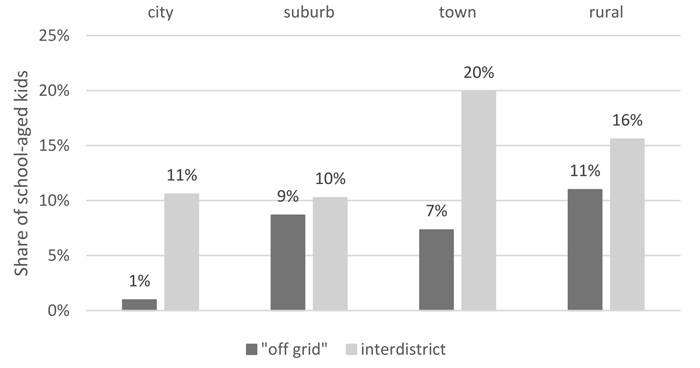
Figure 3 reveals that, outside of cities, families are far more likely to participate in off-grid options—by magnitudes of 6–10 percentage points. Homeschooling rates in cities and suburbs are comparable (at approximately 1–2 percent of school-age residents) and climb a bit for towns (to 3 percent) and rural areas (to 4 percent). (These and other disaggregated statistics are available in supplemental tables here.) That means that the bulk of the “off-grid” difference reported in Figure 3 is some other option for which the state does not report statistics. These could be chartered or non-chartered private schools, but one cannot tease that out from the data. One can only discern that some school-age residents are unaccounted for.
Figure 3 also reveals that families residing in high-poverty towns and rural communities are far more likely than families in cities (and suburbs) to enroll their kids in a district different from the one in which they reside. That means they are indeed far more likely to be enrolled in district schools than their urban counterparts, but the twist is that they are not necessarily attending the schools run by their own district. That is not the case in suburbs, probably because students are kept out of higher income neighboring districts that don’t participate in Ohio’s open enrollment program.
Not less choice, but quite different
The countervailing patterns above largely offset one another, such that overall rates of school choice do not vary significantly across cities, towns, and suburbs. The off-grid school options accessed in non-urban, high-poverty communities—particularly rural districts—create a bit of a blind spot when assessing schooling quality in Ohio. But the good news is that many families outside of big cities have multiple public district options available to them. Making sure that these public options are high quality must remain a priority.
[1] Since the early 2000s, charter schools have been able to locate in most high-poverty districts because they historically have been identified as poorly performing on state-issued report cards. Notable exceptions are the high-achieving Steubenville and Bellaire districts. Since 2020, charter schools have been able to locate in any Ohio district.