NOTE: Today, the Ohio House Education Committee heard testimony on Substitute Senate Bill 19. The legislation proposes a wide-ranging overhaul of math education in the state—from requiring math improvement plans for students at risk of failure to making sure that future math teachers pass content exams before starting in the classroom—in order to address an ongoing achievement crisis. Fordham’s Vice President for Ohio Policy provided the following Interested Party testimony.
I testified on key components of this legislation in February and remain generally supportive of its approach to taking on the math achievement challenges our state faces. I’ve kept my testimony on those provisions here for the record, but my comments will focus on provisions in the substitute bill involving state assessments and some more technical changes in the sub bill that likely weaken SB 19’s long-term impact.
The Scope of Ohio’s Math Challenge
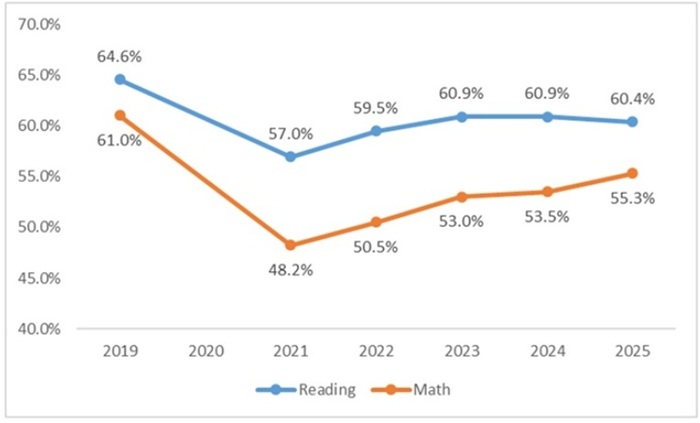
Despite recent academic gains, Ohio remains well below pre-pandemic achievement in both reading and math. As Fordham’s recent analyses show, math proficiency remains 5.7 percentage points below 2019 levels, with only 55.3% of students proficient (on grade level) statewide.
Statewide proficiency rates in math and reading, 2018–19 (pre-pandemic) to 2024–25
These gaps aren’t just academic—they’re economic. Employers consistently cite quantitative reasoning and problem-solving as top skills for the modern workforce. Whether a student aspires to be a nurse, electrician, or software developer, math is a gatekeeper to opportunity. Without stronger math achievement, Ohio risks leaving a generation of students—and the state’s economic future—behind.
How Senate Bill 19 Addresses the Crisis
Senate Bill 19 takes a systematic, evidence-based approach to improving math outcomes that—if implemented robustly—has the potential to boost math achievement. It includes:
1. Academic Intervention and Monitoring
The bill requires schools to identify and support students scoring “limited” (the lowest level on state assessments) in math or reading, providing evidence-based interventions at no cost. This includes high-dosage tutoring, extended learning time, and other targeted supports.
2. Math Improvement Plans for Districts
Beginning in the 2026–27 school year, districts where fewer than 51% of students score proficient on the third-grade math assessment must create a Math Achievement Improvement Plan, ensuring leadership-level accountability and strategic intervention.
3. Statewide Oversight and Transparency
SB 19 strengthens state oversight by requiring the Department of Education and Workforce (DEW) to audit 5 percent of schools annually, reviewing the quality and fidelity of intervention programs. These findings will appear on public report cards—providing families and taxpayers with greater transparency.
4. High-Quality Math Curriculum and Instructional Materials
In one of the bill’s most significant provisions, DEW will review core math curricula and publish a list of high-quality, standards-aligned instructional materials. Schools’ use of these materials will be publicly reported on state report cards.
5. Strengthening the Teaching Profession
SB 19 recognizes that great instruction begins with great teachers. It calls for new math proficiency assessments for early-grade teacher candidates and state-developed professional development programs focused on evidence-based math instruction. These steps ensure educators have both the content knowledge and tools to deliver high-quality math lessons.
6. Opportunities for Advanced Learners
Finally, the bill opens new doors for high-achieving students by requiring that students who score accomplished (this portion was disappointingly removed in the sub bill) or advanced in math on the state assessment be automatically placed in accelerated or Algebra I courses, with a parental opt-out. This provision ensures that excellence is nurtured, not neglected—a crucial step in closing both the lower and upper ends of Ohio’s achievement gaps.
Why This Matters: Ohio’s Path Forward
Ohio has taken strides to improve literacy through the Science of Reading reforms. But as Fordham has repeatedly emphasized, we must now apply that same urgency to math. The bill reflects a clear understanding that strong math achievement is not optional in today’s economy. It is the foundation for innovation, progress, and workforce readiness. Students who can think mathematically will not only succeed in college but also thrive in trades, technology, and countless real-world applications.
Provisions Related to State Assessments
I would like to address one provision that raises significant concerns: the proposal to request a waiver from the United States Department of Education to shift Ohio’s state assessment system to a nationally normed referenced test, or NRT.
While NRTs can be useful in certain contexts—particularly as diagnostic tools—they are not well suited to serve as a state accountability assessment.
Ohio’s current system is built on a fundamental principle: alignment between academic standards and assessments. Standards define what students are expected to learn, and assessments measure whether they have learned it. This alignment ensures fairness and clarity for students, educators, and parents alike.
NRTs, by design, do not operate this way. They are intended to compare students to one another on a national scale, not to measure mastery of a specific state’s standards. As a result, adopting an NRT would weaken the connection between what is taught in Ohio classrooms and what is measured on state assessments.
That shift would have real consequences. It would make it more difficult to hold schools accountable for helping students meet Ohio’s expectations. It would introduce questions about fairness, as students could be tested on material that is not aligned with state standards. And it would move Ohio away from the standards-based system required under federal law.
Beyond these concerns, changing assessments at the state level is a complex and disruptive undertaking. Ohio has experienced this firsthand. Past transitions led to confusion, frustration, and a loss of continuity in student achievement data. A shift to an NRT would risk repeating those challenges, breaking trend lines that policymakers and educators rely on to understand whether reforms—like the Science of Reading—are working.
Importantly, moving to a national test would reduce Ohio’s control over its own assessment system. State tests should reflect Ohio’s academic priorities and benefit from the input of Ohio educators. An NRT, developed for a national market, cannot fully meet that need.
Fortunately, Senate Bill 19 also points toward a better path.
The bill directs the Department of Education and Workforce to develop a plan for a next-generation, computer-adaptive assessment. This approach has the potential to address many of the legitimate concerns that have been raised about testing.
A well-designed computer-adaptive assessment can reduce testing time by adjusting to each student’s performance in real time. It can provide more precise information about what students know and where they need support. And, importantly, it can deliver results much more quickly—making the data useful to teachers and families.
This is exactly the kind of thoughtful improvement Ohio should pursue. Rather than abandoning its current system, Ohio should build on it—modernizing assessments while preserving the critical alignment to state standards. Doing so would maintain fairness and accountability while making the system more efficient and more responsive to the needs of students and educators.
Provisions that Weaken SB 19
Auto enrollment: The bill previously enrolled every student who performed accomplished or advanced on the state assessment into advanced math in seventh and eighth grades, culminating in completing Algebra in eighth. The bill modified the language to only auto enroll students scoring advanced into the accelerated middle school path. Accomplished students would need approval from their principal and teachers. That provision accomplishes nothing as principals and teachers can already do that. This change goes against available data which shows that students scoring accomplished on the state assessment in seventh grade who take algebra in eighth grade excel. We encourage you to expand the pipeline for advanced math opportunities. As amended, this is going to keep disadvantaged students out of advanced math opportunities that they are prepared for. As a state, we must do better.
Science of reading instructional materials waiver: One of the hallmarks of the 2023 science of reading reforms is the requirement for all schools to use high quality instructional materials that are aligned to the science of reading. The sub bill includes waiver language for this year and next to allow a subset of schools to use materials that aren’t aligned to the science of reading. This creates a potential slippery slope for future carveouts. Accountability is accomplished through consistency of action—not strong policies that are walked back a little each year.
Reading diagnostics: In last year’s budget, you limited the number of approved reading diagnostics to five. Given the huge variability in the quality of diagnostics, we believe that was the right decision. Unfortunately, not all tests are created equal and some have very mixed results in actually correlating with state assessments. The sub bill raises the number of approved tests to six and appears to allow districts to apply for waivers to DEW on the diagnostic used for the 26-27 school year. These may well be the right moves, but they also could well be early backsliding on last year’s enacted language. I’m simply flagging the issue for the committee’s consideration.
Conclusion
In closing, Senate Bill 19 is a strong and important piece of legislation that addresses a pressing need in Ohio education. I urge the committee to advance the bill. At the same time, I encourage you to reconsider the proposed shift to a nationally normed test, focus on improving Ohio’s existing assessment system, and reverse course on the most recent sub bill changes related to auto enrollment.