
The Ohio state board of education recently released draft revisions of its professional standards for superintendents. The document articulates the expectations Ohio has for the men and women who lead the state’s 606 districts that serve 1.4 million students. Though state law does not mandate use of these standards, they can guide school boards when hiring superintendents and evaluating their performance. They can also assist superintendents in understanding their own responsibilities.
First published in 2008, the standards contain five strands outlining the duties of a superintendent: 1) establish a vision and strategic plan for the district; 2) be an effective instructional leader; 3) communicate and collaborate well; 4) steward district resources; and 5) set district policy with the school board. The proposed revisions maintain these five areas, and even reorders them to signal greater emphasis on instructional leadership (a big improvement). The rest of the revisions are mostly wording tweaks.
But there is one glaring change. As shown below, the proposed standards delete an expectation that superintendents “recognize the moral imperative to ensure the success of every child and recommend and enforce policies and governance practices accordingly.”
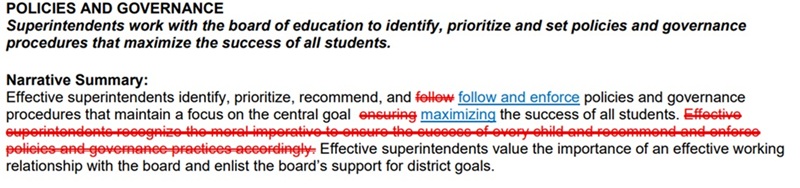
Erasing this line is baffling because, at a most basic level, it’s precisely what we ought to expect of superintendents.
The first part of the sentence calls on superintendents to “recognize the moral imperative to ensure the success of every child.” This statement is fundamental. Underpinning effective education is a conviction that each and every child can succeed, whether “success” means mastering specific academic content, completing assignments on time, participating productively in class, or passing a rigorous exam. Yet without this belief in children’s capacity to learn and succeed, education falters. Not even the most lavish amount of funding can overcome schools that expect little of their students.
The importance of this conviction likely explains the “moral imperative” language. In our anything-goes culture, some might object to the stern terminology. But the Cambridge Dictionary simply defines the phrase as “something that must happen because it is extremely important or urgent, and is the right thing to do morally” (emphasis added). It shouldn’t be controversial to obligate superintendents to recognize the extreme importance of understanding that every child has the capacity to succeed and to act with urgency to make sure they achieve success. The language also affirms that superintendents are in the right—acting ethically and morally—when they demand excellence and hold employees accountable for having high expectations of students, too.
The second part of the sentence directly challenges superintendents to act on this moral imperative by “recommend[ing] and enforce[ing] policies and governance practices accordingly.” In other words, superintendents are not merely to pay lip service to this moral imperative, but also operationalize it. What precisely this looks like in practice is not spelled out in the document. But here are some ways that superintendents might advance student success through district policy and practice:
- Take action to dismiss poor-performing or chronically absent school employees.
- Reward, and work to retain, high-performing teachers, no matter their seniority.
- Add instructional time and/or create a summer school for students who need academic help.
- Protect learning time by minimizing disruptions during the school day and school year.
- Enforce disciplinary practices that promote an orderly learning environment.
- Provide high-achieving students with the challenge and advancement they deserve.
- Set the tone for the district by establishing a clear expectation that all students will succeed.
Words, attitudes, expectations, and beliefs all matter in education. So does school leadership. When push comes to shove, will school leaders hold fast to the “moral imperative” of educating every student or fall prey to low standards and expectations? The stakes are high—the futures of 1.4 million students are on the line—and Ohio must preserve a clear expectation that its superintendents adhere to an unwavering belief in the capacity of every student to succeed.