
Ohio has a choice-based education system that empowers families to make schooling decisions based on what’s best for their children rather than what they can afford. In a conventional system, families assigned to a persistently low-performing school would be stuck there unless they could afford to move to a different neighborhood or an entirely new district. The same is true for parents looking for a safer school, one that offers specific courses or extracurriculars, or a building that’s just a better fit. But in Ohio, all families—not just the wealthy ones—have alternatives through public and private school choice programs.
Those who are interested in public options can consult state report cards, which are annually updated by the Department of Education and Workforce (DEW), to examine data on a variety of academic and non-academic measures. This information is crucial in helping families make informed choices. But parents considering one of Ohio’s five private school choice programs, which provide scholarships for eligible students to attend non-public schools, don’t have access to a similar resource.
That’s not to say data aren’t available. Ohio collects and publishes plenty of information on scholarship-accepting private schools. But most of it is scattered across various webpages and hasn’t been put into a parent-friendly format. Many private schools offer information on their websites, but meaningfully comparing schools can be difficult and time-consuming. Even when parents have the time and energy to spare (which is no small feat), it can be hard to sort through fact and fiction because choice opponents routinely flood the media with misleading claims and inaccurate analyses.
If Ohio is going to deliver on the promise of its choice-based education system, families need user-friendly data on all their options. That’s why state officials should consider creating annually updated informational sheets for each scholarship-accepting private school and then publishing them on the state’s website.
But what would these informational sheets look like? To help visualize the possibilities, Fordham has designed two samples: one for a fictional elementary school and another for a fictional high school. Both contain the following information:
- Details including the school’s address, phone number, website, grade span, and student enrollment.
- Which state scholarships the school accepts, as well as the number and percentage of the student population that attends via each scholarship.
- Confirmation that the school meets state operating standards and background check requirements.
- Student and teacher demographics.
- Academic outcomes. For achievement, that includes the percentage of students who scored proficient or above on state or state-approved alternative tests, both schoolwide and broken down by grade and subject. Student growth data, which will be calculated beginning in 2026, would appear as well.
It’s important to recognize that all the information listed above is already publicly available. Private schools are required to report these data to participate in Ohio’s five scholarship programs, which means lawmakers wouldn’t need to mandate additional reporting requirements or testing. The administrative burden would fall on the state, not schools, to create a parent-friendly information system. And unlike national websites like GreatSchools, which also offer families useful information, these sheets would be Ohio-specific.
There are, however, two areas where private schools should be given the option to submit additional information.
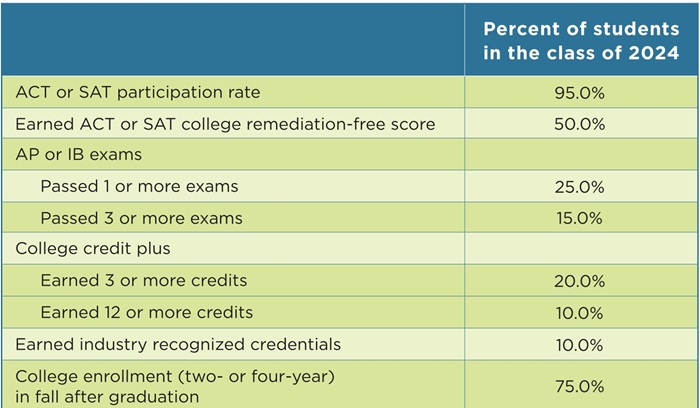
The first is college and career readiness. Public school report cards measure this via the College, Career, Workforce, and Military Readiness component. The data identified in Table 1 below would provide families considering a private school scholarship with similar information and a clearer picture of how high schools are preparing students for life after graduation.
Table 1. College and career readiness outcomes on a sample information sheet
The second is an opportunity for schools to describe unique offerings or points of pride. A language immersion program, work-based learning opportunities, high percentages of graduates accepted to Ivy-League institutions, championship athletic teams—the possibilities are endless. Giving schools an opportunity to share what makes them great acknowledges that families choose schools for all sorts of reasons.
At the end of the day, access isn’t access unless it’s accompanied by information. Ohio’s robust school choice sector is set up to ensure that every family—regardless of income—has multiple school options. To help parents navigate these options, the state should provide tools that enable them to compare and make informed choices. Ohio already has the data to provide families with these tools. It’s time for state officials to put that material to good use and empower families.