
Note: Today, the Ohio House Education Committee heard testimony on Senate Bill 19. The bill proposes a wide-ranging overhaul of math education in the state—from requiring math improvement plans for students at risk of failure to making sure that future math teachers pass content exams before starting in the classroom—in order to address an ongoing achievement crisis. Fordham’s Vice President for Ohio Policy provided the following proponent testimony on the bill.
I want to start by thanking Chair Fowler Arthur both for putting this legislation before the committee and for recent public comments recognizing the importance of students being competent in both reading and math. While Ohio has admirably worked on improving students’ ability to read, the math achievement of students continues to fall below pre-pandemic levels. And let’s be honest, it wasn’t exactly great pre-pandemic.
Before I argue why this legislation is critical and talk about its high points, I want to emphasize that this bill passed the Senate unanimously. For too many education bills, that isn’t the case. Of note, the bill had seven committee hearings and—in my review of committee agendas—faced no opposition testimony.
The Scope of Ohio’s Math Challenge
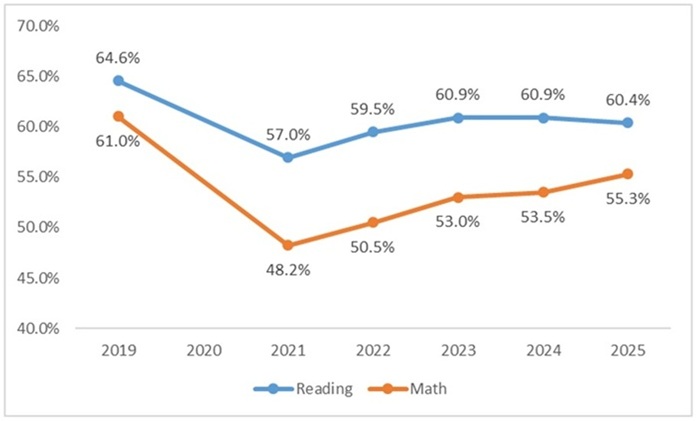
Despite recent academic gains, Ohio remains well below pre-pandemic achievement in both reading and math. As Fordham’s recent analyses show, math proficiency remains 5.7 percentage points below 2019 levels, with only 55.3 percent of students proficient (on grade level) statewide.
Statewide proficiency rates in math and reading, 2018–19 (pre-pandemic) to 2024–25
These gaps aren’t just academic—they’re economic. Employers consistently cite quantitative reasoning and problem-solving as top skills for the modern workforce. Whether a student aspires to be a nurse, electrician, or software developer, math is a gatekeeper to opportunity. Without stronger math achievement, Ohio risks leaving a generation of students—and the state’s economic future—behind.
How Senate Bill 19 Addresses the Crisis
Senate Bill 19 takes a systematic, evidence-based approach to improving math outcomes that—if implemented robustly—has the potential to boost math achievement. It includes:
1. Academic Intervention and Monitoring
The bill requires schools to identify and support students scoring “limited” (the lowest level on state assessments) in math or reading, providing evidence-based interventions at no cost. This includes high-dosage tutoring, extended learning time, and other targeted supports.
2. Math Improvement Plans for Students and Districts
Beginning in the 2026–27 school year, each struggling student must receive a Math Improvement and Monitoring Plan, developed collaboratively with parents and teachers. Additionally, districts where fewer than 51 percent of students score proficient on the third-grade math assessment must create a Math Achievement Improvement Plan, ensuring leadership-level accountability and strategic intervention.
3. Statewide Oversight and Transparency
SB 19 strengthens state oversight by requiring the Department of Education and Workforce (DEW) to audit 5 percent of schools annually, reviewing the quality and fidelity of intervention programs. These findings will appear on public report cards—providing families and taxpayers with greater transparency.
4. High-Quality Math Curriculum and Instructional Materials
In one of the bill’s most significant provisions, DEW will review core math curricula and publish a list of high-quality, standards-aligned instructional materials. Schools’ use of these materials will be publicly reported on state report cards.
5. Strengthening the Teaching Profession
SB 19 recognizes that great instruction begins with great teachers. It calls for new math proficiency assessments for early-grade teacher candidates and state-developed professional development programs focused on evidence-based math instruction. These steps ensure educators have both the content knowledge and tools to deliver high-quality math lessons.
6. Opportunities for Advanced Learners
Finally, the bill opens new doors for high-achieving students by requiring that students who score accomplished or advanced in math on the state assessment be automatically placed in accelerated or Algebra I courses, with a parental opt-out. This provision ensures that excellence is nurtured, not neglected—a crucial step in closing both the lower and upper ends of Ohio’s achievement gaps.
Why This Matters: Ohio’s Path Forward
Ohio has taken strides to improve literacy through the Science of Reading reforms. But as Fordham has repeatedly emphasized, we must now apply that same urgency to math. The bill reflects a clear understanding that strong math achievement is not optional in today’s economy. It is the foundation for innovation, progress, and workforce readiness. Students who can think mathematically will not only succeed in college but also thrive in trades, technology, and countless real-world applications.
Conclusion
In short, Senate Bill 19 is both timely and essential. It creates a coherent, statewide strategy for improving math outcomes—built on evidence, transparency, and accountability. Most importantly, it affirms that every Ohio student, regardless of ZIP code, deserves access to rigorous math instruction and the opportunity to succeed.
Chair Fowler Arthur and members of the Committee, thank you for your leadership in confronting this urgent challenge. The Fordham Institute strongly supports Senate Bill 19, and we urge its swift passage.