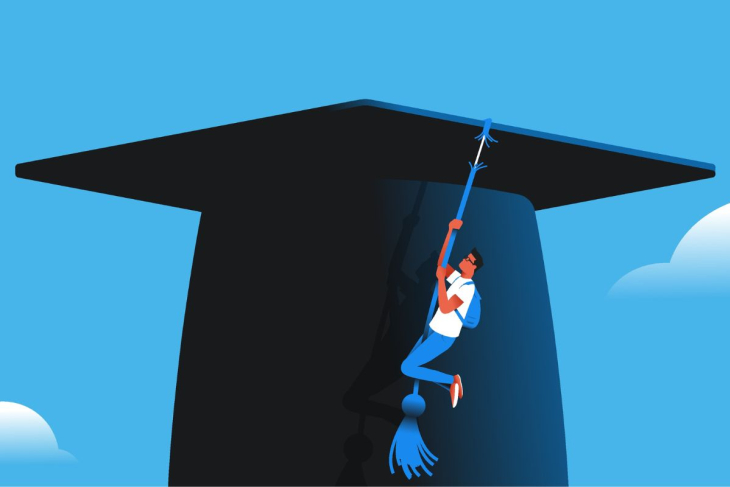
Earning a bachelor’s degree has long stood as a marker of success—in one’s education journey, in life generally, and as the starting point for one’s career. Though the financial cost can be high (especially for those who struggled academically), the potential success is often deemed to be worth it. So millions of optimistic young people every year take out student loans to embark on the quest for a degree. But is misplaced optimism clouding some students’ judgment, and ultimately loading them down with long-term financial obligations that could have been avoided? A new research paper digs into some data to find out.
A trio of economists from the United States and Canada draw their data from two nationally-representative panel surveys of young people in the U.S.—the 1997 National Longitudinal Survey of Youth (NLSY97) and the High School Longitudinal Study of 2009 (HSLS:09)—both of which tracked their initial subjects through age 30. Both surveys asked high-school-age respondents to rate their probability of earning a four-year bachelor’s degree by age 30; measured students’ academic achievement prior to college based on their performance on the Armed Services Vocational Aptitude Battery (ASVAB); and tracked college enrollment (or not), student loan usage (or not), and degree completion (or not)—also through age 30.
Survey data revealed widespread optimism among respondents about their likelihood of earning a college degree. On average, high schoolers in the sample reported a 54 percent probability they would enroll in college and, among that group, a 78 percent likelihood they would earn a bachelor’s degree (so 42 percent of the total sample). The average ASVAB score among respondents was 50 out of 99, in the middle of the typical range of scores. Students with lower test scores were less likely to predict college enrollment and degree attainment, controlling for other observable characteristics, while their peers with higher scores were more likely to predict both outcomes for themselves. So far so good.
However, longitudinal data showed that only 35 percent of all sample members actually ended up earning a degree by age 30, including a large number who predicted a degree while in high school but ended up never enrolling in college. Even those who did enroll showed a 23 percentage-point gap between their average prediction of degree completion (88 percent) and their actual completion by age 30 (65 percent). The researchers call this an “optimism gap” and break it out among various groups of students based on test scores, income, and other demographics. College enrollees who scored lowest on the ASVAB showed the largest optimism gap (about 37 percentage points), compared with those who scored highest (15 percentage points). That is: High school students generally overestimated their ability to earn a bachelor’s degree—compared to what the future actually held for them—with those at the lowest academic skill level overestimating by the largest extent.
Next the researchers examined whether inflated optimism drove students to take out federal loans to pursue a college path they were unlikely to complete. Among all college enrollees in the sample, 24 percent failed to earn a degree by age 30. Those who did not complete were just as likely to have student debt relative to those who persisted to a degree, though they owed a little less, presumably in large part because they attended for less time. The average non-completer owed about $11,000 at age 30, compared to $17,200 for completers.
Using these real-world outcomes, the researchers also model the hypothetical impacts of specific variables. Notably, they found that moderately increasing the student loan borrowing limit (from approximately 37 percent of average tuition and fees up to 56 percent) introduced long-term “welfare” losses (an economics concept that includes measures of income and consumption over a lifetime) among individuals who borrowed.
These losses would disproportionately impact the lowest ASVAB performers and those who were low-income—specifically, the young people with the highest “optimism gaps”—by nudging more of them from non-enrollees to college enrollees. In other words, if students were able to borrow greater amounts, more college students would do so and enroll in college, based on their optimism for degree completion. But because completion rates would be unlikely to change for the lowest-performing and lowest-income students, that group would simply accrue more debt.
By reducing the loan limit in their model, the researchers found that more low-performing and low-income students would choose not to enroll in college, regardless of their optimism for degree completion. Not only did this, predictably, limit their debt, it also modestly boosted their welfare in the long run.
The researchers conclude that “access to student loans can be harmful to some young adults in the presence of optimistic beliefs” and express hope that their findings “will be useful for researchers seeking to evaluate and improve the design of college financial aid.” But those are largely conclusions based on the modeling part of the research.
Unanswered here is the question of where students’ misguided optimism is coming from in the real world. Why are so many high schoolers who achieve an average (or lower) score on the ASVAB so sure they will succeed in college? Could it be the messages they received as a result of lowered classroom expectations and/or inflated grades? Or, more fundamentally, are they internalizing a “college at all costs” mantra coming at them from all directions when other postsecondary options could improve their long-term outcomes quicker, cheaper, and more directly? The report considers the choices made due to over-optimism to be “subjective,” which is true up to a point, but those choices are not made in a vacuum.
SOURCE: Emily G. Moschini, Gajendran Raveendranathan, and Ming Xu, “Optimism about Graduation and College Financial Aid,” American Economic Journal: Macroeconomics (April 2026).