
School district consolidation has recently emerged as a hot topic, as discussions about local tax burdens and the cost of government continue to percolate throughout Ohio. One county auditor suggested a move towards countywide districts in a streamlining effort. Meanwhile, a left-leaning national think tank (concerned more with segregation) generated headlines for recommending that Ohio go from 606 districts to somewhere between 88 and 163 districts.
While large, consolidated districts are not uncommon in America, merging hundreds of Ohio districts would be a massive undertaking and likely to set off a political firestorm. Fearing job losses, public school groups would vehemently oppose largescale consolidation. Community members would likely join the fray, as many Ohioans rightly view the local district as part of their community identity. Indeed, there is a strong argument for maintaining small(ish) school districts that are more responsive to parents and citizens than creating sprawling bureaucracies.
Nevertheless, consolidation should be on the policy agenda—albeit not the sort that wipes hundreds of districts off the map through brute force. Here’s a look at why Ohio should pursue consolidation and how it could be done in way that is sensitive to communities and eases transitions.
Dwindling enrollments, rising costs
Ohio must come to grips with the substantial enrollment declines occurring in traditional districts due to a combination of out-migration, low birthrates, and increasing demand for educational choice (including private, public charter, career-tech, and homeschool). In 2010, 1.65 million Ohio students attended a district school. Fast forward fifteen years, and district enrollment now stands at 1.43 million students, a 14 percent decline. Only three districts dissolved through voluntary consolidation during this timeframe, despite the sector’s loss of nearly 230,000 students.[1] Moving forward, the enrollment picture looks similarly bleak, as the U.S. Department of Education projects further declines over the next five years.
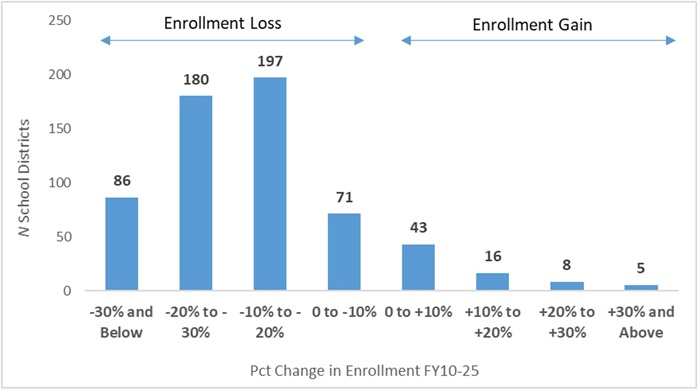
The statewide enrollment decline masks even larger downturns in specific districts. As Figure 1 indicates, 86 districts experienced losses of more than 30 percent over the past 15 years. Enrollment in another 180 districts fell by 20 to 30 percent. Only a handful of districts—mostly suburbs of Cincinnati and Columbus—have gained enrollment.
Figure 1: Number of Ohio districts by their change in enrollment from FY 2010 to 2025
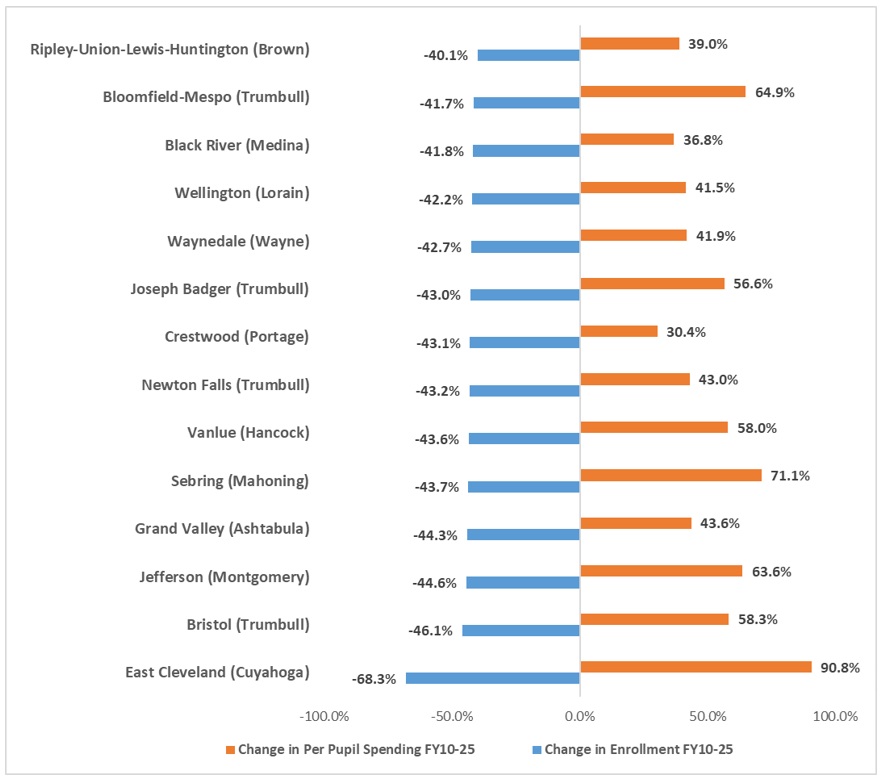
Enrollment decline isn’t necessarily a cause for concern—at least on efficiency grounds—if districts “right size” their budgets commensurate with reduced headcounts. Unfortunately, that hasn’t happened in most rapidly declining districts. Consider the figure below. It shows 14 districts whose enrollments fell more than 40 percent and whose per-pupil spending increased more than 30 percent between 2010 and 2025. East Cleveland, for instance, suffered enrollment declines of 68 percent, while at the same time experiencing soaring costs to educate a dwindling number of students. Even after accounting for inflation, the district’s per-pupil expenditures rose by 91 percent—nearly doubling—over the past 15 years and reached a stunning $40,716 per pupil in FY25, about 2.5 times the state average. Other districts shown below, including four in Trumbull County, have likewise failed to contain costs in the face of massive enrollment declines.
Figure 2: Ohio districts with large enrollment losses and rising per-pupil expenditures, FY 2010 to 2025
Allowing small (and shrinking) districts to operate at an outsized cost is poor stewardship. With all the money East Cleveland receives, it employs 22 administrators at an average salary of more than $110,000. In a district of just 1,100 students, that number of administrators is way out-of-line—it has more admins than nearby Solon, which has four times as many students—and the cost is being shouldered by state and local taxpayers. Some of the districts continue to operate multiple school buildings, and pay associated expenses, despite tiny enrollments. For instance, Sebring (enrollment 360) and Jefferson Township (enrollment 259) both operate two buildings when each could likely consolidate into one. Beyond fiscal concerns, students attending districts of such miniscule scale can also miss out on opportunities such as specialized academic courses and extracurricular activities. It’s hard to offer AP courses, support a school play, or even field a football team when schools lack a critical mass of students.
Policy solutions: Use sticks and carrots
Under current law, there is little to stop districts from operating in perpetuity, even if their enrollments continue to fall and per-pupil expenses spiral further out of control. State law does authorize the state board of education to consolidate districts, though their actions are subject to citizen petition and referendum. The language is permissive (using “may” instead of “shall”), so it would require an unusually proactive state board to initiate consolidation. School districts can also consolidate voluntarily. As noted earlier, three districts have chosen to merge over the past 15 years—they were all struggling financially—but the rarity of consolidation in an era of enrollment loss suggests weaknesses in Ohio policy.
What to do? Mandatory consolidation is one option, but it would be a blunt tool and politically risky. A better approach is to create “sticks and carrots” that prod along district consolidation. In this vein, here are three ideas:
Create a framework that automatically initiates a county-level consolidation review. State lawmakers could require the formation of a commission comprising county leaders when districts meet certain criteria, such as enrollment losses of more than 30 percent and spending increases of more than 30 percent per pupil over the past 15 years.[2] The commission would be tasked with examining merger options, gathering input, and crafting a plan. While it wouldn’t directly mandate consolidation, the process would start local conversations about consolidation and increase the likelihood that it happens—and in a smooth way. Moreover, the threat of a consolidation commission might also encourage shrinking districts to pursue budget reductions (and perhaps property tax rebates for local residents) to avoid scrutiny. However, if no action is taken on the plan after a certain amount of time and the district continues to lose enrollment and face escalating costs, lawmakers could require the state board of education to initiate the consolidation process.
Remove funding “guarantees” that discourage consolidation. Through its current school funding model, Ohio provides excess subsidies that prop up districts whose enrollments are extremely small enrollments (via staffing minimums) or significantly decreasing (via guarantees, of which East Cleveland is the state’s largest beneficiary). Lawmakers should strip these elements from the formula. Maintaining them largely eliminates the necessity for districts to downsize their budgets consistent with enrollment declines or pursue efficiencies, including consolidation.
Provide state grants to support consolidation. One of the tools that states typically use to encourage consolidation is financial support. For the past couple decades, Ohio has not offered clear and direct funding incentives for consolidation, but House lawmakers have recently introduced legislation (HB574) that creates a $25 million grant program to support local government entities (including school districts) that choose to consolidate. The grants would help ease the transition costs of a merger and would provide an incentive for voluntary consolidation. In addition to short-term grants, Ohio lawmakers should update state law to give a newly consolidated district priority for school construction funding (the current provision appears to be outdated).
****
State lawmakers are responsible for being good stewards of taxpayer dollars. In fact, the Ohio Constitution charges them with securing a “thorough and efficient” system of common schools. But the status quo of running 606 school districts—many of which have shrunk considerably and operate at an escalating cost—is not an efficient use of funds. Small schools have their virtues, to be sure, but when districts become too small to operate efficiently or provide adequate services to students, consolidation must be on the table.
[1] Bettsville merged with Old Fort; Ledgemont merged with Berkshire; and Newbury merged with West Geauga. School-level consolidation within districts has been far more common, as the number of district-run schools has decreased by more than 300 over the past 15 years.
[2] Based on 2024–25 data (and if restricted to districts with enrollment below 2,000), these criteria would have applied to 49 out of 606 school districts. The precise criteria could be adjusted depending on how aggressive state policymakers wanted to be on consolidation. The idea of county committees tasked with exploring options for streamlining local government (including but not limited to school districts) has been proposed in House Bill 520.