
Dual-enrollment programs have long provided students with opportunities to take advanced courses and earn college credit during high school. This can give students a head start on college and possibly defray higher education costs by allowing them to earn a degree in less time.
Understanding the potential benefits, Ohio lawmakers revamped the state’s dual-enrollment program in 2015 and rebranded it College Credit Plus (CCP). The overhaul generally aimed to increase access to college-level coursework and encourage greater student participation. For instance, schools are now required to provide students with program information and counseling, and students as early as seventh grade may participate (previously, it had been limited to grades 9–12). Policymakers also encourage dual enrollment through the report card system, as districts receive points on the post-secondary readiness measure when students earn college credits. State officials routinely champion the program and tout its benefits.
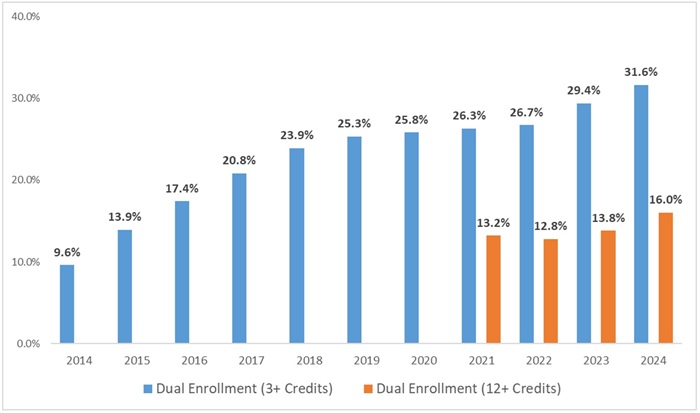
Buoyed by these policy developments, participation and attainment numbers have skyrocketed. Prior to 2015, roughly one in ten students earned at least three college credits through dual enrollment. Now, just over 30 percent of students exit high school with three or more credits, and about half that number—16 percent—earn almost a semester’s worth of college credit (twelve or more).
Figure 1: Percentage of students earning college credits via dual enrollment, graduating classes of 2014 to 2024
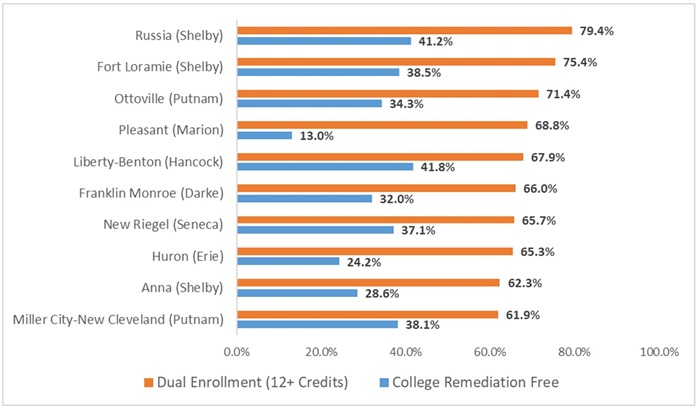
At first blush, the rapid rise of college credits being earned in high school might seem like cause for celebration, as more students are now earning credits that could put them on the fast-track to degrees. But there are also concerning signs in the data. In some districts, substantial numbers of students who are not actually “college ready” are participating in CCP and stockpiling college credits. Consider the figure below, which shows the ten districts with the highest percentage of students earning 12 or more credits, along with the percentage of students earning a remediation-free score on the ACT or SAT. These scores are established by the presidents of Ohio’s colleges and are based on research that relates scores to students’ likelihood of success in freshman-level coursework. We notice large disparities in the two rates. In Russia Local, 79 percent of its graduating class earned 12 or more dual-enrollment credits. Yet just 41 percent of the class met remediation-free standards. In Pleasant Local, 69 percent of students received nearly a semester of credit, even though a scant 13 percent achieved a remediation-free score.
Figure 2: Percentage of students earning 12 or more college credits versus college remediation-free rates, graduating class of 2024
What gives? How can students who haven’t met the remediation-free bar rack up so many college credits?
The answer lies in a policy loophole that allows non-college-ready students to participate in CCP. Under state law, students are eligible for the program if they achieve a remediation-free score on the ACT, SAT, or a handful of other alternative tests. So far, so good. Strict adherence to that entrance standard would ensure that only students who demonstrate clear academic readiness are allowed to take college-level courses. But here’s the twist: Under state administrative rules (authorized by statute), students can bypass exam-based standards and qualify for CCP based on their grade point average (GPA). Specifically, students are eligible if they have either a cumulative high school GPA of 3.0 or higher, or a 2.75–3.00 GPA and an A or B in a loosely defined “relevant high school course.”
In an era of rampant grade inflation, it’s not hard to imagine large numbers of marginally proficient students getting A’s and B’s, and thus qualifying for CCP through these alternative routes. This raises some thorny questions. Are CCP courses—mostly taken in high schools or online—truly college-level? Or are students taking courses that have been watered down for the sake of those who aren’t academically prepared, making them “college” classes in name only? And how will these students fare when they need to pass upper-level courses to complete their degree? Are we setting them up for failure if and when they continue their post-secondary education?
From the inception of CCP, Fordham has (unsuccessfully) urged more stringent eligibility requirements. Strong entrance standards would ensure the program is geared to academically prepared students and provides challenging, college-level content. Remember also that front-end requirements are especially critical in dual-enrollment settings because, unlike AP or IB programs, students are not required to pass a standardized exam at the end of the course to earn credit. Course credit in CCP hinges on the grades of teachers, who may not hold to rigorous standards.
Given that hundreds, possibly thousands, of non-college-ready students are availing themselves to CCP, Ohio policymakers should tighten eligibility requirements. One option is to simply remove the GPA-based alternatives and establish a strict college remediation-free standard based on exams. A more relaxed option might allow students to participate in CCP if they score within one standard error of the college remediation-free scores and have an unweighted high school GPA of 3.0 or above.[1]
Awarding college credit is serious business. It should be earned based on mastery of rigorous college-level material. But when non-college-ready students are racking up credits, it makes you wonder whether Ohio has set the dual-enrollment bar too low.
[1] This is a slightly modified version of Ohio’s earlier CCP eligibility requirements. In all variations of CCP policy, including the current one, students must meet a college’s admissions requirements, though these may not be very stringent for open-access two-year institutions.