Mobile Navigation

  • National
    • Policy
      • High Expectations
      • Quality Choices
      • Personalized Pathways
    • Research
    • Commentary
      • Gadfly Newsletter
      • Flypaper Blog
    • Events
    • Scholars Program
  • Ohio
    • Policy
      • Priorities
      • Media & Testimony
    • Research
    • Commentary
      • Ohio Education Gadfly Biweekly
      • Ohio Gadfly Daily
  • Charter Authorizing
    • Application
    • Sponsored Schools
    • Resources
  • About
    • Mission
    • Board
    • Staff
    • Career
Home
Home
Advancing Educational Excellence

Main Navigation

  • National
  • Ohio
  • Charter Authorizing
  • About

National Menu

  • Topics
    • Accountability & Testing
    • Advanced Education
    • Career & Technical Education
    • Charter Schools
    • Curriculum & Instruction
    • ESSA
    • Evidence-Based Learning
    • Facilities
    • Governance
    • Personalized Learning
    • Private School Choice
    • School Finance
    • Standards
    • Teachers & School Leaders
    • Think Again
  • Research
  • Commentary
    • Gadfly Newsletter
    • Flypaper Blog
    • Gadfly Podcast
  • Events
  • Scholars Program

Curriculum & Instruction

Displaying 1561-1590 of 1594 results
Commentary
3.24.2010
Curriculum & Instruction

Like the tide, great standards lift all boats

Kathleen Porter-Magee

There's a debate brewing about how much???if at all???great standards contribute to education reform. This week, the Wall Street Journal published an editorial saying that they are not as important to student achievement as universal choice.

Commentary
3.23.2010
Curriculum & Instruction

Common Core education standards get A- and B from Fordham experts

Kathleen Porter-Magee

Anyone who's been following the debate over national standards knows that two weeks ago, the National Governors Association (NGA) together with the Council of Chief State Schools Officers (CCSSO) released the much-anticipated public draft of the K-12 math and English language arts (ELA) Common Core State Standards.[quote]

Commentary
2.2.2010
Charter Schools, Curriculum & Instruction

Can failing schools be turned around or is it better to close them?

Watch our debate on school turnarounds vs. closures, and don't miss insightful and provocative comments from the panelists, including this one from Andres Alonso, CEO of Baltimore City Public Schools:

Commentary
1.20.2010
Curriculum & Instruction

Open source education

Stafford Palmieri

You can find whatever your heart desires on the internet, and that's in part thanks to something called open source. It's a bit of an amorphous term, but that hasn't stopped this Utah virtual charter school from diving in to this potentially revolutionizing movement. Open source is just as its name implies--open.

Commentary
1.13.2010
Curriculum & Instruction

Today's Quotable and Notable

Quotable: "I think it would be a tragedy to talk about Martin Luther King Jr., while not being able to talk about the fact that he had a strong Christian faith. I'm hoping that's not the direction we're headed." - Jonathan Saenz, Lobbyist, Free Market Foundation

Commentary
12.10.2009
Curriculum & Instruction

The implications of tracking and detracking

Our latest report, "Tracking and Detracking: High Achievers in Massachusetts Middle Schools ," analyzes the implications of tracking, or grouping students i

Commentary
10.30.2009
Curriculum & Instruction

Flypaper readers debate Education Schools and MUCH more

Amber M. Northern, Ph.D.

A week ago, I posted this in response to Secretary Duncan's speech about education schools at Teachers College. Over the course of several days, there were 11 comments posted that, when printed out, clocked in at 20 pages (single spaced, mind you).

Commentary
10.23.2009
Curriculum & Instruction

Arne Duncan and the E.D. Hirsch imperative

Amber M. Northern, Ph.D.

Whew, I just finished reading Secretary Duncan's??meaty address to the faculty and students at Teachers College at Columbia University.

Commentary
10.8.2009
Curriculum & Instruction

Fordham's newest report assesses Common Core education standards

The Fordham Institute's newest report???-Stars By Which to Navigate? Scanning National and International Education Standards in 2009--reviews the ???Common Core???

Commentary
9.8.2009
Curriculum & Instruction

Unschooling: the worst education idea... ever?

Chester E. Finn, Jr.

The worst education idea of the year turns out not to be a new idea at all. "Unschooling" has roots in Rousseau, in Summerhill, in John Holt and Ivan Illich and any number of other progressive/romantic/libertarian nihilists.

Commentary
7.10.2009
Curriculum & Instruction

Today's 'Quotable and Notable'

Quotable

Commentary
6.30.2009
Curriculum & Instruction

Today's 'Quotable and Notable'

Quotable

Commentary
6.26.2009
Curriculum & Instruction

David Whitman interview

David Whitman, fresh off of being honored by the American Independent Writers, has now done an interview with EducationNews.org about his book, Sweating the Small Stuff: Inner-City S

Report
8.15.2008
Curriculum & Instruction

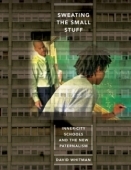
Sweating the Small Stuff: Inner-City Schools and the New Paternalism

David Whitman

The most exciting innovation in education policy in the last decade is the emergence of highly effective schools in our nation's inner cities, schools where disadvantaged teens make big gains in academic achievement. In this book, David Whitman takes readers inside six of these secondary schools—many of them charter schools—and reveals the secret to their success: They are paternalistic.

Commentary
3.21.2008
Curriculum & Instruction

The California Reading Revival

Michael J. Petrilli

Over at the "ELL Advocates" blog, whole language apologist Stephen Krashen makes a lame attempt to poke holes in Sol Stern's recent Fordham r

Commentary
3.20.2008
Curriculum & Instruction

Too much

For the same reason I'm opposed to sex-ed class in schools, I'm opposed to clubs like this. A parent sends his students to a public school to receive a rigorous education in the core curriculum.

Commentary
3.20.2008
Curriculum & Instruction

1.e4 e5 2.f4

Coby Loup

The New York Times reports today that Idaho will set aside somewhere from $200,000 to $600,000 to fund a pilot program that will make chess education available to all second- and third-graders. The state will use a curriculum called First Move, which was developed by the Seattle-based nonprofit Foundation for Chess.

Commentary
3.17.2008
Curriculum & Instruction

Obama's education solution in search of a problem

Michael J. Petrilli

Over at The Corner, Victor Davis Hanson wonders why Barack Obama is so worried about teaching students about oppression. He quotes a recent "news source":

Commentary
2.29.2008
Curriculum & Instruction

Ignorance is not bliss

Are we rearing a nation of ignorant students? This is the question posed in the latest report, Still at Risk, by Fordham's sister organization, Common Core.

Report
7.11.2007
Curriculum & Instruction, Governance

Beyond the Basics: Achieving a Liberal Education for All Children

Chester E. Finn, Jr., Diane Ravitch

America's true competitive edge over the long haul is not its technical prowess but its creativity, its imagination, its inventiveness. And those attributes are best inculcated not by skill-drill or 'STEM' but through liberal arts and sciences, liberally defined. Thus argues this new Fordham volume, edited by Chester E. Finn, Jr. and Diane Ravitch, which also explores what policymakers and educators at all levels can to do sustain liberal learning and sketches an unlovely future if we fail.

Report
1.29.2007
Evidence-Based Learning, Curriculum & Instruction

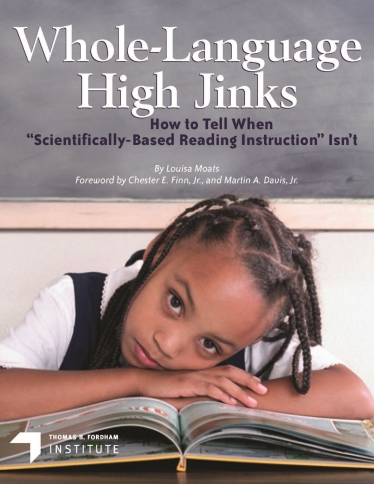
Whole-Language High Jinks

Louisa Moats

If you thought whole-language reading instruction had been relegated to the scrap heap of history, think again. Many such programs (proven to be ineffective) are still around, but they're hiding behind phrases like 'balanced literacy' in order to win contracts from school districts and avoid public scrutiny. Louisa Moats calls them out in Fordham's new report, Whole-Language High Jinks.

Report
10.24.2005
Curriculum & Instruction, Standards

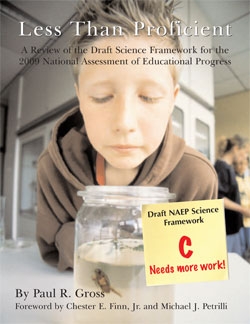
Less Than Proficient

Michael J. Petrilli, Chester E. Finn, Jr., Paul Gross

Almost every week a new report or commission decries the decline of America's preeminence in science, and calls for the nation's education system to raise standards in order for our economy to remain competitive with the rest of the world. Within this context, the National Assessment Governing Board is preparing to launch a new science assessment for 2009. Curriculum developers and textbook writers are likely to follow its lead. Fordham couldn't help but wonder: is the draft science Framework up to the challenge? Using much the same criteria applied in the Foundation's state science standards reviews (due out this December), our reviewers answered: no. As author (and esteemed biologist) Paul R. Gross wrote, The Framework is an interesting start, but there is much work to be done if it is to achieve its potential usefulness.

Report
9.14.2005
Accountability & Testing, Curriculum & Instruction

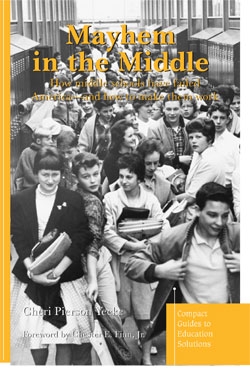
Mayhem in the Middle: How middle schools have failed America, and how to make them work

Chester E. Finn, Jr., Cheri Pierson Yecke

American middle schools have become the places "where academic achievement goes to die." So says Cheri Yecke, K-12 Education Chancellor of Florida and author of the new Fordham report Mayhem in the Middle: How middle schools have failed America, and how to make them work. Today's middle schools have succumbed to a concept of "middle schoolism" in which a strong academic curriculum is traded for one that focuses more on emotional and social development, and less on learning the basics. And the achievement data reflects "middle schoolism's" results. In 1999, U.S. eighth graders scored nine points below average on the TIMSS assessment of math. What's more, these same eighth graders had outperformed the average by 28 points as fourth graders in 1995! According to Fordham President Chester E. Finn, Jr., "Trying to fix high schools while ignoring middle schools is like bandaging a wound before treating it for infection."

Report
9.29.2004
Curriculum & Instruction

The Mad, Mad World of Textbook Adoption

Chester E. Finn, Jr., Diane Ravitch

Statewide textbook adoption, the process by which 21 states dictate the textbooks that schools and districts can use, is fundamentally flawed. It distorts the market, entices extremist groups to hijack the curriculum, enriches the textbook cartel, and papers the land with mediocre instructional materials that cannot fulfill their important education mission. Tinkering with it won't set it right, concludes this latest Fordham Institute report. Legislators and governors in adoption states should eliminate the process, letting individual schools, individual districts, or even individual teachers choose their own textbooks.

Report
4.13.2004
Curriculum & Instruction

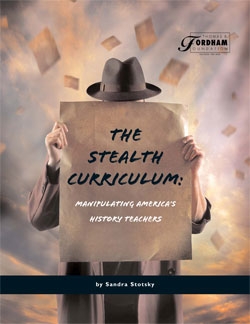
The Stealth Curriculum: Manipulating America's History Teachers

Sandra Stotsky

Widely used supplemental materials may be dangerous to educational health! These works often include hefty doses of political manipulation and ideological bias, courtesy of their authors. This study casts a wary glance toward materials that seldom come under scrutiny. This study is the fifth in a series dedicated to reforming social studies education.

Report
2.26.2004
Curriculum & Instruction

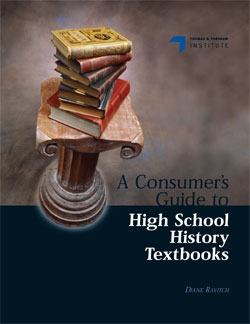
A Consumer's Guide to High School History Textbooks

Diane Ravitch

A Consumer's Guide to High School History Textbooks is a summary review of 12 widely used U.S. and world history textbooks.

Report
8.1.2003
Curriculum & Instruction

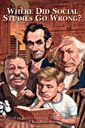
Where Did Social Studies Go Wrong?

Kathleen Porter-Magee, James Leming, Lucien Ellington

This new report from the Thomas B. Fordham Foundation consists of penetrating critiques by renegade social studies educators who fault the regnant teaching methods and curricular ideas of their field and suggest how it can be reformed. While nearly everyone recognizes that American students don't know much about history and civics, these analysts probe the causes of this ignorance-and lay primary responsibility at the feet of the social studies 'establishment' to which they belong.

Report
8.1.2003
Curriculum & Instruction

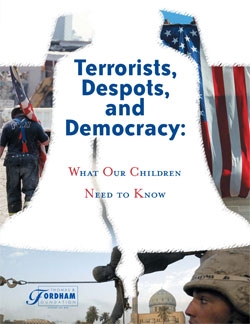
Terrorists, Despots, and Democracy: What Our Children Need to Know

Richard Rodriguez, Kenneth R. Weinstein, Victor Davis Hanson, Walter Russell Mead

This new report from the Thomas B. Fordham Foundation includes the voices of 29 political leaders, education practitioners, and cultural analysts who discuss what schools should teach about U.S. history, American ideals, and American civic life in the wake of 9/11, the war on terror, and the liberation of Iraq.

Report
8.1.2003
Curriculum & Instruction

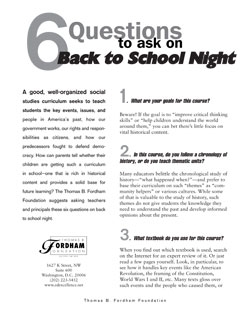
Six Questions to Ask on Back to School Night

A good, well-organized social studies curriculum seeks to teach students the key events, issues, and people in America's past, how our government works, our rights and responsibilities as citizens, and how our predecessors fought to defend democracy. How can parents tell whether their children are getting such a curriculum in school?one that is rich in historical content and provides a solid base for future learning? The Thomas B. Fordham Foundation suggests asking teachers and principals these six questions on back to school night.

Report
2.1.2003
Curriculum & Instruction

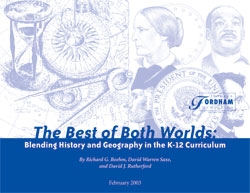
The Best of Both Worlds: Blending History and Geography in the K-12 Curriculum

David W. Saxe, David J. Rutherford, Richard G. Boehm

Geography plays a crucial role in shaping history, and the study of history provides an important context for students learning geography, but teachers rarely take advantage of the complementary nature of these subjects. This report shows how the study of U.S. history can be enriched by blending geography into the curriculum. The centerpiece is an innovative curriculum framework in which each historical period is supplemented and enriched by the introduction of relevant geography.

Pagination

  • First page « First
  • Previous page ‹ Previous
  • Page 46
  • Page 47
  • Page 48
  • Page 49
  • Page 50
  • Page 51
  • Page 52
  • Current page 53
  • Page 54
  • Next page Next ›
  • Last page Last »

Type

  • Book (3)
  • Commentary (1464)
  • Event (11)
  • Podcast (68)
  • Report (34)

Topics

  • Accountability & Testing (504)
  • Advanced Education (267)
  • Career & Technical Education (84)
  • Charter Schools (1117)
  • (-) Curriculum & Instruction (1594)
  • ESSA (129)
  • Evidence-Based Learning (837)
  • Facilities (25)
  • Governance (1416)
  • Personalized Learning (51)
  • Private School Choice (140)
  • School Finance (169)
  • Standards (190)
  • Teachers & School Leaders (1456)

Date

  • 2026 (121)
  • 2025 (158)
  • 2024 (142)
  • 2023 (148)
  • 2022 (197)
  • 2021 (203)
  • 2020 (170)
  • 2019 (94)
  • 2018 (13)
  • 2017 (5)
  • 2016 (46)
  • 2015 (76)
  • 2014 (50)
  • 2013 (38)
  • 2012 (15)
  • 2011 (83)
  • 2010 (6)
  • 2009 (8)
  • 2008 (6)
  • 2007 (2)
  • 2005 (2)
  • 2004 (3)
  • 2003 (4)
  • 2002 (1)
  • 2000 (2)
  • 1998 (1)
Fordham Logo

© 2026 The Thomas B. Fordham Institute
Privacy Policy
Usage Agreement

National

P.O. Box 110
Burke, VA 22009

202.223.5452

[email protected]

Ohio

P.O. Box 82291
Columbus, OH 43202

614.223.1580

[email protected]

Sponsorship

130 West Second Street, Suite 410
Dayton, Ohio 45402

937.227.3368

[email protected]