Mobile Navigation

  • National
    • Policy
      • High Expectations
      • Quality Choices
      • Personalized Pathways
    • Research
    • Commentary
      • Gadfly Newsletter
      • Flypaper Blog
    • Events
    • Scholars Program
  • Ohio
    • Policy
      • Priorities
      • Media & Testimony
    • Research
    • Commentary
      • Ohio Education Gadfly Biweekly
      • Ohio Gadfly Daily
  • Charter Authorizing
    • Application
    • Sponsored Schools
    • Resources
  • About
    • Mission
    • Board
    • Staff
    • Career
Home
Home
Advancing Educational Excellence

Main Navigation

  • National
  • Ohio
  • Charter Authorizing
  • About

National Menu

  • Topics
    • Accountability & Testing
    • Advanced Education
    • Career & Technical Education
    • Charter Schools
    • Curriculum & Instruction
    • ESSA
    • Evidence-Based Learning
    • Facilities
    • Governance
    • Personalized Learning
    • Private School Choice
    • School Finance
    • Standards
    • Teachers & School Leaders
    • Think Again
  • Research
  • Commentary
    • Gadfly Newsletter
    • Flypaper Blog
    • Gadfly Podcast
  • Events
  • Scholars Program

Curriculum & Instruction

Displaying 1141-1170 of 1594 results
Podcast
12.17.2019
Curriculum & Instruction, Teachers & School Leaders

The Education Gadfly Show: Why rural education matters

On this week’s podcast, Daniel Showalter, associate professor of math at Eastern Mennonite University and author of 

Commentary
12.17.2019
Curriculum & Instruction, Teachers & School Leaders

How districts can mitigate the harm of popular but low-quality online curriculum resources

Jennifer Dean, Jenni Aberli, Sarah Baughman, Bryan Drost, Joey Hawkins

Editor’s note: This article is the second in a two-part series written by the expert review team from Fordham’s recent study, The Suppleme

Commentary
12.13.2019
Curriculum & Instruction

Why we reviewers are wary about the popular online curriculum resources teachers are downloading

Jennifer Dean, Jenni Aberli, Sarah Baughman, Bryan Drost, Joey Hawkins

Editor’s note: This article is part one of two written by the expert review team from Fordham’s recent study, The Supplemental Curriculum Bazaar: Is What’s O

Commentary
12.11.2019
Curriculum & Instruction, Teachers & School Leaders

Dear teachers, most of the popular lessons you found online aren't worth using

Amber M. Northern, Ph.D., Michael J. Petrilli

Amazon unveiled a new online “storefront” called Amazon Ignite that will allow educators to earn money by publishing—online, of course—their original lesson plans, worksheets, games, and more. The entry into the curricular marketplace is obviously motivated by a perceived market opportunity—and that’s not wrong. The vast majority of teachers are supplementing their core curriculum or don’t have one to start with. Yet we know almost nothing about the quality of such supplementary materials. Our new study helps fill that void.

Commentary
12.11.2019
Curriculum & Instruction, Teachers & School Leaders

Reading between the lines: What states can do about America’s literacy challenge

Joanne Weiss

In her compelling new book, The Knowledge Gap, Natalie Wexler relates a story about a young girl in an elementary school in Washington, D.C., who, for over ten minutes during reading class, is busy drawing a picture on her reading worksheet. When Wexler asks what she’s doing, the little girl replies that she’s drawing clowns. “Why are you drawing clowns?” Wexler asks.

Commentary
12.11.2019
Curriculum & Instruction, Teachers & School Leaders

A heroic effort to right the civics ship

Chester E. Finn, Jr.

Civics education has been a problem forever, or so it seems, and if that problem feels more urgent today it’s because so many are dismayed by the erosion of civility and good citizenship in today’s America, as well as mounting evidence that younger generations are both woefully ignorant in this realm—check out

Podcast
12.11.2019
Curriculum & Instruction

The Education Gadfly Show: On online curriculum materials

On this week’s podcast, Morgan Polikoff, associate professor of education at USC, joins Mike Petrilli and David Griffith to talk about Fordham’s new re

Report
12.10.2019
Curriculum & Instruction, Teachers & School Leaders

The Supplemental Curriculum Bazaar: Is What's Online Any Good?

Morgan Polikoff, Jennifer Dean

Nearly all teachers today report using the Internet to obtain instructional materials, and many of them do so quite often. And while several organizations now offer impartial reviews of full curriculum products, very little is known about the content and quality of supplemental instructional materials.

Commentary
12.4.2019
Curriculum & Instruction

The different ways schools go about character development

Chester E. Finn, Jr.

The Content of Their Character: Inquiries into the Varieties of Moral Formation is dense and subtle, but it’s also informative and valuable, particularly for educators.

Podcast
12.4.2019
Accountability & Testing, Curriculum & Instruction

The Education Gadfly Show: The effects of early college programs

On this week’s podcast, Kristina Zeiser, senior researcher at American Institutes for Research, joins Mike Petrilli and David Griffith to talk a

Commentary
11.26.2019
Accountability & Testing, Curriculum & Instruction, Governance, Teachers & School Leaders

Time to press “pause” on credit recovery

Adam Tyner, Ph.D.

“It’s like some bullsh-t way to get kids to pass.” That’s the cynical description of high school “credit recovery” programs an eleventh grader gave to the New York Post last year. But cynicism appears to be in order.

Commentary
11.21.2019
Evidence-Based Learning, Charter Schools, Curriculum & Instruction

Social capital and schools’ opportunity equation

Bruno V. Manno

The words “American Dream” are shorthand for describing an individual’s pathway to opportunity and a successful life. Historically, K–12 schools provide young people with the foundational knowledge and skills they need for achieving success and the American Dream.

Commentary
11.20.2019
Curriculum & Instruction

Curriculum advocates: Prepare for a long, hard struggle

Robert Pondiscio

American education is taking a welcome and overdue interest in curriculum, but there’s no reason to expect that to result in sudden and dramatic gains in student achievement, especially for our lowest-performing children. Curriculum does not exist in isolation; schools are complex institutions with competing priorities, almost hard-wired to metabolize and neutralize any “fix.” Curriculum advocates should brace themselves for years of struggle, identify allies doing the actual work, and prepare to protect their flank.

Commentary
11.13.2019
Evidence-Based Learning, Curriculum & Instruction, Governance, Teachers & School Leaders

All 2019 Wonkathon submissions are in. Here’s what the wonks proposed.

Tran Le

The past decade’s shift to significantly higher academic standards and more rigorous assessments means that many more students are now far below grade-level expectations. In recent months and years, there’s been much debate about how best to help such students catch up.

Podcast
11.13.2019
Curriculum & Instruction

The Education Gadfly Show: The Scarcity of High-Quality Early Childhood Education

On this week’s podcast, Carrie Gillispie, senior analyst in P–12 policy at The Education Trust, joins Mike Petrilli and David G

Commentary
11.13.2019
Accountability & Testing, Evidence-Based Learning, Curriculum & Instruction, Teachers & School Leaders

How magnet programs can promote diversity and turn around failing schools

Pedro Enamorado

What can be done to rescue failing schools?

Commentary
11.12.2019
Evidence-Based Learning, Curriculum & Instruction, Governance, Teachers & School Leaders

Driving learning for all students: A framework for Multi-Tiered Systems of Support

Bonnie Hain, Laura Slover

In our work with schools at CenterPoint, we often are asked to help design or support the implementation of research-based, high quality curriculum. Almost invariably, discussions with school leaders turn to the connections among and between the core curriculum and the tiered supports for students who are off grade level and struggling to advance.

Commentary
11.12.2019
Curriculum & Instruction, Governance, Teachers & School Leaders

The best way to help students who are several grade levels behind is to do a better job of following their progress, or lack of it, in the long term

Barbara Gottschalk

By the time struggling students reach middle school, it’s pretty obvious it took time for them to get several grade levels behind. It’s also obvious we have numerous ways to help these students. I’m guessing many other submissions to Wonkathon 2019 describe these strategies and approaches. What isn’t so obvious, however, is what’s causing some students to struggle.

Commentary
11.12.2019
Evidence-Based Learning, Curriculum & Instruction, Teachers & School Leaders

Closing student achievement gaps requires both rigorous grade-level work and personalized learning

Britt Neuhaus

National data indicate that approximately three of every five students begin the school year below grade level, with those numbers even higher for low-income students and students of color.

Commentary
11.11.2019
Accountability & Testing, Evidence-Based Learning, Charter Schools, Curriculum & Instruction, Teachers & School Leaders

2019 WONKATHON RUNNER-UP: Teachers and curricula aren’t enough for below-grade-level students. They also require scalable strategies tailored to their needs.

Jessica Varevice

Editor’s note: This was the second-place submission, out of nineteen, to Fordham’s 2019 Wonkathon, in which we asked participants to answer the question: “What’s the best way to help students who are several grade levels behind?”

Commentary
11.11.2019
Accountability & Testing, Evidence-Based Learning, Curriculum & Instruction, Teachers & School Leaders

Fostering teacher quality and expertise is the best way to help students who are several grade levels behind

Candice McQueen

Research and our personal experience tell us that the single most important factor affecting student achievement is the quality of the teacher in the classroom. No technology, tool, or other seemingly magic program can help students who are several grade levels behind get back on track and ultimately thrive.

Commentary
11.8.2019
Accountability & Testing, Evidence-Based Learning, Curriculum & Instruction, Governance, Teachers & School Leaders

To ensure success for all students, state assessment makers must be learners, too

In the last two decades, since states began implementing standardized testing under No Child Left Behind, there has been much debate about the value of those assessments. In Louisiana, where I serve as an Assistant Superintendent, we know measurement of student learning is critical, and tests hold the power to define the academic bar for all students.

Commentary
11.8.2019
Evidence-Based Learning, Curriculum & Instruction, Teachers & School Leaders

If we want to accelerate student learning, we need to redesign the school day

David Liben, Meredith Liben

Historically, literacy instruction in the United States privileges the privileged. It starts in the earliest grades, when less systematic approaches favored in many early literacy curricula privilege students who arrive at school more comfortable with language and books.

Commentary
11.7.2019
Curriculum & Instruction, Teachers & School Leaders

Parent communication, not data, is the problem when it comes to below-grade-level students

Lisa Murdock

Let me preface my response on the fact that I am I am a mom and a scientist. I dabble in education policy because it has such a profound impact on my household and my community.

Commentary
11.7.2019
Evidence-Based Learning, Curriculum & Instruction, Teachers & School Leaders

Engaging families, early and often, is the best way to help students who are several grade levels behind

Vidya Sundaram, Elisabeth O’Bryon

During this past summer, Family Engagement Lab facilitated a gathering of parents to discuss parent-teacher partnerships at their elementary school. During the discussion, the group moderator pulled us aside to let us know that a parent was there because her child had been retained a grade and she did not know why.

Commentary
11.6.2019
Evidence-Based Learning, Curriculum & Instruction, Teachers & School Leaders

Staying on the shelf: Why rigorous new curricula aren’t being used

David Steiner

I want that quiet rapture again. I want to feel the same powerful, nameless urge that I used to feel when I turned to my books.

Commentary
11.6.2019
Evidence-Based Learning, Curriculum & Instruction, Teachers & School Leaders

From Play-doh to Plato: All students need to grapple with grade-level text

Harriett Janetos

My thirty-plus years in teaching have taken me on an unplanned path from Plato to Play-doh. When I taught Advanced Placement English to seniors three decades ago, I would have confidently bet against finding myself twenty-five years later teaching kindergarteners how to read.

Commentary
11.6.2019
Evidence-Based Learning, Curriculum & Instruction, Teachers & School Leaders

Tailored paths that can combine pre-, on-, and post-grade skills are the solution for students below grade level in math

Joel Rose

Standards are written to reflect the instructional path that students should follow throughout their educational journey. In math, that includes concepts such as basic algebraic thinking in the early elementary grades, multiplying fractions in the fifth grade, working with ratios and rates in the sixth grade, and so forth. Let’s call this the “standard instructional path.”

Event
11.5.2019
Accountability & Testing, Curriculum & Instruction, Advanced Education, Standards

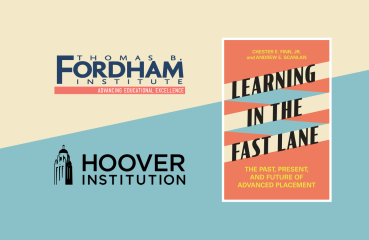
Is Advanced Placement Good for Everyone? A Discussion with Partisans and Doubters

Learning in the Fast Lane: The Past, Present, and Future of Advanced Placement (Princeton, 2019), the new book by Chester Finn and Andrew Scanlan, tells the story of the Advanced Placement (AP) program, widely regarded as the gold standard for academic rigor in American high schools.

Commentary
11.5.2019
Accountability & Testing, Curriculum & Instruction, Teachers & School Leaders

To help students who are behind, find out if their assignments match their goals

Dan Weisberg

A typical sixth-grade teacher we work with serves a wide range of students. She likely has some who read above grade level, some who are a little behind, a student who doesn’t speak English but has excellent reading and writing skills in another language, and several students—some of whom have diagnosed learning disabilities—who are reading at an early elementary level.

Pagination

  • First page « First
  • Previous page ‹ Previous
  • Page 35
  • Page 36
  • Page 37
  • Page 38
  • Current page 39
  • Page 40
  • Page 41
  • Page 42
  • Page 43
  • Next page Next ›
  • Last page Last »

Type

  • Book (3)
  • Commentary (1464)
  • Event (11)
  • Podcast (68)
  • Report (34)

Topics

  • Accountability & Testing (504)
  • Advanced Education (267)
  • Career & Technical Education (84)
  • Charter Schools (1117)
  • (-) Curriculum & Instruction (1594)
  • ESSA (129)
  • Evidence-Based Learning (837)
  • Facilities (25)
  • Governance (1416)
  • Personalized Learning (51)
  • Private School Choice (140)
  • School Finance (169)
  • Standards (190)
  • Teachers & School Leaders (1456)

Date

  • 2026 (121)
  • 2025 (158)
  • 2024 (142)
  • 2023 (148)
  • 2022 (197)
  • 2021 (203)
  • 2020 (170)
  • 2019 (94)
  • 2018 (13)
  • 2017 (5)
  • 2016 (46)
  • 2015 (76)
  • 2014 (50)
  • 2013 (38)
  • 2012 (15)
  • 2011 (83)
  • 2010 (6)
  • 2009 (8)
  • 2008 (6)
  • 2007 (2)
  • 2005 (2)
  • 2004 (3)
  • 2003 (4)
  • 2002 (1)
  • 2000 (2)
  • 1998 (1)
Fordham Logo

© 2026 The Thomas B. Fordham Institute
Privacy Policy
Usage Agreement

National

P.O. Box 110
Burke, VA 22009

202.223.5452

[email protected]

Ohio

P.O. Box 82291
Columbus, OH 43202

614.223.1580

[email protected]

Sponsorship

130 West Second Street, Suite 410
Dayton, Ohio 45402

937.227.3368

[email protected]