Commentary
On this week’s Education Gadfly Show podcast, Brian Kisida, Associate Professor at
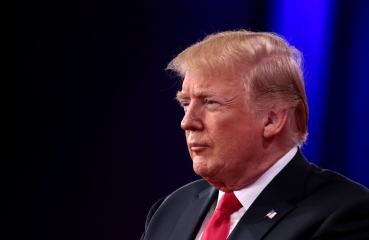
Though President Trump’s new executive order “Ending Radical Indoctrination in K-12 Schooling” contains many elements that resonate with me philosophically and educationally, I’m having trouble reconciling it with the longstanding statutory prohibition on Uncle Sam mucking with
Editor’s note: This was first published on the author’s Substack, Governing Right
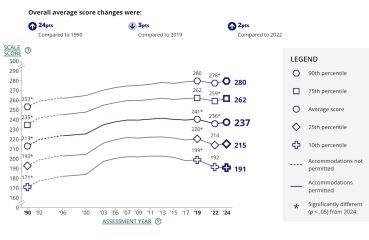
The data are out, and as everybody now knows—and as Mike Petrilli foresaw—they’re pretty grim. Here’s the short version, straight from the National Center for Education Statistics:
From its founding, the lodestone of the Knowledge Matters Campaign has been evidence-based, content-rich English language arts (ELA) curricula. A possible unintended consequence of the success of this movement has been reduced instruction in science and social studies.

Ignite Reading is one of many tutoring interventions unleashed upon America’s schools to try to mitigate learning loss experienced by students in the wake of pandemic-era school closures.

Despite working longer hours and experiencing higher levels of stress


In the highly polarized debate over critical race theory (CRT), one side claims that CRT is nonexistent in schools, while the other argues that it is an epidemic. A new survey finds that the truth is somewhere in between—and that, regardless, most students are forming their beliefs based on sources outside of school.

On this week’s Education Gadfly Show podcast, Tim Daly, CEO of EdNavigator, joins Mike and David to discuss w
The Supreme Court agreed on Friday afternoon to hear a landmark religious charter schools case out of Oklahoma, and it’s a much bigger deal than you might imagine.
The education world was greeted with encouraging news over the weekend when President Trump announced that former Tennessee education commissioner Penny Schwinn would serve as the next U.S. Deputy Secretary of Education. Schwinn’s track record should complement Secretary-designate Linda McMahon’s skill set, and augurs well for a new administration that is being pulled in different directions on education policy.
Editor’s note: This piece was also published on the author’s new Substack, The Next 30 Years.
When I graduated from high school, the first charter schools in America were just opening their doors. But I have advocated for, worked with, and supported their right to serve families for more than twenty years now.

Remedial courses can soak up time and money (with often poor results), but federal


A New York Times analysis finds that top colleges didn’t see major changes in student diversity following the end of affirmative action in 2023.

On this week’s Education Gadfly Show podcast, Rick Hess, the director of education policy studies
“A supernova is what happens when a star has reached the end of its life and explodes in a brilliant burst of light. Supernovas can briefly outshine entire galaxies and radiate more energy than our sun will in its entire lifetime.” —Nancy Taylor Tillman, Space.com

The forthcoming results from the 2024 National Assessment of Educational Progress—due out on January 29—are likely to be bad, bad, bad. The term we may hear a lot is that “the bottom is falling out,” if the scores for low-performing students in particular continue to plummet.
President-elect Donald Trump is about to return to Washington with a ragtag coalition, united in their rejection of the status quo. Yet this shared opposition has also led to a rash of infighting over a range of policy issues.
It’s not with pleasure that I tackle the too-frequent topic of school shootings. The latest in Madison, Wisconsin, claimed the lives of two and left six others injured, just a stone’s throw away from my own school. Friends of mine were on the scene.

The Advanced Placement (AP) program, celebrating its seventieth anniversary this year, has largely lived up to the promise of encouraging and rewarding ambitious high school students looking to prepare themselves for college rigor.


Professor Douglas Fuchs is challenging the prevailing belief that inclusion is best for students with disabilities, arguing that the evidence supporting it is weak and that many students may benefit more from specialized instruction in separate settings.

On this week’s Education Gadfly Show podcast, Barbara Biasi, assistan
After more than a decade of trying to launch some form of education savings account/tax credit program for parent choice, it looks like Idaho’s legislature is likely to pass legislation this year to get it done.

Once upon a time, such as when I entered college in 1962, it was possible—correction: it was relatively easy—to graduate in three years with the help of Advanced Placement scores that you submitted upon arrival.

Is the conventional wisdom right that both parties have abandoned education reform? The evidence indicates that it’s mostly fair when it comes to Democrats, but not so fair when it comes to the GOP—at least if we look beyond Washington to the states.