Mobile Navigation

  • National
    • Policy
      • High Expectations
      • Quality Choices
      • Personalized Pathways
    • Research
    • Commentary
      • Gadfly Newsletter
      • Flypaper Blog
    • Events
    • Scholars Program
  • Ohio
    • Policy
      • Priorities
      • Media & Testimony
    • Research
    • Commentary
      • Ohio Education Gadfly Biweekly
      • Ohio Gadfly Daily
  • Charter Authorizing
    • Application
    • Sponsored Schools
    • Resources
  • About
    • Mission
    • Board
    • Staff
    • Career
Home
Home
Advancing Educational Excellence

Main Navigation

  • National
  • Ohio
  • Charter Authorizing
  • About

National Menu

  • Topics
    • Accountability & Testing
    • Advanced Education
    • Career & Technical Education
    • Charter Schools
    • Curriculum & Instruction
    • ESSA
    • Evidence-Based Learning
    • Facilities
    • Governance
    • Personalized Learning
    • Private School Choice
    • School Finance
    • Standards
    • Teachers & School Leaders
    • Think Again
  • Research
  • Commentary
    • Gadfly Newsletter
    • Flypaper Blog
    • Gadfly Podcast
  • Events
  • Scholars Program

Topics

Displaying 31-60 of 523 results
Commentary
12.5.2013

Fewer, Clearer, Higher: How the Common Core State Standards Can Change Classroom Practice

Melissa Reynolds

“Fewer, clearer, higher”: These were the words that guided the crafting of the Common Core State Standards.

Commentary
12.5.2013
Charter Schools

A common app for uncommon schools

The Education Gadfly

For a decade, the nonprofit Institute for Innovation in Public Choice (IIPSC) has helped the cities of New York, Boston, Denver, and New Orleans bring order to the Wild West of school choice, using the one-two punch of economic theory and custom software.

Commentary
12.5.2013
Advanced Education

Gifted education—what I saw, what I’m learning

Chester E. Finn, Jr.

I’m halfway through an ambitious research project, in which I examine how other countries educate their high-ability kids in the hope that we might pick up tips that would prove useful in improving the woeful state of “gifted education” in the U.S.

Commentary
12.5.2013

The Polish education system is no joke

Terry Ryan

Poland’s gains in mathematics and science on the 2012 PISA assessments made big news in the United States. The impressive achievements by fifteen-year-old Polish youngsters contrast starkly with the scores of American youngsters. U.S.

Commentary
12.5.2013

Financing the education of high-need students

Chester E. Finn, Jr.

America’s approach to the education of children with disabilities is antiquated, costly, and ineffective. “Special education” as we know it is broken—and repainting the surface won’t repair it. It cries out for a radical overhaul.

Commentary
12.4.2013

Observations from the front line: Ohio debates the Common Core

Chad L. Aldis

A House committee hearing on the Common Core lasts until 1:00 in the morning.

Commentary
12.4.2013

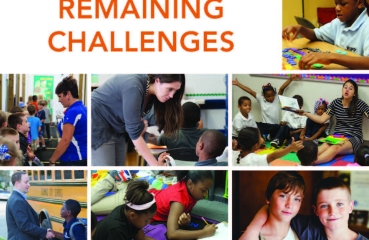
Remodeled Report Cards, Remaining Challenges

Kathryn Mullen, Aaron Churchill

The performance of Fordham-sponsored schools for the 2012-13 school year.
Commentary
12.3.2013
Curriculum & Instruction

How bad are the Common Core lessons on the Gettysburg Address?

Tim Shanahan

Welcome to the new Common Core kerfuffle.

Commentary
12.3.2013

PISA and Occam’s Razor

Michael J. Petrilli

Commentary
12.3.2013

What I’ve been reading

The Tennessee Charter School Center (TCSC) is out with a terrific new report on Nashville’s schools landscape.

Commentary
12.2.2013

SIG’s Downfall: Judge, and be judged, by proficiency rates

Michael J. Petrilli

Commentary
11.27.2013
Charter Schools

Why and how parents choose schools

The Friedman Foundation for Educational Choice recently released a study that seeks to better understand the decision-making processes of parents who send their children to private schools.

Commentary
11.26.2013

Recent teacher-eval reform happenings

For those of you following the interesting and ever-changing world of educator evaluations, a few recent happenings may be worth a look.

Commentary
11.26.2013

Cincinnati's magnet school campouts: What do they really mean?

Jeff Murray

Do highly-motivated parents guarantee a seat in a good school?

Commentary
11.25.2013
Charter Schools

Testing voucher students: A reasonable quality-control measure with minimal threats to school diversity

Adam Emerson

Jay Greene wants school-choice supporters to relax the testing mandates in the newest and largest voucher programs in the nation.

Commentary
11.25.2013

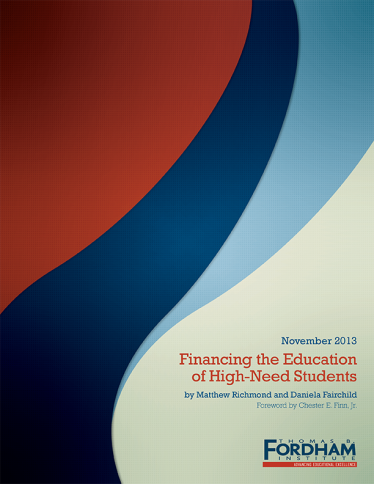
Financing the Education of High-Need Students

Matt Richmond, Daniela Fairchild

The Thomas B.

Commentary
11.25.2013

Interesting SIG vs. non-SIG comparisons


Report
11.24.2013
School Finance

Financing the Education of High-Need Students

Matt Richmond, Daniela Fairchild

School districts face an enormous financial burden when it comes to educating our highest-need students. Financing the Education of High-Need Students focuses on three specific challenges that are often encountered when districts—especially small ones—grapple with the costs of serving their highest-need special-education students.
Commentary
11.22.2013
Charter Schools

Meanwhile, in ACTUAL federal-overreach news...

It seems the largest battle in education policy today centers on the question of whether or not the Obama administration cheerleading for the Common Core State Standards, a state-led initiative, represents an existential threat to federalism.

Commentary
11.22.2013

SIG and the lessons of history

There is no doubt in my mind that Secretary of Education Arne Duncan cares deeply about disadvantaged kids. He deserves our admiration and respect for bringing a renewed sense of urgency to addressing America’s persistently failing schools.

Commentary
11.21.2013

Right-sizing the classroom

Michael J. Petrilli, Amber M. Northern, Ph.D.

Last month, USA Today reported that officials in the Brevard County Schools had broken Florida state law—on purpose. Their offense? Placing more kids in classrooms than Florida’s Class Size Reduction statute allows.

Commentary
11.21.2013

Class size isn’t as important as who’s at the front of the room

For decades, lowering class size has been touted as a strategy for improving student learning, despite loads of research asserting that it is not an effective solution.

Commentary
11.21.2013

America’s rural schools and communities

What if I told you there were millions of American boys and girls living in communities where half of students are low-income, just one in five adults has earned a bachelor’s degree, and only 27 percent of high school graduates go on to college?

Commentary
11.21.2013

Another set of worthwhile reads

Recently, 2013 NAEP results were made public, and, as is typical for such bi-annual releases, there was lots of excitement, somberness, and everything in between.

Commentary
11.20.2013

Stay the course on the Common Core

Michael J. Petrilli

For years, the Thomas B.

Commentary
11.20.2013

Great teachers can teach more students, even without raising class sizes

Bryan C. Hassel

Fordham released a paper by Michael Hansen projecting the impact on student learning if excellent eighth-grade teachers—those in the top 25 percent—were responsible for six or twelve more students per class.

Commentary
11.20.2013
Charter Schools

Times have changed, so must we: Seize the day, adapt, and thrive

On Tuesday, November 19, I gave the keynote speech at the American Center for School Choice event tied to the release of the report of its Commission on Faith-based Schools. The following is the text (edited for length) as it was prepared.

Commentary
11.19.2013

Making Americans: Civic education and the Common Core

This post is adapted from comments prepared by Stefanie Sanford for the Manhattan Institute event on Civic Education and the Common Core.

Commentary
11.19.2013

If you like your federal education policy, you can keep it!

Commentary
11.19.2013

Right-sizing the Classroom: Making the Most of Great Teachers

In the overwhelming majority of American classrooms, pupils are divided roughly equally among teachers of the same grade in the same school. Parceling them out uniformly is viewed as fair to teachers—and doing otherwise might be seen as unfair. Parents might wonder, too.

Pagination

  • First page « First
  • Previous page ‹ Previous
  • Page 1
  • Current page 2
  • Page 3
  • Page 4
  • Page 5
  • Page 6
  • Page 7
  • Page 8
  • Page 9
  • Next page Next ›
  • Last page Last »

Type

  • Commentary (486)
  • Event (2)
  • Report (18)
  • Video (17)

Topics

  • Accountability & Testing (1)
  • Advanced Education (9)
  • Charter Schools (84)
  • Curriculum & Instruction (38)
  • Governance (8)
  • Private School Choice (1)
  • School Finance (5)
  • Standards (4)
  • Teachers & School Leaders (3)

Date

  • (-) 2013 (0)
  • September 2013 (73)
  • October 2013 (78)
  • November 2013 (63)
  • May 2013 (97)
  • March 2013 (109)
  • June 2013 (93)
  • July 2013 (73)
  • January 2013 (110)
  • February 2013 (101)
  • December 2013 (55)
  • August 2013 (108)
  • April 2013 (103)
Fordham Logo

© 2026 The Thomas B. Fordham Institute
Privacy Policy
Usage Agreement

National

P.O. Box 110
Burke, VA 22009

202.223.5452

[email protected]

Ohio

P.O. Box 82291
Columbus, OH 43202

614.223.1580

[email protected]

Sponsorship

130 West Second Street, Suite 410
Dayton, Ohio 45402

937.227.3368

[email protected]