Mobile Navigation

  • National
    • Policy
      • High Expectations
      • Quality Choices
      • Personalized Pathways
    • Research
    • Commentary
      • Gadfly Newsletter
      • Flypaper Blog
    • Events
    • Scholars Program
  • Ohio
    • Policy
      • Priorities
      • Media & Testimony
    • Research
    • Commentary
      • Ohio Education Gadfly Biweekly
      • Ohio Gadfly Daily
  • Charter Authorizing
    • Application
    • Sponsored Schools
    • Resources
  • About
    • Mission
    • Board
    • Staff
    • Career
Home
Home
Advancing Educational Excellence

Main Navigation

  • National
  • Ohio
  • Charter Authorizing
  • About

National Menu

  • Topics
    • Accountability & Testing
    • Advanced Education
    • Career & Technical Education
    • Charter Schools
    • Curriculum & Instruction
    • ESSA
    • Evidence-Based Learning
    • Facilities
    • Governance
    • Personalized Learning
    • Private School Choice
    • School Finance
    • Standards
    • Teachers & School Leaders
    • Think Again
  • Research
  • Commentary
    • Gadfly Newsletter
    • Flypaper Blog
    • Gadfly Podcast
  • Events
  • Scholars Program
High Expectations

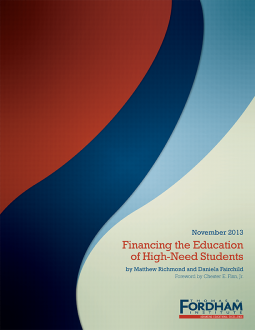
Financing the Education of High-Need Students

Matt Richmond Daniela Fairchild
11.24.2013
11.24.2013

School districts face an enormous financial burden when it comes to educating our highest-need students. Financing the Education of High-Need Students focuses on three specific challenges that are often encountered when districts—especially small ones—grapple with the costs of serving their highest-need special-education students.

Districts and states could put these recommendations into practice today, without waiting for reforms or help from Washington:

  1. District Cooperatives: Many districts—including charter schools, which often comprise their own mini-districts—do not have the requisite size and capacity to serve high-need students effectively and affordably. Multi-district co-ops allow for both economies-of-scale and better service-delivery for these children.
  2. Student Funding Based on Multiple Weights: Special education funding systems based on average student needs may be easily administered, but they can also lead to inefficient and ineffective resource allocations. Weighted student funding is a tiered system of resource allocation that allows for a more rational and efficacious distribution of funds, enabling districts with more high-need pupils (or pupils who require more dollars to pay for their IEP-mandated services) to receive more money while jurisdictions that need less receive less. Basing those weights on services needed by children rather than disability diagnoses significantly improves the accuracy of this system.
  3. Exceptional-Need Funds: Districts (especially small ones) sometimes find themselves overwhelmed by the high cost of educating one or two particularly needy children. This type of fund, managed and predominantly financed by the state, acts as an insurance mechanism for districts that can’t cover the full cost of educating high-need pupils along with all others under their purview.
Policy Priority:
High Expectations
Topics:
School Finance
Tags: Individualized Education Program
DOWNLOAD PDF

Matt Richmond is a research analyst at the Thomas B. Fordham Institute. Matt’s work incorporates an even mix of quantitative and qualitative methods, primarily on special education and school staffing patterns. Recently, his interests have included the Institute’s “pathways out of poverty” project and issues of …

View Full Bio

Daniela was the development manager and policy analyst for the Fordham Institute. Donning many hats at Fordham prior to this role, Daniela had worked as a research intern, research assistant, and interim new-media manager. She started her career as a teacher of students with emotional and behavioral disabilities, and as a high school rowing coach. Prior to joining forces with TBFI, Daniela was a Global Development…

View Full Bio

Related Resources

view
High Expectations

Shifting Trends in Special Education

Janie Scull, Amber M. Northern, Ph.D. 5.25.2011
NationalReport
view
High Expectations

Boosting the Quality and Efficiency of Special Education

Nathan Levenson 8.28.2012
NationalReport
view
Standards & Accountability

Applying Systems Thinking to Improve Special Education in Ohio

Nathan Levenson 9.4.2012
OhioReport
Fordham Logo

© 2026 The Thomas B. Fordham Institute
Privacy Policy
Usage Agreement

National

P.O. Box 110
Burke, VA 22009

202.223.5452

[email protected]

Ohio

P.O. Box 82291
Columbus, OH 43202

614.223.1580

[email protected]

Sponsorship

130 West Second Street, Suite 410
Dayton, Ohio 45402

937.227.3368

[email protected]