
High Tech, Low Standards: High School in the Age of Distraction
A new national survey finds that school-issued devices, AI misuse, and grade inflation are undermining learning and leaving many students feeling unprepared for the future.
Failing Our Brightest Kids: The Global Challenge of Educating High-Ability Students
In Failing Our Brightest Kids, Chester E. Finn, Jr. and Brandon L. Wright argue that for decades, the United States has focused too little on preparing students to achieve at high levels.
Schools of Thought: A Taxonomy of American Education Governance
Questions of education governance are often considered moot by policymakers, who typically assume that the governance challenges plaguing their local schools are both universal and inevitable. Given the ubiquity of everything from local school boards to state superintendents, this seems to be a logical assumption.
Who Should Be in Charge When School Districts Go into the Red?
School districts across the land are contending with rising education costs and constrained revenues. Yet state policies for assisting school districts in financial trouble are uneven and complex. Interventions are often haphazard, occur arbitrarily, and routinely place politics over sound economics.
Education for Upward Mobility
At the Education for Upward Mobility conference, the Thomas B.
Building a Lattice for School Leadership
Over the past decade, the English government has revamped that country’s approach to school leadership. At the center of the reform is the sensible idea that school leadership needs to be a team endeavor. While not a new idea—there’s been for years plenty of discussion about “distributed leadership” on both sides of the pond—the Brits got busy actually making it happen as opposed to jawboning about it. Central to their leadership structure is the formalization of three levels of school leaders, each with distinct roles and responsibilities: headteachers who lead schools (equivalent to the principal’s role in the U.S.), senior leaders or deputy heads who assist the headteacher (similar to the vice principal role in American education but...

Redefining the School District in Michigan
What happens when policymakers create statewide school districts to turn around their worst-performing public schools?
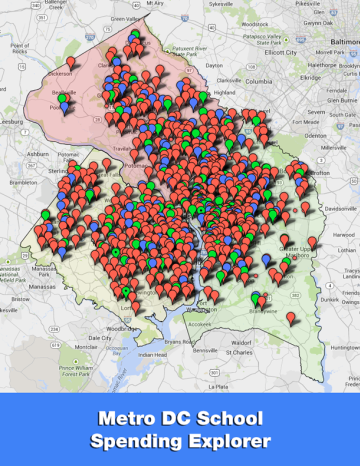
Metro D.C. School Spending Explorer
The Thomas B. Fordham Institute set out to answer a basic (yet complicated) question: how much does each school in the D.C. metro area spend on day-to-day operations for each student it enrolls? In the Metro D.C.
The Hidden Half: School Employees Who Don't Teach
The number of non-teaching staff in the United States (those employed by school systems but not serving as classroom teachers) has grown by 130 percent since 1970. Non-teachers—more than three million strong—now comprise half of the public school workforce. Their salaries and benefits absorb one-quarter of current education expenditures.
Lacking Leaders: The Challenges of Principal Recruitment, Selection, and Placement
A school’s leader matters enormously to its success and that of its students and teachers. But how well are U.S. districts identifying, recruiting, selecting, and placing the best possible candidates in principals’ offices? To what extent do their practices enable them to find and hire great school leaders? To what degree is the principal’s job itself designed to attract outstanding candidates?
State Accountability in the Transition to Common Core
The Common Core is at a critical juncture. While many surveys show that support for the standards themselves remains strong, implementation has not been without major challenges.

Expanding the Education Universe: A Fifty-State Strategy for Course Choice
After twenty years of expanding school-choice options, state leaders, educators, and families have a new tool: course choice, a strategy for students to learn from unconventional providers that might range from top-tier universities or innovative community colleges to local employers, labs, or hospitals.
The State Education Agency: At the Helm, Not the Oar
In recent years, policymakers and reform advocates have viewed State Education Agencies (SEAs) as the lead organizations for implementing sweeping reforms and initiatives in K–12 education—everything from Race to the Top grants and federal waivers to teacher-evaluation systems and online schools.