
High Tech, Low Standards: High School in the Age of Distraction
A new national survey finds that school-issued devices, AI misuse, and grade inflation are undermining learning and leaving many students feeling unprepared for the future.

Charter School Deserts: High-Poverty Neighborhoods with Limited Educational Options
2016–17 was one of the slowest-growth years for charter schools in recent memory. Nobody knows exactly why, but one hypothesis is saturation: With charters having achieved market share of over 20 percent in more than three dozen cities, perhaps school supply is starting to meet parental demand, making new charters less necessary and harder to launch.

Is There a Gifted Gap? Gifted Education in High-Poverty Schools
Schools have long failed to cultivate the innate talents of many of their young people, particularly high-ability girls and boys from disadvantaged and minority backgrounds. This failure harms the economy, widens income gaps, arrests upward mobility, and exacerbates civic decay and political division.
The Academic and Behavioral Consequences of Discipline Policy Reform
One important question about school discipline is whether it helps or harms those being disciplined. But a second, equally important question is whether a push to reduce the number of suspensions is harmful to the rule-abiding majority.
Rating the Ratings: An Analysis of the 51 ESSA Accountability Plans
The Every Student Succeeds Act grants states more authority over their accountability systems than did No Child Left Behind, but have they seized the opportunity to develop school ratings that are clearer and fairer than those in the past?
Teacher Absenteeism in Charter and Traditional Public Schools
Research confirms what common sense dictates: Students learn less when their teachers aren’t there. According to multiple studies, a ten-day increase in teacher absence results in at least ten fewer days of learning for students.
Rating the Ratings: Analyzing the First 17 ESSA Accountability Plans
The Every Student Succeeds Act (ESSA) grants states more authority over their school accountability systems than did No Child Left Behind (NCLB)—meaning that states now have a greater opportunity to design improved school ratings. Rating the Ratings: Analyzing the First 17 ESSA Accountability Plans examines whether states are making the most of the moment.
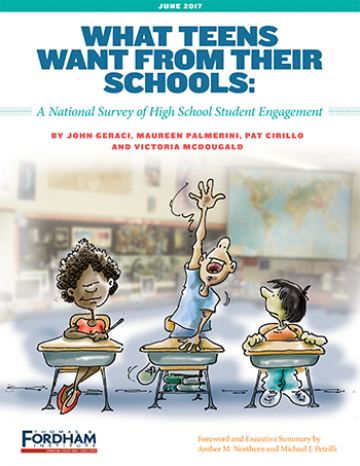
What Teens Want From Their Schools: A National Survey of High School Student Engagement
Among high school students who consider dropping out, half cite lack of engagement with the school as a primary reason, and 42 percent report that they don’t see value in the schoolwork they are asked to do.
Three Signs That a Proposed Charter School Is at Risk of Failing
It’s well established that some charter schools do far better than others at educating their students. This variability has profound implications for the children who attend those schools. Yet painful experience shows that rebooting or closing a low-performing school is a drawn-out and excruciating process.
Leveraging ESSA to Support Quality-School Growth
Under the Every Student Succeeds Act, the federal School Improvement Grants program is gone, but the goal of school improvement remains. States must now use seven percent of their Title I allocation for these efforts, but are no longer constrained by a prescribed menu of intervention options.
The Right Tool for the Job: Improving Reading and Writing in the Classroom
Although it’s been almost seven years since many states took the important step of elevating their academic standards by adopting the Common Core, teachers and administrators across the country still bemoan the lack of reliable information about which instructional materials are high-quality and best aligned to the new standards.
(No) Money in the Bank: Which Retirement Systems Penalize New Teachers?
A new teacher’s pension is supposed to be a perk. The truth is that for the majority of the nation’s new teachers, what they can anticipate in retirement benefits will be worth less than what they contributed to the system while they were in the classroom, even if they stay for decades.
Undue Process: Why Bad Teachers in Twenty-Five Diverse Districts Rarely Get Fired
Countless studies have demonstrated that teacher quality is the most important school-based determinant of student learning, and that removing ineffective teachers from the classroom could greatly benefit students.