
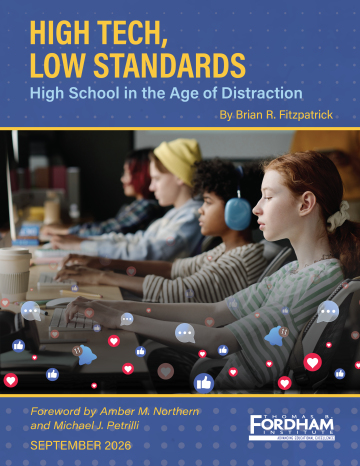
High Tech, Low Standards: High School in the Age of Distraction
A new national survey finds that school-issued devices, AI misuse, and grade inflation are undermining learning and leaving many students feeling unprepared for the future.
To Dream the Impossible Dream: Four Approaches to National Standards and Tests for America's Schools
Education policy leaders from across the political spectrum flesh out and evaluate several forms that national standards and testing could take.
Fund the Child
Everyone agrees that education funding today is a mess. But a broad, bipartisan coalition now urges a new method of funding our public schools--one that finally ensures the students who need the most receive it, that empowers school leaders to make key decisions, and that opens the door to public school choice. It's a 100 percent solution to the most pressing problems in public school funding--and it's called Weighted Student Funding.
The State of State World History Standards 2006
Is America's K-12 education system preparing students for life in a global village? Unfortunately, it is not. Renowned historian Walter Russell Mead, author of this report, found that thirty-three states deserved D or F grades for their world history standards.
Trends in Charter School Authorizing
Belatedly, policymakers and researchers are recognizing that quality charter schools depend on quality charter school authorizing. This report presents findings from a pioneering national examination of the organizations that sponsor, oversee, and hold accountable U.S. charter schools. Its primary aim is to describe and characterize these crucial but little-known organizations.
Playing To Type? (2006)
Most discussions of charter schools assume that they are monolithic. This study, the first of its kind, categorizes the nation's charter schools into a robust typology according to their educational approaches. It also provides demographic information by type,how many are in each category, what their student populations look like, and so forth,and makes a first attempt at comparing their test scores. The result is a much richer and more accurate picture of the charter school universe.
Fwd: Teacher Education: Coming Up Empty
The nation's leading teacher educators made a startling admission last year in their tome, Studying Teacher Education, by conceding there's little evidence that what happens in ed schools helps in the K-12 classroom. Kate Walsh explores why teacher educators are ignoring the achievement gap and, thus, consigning their field to irrelevance.
The State of State Science Standards 2005
Science education in America is under attack, with "discovery learning" on one flank and the Discovery Institute on the other. That's the core finding of this comprehensive review of state science standards, the first since 2000. Written by pre-eminent biologist Paul R. Gross, The State of State Science Standards 2006 finds that even though the majority of states have reworked, or completely re-written, their science standards over the past five years, we're no better off now than before. The good news is that many of the standards are easily fixed. The public's anxiety about the future of our nation's scientific prowess is palpable,and reasonable. How serious are we in addressing their concerns?
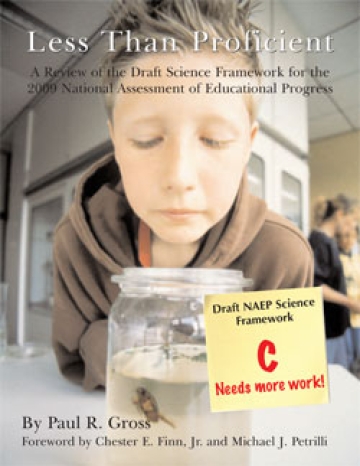
Less Than Proficient
Almost every week a new report or commission decries the decline of America's preeminence in science, and calls for the nation's education system to raise standards in order for our economy to remain competitive with the rest of the world. Within this context, the National Assessment Governing Board is preparing to launch a new science assessment for 2009. Curriculum developers and textbook writers are likely to follow its lead. Fordham couldn't help but wonder: is the draft science Framework up to the challenge? Using much the same criteria applied in the Foundation's state science standards reviews (due out this December), our reviewers answered: no. As author (and esteemed biologist) Paul R. Gross wrote, The Framework is an interesting start, but there is much work to be done if it is to achieve its potential usefulness.
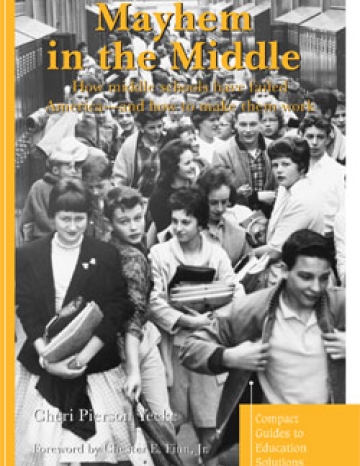
Mayhem in the Middle: How middle schools have failed America, and how to make them work
American middle schools have become the places "where academic achievement goes to die." So says Cheri Yecke, K-12 Education Chancellor of Florida and author of the new Fordham report Mayhem in the Middle: How middle schools have failed America, and how to make them work. Today's middle schools have succumbed to a concept of "middle schoolism" in which a strong academic curriculum is traded for one that focuses more on emotional and social development, and less on learning the basics. And the achievement data reflects "middle schoolism's" results. In 1999, U.S. eighth graders scored nine points below average on the TIMSS assessment of math. What's more, these same eighth graders had outperformed the average by 28 points as fourth graders in 1995! According to Fordham President Chester E. Finn, Jr., "Trying to fix high schools while ignoring middle schools is like bandaging a wound before treating it for infection."
Personality Test: The dispositional dispute in teacher preparation today, and what to do about it
The standards of the National Council for Accreditation of Teacher Excellence (NCATE) are of critical import for America's future teaching corps and will wield disproportionate influence for decades to come. Over the past fifteen years, 25 states have outsourced the approval of teacher preparation programs to NCATE by adopting or adapting its standards as their own; the other 25 have various 'partnerships' with the organization. Which makes it all the more disturbing that central to these standards is the call for teachers to possess certain 'dispositions' such as particular attitudes toward 'social justice.' As Professor William Damon of Stanford University explains in Fordham's latest Fwd: Arresting Insights in Education, NCATE's framing of the 'dispositions' issue has given education schools 'unbounded power over what candidates may think and do.' This is leading to (understandable) charges of ideological arm-twisting and Orwellian mind-control.
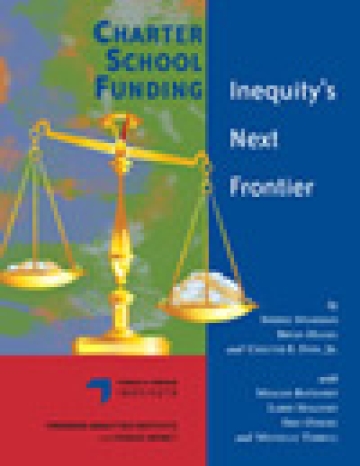
Charter School Funding: Inequity's Next Frontier
Of all the controversies swirling around the nation's charter schools, none is more hotly contested than the debate over funding. Into the fray leaps Charter School Funding: Inequitys Next Frontier, the most comprehensive and rigorous study ever undertaken of how public charter schools are funded, state by state, and how their revenues measure up to dollars received by district-run schools.
Fwd: It's All About the Kids
In just more than five years, Mary Anne Stanton has led 13 Catholic schools from high-poverty Washington, D.C. neighborhoods into a consortium that has not only strengthened each school's financial health, but has also greatly improved the academic performance of the children the schools are charged with educating. To get there, she's installed a new standards-based curriculum, shaken up old bureaucratic approaches, and streamlined operations. In its latest Fwd: Arresting Insights in Education, the Thomas B. Fordham Foundation presents a compelling story of just how much change can be made by one determined school leader with a vision.