
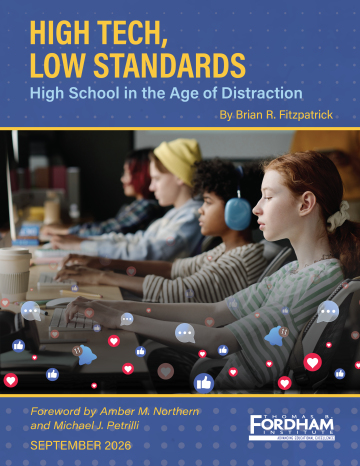
High Tech, Low Standards: High School in the Age of Distraction
A new national survey finds that school-issued devices, AI misuse, and grade inflation are undermining learning and leaving many students feeling unprepared for the future.
Too Good to Last: The True Story of Reading First
Too Good to Last: The True Story of Reading First is an in-depth and alarming study of Reading First's betrayal. Under the leadership of White House domestic policy chief Margaret Spellings and with support from Congress, Reading First was to provide funding to primary-reading programs that were based on scientific research. Backlash and brouhaha followed. Aggrieved whole-language program proprietors complained bitterly that their wares couldn't be purchased with Reading First funds. Then the administration turned its back on Reading First, allowing the program to be gutted and starved of funding.
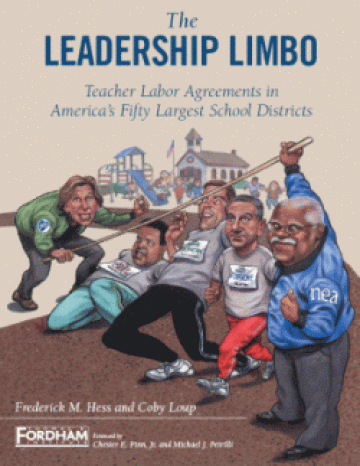
The Leadership Limbo
In the era of No Child Left Behind, principals are increasingly held accountable for student performance. But are teacher labor agreements giving them enough flexibility to manage effectively? The Leadership Limbo: Teacher Labor Agreements in America's Fifty Largest School Districts, answers this question and others.
Advanced Placement and International Baccalaureate: Do They Deserve Gold Star Status?
This report examines whether the reputation the Advanced Placement and International Baccalaureate programs have for academic excellence is truly deserved. Our expert reviewers looked at the four AP and IB courses most similar to the core content areas in American high schools--English, history, math, and science--and found that, in general, the courses do warrant praise. In a few cases, they deserve gold stars.
Alternative Certification Isn't Alternative
At first glance, the explosive growth of 'alternative' teacher certification--which is supposed to allow able individuals to teach in public schools without first passing through a college of education--appears to be one of the great success stories of modern education reform. But, as this report reveals, alternative certification programs have so far failed to provide a real alternative to traditional education schools. In fact, they represent a significant setback for education reform advocates.
Beyond the Basics: Achieving a Liberal Education for All Children
America's true competitive edge over the long haul is not its technical prowess but its creativity, its imagination, its inventiveness. And those attributes are best inculcated not by skill-drill or 'STEM' but through liberal arts and sciences, liberally defined. Thus argues this new Fordham volume, edited by Chester E. Finn, Jr. and Diane Ravitch, which also explores what policymakers and educators at all levels can to do sustain liberal learning and sketches an unlovely future if we fail.
The Autonomy Gap
Though most public school principals believe that effective leadership of their schools requires authority over personnel decisions (e.g., staff selection, deployment, dismissal), they report having little such authority in practice. Based on a series of interviews with a small sample of district and charter-school principals, the report shows that most district principals encounter a sizable gap between the extent and kinds of authority that leaders need to be effective and the authority that they actually have.
Crystal Apple: Education Insiders' Predictions for No Child Left Behind's Reauthorization
January 8, 2007, was the fifth birthday of the No Child Left Behind Act. This isn't just another milestone to be celebrated (or mourned). The law is now due for an update from Congress. But will NCLB be reauthorized on schedule? What changes are likely? No one knows for sure, but the ubiquitous 'Washington insiders' might be in a better position than others to cast prognostications. While not a 'representative sample' of thousands, their inside knowledge adds valuable insight.
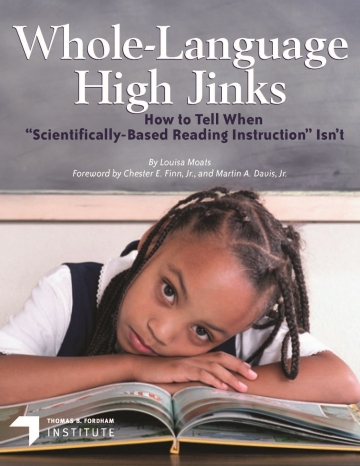
Whole-Language High Jinks
If you thought whole-language reading instruction had been relegated to the scrap heap of history, think again. Many such programs (proven to be ineffective) are still around, but they're hiding behind phrases like 'balanced literacy' in order to win contracts from school districts and avoid public scrutiny. Louisa Moats calls them out in Fordham's new report, Whole-Language High Jinks.
2006 Thomas B. Fordham Foundation Sponsorship Accountability Report
For information on Fordham's unique role as a charter school sponsor in Ohio, there's no better source than The Thomas B. Fordham Foundation Sponsorship Accountability Report 2005-06. The report offers a comprehensive account of Fordham's sponsorship policies and practices-as well as individual profiles of all Fordham-sponsored schools. Included in the profiles are descriptions of each school's educational program, school philosophy, and overall academic performance based on state achievement data.
The Fordham Report 2006: How Well Are States Educating Our Neediest Children?
The Fordham Report 2006: How Well Are States Educating Our Neediest Children? appraises each state according to thirty indicators across three major categories: student achievement for low-income, African-American, and Hispanic students; achievement trends for these same groups over the last 10-15 years; and the state's track record in implementing bold education reforms. It finds that just eight states can claim even moderate success over the past 15 years at boosting the percentage of their poor or minority students who are at or above proficient in reading, math or science.
The State of State Standards 2006
Two-thirds of schoolchildren in America attend class in states with mediocre (or worse) expectations for what their students should learn. That's just one of the findings of Fordham's The State of State Standards 2006, which evaluates state academic standards. The average state grade is a 'C-minus'--the same as six years earlier, even though most states revised their standards since 2000.