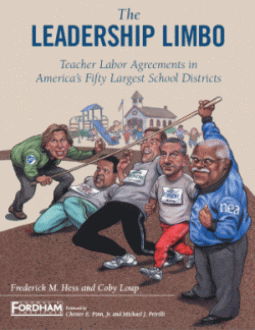
In the era of No Child Left Behind, principals are increasingly held accountable for student performance. But are teacher labor agreements giving them enough flexibility to manage effectively? The Leadership Limbo: Teacher Labor Agreements in America's Fifty Largest School Districts, answers this question and others.
The main findings:
- Thirty, or more than half, of the 50 districts have labor agreements that are ambiguous. The collective bargaining agreements and the formal board policies in these districts appear to grant leaders substantial leeway to manage assertively, should they so choose.
- Fifteen of the 50 districts are home to Restrictive or Highly Restrictive labor agreements. Nearly 10 percent of the nation's African-American K-12 students population attend school in the 15 lowest-scoring districts-making these contracts major barriers to more equal educational opportunity.
- The study also found that districts with high concentrations of poor and minority students tend to have more restrictive contracts than other districts-another alarming indication of inequity along racial and class lines.
- The labor agreements of the nation's 50 largest districts are particularly restrictive when it comes to work rules.
- Most of these agreements are also quite restrictive when it comes to rewarding teachers for service in hard-to-staff subject areas such as math and science, with 31 actually prohibiting districts from doing so.
Individual District Reports
Albuquerque Public Schools (NM)
Anne Arundel County Public Schools (MD)
Austin Independent School District (TX)
Baltimore City Public School System (MD)
Baltimore County Public Schools (MD)
Brevard County School District (FL)
Broward County School District (FL)
Charlotte-Mecklenburg Schools (NC)
City of Chicago School District (IL)
Clark County School District (NV)
Cleveland Municipal City School District (OH)
Cobb County School District (GA)
Cypress-Fairbanks Independent School District (TX)
Dallas Independent School District (TX)
Dekalb County School System (GA)
Denver Public Schools (CO)
Detroit Public Schools (MI)
Duval County School District (FL)
Fairfax County Public Schools (VA)
Fort Worth Independent School District (TX)
Fresno Unified School District (CA)
Fulton County Schools (GA)
Granite School District (UT)
Guilford County Schools (NC)
Gwinnett County Public Schools (GA)
Hawaii Department of Education (HI)
Hillsborough County School District (FL)
Houston Independent School District (TX)
Jefferson County Public Schools (CO)
Jefferson County Public Schools (KY)
Jordan School District (UT)
Long Beach Unified School District (CA)
Los Angeles Unified School District (CA)
Memphis City Schools (TN)
Mesa Public Schools (AZ)
Metropolitan Nashville Public Schools (TN)
Miami-Dade County Public Schools (FL)
Milwaukee Public Schools (WI)
Montgomery County Public Schools (MD)
New York City Public Schools (NY)
Northside Independent School District (TX)
Orange County School District (FL)
Palm Beach County School District (FL)
Pinellas County School District (FL)
Polk County School District (FL)
Prince Georges County Public Schools (MD)
San Diego Unified School District (CA)
School District of Philadelphia (PA)
Virginia Beach City Public Schools (VA)
Wake County Schools (NC)
Related Resources
Click here to read the "In A Nutshell" summary of The Leadership Limbo.
Click here to see the fifty districts ranked from top to bottom.
Panel Discussion
On February 20, Frederick M. Hess, co-author of The Leadership Limbo, was joined by the following distinguished panelists to discuss the report:
- Dr. Terry Grier, Superintendent, Guilford County (NC) Schools
- Gail Littlejohn, Senior Vice President and Chief Operating Officer, Center for Reform of School Systems
- Bill Raabe, Director of Collective Bargaining and Member Advocacy, National Education Association
- Moderator: Chester E. Finn, Jr., President, Fordham Institute
Opening remarks from Chester Finn and panelists
Chester Finn asks panelists questions