Mobile Navigation

  • National
    • Policy
      • High Expectations
      • Quality Choices
      • Personalized Pathways
    • Research
    • Commentary
      • Gadfly Newsletter
      • Flypaper Blog
    • Events
    • Scholars Program
  • Ohio
    • Policy
      • Priorities
      • Media & Testimony
    • Research
    • Commentary
      • Ohio Education Gadfly Biweekly
      • Ohio Gadfly Daily
  • Charter Authorizing
    • Application
    • Sponsored Schools
    • Resources
  • About
    • Mission
    • Board
    • Staff
    • Career
Home
Home
Advancing Educational Excellence

Main Navigation

  • National
  • Ohio
  • Charter Authorizing
  • About

National Menu

  • Topics
    • Accountability & Testing
    • Advanced Education
    • Career & Technical Education
    • Charter Schools
    • Curriculum & Instruction
    • ESSA
    • Evidence-Based Learning
    • Facilities
    • Governance
    • Personalized Learning
    • Private School Choice
    • School Finance
    • Standards
    • Teachers & School Leaders
    • Think Again
  • Research
  • Commentary
    • Gadfly Newsletter
    • Flypaper Blog
    • Gadfly Podcast
  • Events
  • Scholars Program

The Education Gadfly Weekly

Sign Up to Receive Fordham Updates

We'll send you quality research, commentary, analysis, and news on the education issues you care about.
Thank you for signing up!
Please check your email to confirm the subscription.

The Education Gadfly Weekly: School choice is a better instrument for racial justice than critical race theory

Volume 21, Number 37
9.16.2021
9.16.2021

The Education Gadfly Weekly: School choice is a better instrument for racial justice than critical race theory

Volume 21, Number 37
view
Quality Choices

School choice is a better instrument for racial justice than critical race theory

The outlook has gotten bleak for the anti-racist and CRT movements in U.S. classrooms, as Americans saw these ideas in action and largely recoiled from them. But there's another K–12 strategy for achieving racial justice: school choice.

Daniel Buck 9.16.2021
NationalFlypaper

School choice is a better instrument for racial justice than critical race theory

Daniel Buck
9.16.2021
Flypaper

Blinding ourselves to America’s achievement woes

Chester E. Finn, Jr.
9.16.2021
Flypaper

Ohio data show the pandemic's heavy toll on student achievement and the importance of in-person learning

Vladimir Kogan | Stéphane Lavertu
9.16.2021
Flypaper

What U.S. teens think about their futures—and the country’s

Jeremy Smith
9.16.2021
Flypaper

The Education Gadfly Show #787: How the Delta variant is impacting back-to-school season

9.16.2021
Podcast

Cheers and Jeers: September 16, 2021

The Education Gadfly
9.16.2021
Flypaper

What we're reading this week: September 16, 2021

The Education Gadfly
9.16.2021
Flypaper
view

Blinding ourselves to America’s achievement woes

Chester E. Finn, Jr. 9.16.2021
Flypaper
view
1

Ohio data show the pandemic's heavy toll on student achievement and the importance of in-person learning

Vladimir Kogan, Stéphane Lavertu 9.16.2021
Flypaper
view

What U.S. teens think about their futures—and the country’s

Jeremy Smith 9.16.2021
Flypaper
view

The Education Gadfly Show #787: How the Delta variant is impacting back-to-school season

Michael J. Petrilli, John Bailey, David Griffith, Ph.D., Amber M. Northern, Ph.D. 9.16.2021
Podcast
view

Cheers and Jeers: September 16, 2021

The Education Gadfly 9.16.2021
Flypaper
view

What we're reading this week: September 16, 2021

The Education Gadfly 9.16.2021
Flypaper
view

School choice is a better instrument for racial justice than critical race theory

Daniel Buck
9.16.2021
Flypaper

Over a year ago, Americans watched a Black man die under a police officer’s knee. They saw statistics detailing the disparities between Whites and Blacks and earnestly sought a means for justice in our society. They were left asking “why” and “what can we do”?

Racism in America became the political issue—and rightly so. Black-White disparities persist in household income, incarceration, educational attainment, healthcare, wealth, and more. Efforts to close these gaps get bipartisan support. In the aftermath of George Floyd’s murder, roughly 40 percent of Americans say they changed their views on race. Protests swept the country. Books like How to Be an Anti-Racist and White Fragility became New York Times bestsellers. In the latter’s case, it claimed the title two years after its publication.

Concurrently, critical race theorists became the self-anointed purveyors of racial progress in America. Its dogma, they’ll tell you, is the sole avenue for racial justice. By Ibram Kendi’s estimation, there’s no such thing as nonracist; any action or policy is either racist or antiracist. One either accepts critical race theory and all its conclusions or not.

Except, one year later things look less welcoming to the anti-racist and CRT movements. Parents are protesting at school board meetings. Centrist publications are running op-eds against it. Most striking to me, well over half of Americans have an unfavorable opinion of critical race theory. What changed?

In short, Americans saw these ideas in action. They wanted justice for George Floyd and action against racist cops and racist systems. But they did not then expect racialized affinity groups, privilege walks, and ethnomathematics. They did not want an ideology that “questions the very foundations of the liberal order, including equality theory, legal reasoning, enlightenment rationalism, and neutral principles of constitutional law,” one that ascribes neutral principles like hard work and objectivity to “whiteness.”

In my own teaching, I have watched many students struggle through the system. Anton was one example. Despite his endless positivity, his school featured near-daily fights and a staff seemingly impotent to improve the school. His situation was tenuous, but he made it. He didn’t need the consciousness-raising activities that we’ve seen make headlines. He needed reading instruction, lunch, and a job.

The view that our contemporary politics has only one narrative of racial progress and it is encompassed in the anti-racist rhetoric is a historical aberration. In reality, there has always run a conflict between how to define and achieve social progress. The conflicts arose in the tensions between Abraham Lincoln and John Brown or Booker T. Washington, and between W.E.B. Du Bois and Martin Luther King Jr. or Malcolm X—parallel lines running through history between radical and moderate reformers.

While each of those figures had both strengths and flaws, my intent is merely to expose this historical disagreement. In contemporary America, the moderate wing has lately been battered and is still weak, but can now be seen gaining strength. In contrast to Kendi and DiAngelo are voices like John McWhorter and Coleman Hughes. They are questioning the central tenets and rhetoric of anti-racism while advancing alternative policies for progress. We ought to do the same in response to CRT as it loses some traction.

So far, the conservative response to anti-racism and CRT in schools has been aggressive contention and, in many states, outright bans. However, like a town with a polluted well, we can sanction it all we want, but until we furnish an alternative—another source of water, another solution to the real racial disparities that people perceive—bans will only foster resentment. People yearn for justice and will take what they can get unless something better comes along. I submit that something better calls for an approach to progress that maintains our commitment to small government and individual liberty.

In a recent op-ed, McWhorter gave one such example: instructional reform. We know how to teach reading, he contends. Even so, many schools rely on methods of reading instruction that find little to no support in research. Through tutoring and other such privileges, students from affluent backgrounds develop the necessary phonemic awareness and background knowledge necessary for literacy regardless of the classroom instruction they receive, while those in poverty are left floundering.

An emphasis on reading instruction recently brought Mississippi from the bottom of NAEP scores to near the top. Mirroring its emphasis on early reading instruction could similarly lift up struggling readers in the other forty-nine states without the need for politicized classroom activities.

But it’s charter schools and school choice legislation that would together restructure the American education system along far more just lines. To begin, school choice would undo many of the lingering effects of historical racism. Where redlining blocked African Americans from securing mortgages, thereby barring them from accruing wealth through homeownership, modern day school-zoning laws effectively lock minority students into underfunded or underperforming schools, thereby barring them from accruing intellectual capital. Understood so, school-zoning laws are a modern-day iteration of redlining. School choice breaks this de facto segregationist holdover from a bygone era.

At the same time, charter schools freed from bureaucratic mandates can more effectively respond to a local community’s needs and preferences. A comprehensive study from Stanford found that—whereas White students actually fared worse at charter schools—poor, Black, Hispanic, and special education students fared better. Many of our nation’s biggest charter systems outperform affluent district schools despite working with predominantly poor students.

After decades and decades of debate, we will not solve our problems by asking K–12 classroom teachers to teach one side’s approach. Neither should we simply ban anything that smacks of critical race theory. Rather we need a substantive alternative, both in ideology and practical policy, with which to supplant pernicious ideas. Americans want racial justice. It’s time we provide policy, practices, and theories actually accomplish just that.

view

Blinding ourselves to America’s achievement woes

Chester E. Finn, Jr.
9.16.2021
Flypaper

Much as happened after A Nation at Risk, the U.S. finds itself facing a bleak education fate, even as many deny the problem. Back then, however, the denials came mostly from the education establishment, while governors, business leaders, and even U.S. presidents seized the problem and launched the modern era of achievement-driven, results-based education reform. There was a big divide between what educators wanted to think about their schools—all’s well but send more money—and what community, state, and national leaders were prepared to do to rectify their failings. Importantly, those reform-minded leaders were joined by much of the civil rights community and other equity hawks, mindful that the gravest education problems of all were those faced by poor and Black and Brown youngsters.

Today, by contrast, we’re surrounded by denial on all sides, including today’s version of equity hawks, and we see little or nothing by way of reform zeal or political leadership, save for a handful of reddish states where school choice initiatives continue to flourish. We certainly see nothing akin to the bipartisan commitment to better school outcomes, higher standards, reduced achievement gaps, and results-based accountability that characterized much of the previous forty years.

Yet today’s core education problem is much the same as what the Excellence Commission called attention to way back then:

[T]he educational foundations of our society are presently being eroded by a rising tide of mediocrity that threatens our very future as a Nation and a people. What was unimaginable a generation ago has begun to occur—others are matching and surpassing our educational attainments.... Our society and its educational institutions seem to have lost sight of the basic purposes of schooling, and of the high expectations and disciplined effort needed to attain them.

That was 1983. Today we find continued signs of weak achievement, arguably more menacing because, during the intervening decades, so many other countries, friend and foe alike, have advanced much farther in education, while the U.S., with a few happy exceptions, has either run in place or slacked off. If you don’t believe me, check any recent round of TIMSS or PISA results.

As other countries’ children surpass ours in core skills and knowledge, we face ominous long-term consequences for our national well-being, including both our economy and our security. But what’s even more worrying than the achievement problem is the loss of will to do much about it and the creative ways we’re finding to conceal from ourselves the fact that it’s even a problem—and doing that without necessarily even being aware of the concealment. These strategies take five main forms.

First, we change the subject. Instead of focusing on achievement failings, academic standards, and measurable outcomes, we’ve been redirecting our attention and energy to other aspects of education and schooling, such as social-emotional learning, and to beefing up inputs and services, such as universal pre-K and community college.

Second, we’ve been denouncing and canceling the metrics by which achievement (and its shortfalls and gaps) have long been monitored, declaring that tests are racist, barring their use for admission to selective schools and colleges, and curbing their use as outcome measures (e.g., states scrapping end-of-course exams) without substituting any other indicators of achievement. I understand the ESSA testing “holiday” as Covid-19 raged and schools closed in spring 2020. But why did the College Board abruptly terminate the “SAT II” tests that for many college applicants served as a great way to demonstrate their mastery of particular subjects? Combine what was already a teacher-inspired (and parent-encouraged) “war on testing” with the allegation that tests worsen inequity and you have a grand example of executing the messenger.

Third, we’ve been monkeying with the measures themselves, usually in the name of making them “fairer” and broadening access to them. Policymakers have built innumerable workarounds for kids who struggle with high school graduation tests, such as MCAS, third grade “reading gates,” and the remaining end-of-course exams. The College Board has twice “renormed” the SATs to bring the median back up to 500, and that practice has been joined by other score boosters, such as the invitation to mix and match one’s top scores from the verbal and math sections on different test dates rather than simply adding the scores that one earns on a given day.

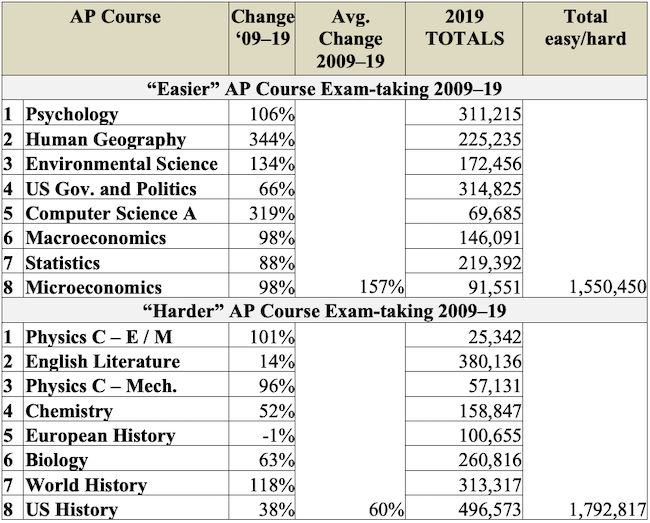
Less noticed, I think, is how the gold-standard Advanced Placement program has also been getting easier to do well on. It’s true that AP minders at the College Board and ETS have striven to maintain their scoring standards from year to year within each AP subject, even when transforming the exams to align with new subject “frameworks.” But what’s also happened over time is that the number of AP subjects (and exams) has grown—now it’s a whopping thirty-eight—and many of the newer arrivals are known to be easier things to learn and easier exams to take. The internet abounds with lists of which are the hard and which are the easy AP exams and advice as to which ones you should take to maximize your odds of scoring well. These, typically, are isolated single-year subjects, often new to the AP portfolio, such as psychology, “human geography,” and environmental science, although the most popular exam on the “easy” lists is the long-time stalwart called “U.S. Government and Politics,” i.e., AP’s version of civics.

Moreover, participation in the easier APs has been rising much faster than the harder ones. With my colleague Pedro Enamorado’s help, we gauged the rate of increase (in one case a slight decline) over the decade 2009–19 in AP exam-taking in eight of the toughest and eight of the easiest AP courses. We found an average growth rate during that period of 60 percent in the former versus 157 percent in the latter. While the overall rise in AP participation is a bright spot in American education, within it we see this hint that today’s high school students are gradually reaching for the less demanding forms of it.

Table 1. Change in Advanced Placement exam-taking, 2009–19, by exam difficulty and subject

1222

Fourth, we’re inflating grades and scores to make things look better than they are. Grade inflation in high schools and colleges is widespread and well documented, now exacerbated by “no zero” grading policies and suchlike at the elementary- and middle-school levels. Standardized tests, too, can subtly be made to show higher scores—as many states did by setting their proficiency cut-points low—and even the National Assessment will gradually raise all boats as it supplies more “universal design” assists to test takers. (It may also artificially reduce learning gaps.)

Fifth and finally, we’re scrapping consequences. In a no-fault, free-pass world that scoffs at both metrics and merit and practices the equivalent of social promotion and open admission for students, teachers, and schools alike, results-based accountability goes out the window. Out with it goes the central action-forcing element of standards-based education reform. Which is, in a sense, the ultimate erasure of achievement-related education problems and their replacement by an all’s-well-and-don’t-bother-telling-me-otherwise-much-less-doing-anything-about-it attitude. Which, let me say again, is pretty much what we faced from the education establishment after A Nation at Risk. The difference is that now it’s coming from the political system, the culture, and many onetime reformers, too, and we don’t appear to have any leaders pushing back against it. Instead, they’re fussing about how many trillions more to pump into the schools.

Not a good prospect. Call me an old fuddy-duddy and you won’t be wrong. But close your eyes to America’s achievement problems and their denial and you will be very wrong.

view
1

Ohio data show the pandemic's heavy toll on student achievement and the importance of in-person learning

Vladimir Kogan | Stéphane Lavertu
9.16.2021
Flypaper

The Covid-19 pandemic caused unprecedented disruptions to teaching and learning across America, including school closures, sudden changes to instructional delivery, economic hardship, and social isolation. In January 2021, to measure the magnitudes of these harms, we looked to our home state of Ohio and released a report that examined the impact of the pandemic on its students’ achievement, as measured by the fall 2020 administration of Ohio’s third grade English language arts (ELA) exam. That study documented significant declines in achievement relative to student performance on the same test prior to the pandemic—especially among traditionally disadvantaged students and students whose districts opted for remote instruction.

Ohio’s public officials—from Governor DeWine to school administrators—sought to stem the achievement decline by expediting a return to in-person learning and implementing learning recovery plans. For example, many districts expanded their summer school offerings and supported students by providing computers and Wi-Fi, tracking down those chronically absent, and coordinating a variety of social services. Importantly, and in spite of significant resistance, Ohio’s governor and legislators were determined to administer state tests in spring of 2021 in order to monitor student learning, identify student populations that continue to struggle, and determine what educational and administrative practices work.

Our new report, examining student performance on Ohio state tests from this past spring, demonstrates the tremendous insights state assessments provide about the educational progress of Ohio students. Unlike data released in other states in recent weeks, our analysis carefully accounts for the lower-than-usual rates of student test participation. Because disadvantaged students who tend to be low-achieving were those least likely to take state exams this past spring, naïve estimates that fail to account for low participation rates significantly understate learning declines. Our analysis addresses this problem. We also take advantage of Ohio’s rich data to document differences in learning impacts across student subgroups and assesses the consequences of different district educational delivery models.

Thus, once again, Ohio sets itself apart with its commitment to bringing the very best evidence to bear on state and local education decision-making. Specifically, our report uses Ohio’s detailed student-level data to do the following:

  1. Examine if schools have been able to make up ground lost between March and November of 2020 by estimating student learning growth from November 2020 to April 2021 on third-grade ELA exams. This analysis helps isolate the learning disruptions that have taken place since the beginning of the school year, separating their impacts from closures and other disruptions in the spring of 2020.
  2. Estimate the total impact of the pandemic—from March 2020 to April 2021—in grades 5–8 and high school in both ELA and math. This analysis focuses on how much progress students have made in achievement over this entire time span and examines differences in learning disruption across student populations and modes of instruction.

Below, we highlight some major findings from our analysis. We encourage readers to consult the report for a more complete set of results.

1. Achievement declines continued during the 2020-21 academic year.

As we reported previously, the fall 2020 third-grade ELA exams indicated that Ohio third graders fell behind due to Covid-related disruptions from spring to fall of 2020. The spring 2021 tests reveal that these third graders did not catch up during the remainder of the 2020–21 school year. Instead, they continued to lose ground compared to previous cohorts of students.

Specifically, in ELA, third-grade students learned roughly 20 percent less on average between November 2020 and April 2021 as compared to students in prior years. Indeed, as of spring 2021, at least one third of the total pandemic-related achievement decline on third-grade ELA exams is due to decreased growth during the 2020–21 academic year. The remainder is due to declines that took place prior to the fall testing window (including but not limited to school closures in spring 2020).

We found similar overall impacts across all of the grades we examined. The total decline in student achievement in spring 2021 compared to prior years was roughly equivalent to between one-half and a whole year’s worth of learning in math and between one-third and one-half of a year’s worth of learning in ELA, depending on the grade level. In most grades, ELA proficiency rates decreased by about 8 percentage points and math proficiency decreased by approximately 15 percentage points.

2. Remote instruction is to blame for a significant portion of student learning declines.

Students in districts that spent the majority of the academic year using fully in-person instruction experienced smaller achievement declines than students in districts using either hybrid or virtual learning. These differences across modes of learning were somewhat more pronounced in lower grades compared to higher grades and in ELA compared to math. In ELA, districts with fully remote instruction for most of the year recorded test score declines 2–3 times larger, depending on the grade level, than districts that spent the majority of the year fully in person.

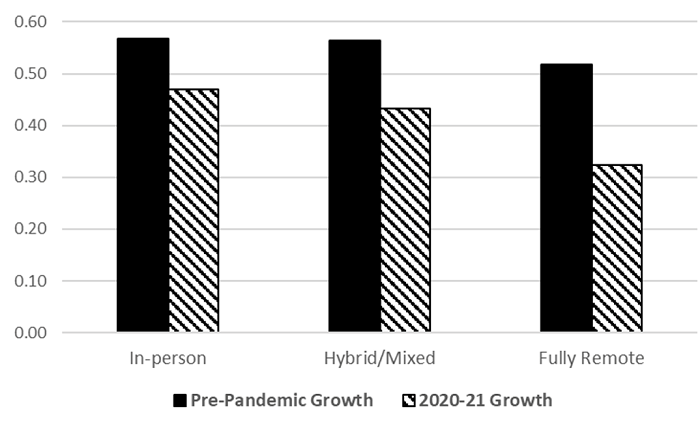
Our analysis of fall-to-spring achievement growth on the third-grade ELA test—as well as Ohio’s data on district mode of learning—confirms that this correlation between district mode of instruction and student achievement likely captures a real difference in the effectiveness of in-person and remote modes of instruction. We estimate that students had learning declines almost twice as large with remote instruction as compared to in-person instruction (-0.19 standard deviations instead of -0.10 standard deviations; see Figure 1).

Figure 1. Changes in fall-to-spring standardized test score growth on Ohio’s third-grade ELA exam in 2020–21 compared to pre-pandemic years, by district mode of instruction
oh1

Note: The figure presents the average fall-to-spring growth of normalized test scores in standard deviation units between pre-pandemic years (2018 and 2019) and 2021. These are regression estimates that compare changes in test scores over time for students who took the same exam in fall and spring of each year. Mode of instruction is determined based on weekly data submitted to the Ohio Department of Education for weeks between the fall and spring test administration windows. Due to changes in how mode of instruction was recorded over the course of the year, the “hybrid” category combines districts that offered fully hybrid instruction across all grades and districts that offered at least some in-person instruction for lower grades and remote instruction for older students.

3. Disadvantaged students were most negatively affected by the pandemic, further exacerbating achievement gaps.

Compared to their peers, historically underserved student subgroups (measured by race, economic status, homelessness, disability, and English-learner status) generally experienced test score declines that were 1.5–2 times larger in ELA compared to their peers. The analysis of fall-to-spring achievement growth on the third-grade ELA exam is particularly enlightening. For example, students who performed in the highest quartile of achievement in the fall learned as much between fall and spring of the 2020–21 school year as they did in years prior to the pandemic. Those in the bottom achievement quartile, however, learned about 25 percent less than usual. This difference is highly consequential because third-grade students in the bottom quartile typically experience two to three times more learning growth during the school year than students in the top achievement quartile.

4. Contrary to popular belief, students in later grades experienced the greatest learning declines relative to typical achievement growth rates.

In contrast to recent analyses examining achievement trends on district-administered assessments, we find little evidence that student achievement growth declined most in lower grades. Indeed, relative to typical achievement growth in each grade, students in upper-middle school and high school have fallen behind more than students in lower-middle and elementary grades. The greater decline in later grades is particularly due to greater declines in math.

For example, between 2019 and 2021, fifth graders had test score declines of 0.34 standard deviations in math compared to prior cohorts, whereas students who took the high school geometry exam (usually in tenth grade) had test score declines of 0.29 standard deviations. It appears, then, that there were larger declines in earlier grades. However, younger students typically learn a lot more from year to year than older students. When we compare the raw test score declines to typical achievement growth in those grades, students in fifth grade fell behind the equivalent of just over half of a year of learning, whereas students who took the high school geometry test were behind the equivalent of a full year’s worth of learning. Other studies’ failure to account for differences in the amount of typical achievement growth across grade levels has led to considerable confusion and, perhaps, a failure to target interventions appropriately.

Our findings—in conjunction with emerging research on the social-emotional impacts of distance learning and student isolation—make very clear that, typically, students learn much better when they can attend school in person. The academic literature also indicates that this is particularly true for low-achieving and disadvantaged students. The surge in Covid-19 cases due to the delta variant might tempt policymakers to rethink in-person instruction. Our analysis confirms that would be a bad idea for most Ohio students, and likely those throughout the nation. It is important to balance the serious near-term public health concerns posed by the more highly contagious form of the virus against the long-term impacts of learning disruptions—particularly since these disruptions have affected disadvantaged communities the most.

Our focus needs to be on opening schools as safely as possible—and making sure they can stay open. Districts leaders should make every effort to implement layered mitigation strategies that we saw work so well during the last academic year and develop proactive testing and other approaches to minimize further disruptions from quarantines, which have already had a devastating effect on student learning. But more than simply prioritizing in-person instruction, we must ensure that students, especially those who have suffered the most learning loss, are getting the supports that they need to get back on track.


view

What U.S. teens think about their futures—and the country’s

Jeremy Smith
9.16.2021
Flypaper

The Washington Post and Ipsos recently surveyed fourteen to eighteen year olds on their attitudes toward the state of the U.S. and its future. The survey, which used random national samples, showed that majorities of teens are pessimistic about the country’s future but optimistic about their own personal futures. Some groups of teens are also much more optimistic about the future than other groups. 

Although 75 percent of the teens surveyed said the U.S. is either the best or one of the best countries in the world, only 48 percent think now is a good time to be growing up in America. And just 43 percent are confident that the country’s best years lie ahead. Some groups expressed more pessimism than others. Least confident that the best lies ahead are White teens (38 percent), considerably surpassed on this metric—perhaps surprisingly so—by Black and Hispanic teens (48 and 49 percent respectively). Most bullish about the future are Asian teens (64 percent).

Conflict and division in the United States and the world may be driving their concerns. Fifty-nine percent of those surveyed identified political divisions as a major threat, and they expressed similar worry about racial discrimination, gun violence, and terrorism. By contrast, just 34 percent were concerned about access to career opportunities, and only 28 percent were concerned about access to education.

Despite their gloomy outlook for the country, most teens think their own lives will be OK. Forty-six percent expect to have more opportunities than their parents, compared with only 16 percent who expect to have less. Ninety percent expect to have a good standard of living when they grow up, and more than half expect to be rich. An impressive seventy-six percent of Black teens and 68 percent of Asian teens expect to be rich when they grow up.

A question worth asking is why Asian and Black teens are so much more bullish on their futures than White teens. After all, our country has historically given preferential treatment to Whites, and many argue that it continues to do so today. Given those facts, shouldn’t Whites be more optimistic about their futures? The answer might lie in Asian and Black teens’ perception of “gaining something” in the future versus White teens’ perception they will “lose something.” Whether those perceptions turn out to be true, today’s teens will be living out their futures soon enough.

SOURCE: “May 7-June 15, 2021, Washington Post-Ipsos Teens in America poll,” The Washington Post (August 25, 2021).

view

The Education Gadfly Show #787: How the Delta variant is impacting back-to-school season

9.16.2021
Podcast
 

On this week’s podcast, John Bailey, nonresident senior fellow at AEI, joins Mike Petrilli and David Griffith to discuss how students’ transition back into classrooms is going in the face of the Delta variant and battles over vaccine, mask, and quarantine policies. On the Research Minute, Amber Northern examines the unique characteristics of gifted programs.

And check out our conversation with John earlier this summer about how schools were adapting to Covid!

Amber's Research Minute

Benjamin Backes, James Cowan, and Dan Goldhaber, "What Makes for a "Gifted" Education? Exploring How Participation in Gifted Programs Affects Students' Learning Environments," CALDER Working Papers (August 2021).

view

Cheers and Jeers: September 16, 2021

The Education Gadfly
9.16.2021
Flypaper

Cheers

  • Bainbridge Island, Washington’s memorial to the horrid experience of Japanese Americans in internment camps, is a testament to America’s willingness to confront its past wrongs. —George F. Will
  • Excusing illiteracy, innumeracy, and ignorance by lowering standards and rejecting excellence isn’t antiracism. It’s nihilism. —Rick Hess
  • “Covid is hard on everyone. Please don’t take your frustrations out on teachers.” —Washington Post
  • Contra Ibram Kendi, the real way to improve young, Black lives is with high expectations, access to free test prep, and supports for gifted programs—not by calling those things “White.” —John McWhorter
  • For two decades, South-Western City Schools in Ohio has partnered with the YMCA to create an alternative to suspension or expulsion that provides academic and mental health support. —Columbus Dispatch

Jeers

  • An article in the New Republic makes it sound like all Democrats are giving up on charters, when that’s only the case for White progressives.
  • "Facebook knows Instagram is toxic for teen girls, company documents show." —Wall Street Journal
view

What we're reading this week: September 16, 2021

The Education Gadfly
9.16.2021
Flypaper
  • Boston’s next mayor will have to rise to the challenge of revitalizing the once-exemplary school district after years of declining performance. —The 74
  • “A recent viral news story reported that a generation of young men is abandoning college. The pattern has deep roots.” —The Atlantic
  • Daniel Idfresne, a seventeen-year-old from an immigrant family, believes that his parents’ values, and his time in effective charter and selective-admission schools that shared them, immunized him from woke groupthink. —Common Sense with Bari Weiss
  • “How 9/11 helped pass No Child Left Behind—and fueled its eventual demise.” —The 74
  • The data finds that it’s not White, wealthy students who benefit most from SAT test prep, but students who are lower-income, Black, and first- or second-generation East Asian immigrants. —New York Times
  • “Ed policy is often based on public perception. But how much do people really know?” — Mike Antonucci
  • In Chicago’s LEARN Charter Schools, kindergarten teachers are prioritizing calming classroom techniques, oral repetition, and visual cues to help students regain their ability to focus and get along with peers. —Chalkbeat Chicago
  • “Racial justice through expanded choice.” —Derrell Bradford
Fordham Logo

© 2026 The Thomas B. Fordham Institute
Privacy Policy
Usage Agreement

National

P.O. Box 110
Burke, VA 22009

202.223.5452

[email protected]

Ohio

P.O. Box 82291
Columbus, OH 43202

614.223.1580

[email protected]

Sponsorship

130 West Second Street, Suite 410
Dayton, Ohio 45402

937.227.3368

[email protected]