Mobile Navigation

  • National
    • Policy
      • High Expectations
      • Quality Choices
      • Personalized Pathways
    • Research
    • Commentary
      • Gadfly Newsletter
      • Gadfly Podcast
      • Flypaper Blog
      • Events
    • Covid-19
    • Scholars Program
  • Ohio
    • Policy
      • Priorities
      • Media & Testimony
    • Research
    • Commentary
      • Ohio Education Gadfly Biweekly
      • Ohio Gadfly Daily
  • Charter Authorizing
    • Application
    • Sponsored Schools
    • Resources
    • Our Work in Dayton
  • About
    • Mission
    • Board
    • Staff
    • Career
Home
Home
Advancing Educational Excellence

Main Navigation

  • National
  • Ohio
  • Charter Authorizing
  • About

National Menu

  • Topics
    • Accountability & Testing
    • Career & Technical Education
    • Charter Schools
    • Curriculum & Instruction
    • ESSA
    • Evidence-Based Learning
    • Facilities
    • Governance
    • High Achievers
    • Personalized Learning
    • Private School Choice
    • School Finance
    • Standards
    • Teachers & School Leaders
  • Research
  • Commentary
    • Gadfly Newsletter
    • Flypaper Blog
    • Gadfly Podcast
    • Events
  • COVID-19
  • Scholars Program

The Education Gadfly Weekly

Sign Up to Receive Fordham Updates

We'll send you quality research, commentary, analysis, and news on the education issues you care about.
Thank you for signing up!
Please check your email to confirm the subscription.

The Education Gadfly Weekly: PISA 2018: Leaning into the economic headwinds

Volume 19, Number 48
12.4.2019
12.4.2019

The Education Gadfly Weekly: PISA 2018: Leaning into the economic headwinds

Volume 19, Number 48
view
High Expectations

PISA 2018: Leaning into the economic headwinds

The latest PISA results largely mirror the findings from NAEP: America’s scores are mostly flat, with some widening of gaps between our high and low performers in reading and math because the higher achieving students are making progress while their less accomplished peers aren’t. America’s standing also improved because some of the highest-achieving countries lost ground. Here are five big takeaways.

Michael J. Petrilli 12.4.2019
NationalFlypaper

PISA 2018: Leaning into the economic headwinds

Michael J. Petrilli
12.4.2019
Flypaper

The Houston Federation of Teachers plays the Trump card

Dale Chu
12.4.2019
Flypaper

Mississippi rising? A partial explanation for its NAEP improvement is that it holds students back

Todd Collins
12.4.2019
Flypaper

The different ways schools go about character development

Chester E. Finn, Jr.
12.4.2019
Flypaper

The Education Gadfly Show: The effects of early college programs

12.4.2019
Podcast
view

The Houston Federation of Teachers plays the Trump card

Dale Chu 12.4.2019
Flypaper
view

Mississippi rising? A partial explanation for its NAEP improvement is that it holds students back

Todd Collins 12.4.2019
Flypaper
view

The different ways schools go about character development

Chester E. Finn, Jr. 12.4.2019
Flypaper
view

The Education Gadfly Show: The effects of early college programs

Michael J. Petrilli, David Griffith, Amber M. Northern, Ph.D., Kristina Zeiser 12.4.2019
Podcast
view

PISA 2018: Leaning into the economic headwinds

Michael J. Petrilli
12.4.2019
Flypaper

Another week, another round of test scores, this time the international variety. The latest results from the Program for International Student Assessment (PISA) are out, and they largely track the findings from the 2019 National Assessment of Educational Progress. Meaning: American scores are mostly flat, with some widening of the gaps between our high and low performers in reading and math because the higher achieving students are making progress while their peers are standing still. Our comparative rankings also improved because some of the highest-achieving countries—such as Canada, Japan, and even South Korea—lost ground. Oh, and four Chinese provinces supposedly knocked it out of the park.

The New York Times reported this as bad news for education reform: “‘It Just Isn’t Working’: PISA Test Scores Cast Doubt on U.S. Education Efforts.” The Washington Post also went negative: “U.S. students continue to lag behind peers in East Asia and Europe in reading, math and science, exams show.” EdWeek, meanwhile, played up our relative progress (sorta): “U.S. Students Gain Ground Against Global Peers. But That's Not Saying Much.”

All of those, I believe, are too gloomy. Here are my own big takeaways:

1. Our flat scores don’t look so bad in context. To be sure, we desperately need to improve achievement in America, especially for disadvantaged groups. But it’s more than a little interesting that countries including Canada, Japan, Australia, France, and New Zealand lost ground in reading since 2000 while we held our own. Most of those, plus South Korea, have lost ground in math since 2003. And in science we’ve actually made gains since 2006—not so flat after all!—while a bunch of countries, including the United Kingdom, Ireland, Germany, Canada, New Zealand, and Australia, have gone backwards.

2. The Great Recession may have caused the Global Education Recession. The lackluster results for many of the rich countries make me wonder (as I often do) about broader social trends that could be negatively impacting student learning—either the lingering effects of the Great Recession or the explosion in out-of-school screen time, both of which have been global phenomena. These topics are hard to study rigorously, but scholars should get cracking!

3. Our gains for high-achieving students represent GOOD NEWS. Many of the articles are depicting this as a widening of the achievement gap, which is true as far as it goes, but that merely illustrates the problem with what my friend Rick Hess once termed “achievement gap mania.” We want students to learn more. We should be rooting for everyone to do better, regardless of their performance level, income, or race. So hooray for the high achievers! Their improved performance might be due to what’s happening at home—the much-maligned helicopter parenting. Or, as I speculated recently, maybe the higher standards and tougher tests of the Common Core–era are helping high performers learn more. The challenge is now to walk and chew gum at the same time—to keep boosting the achievement of kids at the top of the achievement spectrum while also figuring out how to do the same for their peers at the bottom.

4. Don’t pay excessive attention to China. We should put as much faith in Chinese test score results as we do in Russian doping results. The correct attitude is somewhere between skepticism and incredulity. Past rounds of PISA have shown great results for Shanghai, but smart analysts have pointed out various concerns, including that many students—especially migrants—are excluded from the test, and that it’s not even given in China’s many impoverished and pre-modern rural communities. Given that vast land’s authoritarian government and obsession with nationalistic pride, we should reason that similar games were played this time around, even if that’s not something PISA hierarchs want to dwell on.

5. Put enthusiasm for Finland on ice. Remember when that charming, icy little Nordic country was all the rage among educators? Well, since 2000, its reading scores have declined more than in any OECD country, save Iceland—a whopping 26 points. In math, they are down 37 points, the biggest decline among OECD countries. And worst of all, in science, they are down 41 points, also the worst in the developed world. The anti-ed-reform crowd is going to need to find another darling. (It appears that Finland was doing well until it ditched its successful top-down reform model.)

These PISA results don’t give us much to cheer about, but they also shouldn’t lead to despair. To misquote Tom Friedman, we might be flat, but the world is sloping down. That’s surely a better situation than the reverse.

view

The Houston Federation of Teachers plays the Trump card

Dale Chu
12.4.2019
Flypaper

In the latest episode of what promises to be a protracted saga in the Lone Star State, the Houston Federation of Teachers (HFT) recently filed a federal lawsuit to halt the state’s takeover of the Houston school district, one of the largest in the country. Two years in the making, Texas education commissioner Mike Morath’s widely anticipated announcement follows years of malfeasance and dysfunction on the part of district board members. But that daftness and ineptitude hasn’t stopped HFT from coming to their defense with a legal salvo resplendent in creative if not spurious arguments.

The most outlandish among these is that Morath’s decision to strip the elected school board of its powers is an end run around democracy itself. To wit, here’s what HFT’s president had to say on the move:

It’s really important that nobody gets comfortable with waving away democracy, regardless of what level it is. Municipal, state or federal. We have a tried and true system of changing government and changing representation, that’s through an electoral process.

And in the text of the lawsuit, HFT writes:

The right to cast a meaningful vote is the foundation upon which all other rights and freedoms are based. The right to vote for the educational leadership of a [district] is granted by statute, protected by federal and state law, and guaranteed by the U.S. and Texas Constitutions. It is the public interest of this State to protect the right of every person to cast a meaningful vote to elect leaders to public office.

HFT’s conclusion that the state takeover of the district is thus unconstitutional, however, is a bridge too far. In fact, it is as incandescently ridiculous as it is unfounded, and no less mind-boggling than the one being made by President Trump and his supporters that impeachment is an unconstitutional “coup.”

Yes, Americans value democracy (i.e., majority rule) and for good reason. But democracy is not the only value our founders advanced. They didn't want a government run by tyrants, but neither did they want a government run by mobs. So they developed an intricate system of checks and balances, all with the goal of protecting individual liberty and keeping power from coalescing in one place.

Trump and others ignore all of this when they rail against impeachment as a coup or somehow unconstitutional. It’s in the Constitution! Moreover, the dictionary definition of “coup” is the violent or sudden overthrow of a government. How a constitutionally prescribed procedure would qualify remains a mystery. As political pundit Jonah Goldberg has wryly observed: “If this ‘coup’ were successful, the president of the United States would be…Mike Pence. What kind of coup leaves the regime and the second-in-command in place?”

Likewise, our educational governance system has checks and balances. There’s no question that Houston’s school board was duly elected. But so were Texas’s governor, and its legislature. And there is a strong case to be made that the Houston school board is hurting the cause of liberty—Houston’s kids’ rights to “the pursuit of happiness”—via its mismanagement and dysfunction. In addition, Texas has policies on the books—policies enacted democratically—that provide for state takeovers in dire circumstances such as this. 

Not unlike Trump’s coup assertion, HFT’s claim that a state takeover would disenfranchise voters is an embarrassing one. Yet there’s a genius stroke behind both of their positions, which is that neither Trump nor the HFT ever intended to offer serious arguments or rebuttals. Rather, the goal here is to create a scene. In the impeachment inquiry, the GOP surely realizes that the proceedings will fail in the Senate, so their hope is to make enough noise in service of their political aims. With HFT’s lawsuit, the union is betting that public outrage can be stoked by appealing to broader sensibilities against social injustice. That’s the underlying strategy of calling the state takeover “undemocratic.”

And who knows? It might work. State takeovers are fiendishly difficult, and the dynamics in Houston have already taken on political and racial overtones. Trump has been shameless in saying whatever he believes will benefit him—to inexplicable and disquieting success—while remaining largely immune to any consequences. One can only imagine that the HFT would like to realize a similar result in their attempt to fend off the state’s all-too-justifiable intervention.

view

Mississippi rising? A partial explanation for its NAEP improvement is that it holds students back

Todd Collins
12.4.2019
Flypaper

One of the bright spots in an otherwise dreary 2019 NAEP report is Mississippi. A long-time cellar dweller in the NAEP rankings, Mississippi students have risen faster than anyone since 2013, particularly for fourth graders. In fourth grade reading results, Mississippi boosted its ranking from forty-ninth in 2013 to twenty-ninth in 2019; in math, they zoomed from fiftieth to twenty-third. Adjusted for demographics, Mississippi now ranks near the top in fourth grade reading and math according to the Urban Institute’s America’s Gradebook report.

So how have they done it? Education commentators have pointed to several possible causes: roll-out of early literacy programs and professional development (Cowen & Forte), faithful implementation of Common Core standards (Petrilli), and focus on the “science of reading” (State Superintendent Carey Wright).

But one key part of Mississippi’s formula has gotten less coverage: holding back low-performing students. In response to the legislature’s 2013 Literacy Based Promotion Act (LBPA), Mississippi schools retain a higher percentage of K–3 students than any other state. (Mississippi-based Bracey Harris of The Hechinger Report is one education writer who has reported on this topic.)

The LBPA created a “third grade gate,” making success on the reading exit exam a requirement for fourth grade promotion. This isn’t a new idea of course. Florida is widely credited with starting the trend in 2003, and now sixteen states plus the District of Columbia have a reading proficiency requirement to pass into fourth grade.

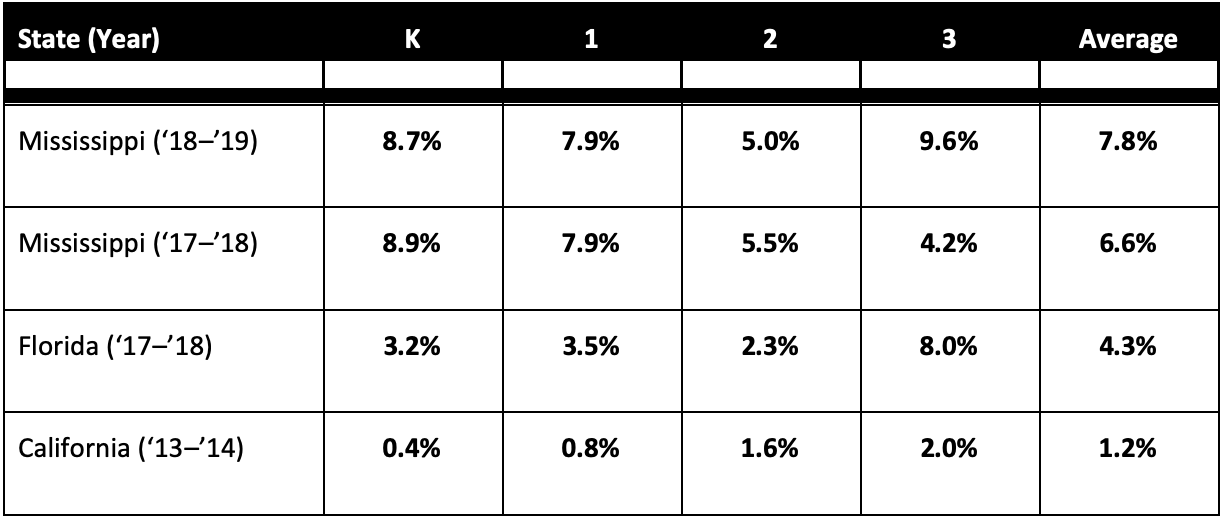
But Mississippi has taken the concept further than others, with a retention rate higher than any other state. In 2018–19, according to state department of education reports, 8 percent of all Mississippi K–3 students were held back (up from 6.6 percent the prior year). This implies that over the four grades, as many as 32 percent of all Mississippi students are held back; a more reasonable estimate is closer to 20 to 25 percent, allowing for some to be held back twice. (Mississippi's Department of Education does not report how many students are retained more than once.)

Table 1: Student retention rate for early grades, selected states
1

Sources: State reports, U.S. Department. of Education CRDC reports

These retention levels are much higher than other states. The closest are Oklahoma at 6 percent and Alabama at 5 percent. Florida, probably the most well-known example, today holds back 4 percent of its K–3 students, including 8 percent of third graders. When it first enacted its retention policy in 2003–04, Florida’s third grade retention rose as high as 14 percent before steadily declining; it has risen again in recent years. The average for all states is about 3 percent; many states have retention rates of 2 percent or less.

Among the flurry of literacy initiatives in Mississippi, how important is retention to its NAEP results? It’s hard to know for sure, especially without student-level data, but simple modeling suggests it may be a significant factor. Retained students are by definition the lowest performing readers, scoring in the bottom category of Mississippi’s third grade exam. As part of the LBPA, after being held back, they receive a variety of supports, including “intensive reading intervention” and being assigned to a high-performing teacher. Assuming that those policies improve their achievement, they should certainly score better once reaching fourth grade than they otherwise would have.

So is Mississippi’s lesson for educators that they should increase student retention? The traditional view of retaining students is strongly negative. In 2004, school psychology researcher Shane Jimerson famously labeled it “educational malpractice.” According to Stanford researcher Linda Darling-Hammond (now President of the California State Board of Education), “The findings are about as consistent as any findings are in education research: the use of [retention based on] testing is counterproductive, it does not improve achievement over the long run, but it does dramatically increase dropout rates.”

More recently, Martin West and others, looking at the results from Florida’s 2003 retention policy, have taken a more positive view of the impact of early-grade retention, like that practiced by Mississippi. They report that third-grade retention increases high school grade point average and leads to fewer remedial courses, though it does not increase graduation rates (or lower them). With the first Florida cohorts now in early adulthood, we may get a better view of retention’s long-term impact. While some have criticized Florida’s past NAEP score gains as “dubious” and “highly misleading” due to its retention policy, others claim they represent “genuine progress.”

In the meantime, Mississippi isn’t waiting. Buoyed by the perceived success of the 2013 standards, last year the legislature raised the third-grade exit bar even higher, leading to 14 percent of the state’s third-graders failing the test, and 10 percent being ultimately retained (in some counties, up to 45 percent failed and 40 percent were retained). While the long-term effects are uncertain, a very likely outcome will be continued growth in the NAEP fourth grade results, as the lowest performing students get an added year of instruction before the test.


view

The different ways schools go about character development

Chester E. Finn, Jr.
12.4.2019
Flypaper

The Content of Their Character: Inquiries into the Varieties of Moral Formation is dense and subtle, but it’s also informative and valuable, particularly for educators. We’ve come to expect as much from the University of Virginia–based Institute for Advanced Studies in Culture, headed by Ryan Olson and founded by his co-editor, the distinguished UVa professor James Hunter. It ought to command the attention of those in the education field concerned with strengthening schools’ capacity to assist with character development in their students, as well as those interested in social-emotional learning—including we who worry that much of today’s SEL is neglecting character and moral formation, which should be integral to it!

Intentionally or not, the book is also directly relevant to, and ultimately makes a powerful case for, school diversity and choice.

What the contributors did was to probe deeply into the ways that nine different species of U.S. schooling go about moral formation and character development and what distinguishes them from the approaches of other species. The “species”—almost all high schools—are urban public, rural public, charter, Evangelical, Catholic, Jewish, Muslim, Independent, and home. Each gets a descriptive/analytical chapter that distills key features of its handling of moral formation, mindful of course that there’s much variation of approach within each category. A tenth chapter looks across a host of high schools that practice various forms of “alternative pedagogy” and that have distinctive cultures of their own.

Finally, Messrs. Hunter and Olson offer penetrating insights into distinctions and overlaps among these several approaches. They conclude that there are indeed “massive differences in the moral ecologies of different schools in America today” and that understanding those differences is key to making any progress on this front, as well as an important justification for sustaining this rich variety and the ability of families to select the forms that are most faithful to their own moral ecologies and approaches to childrearing. Many noteworthy points emerge, such as the big differences between urban and rural public high schools with respect both to school culture and to their handling of morals and values.

A serious, scholarly work, and sometimes dense indeed, this book should not just sit on many educators’ shelves. It should also inform how they understand and think about proceeding on some of American education’s greatest challenges.

SOURCE: The Content of Their Character: Inquiries into the Varieties of Moral Formation, edited by James Davison Hunter and Ryan S. Olson (Finstock & Tew Publishers, 2018).

view

The Education Gadfly Show: The effects of early college programs

12.4.2019
Podcast

On this week’s podcast, Kristina Zeiser, senior researcher at American Institutes for Research, joins Mike Petrilli and David Griffith to talk about the long-term impact of early college high school programs. On the Research Minute, Amber Northern breaks down the latest results from the Program for International Student Assessment.

Amber's Research Minute

Organization for Economic Cooperation and Development (OECD), "PISA 2018 Results: Combined Executive Summaries" (December 2019). 

Sign Up to Receive Fordham Updates

We'll send you quality research, commentary, analysis, and news on the education issues you care about.
Thank you for signing up!
Please check your email to confirm the subscription.
Fordham Logo

© 2020 The Thomas B. Fordham Institute
Privacy Policy
Usage Agreement

National

1016 16th St NW, 8th Floor 
Washington, DC 20036

202.223.5452

[email protected]

  • <
Ohio

P.O. Box 82291
Columbus, OH 43202

614.223.1580

[email protected]

Sponsorship

130 West Second Street, Suite 410
Dayton, Ohio 45402

937.227.3368

[email protected]