Mobile Navigation

  • National
    • Policy
      • High Expectations
      • Quality Choices
      • Personalized Pathways
    • Research
    • Commentary
      • Gadfly Newsletter
      • Flypaper Blog
    • Events
    • Scholars Program
  • Ohio
    • Policy
      • Priorities
      • Media & Testimony
    • Research
    • Commentary
      • Ohio Education Gadfly Biweekly
      • Ohio Gadfly Daily
  • Charter Authorizing
    • Application
    • Sponsored Schools
    • Resources
  • About
    • Mission
    • Board
    • Staff
    • Career
Home
Home
Advancing Educational Excellence

Main Navigation

  • National
  • Ohio
  • Charter Authorizing
  • About

National Menu

  • Topics
    • Accountability & Testing
    • Advanced Education
    • Career & Technical Education
    • Charter Schools
    • Curriculum & Instruction
    • ESSA
    • Evidence-Based Learning
    • Facilities
    • Governance
    • Personalized Learning
    • Private School Choice
    • School Finance
    • Standards
    • Teachers & School Leaders
    • Think Again
  • Research
  • Commentary
    • Gadfly Newsletter
    • Flypaper Blog
    • Gadfly Podcast
  • Events
  • Scholars Program

The Education Gadfly Weekly

Sign Up to Receive Fordham Updates

We'll send you quality research, commentary, analysis, and news on the education issues you care about.
Thank you for signing up!
Please check your email to confirm the subscription.

The Education Gadfly Weekly: No, school choice is not the answer to critical race theory

Volume 21, Number 27
7.8.2021
7.8.2021

The Education Gadfly Weekly: No, school choice is not the answer to critical race theory

Volume 21, Number 27
view
Quality Choices

No, school choice is not the answer to critical race theory

Why fight over critical race theory when we can choose? You teach oppression studies; I’ll teach American exceptionalism. It’s a simple and obvious solution. But it’s also a naïve and unsatisfying one. School choice may “solve” the CRT problem for an individual family, but it can’t address the clear interest that every American holds in the education of the next generation.

Robert Pondiscio 7.8.2021
NationalFlypaper

No, school choice is not the answer to critical race theory

Robert Pondiscio
7.8.2021
Flypaper

An improved forecast for the NAEP reading assessment

Chester E. Finn, Jr.
7.8.2021
Flypaper

We have spelling bees. Why aren’t there reading bees?

Adam Tyner, Ph.D.
7.8.2021
Flypaper

Texting parents helps improve student literacy. But how much is too much?

Jeremy Smith
7.8.2021
Flypaper

Are Virginia’s elementary schools worsening achievement gaps?

William Rost
7.8.2021
Flypaper

The Education Gadfly Show #777: O-H-I-O: School reform victories in the Buckeye State

7.8.2021
Podcast

Cheers and Jeers: July 8, 2021

The Education Gadfly
7.8.2021
Flypaper

What we're reading this week: July 8, 2021

The Education Gadfly
7.8.2021
Flypaper
view

An improved forecast for the NAEP reading assessment

Chester E. Finn, Jr. 7.8.2021
Flypaper
view

We have spelling bees. Why aren’t there reading bees?

Adam Tyner, Ph.D. 7.8.2021
Flypaper
view

Texting parents helps improve student literacy. But how much is too much?

Jeremy Smith 7.8.2021
Flypaper
view

Are Virginia’s elementary schools worsening achievement gaps?

William Rost 7.8.2021
Flypaper
view
ohio flags

The Education Gadfly Show #777: O-H-I-O: School reform victories in the Buckeye State

Michael J. Petrilli, Chad L. Aldis, David Griffith, Ph.D., Amber M. Northern, Ph.D. 7.8.2021
Podcast
view

Cheers and Jeers: July 8, 2021

The Education Gadfly 7.8.2021
Flypaper
view

What we're reading this week: July 8, 2021

The Education Gadfly 7.8.2021
Flypaper
view

No, school choice is not the answer to critical race theory

Robert Pondiscio
7.8.2021
Flypaper

A recent Reason magazine piece offers school choice as the solution to our pitched battles over critical race theory in K–12 education. “Now that the debate is escalating over more fundamental differences involving the value of liberal ideas, individualism, and rationality, it’s difficult to see how Americans of opposing viewpoints can share tax-funded schools that fall on one side or the other of the ideological divide,” writes J.D. Tuccille. “So let’s not even try when we can encourage the growing exodus from public schools to alternatives of all sorts.” The Cato Institute’s public school “battle map,” cited in the Reason piece, marshals its case for school choice documenting more than 2,400 conflicts in the last fifteen years over curriculum, values, gender, sexuality, and other flashpoints. Cato notes, not insensibly, that “public schooling often forces people into wrenching, zero‐sum conflict.”

Why fight over “CRT” when we can choose? You teach oppression studies; I’ll teach American exceptionalism. It’s a simple and obvious solution. But it’s also a naïve and unsatisfying one, and the Reason piece cited above hints at why. The “lens” through which critical race theory would have students view the world cuts to the heart of our most fundamental ideas about the role of education and the civic mission of schools in shaping children’s view of their country. School districts may be the battleground, but the war is about much larger issues and themes.

Choice supporters (and I count myself as one) often engage in a subtle sleight of hand in making our case. We argue that we should “fund students, not systems” and insist that families should have control over “their” money. But this elides that the cost of education in the U.S. is socialized. We pay school taxes whether we have children or not. Thus if we’re honest, we’re really advocating putting parents in control of “our” money (including their own, obviously). It makes good sense to put decision-making in the hands of those closest to schools and with the most at stake: their own children. But the shared cost implies a mutual interest and a literal investment in every child. School choice may “solve” the CRT problem for a family, but it can’t address the clear interest every American holds in the education of the next generation.

Neither side in the debate is merely seeking permission for their children to be taught as they prefer. This is a fight over how to explain American history, society, and culture to all our children, whom we are counting on to be morally committed to protecting, defending, and perfecting it as adults.

When you view education as a private good, choice as a panacea makes sense. When you view it as public good, the rationale becomes less satisfying. (It’s both, so the tension is inevitable.) Moreover, this may be a unique, structural limitation of the American way of running schools. As Ashley Berner of Johns Hopkins has documented, other nations tend to be far more pluralistic in the number and types of schools that are funded by their governments. But they are also far more likely to teach a national curriculum. The U.S. Constitution guarantees control of education to the states, making a national curriculum, for good or for ill, a non-starter here. So curriculum fights are a flaw and a feature our system.

“Wokeness” is proving a nettlesome challenge to the logic of school choice in more ways than one. Those with the greatest amount of capital—both cultural and financial—enjoy the greatest amount of school choice. In theory, this should more closely align school curriculum and culture with the values of the families that pay for it. But the hyper-elite, prodigiously expensive private schools favored by America’s gentry are among the very wokest schools, driving many parents to seethe privately but mostly stay put. The argument has been made that elite private schools are merely a stepping stone to an Ivy League admissions letter, incentivizing ambitious parents to hold their nose and keep their eyes on the prize. But if elite colleges, too, are earnestly committed to “dismantling privilege,” then it’s an open question whether a private prep school education will continue to offer a leg up in admission.

Lastly, choice as the remedy for CRT debates ignores that the percentage of families with ready access to more than a small handful of quality options is probably quite modest. Changing schools is not something to be done quickly or easily. There’s merit to the argument that choice can be a release valve for acute, CRT-related tensions. But in the end, it’s not a solution; it’s an activist’s talking point. And maybe it will prove a useful one for school choice advocates. But by no means is it an “answer” or “solution” to the CRT debate.

Editor’s note: This was first published by the American Enterprise Institute.

view

An improved forecast for the NAEP reading assessment

Chester E. Finn, Jr.
7.8.2021
Flypaper

The prolonged fracas within and far beyond the National Assessment Governing Board (NAGB) concerning a new “framework” for NAEP’s future assessment of reading has been ominous on several fronts—as I haven’t hesitated to say. But the past few weeks have markedly improved the situation to the point that a reasonable and viable consensus is coming into view.

Trouble began two years ago when the Board named a cast-of-thousands “visioning panel” that came up with a plan for a very different sort of reading assessment, one that emphasized race, deemphasized knowledge, risked concealing bona fide reading-comprehension problems, and threatened to disrupt NAEP’s multi-decade “trendline” of reading achievement.

Most of its members were remote from classroom realities and real-world reading practicalities, and many had drunk deeply at the fount of current fads and dubious research. Some had thrown themselves into contemporary cultural conflicts. That group’s wholesale redesign of NAEP’s approach to reading was destined for controversy. 

Hands were wrung, blogs were written, testimonies were submitted, feathers flew, the governing board itself seemed on the verge of coming unglued. So revisions were made—sorely inadequate revisions, unfortunately, from the standpoint of key board members and a number of outside critics (myself included). Once hints began to be dropped that some states (mostly of a vermillion hue) might refuse to participate in assessments erected upon such a framework, NAGB chair Haley Barbour (himself the former governor of one such state) took corrective action. He formed a working party of board members drawn from across several NAGB committees (and factions) but who craved consensus on reading. Ably led by vice-chair Alice Peisch, they worked hard and fast and with awesome celerity came up with yet another revision, this one dubbed the “Chair’s Draft.”

This was put out for public comment late on June 25, an “informational webinar” was held on July 1, and any written comments were requested by July 9 (i.e., tomorrow!). Barbour’s intent is for the Board to vote approval in early August and—if approved—for NCES then to commence the very heavy lift that will enable the new framework to drive NAEP reading assessments from 2026 onward.

The revision is a tour-de-force that the Board should adopt without changing a word. Sure, there are a few words I might change if I were king, but building a livable consensus around the assessment of reading is far more important than trying to please everyone, which is never possible anyway.

The Chair’s Draft is shorter, pruned of much jargon, and much more reader/user friendly. It’s also markedly less ideological—and unlikely to disrupt the vital NAEP reading trendline. Its drafters deserve huge applause. 

Yet mice are nibbling. Some, for example, including some on the original “visioning panel” that caused so much grief, want the final Framework to revert to using “unfamiliar” rather than “obscure” to describe words and terms encountered in reading passages that justify the use of “informational UDEs.” This sounds ridiculously wonky but in the long run it matters quite a lot.

UDE is shorthand for “universal design elements,” originally developed to help children with disabilities access and participate as fully as possible in assessments and other school activities. In the case of NAEP, they’re no longer limited to test-takers with disabilities. They come in several kinds, including “informational.” Within the reading assessment, an “informational UDE” might be available to test-takers in the form of a definition or “pop-up” or link, even a short video, intended to explain or define a word or term that the child may not understand. An example in the draft framework involves a passage from a story set in Turkey, where UDEs supply English definitions (translations, really) of two Turkish words.

Those words (“hodja” and “akche”) are indeed “obscure” for almost every U.S. reader in grades four, eight, and twelve who is apt to find him or herself taking part in the NAEP reading assessment. Because it’s hard to comprehend well what’s going on in that passage without the explanation, and since comprehension is the point, supplying a UDE in this case seems fully justified.

But were a new reading framework to open the door to providing such help for any word, term or expression that’s simply “unfamiliar” to readers, much mischief could commence. That’s because “unfamiliar” begins a slippery slope toward the profligate use of “informational” UDEs in any/every situation where some readers may not yet possess certain vocabulary or knowledge even though proficient readers do—and all should. And that leads on to other “informational” situations that bring us swiftly to “background knowledge,” not just vocabulary. Which would hurl NAEP back into a swirling controversy about the role of background knowledge in reading comprehension—a controversy that NAGB members in the webinar last week made clear they did not want to take a position on and did not want to affect the NAEP reading assessment. 

It’s one thing to supply help when (as in the Turkish terms in the draft framework) a word is completely foreign. A somewhat similar situation arises with rarely-used—and genuinely “obscure”—English words, such as those that kids get asked to spell during the national spelling bee. (From the 2019 Bee: “The words spelled by this year’s co-champions in the final round include ‘auslaut,’ ‘bougainvillea,’ and ‘pendeloque.’”)

But words that are simply “unfamiliar” to students taking a NAEP assessment will include many that they should know. As soon as NAEP starts providing “informational” assistance with such words, it’s on its way to masking children’s actual reading comprehension. For instance, an eighth grade NAEP reading passage in 2013 included the word “epitome.” Should that have an informational UDE to define it? What if a passage were to mention the Caspian Sea, say, or Indonesia, or cantaloupes? It’s no secret that the original framework “visioners” wanted to suppress background knowledge and, when they couldn’t do that, wanted to supply it to test takers. But the cognitive scientists and reading experts who know the most in this realm view that as a hopelessly misguided quest.

They know, too, that the road to “unfamiliar” never ends. The current NAGB and NCES teams might not travel far down it, but what about their successors? Journey a bit further and NAEP risks artificially inflating students’ scores by assisting them to parse words and terms that they should already know. That’s because they’re words and terms that, when encountered in the “real world” of reading, nobody will come rushing to supply the missing information. Sure, motivated readers with sufficient bandwidth could consult the internet, but it’s impractical to stop and look up every word more challenging than “see Spot run.” Which means that if NAEP papers over things that kids should know but don’t, it will cease to be a trustworthy gauge of their true reading comprehension, at which point it loses value both for policymakers and for educators.

So may the Board in its wisdom please refrain from shifting back from “obscure” to “unfamiliar” or anything in that vein. (If for some reason they need to make a change, how about “esoteric”?)

That aside, Barbour and Peisch and their colleagues deserve kudos and thanks. And may consensus prevail on this as it ultimately has done on just about every major issue facing the Governing Board for three-plus decades. Absent such consensus, NAEP’s credibility (and value to the country) is much diminished. And in no realm would that be worse than in the core skill of reading.


view

We have spelling bees. Why aren’t there reading bees?

Adam Tyner, Ph.D.
7.8.2021
Flypaper

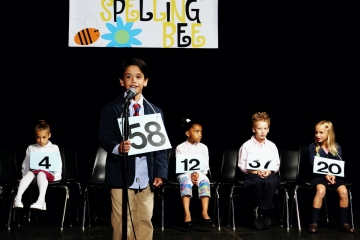
Today, the Scripps National Spelling Bee finals will take place at the ESPN Wide World of Sports Complex. It’s just one of myriad academic competitions focused on different subjects, from academic bowls, to science and math bowls, to spelling bees. But one core academic subject seems to be missing from the academic competition party: reading. Why is this?

The main reason is that reading isn’t really an independent skill at all.

Of course we could imagine, say, a speed-reading competition. But if students were going to compete over who has the best reading comprehension, they would have to read about something and that would turn the competition back into something more like a typical trivia competition. Science is about science. Math is about math. But reading is about everything.

Phonics, where students learn that certain letters correspond to specific sounds, really is a basic skill students need to master early. Once they have that basic skill down, however, reading comprehension will only get stronger as a person’s knowledge and vocabulary about a range of topics expands.

Consider this sentence:

Through Monte Carlo analysis, I have presented evidence that the spectacular seven scoring system actually aggravates the post position bias inherent in jai-alai.

Sure, you can “decode” most of this technical passage from the academic journal Interfaces about how the game of jai-alai is scored, meaning you can “sound out” any words you don’t know and insert some brief pauses in places that are roughly appropriate to the flow. Yet to comprehend the text, you need to know something about statistics, the sport, and what “post-position bias” is and how it could be aggravated by the “spectacular seven scoring system.”

Now imagine you are a fourth-grader trying to read the Orlando Sentinel. You may struggle, but that doesn’t necessarily mean you are “bad at reading.” Instead, like the average adult trying to decipher a passage about jai-alai scoring systems, most young students haven’t yet acquired the necessary background knowledge to fully navigate headlines and understand the news. If you want to understand an article about why President Biden’s spending plans may or may not lead to inflation or how vaccine reluctance could make it impossible for the world to reach “herd immunity,” you first need a critical mass of background knowledge and vocabulary.

This is not how many educators think about reading, though. For decades, many have claimed that reading comprehension is a fundamental skill. Admittedly, the idea is intuitive. As Sal Khan, the inventor of the online education platform Khan Academy, recently told the Washington Post: “The basics are reading, writing and math. If kids are able to progress in those, or at a minimum not atrophy in those, they’re going to be able to pick up where they left off in other subjects.” Using data from a large federal survey, a recent study I co-authored shows schools are following this logic, with elementary teachers reporting a whopping two hours per day on reading. Unfortunately, national assessments show that this approach isn’t working, with around two-thirds of students still failing to reading proficiency.

In contrast, social studies and science instruction amounted to less than an hour per day, combined. But students need to learn about those “other subjects”—geography, art, science, and history—to build vocabulary and knowledge across a range of topics and become truly literate. Our study’s findings tended to support this idea as well: While additional instructional time in the English language arts did not improve students’ reading abilities, more time spent on social studies was associated with increased reading ability for elementary students. Really, it shouldn’t be a surprise that a better understanding of the social world opens the doors to everything from novels to newspapers, or that it would show up on reading assessments.

A few dissident scholars such as E.D. Hirsch, Jr. have sounded these alarms for years, but to many educators, knowledge is still disparaged as mere “trivia.” Helping students build systematic knowledge through quality texts, iterative writing, engaging projects, substantive conversations—and, yes, academic bowls and spelling bees—probably does more to deepen reading comprehension abilities than the all-too-common focus on an ephemeral “skill” of literacy.

Editor’s note: This was first published by the Orlando Sentinel.

view

Texting parents helps improve student literacy. But how much is too much?

Jeremy Smith
7.8.2021
Flypaper

Text-message nudges have been a viable tool in early-childhood literacy in recent years, with parents or guardians receiving occasional missives to encourage specific literacy activities with their children. These cost little to send, and the kids do significantly better on assessments. Such nudges have gained traction as a way to increase engagement, especially among poorer families, and the idea has expanded to include other behaviors, like school attendance.

More recently, educators have been exploring how to maximize the effectiveness of these programs. A recent paper in Education Finance and Policy found that the frequency and content of the texts can affect literacy test scores. 

Researchers conducted a randomized experiment with the parents of almost 3,000 four-year-old children enrolled in the Dallas Independent School District pre-K program, which primarily serves non-English speakers and children who qualify for free or reduced price lunch. More specifically, the researchers compared three variations of an early literacy texting program using literacy tests, parent surveys, and parent opt-out rates to evaluate the effectiveness of each program.

Parents in the first group received a text message every Wednesday that suggested specific literacy activities to do with their children. The second group received two additional text messages per week, which included more general information and encouragement. The third group received five texts per week, one for each school day. Parents in all three groups received texts for eight months.

The messages, which were delivered in English or Spanish, covered a wide range of literacy topics, including letter recognition, letter sound awareness, beginning sound awareness, rhymes, name writing, story comprehension, vocabulary development, and parent-child book reading routines. The complexity of the texts increased during the eight months, with topics occasionally reintroduced for reinforcement. In general, the suggested activities were designed to integrate easily with existing family activities, such as commuting or sharing meals together.

On average, the researchers found that kids in the second group—those whose parents received three texts per week—had the greatest increase in their literacy test scores. The difference was especially pronounced for students who scored in the bottom quarter on a pretest. According to the researchers, this suggests that too few texts might not do enough to sufficiently engage parents, but that too many texts could overwhelm them. And indeed, more parents dropped out of the program when the number of texts per week rose. The nature of the messages may also have mattered, as the three-text-per-week version of the program featured an equal balance between actionable tips, general information, and encouragement, whereas the other versions placed greater emphasis on actionable tips.

As the authors note, text-message nudges have been gaining traction for some time, and the research on them might also have broader implications for school-to-family engagement. Either way, nudges are more than a fad. They are well on their way to becoming a science.

SOURCE: Kalena E. Cortes, et al., “Too Little or Too Much? Actionable Advice in an Early-Childhood Text Messaging Experiment,” Education Finance and Policy (April 2021).

view

Are Virginia’s elementary schools worsening achievement gaps?

William Rost
7.8.2021
Flypaper

A new working paper from researchers out of the University of Virginia uses data from the state’s kindergarten literacy assessment, the Phonological Awareness Literacy Screening (PALS), to examine how the subsequent achievement trajectories of kindergarteners who enter school with similar literacy levels differ by race and/or SES. The findings are worrying.

In Virginia, 132 out of 133 public school divisions (i.e., districts) require that students entering kindergarten take the PALS. The researchers compared their scores on that exam to their reading scale score in third grade, based on the state’s Standards of Learning (SOL) assessment. The study analyzed a sample size of 67,164 students who took the SOL in 2016–17. They were separated into quintiles based on how they had scored on the kindergarten PALS assessment. The researchers then linked the scores on both exams, while paying close attention to the race and SES.

Like prior studies, they found that racial and socioeconomic achievement gaps are already apparent by the time students enter kindergarten, and that kindergarten literacy scores predict third grade reading scores. But they also found that White and/or more-advantaged students are more likely than Black, Hispanic, English learners, and economically disadvantaged students from the same kindergarten achievement quintile to be proficient readers in third grade. The White-Black and socioeconomic gaps were especially large. In other words, kindergarten gaps widen as children progress through elementary school.

The authors suggest three potential reasons, none of them surprising: differences among schools in resources and quality teaching; students of different SES and/or race having different experiences within the same building; and out-of-school factors.

Whatever the cause, the study’s obvious implication is that Virginia, which already implements targeted interventions for students who score poorly on the kindergarten assessment, should do more to address these disparities, especially for students within the groups highlighted in this study and the schools that serve them. They should, for example, consider embracing the “science of reading,” as Mississippi and Arizona have done. And early assessments like PALS provide an excellent way to spot student deficiencies that schools can and should correct.

SOURCE: Walter Herring, Daphna Bassok, Anita McGinty, Luke C. Miller, and James H. Wyckoff “Racial and Socioeconomic Disparities in the Relationship Between Children’s Early Literacy Skills and Third-Grade Outcomes: Lessons from a Kindergarten Readiness Assessment,” Annenberg Institute at Brown University (June 2021).

view
ohio flags

The Education Gadfly Show #777: O-H-I-O: School reform victories in the Buckeye State

7.8.2021
Podcast
 

O-H-I-O: School reform victories in the Buckeye State

On this week’s podcast, Chad Aldis, Fordham’s vice president for Ohio policy, joins Mike Petrilli and David Griffith to discuss the big ed reform victories this past legislative session on private school choice, charter schools, and accountability. On the Research Minute, Amber Northern examines how parents use education savings accounts.

Amber's Research Minute

Michelle L. Lofton and Martin F. Lueken, "Distribution of Education Savings Accounts Usage Among Families: Evidence from the Florida Gardiner Program," retrieved from Annenberg Institute at Brown University (June 2021).

view

Cheers and Jeers: July 8, 2021

The Education Gadfly
7.8.2021
Flypaper

Cheers

  • A report by the Institute for Family Studies shows a rise in two-parent households since 2012. —Joanne Jacobs
  • The U.S. Department of Education fixes the TEACH Grant Program rules so that teachers can gain loan forgiveness for serving in high-poverty schools. —NPR
  • Antiracism proponents like Kendi and DiAngelo “represent an ideological extremism that embarrasses clever liberals.” Those on the left should avoid their excesses. —Ross Douthat
  • For Americans to be united, we need to learn about our history and its complexity and reject “the dogma of ideological abstraction.” —David Brooks
  • Schools are pulling out all the stops, even using home visits, to convince parents to send their kids back to in-person schooling. —Washington Post
  • Despite the strength and opposition of teacher unions, the school choice movement continues to advance. —WSJ
  • In Rhode Island, two Democratic contenders for governor are fighting over who is more pro-charter after an Achievement First school expansion sparked tensions. —Boston Globe

Jeers

  • Newly-released standardized test scores are revealing how far students have fallen behind because of the pandemic. —Associated Press
  • The Newark school district withheld diagnostics test data showing how much learning loss students experienced. —Chalkbeat Newark
  • In Chicago, boys of color fell further behind at school amid Covid-19. —Chalkbeat Chicago
view

What we're reading this week: July 8, 2021

The Education Gadfly
7.8.2021
Flypaper
  • Education policy is a leading issue for Boston’s mayoral race, especially policies for exam schools and the method for selecting school board members. —Boston Globe
  • The new child tax credit promises millions to help poor families, but it doesn’t address the bigger problem: family instability. —City Journal
  • In a point and counterpoint, Matthew Yglesias argues for, and Scott Winship argues against, Congress making the expanded and refundable child tax credit permanent. —Education Next
  • To diversify exam schools, Chicago maintained its merit-based admissions criteria, but found a way to bring in economically disadvantaged students. Perhaps Boston will do the same. ―Boston Globe
Fordham Logo

© 2026 The Thomas B. Fordham Institute
Privacy Policy
Usage Agreement

National

P.O. Box 110
Burke, VA 22009

202.223.5452

[email protected]

Ohio

P.O. Box 82291
Columbus, OH 43202

614.223.1580

[email protected]

Sponsorship

130 West Second Street, Suite 410
Dayton, Ohio 45402

937.227.3368

[email protected]