Mobile Navigation

  • National
    • Policy
      • High Expectations
      • Quality Choices
      • Personalized Pathways
    • Research
    • Commentary
      • Gadfly Newsletter
      • Flypaper Blog
    • Events
    • Scholars Program
  • Ohio
    • Policy
      • Priorities
      • Media & Testimony
    • Research
    • Commentary
      • Ohio Education Gadfly Biweekly
      • Ohio Gadfly Daily
  • Charter Authorizing
    • Application
    • Sponsored Schools
    • Resources
  • About
    • Mission
    • Board
    • Staff
    • Career
Home
Home
Advancing Educational Excellence

Main Navigation

  • National
  • Ohio
  • Charter Authorizing
  • About

National Menu

  • Topics
    • Accountability & Testing
    • Advanced Education
    • Career & Technical Education
    • Charter Schools
    • Curriculum & Instruction
    • ESSA
    • Evidence-Based Learning
    • Facilities
    • Governance
    • Personalized Learning
    • Private School Choice
    • School Finance
    • Standards
    • Teachers & School Leaders
    • Think Again
  • Research
  • Commentary
    • Gadfly Newsletter
    • Flypaper Blog
    • Gadfly Podcast
  • Events
  • Scholars Program

The Education Gadfly Weekly

Sign Up to Receive Fordham Updates

We'll send you quality research, commentary, analysis, and news on the education issues you care about.
Thank you for signing up!
Please check your email to confirm the subscription.

The Education Gadfly Weekly: The leaky kindergarten-to-college pipeline for high-achieving, low-income students

Volume 25, Number 44
11.6.2025
11.6.2025

The Education Gadfly Weekly: The leaky kindergarten-to-college pipeline for high-achieving, low-income students

Volume 25, Number 44
view
Leaky pipe
High Expectations

The leaky kindergarten-to-college pipeline for high-achieving, low-income students

America is wasting much of its human capital. That’s because many high-achieving, low-income students—we call them HALO students—fall off the education track and never reach the gates of our top colleges and universities. Regrettably, these capable young people won’t reap the benefits of a four-year degree, which remains a generator of upward mobility and career success.

Aaron Churchill, Michael J. Petrilli 11.6.2025
NationalFlypaper

The leaky kindergarten-to-college pipeline for high-achieving, low-income students

Aaron Churchill | Michael J. Petrilli
11.6.2025
Flypaper

CRPE on special education: Great diagnosis, wrong prescription

Chester E. Finn, Jr.
11.6.2025
Flypaper

The illusion of learning: The danger of artificial intelligence for education

Robert Pondiscio
11.6.2025
Flypaper

Cutting the cord: Early evidence on cellphone policy implementation

Alicia Anderson
11.6.2025
Flypaper

The leaky college pipeline for high-achieving, low-income students | Episode 993 of The Education Gadfly Show

11.5.2025
Podcast
view
Student at school

CRPE on special education: Great diagnosis, wrong prescription

Chester E. Finn, Jr. 11.6.2025
Flypaper
view
Students on computers at school

The illusion of learning: The danger of artificial intelligence for education

Robert Pondiscio 11.6.2025
Flypaper
view
School cellphone ban

Cutting the cord: Early evidence on cellphone policy implementation

Alicia Anderson 11.6.2025
Flypaper
view
Stéphane Lavertu

The leaky college pipeline for high-achieving, low-income students | Episode 993 of The Education Gadfly Show

Stéphane Lavertu, Michael J. Petrilli, David Griffith, Ph.D. 11.5.2025
Podcast
view
Leaky pipe

The leaky kindergarten-to-college pipeline for high-achieving, low-income students

Aaron Churchill | Michael J. Petrilli
11.6.2025
Flypaper

America is wasting much of its human capital. That’s because many high-achieving, low-income students—we call them HALO students—fall off the education track and never reach the gates of our top colleges and universities. Regrettably, these capable young people won’t reap the benefits of a four-year degree, which remains a generator of upward mobility and career success. Their families, communities, and states won’t benefit from maximizing their capabilities. This represents a tragic loss of potential, while also leaving our best colleges and—later—our most promising occupations bereft of socioeconomic diversity and looking less like the nation writ large.

We at the Thomas B. Fordham Institute have long been troubled by this leaky pipeline from K–12 to higher education. Through various empirical studies, we have drawn attention to the disappointing outcomes of high achievers from less advantaged backgrounds. We have also worked to develop and widely share policies and practices that would help more high achievers reach their full potential.

Our latest study, The Leaky Pipeline: Assessing the college outcomes of Ohio’s high-achieving low-income students, builds on those efforts to strengthen advanced education in U.S. schools, both generally and particularly in the Buckeye State. We commissioned Ohio State University professor and Fordham research fellow Stéphane Lavertu to focus on the educational experiences and outcomes of HALO students in Ohio. His analysis addresses three main questions:

1. What does the K–12 education experience look like for Ohio’s HALO students?

2. How many of them attend four-year colleges, including more selective “top colleges”?[1]

3. What K–12 education factors best predict their college attendance?

To examine these questions, Dr. Lavertu used anonymous student-level records to study the trajectories of HALO students from elementary school into college (in and out of state).[2]

Key findings

This report presents irrefutable evidence that Ohio’s HALO students are underserved by most school systems, and that too many fail to reach college after high school. Compared to similarly scoring students from more affluent backgrounds, Ohio’s HALO students are:

  • 26 percent less likely to take advanced math—primarily Algebra I—during middle school.
  • 34 percent less likely to complete an Advanced Placement (AP), International Baccalaureate (IB), or dual-enrollment course during high school.
  • 44 percent less likely to receive gifted services (e.g., accelerated coursework or enrichment) during middle or high school.

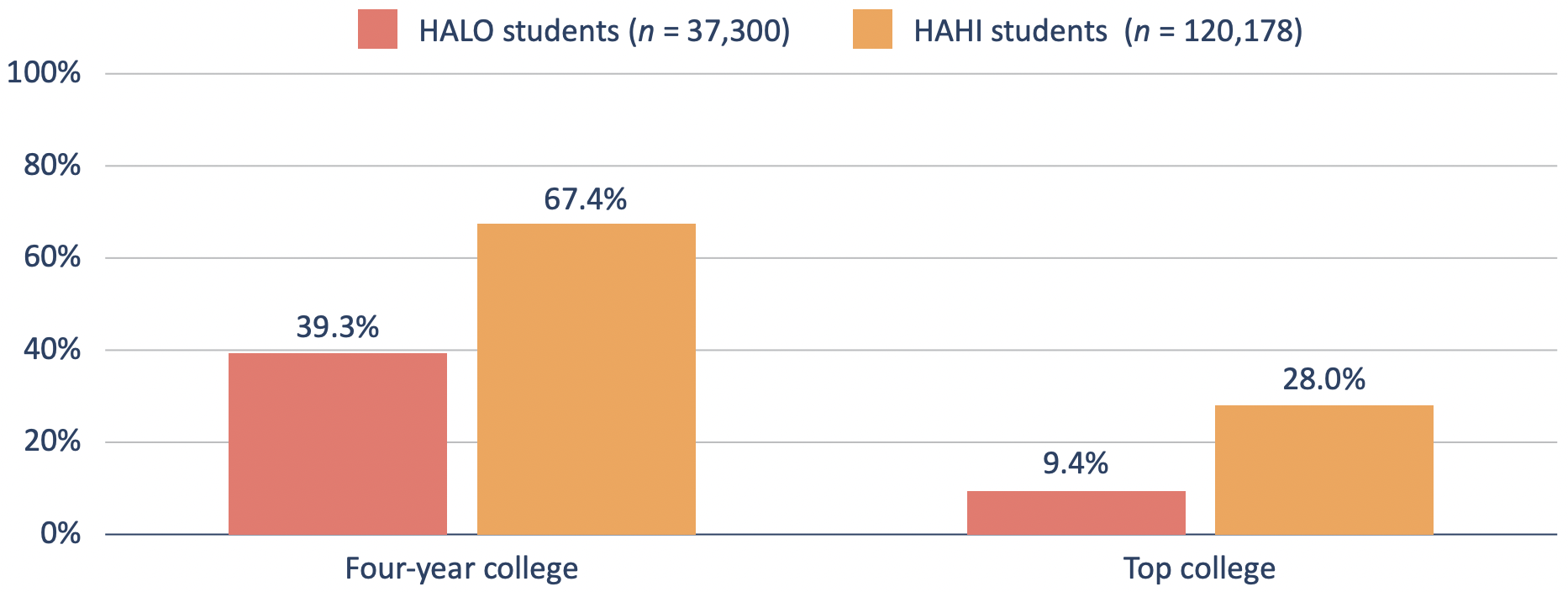
This systemic neglect has ramifications for their college-going. Figure A shows that only two in five HALO students enroll in any four-year college within two years of high school, and fewer than one in ten attends a top college. These college-going rates are far lower than those of high-achieving, high-income (HAHI) students. Specifically, Ohio’s HALO students are 42 percent less likely to attend a four-year college and 66 percent less likely to attend a top college than their similarly-scoring but more affluent peers.[3]

Figure A. HALO students attend college at much lower rates than their more affluent, similarly-scoring peers.

1

Note: The number of HALO and HAHI students identified in this analysis (37,300 and 120,178, respectively) is a combined total based on six years of third-grade test score data (2008–09 to 2013–14). Due to data limitations, the analysis was unable to track all HALO students into college (e.g., students moving out of Ohio), and thus their college-going rates are likely to be slightly understated.

Underscoring how leaky this pipeline is for HALO students, consider this: While they are outnumbered 3-to-1 by their more affluent counterparts in the top achievement quintile in third grade, a decade later they are outnumbered 6-to-1 in four-year colleges and a staggering 10-to-1 in top colleges.

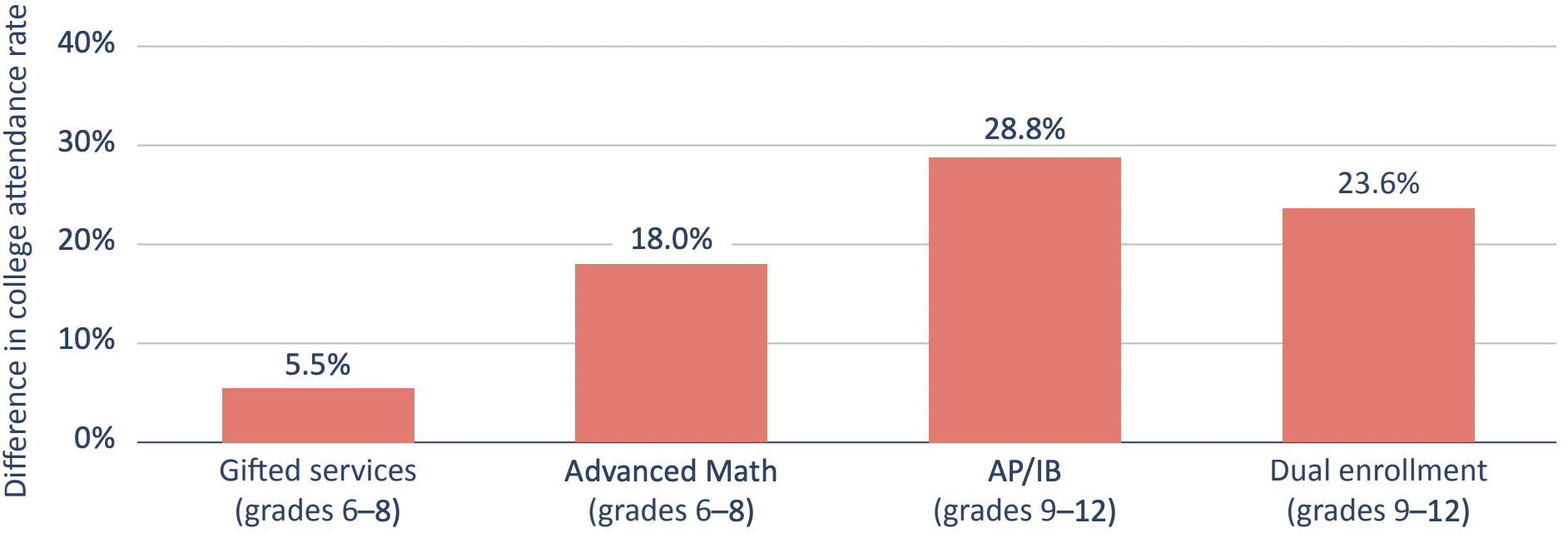
What would keep more HALO students on-track for college? Figure B shows that AP or IB and dual-enrollment course-taking during high school makes a difference in their college-going prospects, as do advanced math courses during middle school and gifted services in English language arts or math. For instance, HALO students who completed an AP or IB course had four-year college-going rates that are 29 percentage points higher than HALO students who did not complete such courses. These results provide compelling evidence that advanced learning opportunities are critical to keeping students on a college pathway.[4]

Figure B. HALO students who participate in advanced learning opportunities have higher four-year college attendance rates than HALO students who do not.

2

Note: This figure displays the differences in attendance rates at any four-year college. See Table 6 in the report for results for top colleges.

Policy implications

What should state and local policymakers do? Many solid recommendations were recently made by a national working group on advanced education, which can be found in this Fordham report. Here, let us highlight five ideas.

1. Ensure early identification of high-achieving students and provision of advanced education during elementary school. It’s hard for schools and teachers to provide advanced learning opportunities to HALO students if they don’t know who they are. Commendably, Ohio (and several other states) require universal screening in the elementary grades for gifted and talented programs (using non-state tests). Policymakers should go a step further and also require identification when students score at the highest levels on state exams—an important marker of academic ability. But identification alone won’t do students much good unless schools provide them opportunities to accelerate and advance. Here, states also have a role to play. They should require schools to provide advanced opportunities to identified students—and enforce that requirement through an audit-type process.

2. Promote automatic enrollment of high achievers in advanced middle school and high school math courses. A few states, including North Carolina and Texas, have automatic enrollment policies that guarantee placement in advanced math courses based on students’ prior-year test scores. For instance, under this type of policy, high-performing seventh graders are automatically placed in eighth grade Algebra I, which is key to more advanced math in high school. Tying course placement to objective measures of achievement ensures that HALO students are in advanced courses—far more reliable than systems that rely primarily on subjective judgments or recommendations for such placements.

3. Expand access to AP and IB coursework into more high-poverty high schools. This goal has long been on the education-reform agenda, but there’s still much to be done to bring such challenging course options into schools that serve the most HALO students (e.g., high-poverty rural or urban campuses). This can be done in many ways, including, for example, “itinerant” programs, whereby an AP teacher covers classes in multiple schools or school districts, or virtual options that bring advanced coursework into classrooms anywhere in the state. Another possibility is to offer schools or teachers financial incentives when students pass AP or IB exams, as North Carolina does. A “weighted” bonus that provides additional funds when low-income students pass these exams could further strengthen the incentive for educators to start programs in schools that have not traditionally offered advanced coursework.

4. Help more HALO students access suburban public schools. In analyses pinpointing which Ohio districts most effectively boost the college-going odds of HALO students, we find several wealthy suburban districts—Solon, Mason, and Dublin among them—topping the charts (see here). That is good news for the handful of low-income students who live in those districts. However, many suburban districts, including two of the three mentioned above, prohibit non-resident pupils from attending their schools. States should require all districts, including suburban, to participate in statewide interdistrict open enrollment, a policy that enables students to cross district boundaries to attend school. This would put suburban public schools—and the advanced opportunities they typically offer—within greater reach of HALO students residing in nearby cities.

5. Launch specialized magnet schools for high achievers. When it comes to Ohio’s best high schools for HALO students (see here for overall rankings and here for rankings focused on top colleges), this varied mix includes a handful of urban district high schools, such as Walnut Hills in Cincinnati and Cleveland School of Science and Medicine, both of which have selective admissions. Also near the top are a few non-district options, such as Dayton Early College Academy, a public charter school that Fordham authorizes, and Metro High School, an independent STEM school in Columbus. Unfortunately, such schools are rare. School districts should work to create specialized, “early college” schools for high achievers—open to students regionally—as could charter or STEM school developers. Following in the footsteps of Illinois, North Carolina, and Oklahoma, states themselves could also create, and directly fund, a residential, competitive public high school that enrolls high-achieving students from all corners of the state.

HALO students have demonstrated their potential to reach college and use it as a springboard to the American dream. Yet due to widespread neglect of their talents, our education system allows too many of them to fall through the cracks. There is a clear pathway that can better nurture HALO students. It includes early identification and acceleration in elementary school, access to advanced math coursework starting in middle school, and enrollment in high schools with strong college-prep curricula and college-going cultures. The playbook is there. Now the question is whether states and school systems can execute those plays and give HALO students the challenge and rigor that prepares them to compete for spots at our top universities.


[1] A “top college” in this report is one in which the average student scores in the top 20 percent on college admissions exams. Among Ohio institutions of higher education, this includes Case Western University, Cedarville University, College of Wooster, Kenyon College, Miami University, Oberlin College, Ohio State University, University of Cincinnati, and University of Dayton.

[2] HALO students are identified based on their characteristics in third or eighth grade, depending on the analysis. Specifically, they are students who scored in the top 20 percent statewide on math and ELA exams and who were identified as “economically disadvantaged,” which is largely based on their eligibility for free or reduced-price lunch.

[3] These college-going gaps reflect not only uneven in-school opportunities, but also factors not directly observed in this study such as college affordability and parents’ educational backgrounds, which a recent study from North Carolina indicates contributes to excellence gaps.

[4] These are not precise “causal” estimates, as unobserved factors, like an effective counselor, might have led students to take advanced courses in the first place.

view
Student at school

CRPE on special education: Great diagnosis, wrong prescription

Chester E. Finn, Jr.
11.6.2025
Flypaper

A remarkable new data engine and provocative policy paper from the Center on Reinventing Public Education should serve to refocus the attention of policymakers and ed-reformers on the many shortcomings of special education as it has evolved over the past half-century. Yes indeed, it’s been 50 years since President Ford reluctantly signed what is now the Individuals with Disabilities Education Act (IDEA).

Back then, 8 percent of U.S. school kids were identified as “handicapped.” Today it’s 15 percent nationally, though the remarkable state-to-state variability is one of the many virtues of CRPE’s new data tool. By all means check it out, as it shows changes over time by disability category and by state, as well as for the country as a whole.

As the policy paper—by Ashley Jochim and Alexander Kurz—explains, the swelling of SpEd rolls can be traced to actions by Congress and the courts to widen eligibility, notably the statutory inclusion of “learning disabilities,” autism, and “other health impairments” (such as ADHD), all in “the wake of protracted advocacy campaigns about students’ unmet needs for support.”

As the authors also note, the current federal special-ed structure rests on two key elements. First is the existence of a government mandated right to “free, appropriate public education,” with “appropriate” expanded over time to mean assured access to a host of services and accommodations not ordinarily available to other students. And, second, exactly that “exclusionary foundation,” such that (for example), “Students whose reading struggles are associated with dyslexia are ‘in,’ whereas those whose struggles are rooted in poverty, language, or poor instruction are ‘out.’”

This structure has given rise to all manner of problems, including vast amounts of litigation, much bureaucracy, a focus on compliance rather than achievement or accountability, endless lobbying, and high costs, only a fraction of which is covered by federal funding, even though this is the second largest federal K–12 program.

These problems have been recognized for ages. Back in 2001, we at Fordham teamed up with the Progressive Policy Institute to issue a comprehensive repair manual, titled Rethinking Special Education for a New Century. We wrote then that:

Over the past 25 years, K–12 education in the United States has undergone a profound paradigm shift, from access-and-services to results-and-accountability. During the most recent decade, this change has been especially dramatic. Special education simply hasn’t kept up. It’s still an access-and-services program enveloped by a civil rights orientation. It still has more to do with combating discrimination than teaching children what they need to learn.

We itemized eight major “policy failures” and recommended a total overhaul resting on six principles:

1. Make the IDEA standards- and performance-based wherever possible, using Section 504 as the civil rights underpinning of special education but viewing the IDEA as a bona fide education program that is judged by its results.

2. Streamline the number of special education categories into a very few broad groupings, distinguished by whether the basic conditions they address are primarily in need of prevention or intervention, remediation or accommodation, or some combination thereof.

3. Focus on prevention and early intervention wherever possible, using research-based practices.

4. Encourage flexibility, innovation, and choices, allowing schools to work with students and parents to customize services and placements to meet varying needs, and foster the integration of special education into the school’s larger mission and program, while giving parents sound options for their children’s education.

5. Provide adequate funding to ensure the program’s success, assigning to Washington full responsibility for funding the education of the country’s growing population of severely disabled students.

6. End double standards wherever possible.

Perhaps I don’t need to note that not much of this happened. When IDEA was reauthorized in 2004—the last time Congress has touched it—some useful changes were made but nothing like a full makeover. And in the two decades since, the policy failures have mostly worsened, the costs have risen, lawyers and lobbyists have grown wealthy, the SpEd rolls have ballooned—and youngsters on those rolls are still not learning nearly as much as they’re capable of.

On the plus side, NCLB identified students with disabilities as a category whose achievement needed to be tracked at the school level and dinged schools that did poorly in this realm. In the early years, this accountability system plus disaggregated results yielded some gains for SpEd students. While it lasted, the Reading First program also produced improvements in the early reading abilities of some disabled youngsters. 

The biggest reform of the past quarter century that bears directly on children with disabilities, however, is that school choice has created escape mechanisms for many families, enabling them to exit the bureaucratic/legalistic precincts of traditional public schooling into private-sector alternatives. This began in a big way with Florida’s creation of the McKay Scholarship Program—piloted in Sarasota in 1999 and now part of the Sunshine State’s overarching “Family Empowerment Scholarship Program.” Today, some 20 private-school scholarship programs scattered across 14 states are designed for students with “special needs.”

Choice continues to grow, but NCLB and Reading First are both history. Congress has avoided going back to fix IDEA and no White House has pressed them to. Much of the rest of the ed-reform movement of the past quarter century seems to have bypassed special education, and today, the federal SpEd edifice is something of a sacred cow or—viewed from the other direction—“third rail” issue that nobody in high office is brave enough to tackle.

Kudos to CRPE for plunging back in. The problem—at least for me—is that the principal reform the new policy brief proposes is to give millions more kids a federally guaranteed right to the education they need. Jochim and Kurz put it this way:

A new, needs-based entitlement is the linchpin of any effort to fix today’s system of general and special education. It would establish reliable criteria (e.g., students identified at-risk for low achievement in reading or math) for identifying educationally disadvantaged students and a legal mandate to provide those students with the additional instruction and support they need to succeed in school.

Think about it. Students would still have to be “identified.” The “criteria” for doing so could be anything and everything—and we can be certain that all imaginable interest groups would do their best to qualify, from gifted students to left-handed students to trans students to artistic students to kids with unusual athletic skills or career aspirations. Meanwhile, others would continue to be left out of this “legal mandate,” thus perpetuating the “exclusionary foundation” that the authors see as the source of today’s SpEd woes.

I do not understand how this proposed remedy solves the problem. It appears to worsen it, even as the authors launch the politically fraught idea of yet more federal “rights” atop a K–12 system that is grounded in state constitutions, mandates and budgets. Is it really a good idea at this moment in time to create a “needs-based entitlement” and to spur vastly more litigation by “providing parents, the courts, and state policymakers a legal basis for adjudicating claims of inadequacy”?

Somehow, I don’t think so.

view
Students on computers at school

The illusion of learning: The danger of artificial intelligence for education

Robert Pondiscio
11.6.2025
Flypaper

In the spring of 2000, E.D. Hirsch Jr. published an essay in American Educator titled “You Can Always Look It Up—Or Can You?” It’s one of those pieces that distills a lifetime of insight into a few pages. Hirsch argued that the notion of teaching “learning skills” instead of knowledge was deeply misguided. To look something up, he noted, presupposes that you already know something—enough to recognize what’s relevant, to interpret what you find, to sift sense from nonsense.

The problem wasn’t that children were lazy or that teachers were inept, but that progressive pedagogy had confused knowing what with knowing how. Hirsch saw this long before most of us: The capacity to find information isn’t the same as understanding it. Skills are empty vessels; knowledge is what fills them.

A quarter century later, we face the same issue on steroids. Artificial intelligence has made “looking it up” obsolete. Why bother? ChatGPT—or whatever model you prefer—doesn’t just find information; it synthesizes, evaluates, and presents it in tidy, authoritative paragraphs, ready to be cut, pasted, and submitted for grading. What Hirsch feared might happen to students who relied too heavily on search engines pales next to the complacency invited by AI, which offers the illusion of mastery without the work of learning. It allows both students and teachers to skip the hard part—the thinking.

The seductive ease of knowing without learning

To learn anything deeply, you must wrestle with it. The effort itself—sorting, comparing, rephrasing, struggling to make sense of what you read—is where learning occurs. Cognitive scientists call this productive struggle or desirable difficulty. “There is a consensus in cognitive psychology that it takes knowledge to gain knowledge,” Hirsch wrote in 2000. “Yes, the internet has placed a wealth of information at our fingertips. But to be able to use that information—to absorb it, to add to our knowledge—we must already possess a storehouse of knowledge. That is the paradox disclosed by cognitive research.”

AI is fatal to this process. Type a question and it produces a fluent answer. The prose is confident, the reasoning plausible, the sources (usually) credible. But the user’s mind remains largely idle. Students who rely on AI to write an essay or solve a problem may submit excellent work, but they have not done excellent thinking. The polished output masks the absence of cognition behind it.

There’s nothing new about this temptation. The spellchecker made us worse spellers; calculators dulled our ability to do mental math. But those technologies automated low-level skills. AI automates higher-order thinking—the very mental operations that define a well-educated person.

This is not just a student problem. Teachers, too, are vulnerable to AI’s siren song of efficiency. AI can spit out lesson plans, differentiated materials, or essay feedback in seconds. But efficiency is not the same as expertise. Teachers become skillful through the deliberate act of designing lessons, anticipating misconceptions, reading and responding to student work. Offload those tasks to AI and you hollow out the craft. The teacher becomes an editor of machine output rather than an author of instruction. In time, that can only erode the kind of pedagogical expertise that separates a novice from an expert.

AI is not a democratizing force that will level the playing field for students and make teachers’ jobs easier. When automation replaces learning, the opposite happens: The knowledgeable become more powerful, the uninitiated more dependent.

Outsourcing judgment

When Hirsch wrote “You Can Always Look It Up,” Google was just getting started. Search engines required users to decide which keywords to enter, which links to click, and how to interpret what they found. It was still an exercise in judgment. You had to know something to get anything of value from the search results.

AI takes judgment out of the loop. It doesn’t simply retrieve information—it makes evaluative decisions about what’s relevant, what’s plausible, and how to frame and communicate it. That might not sound catastrophic—until you consider that developing judgment is the entire point of education. Hirsch’s lifelong project, from Cultural Literacy onward, has been to argue that knowledge is not merely a private good but a civic one. Yes, a shared store of background knowledge enables students to read with comprehension. But it also allows citizens to comprehend the news, participate in democratic debate, and resist manipulation.

AI, used uncritically or as a shortcut, does the opposite. It trains us to trust rather than test what we read. Its convenience invites intellectual passivity. The effect is not enlightenment but anesthesia.

Hirsch’s concern was always larger than pedagogy. The “knowledge deficit,” as he called it, weakens not just individual students but the culture itself. When people lack the background knowledge to make sense of public life, they become easy marks for demagogues and charlatans.

AI enables and accelerates that vulnerability. It substitutes the appearance of understanding for the effort and discipline needed to achieve it. The more we rely on it to summarize, paraphrase, or interpret the world for us, the less capable we become of making sense of the world ourselves.

This is not an argument for technophobia. It’s an argument for intellectual vigilance. The civic mission of education is not to make students efficient consumers of information but to form judicious minds—citizens who can weigh evidence, detect bias, and recognize coherence or nonsense when they see it. If AI makes those faculties atrophy, it will have made us not smarter but shallower.

Can schools use AI well?

The problem is not the technology itself but our disposition toward it. AI can be genuinely useful when it serves as a multiplier of existing competence. A well-informed teacher can use it to save time on tasks that don’t require much judgment, like generating examples or producing low-stakes practice materials. A motivated student can use it to clarify confusion or practice skills already in progress. A chatbot can even serve as a Socratic partner for students, posing counterarguments or probing for clarity. But these examples presuppose that the user already possesses the knowledge and judgment to recognize when the machine is wrong.

That’s the rub. The very people most likely to misuse AI—those with shallow background knowledge, weak discernment or motivation—are the ones most susceptible to its illusions. It’s a knowledge amplifier, not a knowledge substitute. Education is not a product to be delivered; it’s a transformation that occurs through effort. The problem with AI is that it can perform education’s outputs—essays, analyses, answers—without any of its inputs. In sum, it is a powerful tool in the hands of the curious and the motivated but devastating to those merely seeking a shortcut.

The teacher’s dilemma

If you’ve ever taught writing, you know that feedback is not a mechanical process. It’s an act of interpretation: discerning what the student was trying to say, identifying where understanding breaks down, and deciding how to guide improvement. It’s as much an art as a science. And it’s hard, even for accomplished writers.

AI grading tools streamline this labor and even offer useful insight to students. But a teacher who stops giving feedback herself—who stops reading with the mind of a teacher—risks losing the ability to see through her students’ eyes. Over time, and with over-reliance on the technology, her professional discernment dulls.

In this sense, AI poses to teachers the same threat that automation poses to workers in every field: deskilling. But in education, the stakes are uniquely high because what’s being eroded is not merely a job skill but a human connection. The teacher’s authority arises from her knowledge and her capacity to model it. If she becomes merely a conduit for AI-generated content, she ceases to be a craftsman. Her skills can only atrophy or fail to develop in the first place.

The danger of AI

Hirsch’s insight still holds: to make sense of the world, you must already know a great deal about it. As he wrote in his 2000 essay, “One of the most important principles of psychology is that knowledge builds on knowledge. The more you know, the more readily you can learn something new, because you have a lot more analogies and points of contact for connecting the new knowledge with what you already know.”

We should use AI as we use any powerful tool, with caution, curiosity, and a clear sense of purpose. But we should take great care—students and teachers alike—to resist substituting the efficiency of AI with the slow, irreplaceable labor of teaching and learning. Because the great danger of AI is not that it will outthink us but that it will tempt us to stop thinking altogether.

Editor’s note: This was first published on the author’s Substack, The Next 30 Years: The Future of Education Reform.


view
School cellphone ban

Cutting the cord: Early evidence on cellphone policy implementation

Alicia Anderson
11.6.2025
Flypaper

Most U.S. students currently or will soon attend a school with a cellphone policy. Phone bans provide cover for teachers and administrators lamenting the constant fight for kids’ limited attention in the classroom, and most teachers support enforceable policies that limit student use during instructional time. Opponents are often parents of school-age children with concerns both dramatic (what if I can’t reach my kid in an emergency?) and practical (is there soccer practice after school today?).

Given the paucity of empirical evidence to support them, school cellphone bans are effectively policymaking by vibe. The research literature is particular sparse in the U.S. context, and existing data are both mixed and complicated by the pandemic’s disruption. Hence the value of David Figlio and Umut Özek’s new working paper on a Florida district’s cellphone policy implementation. The researchers pull demographic, testing, discipline, and attendance data to compare pre- and post-cellphone ban results, using a quasi-experimental design to determine whether there is a causal connection between policy and outcomes. The findings, though not presently peer-reviewed, provide evidence that supports cellphone ban policies generally and bell-to-bell bans specifically.

In July 2023, Florida enacted HB 379, prohibiting student cellphone use during instructional time in K–12 schools.[1] Figlio and Özek draw on data from a large urban district that went further, requiring devices to be silenced and out of sight throughout the entire school day. Using student data from the district and Advan smartphone activity data to understand cellphone use at the building level, they classify schools by high or low cellphone use before the policy implementation in 2023. They use a difference-in-differences approach to compare test scores, disciplinary records, and attendance data pre- (2022–23) and post-policy shift in the high- and low-cellphone activity schools to see whether the ban had a causal effect on student outcomes during its first two years (2023–24 and 2024–25). 

The ban successfully got kids off their phones—estimated building-level cellphone use by students dropped by about two-thirds within the first two months and remained low in the two years studied. Unsurprisingly, however, implementation presented notable challenges.

Disciplinary incident rates in the high-cellphone use schools went up in the first year of the ban relative to the low-use comparison schools, with an estimated 12 percent increase in overall suspensions and a 20 percent increase in in-school suspension rates compared to the low-use schools—both driven disproportionately by large increases among Black students. Disciplinary issues improved in the second year, but these improvements were driven by reductions in elementary school incidents; rates for middle and high schools were better than in year one but out-of-school suspensions remained elevated compared to pre-ban levels.

Academic outcomes improved under the ban. During the spring testing window at the end of the ban’s second year, scores in previously high-cellphone activity schools were up 1.1 percentiles overall relative to low-cellphone activity schools, with larger effects for boys (1.4 percentiles) and for middle and high school students who are more likely to have access to a phone (1.3 percentiles). Effects were not statistically significant for girls or elementary school students. 

Those modest but promising gains should be viewed against the backdrop of other policy changes. The 2022–23 school year marked a major shift for state assessments, with SB 1048 eliminating the Florida Standards Assessment (FSA) in favor of new thrice-annual FAST assessments, which benchmark twice and then use the spring results for higher-stakes accountability purposes. The overhaul led Figlio and Özek to start their analysis with 2022–23 data rather than merging previous pandemic-era FSA results, but it’s possible that the small improvements stem from building-level differences in adjusting to the new tests. The study measures FAST academic outcomes only for grades 3–10 (English language arts) and grades 3–6 (math).

More importantly, unexcused absences dropped 5 to 10 percent under the new policy, making it difficult to disentangle the academic achievement effects of simply attending school from effects of the ban itself. Figlio and Özek suggest that up to half of the academic gains may be attributable to better attendance, especially among middle and high schoolers.

Why are more kids showing up for class under the new policy? This question falls outside the scope of this study but has real implications for both policy formation and for school leaders trying to build stakeholder buy-in during implementation.

I asked a few teachers, parents, and teens for their take on the attendance findings, and several suggested fear of missing out when friends are engaging in person at school. Others told me with confidence that the inability to quickly text home for a pick-up without trekking to the main office to call via landline under the glaring eyes of the office staff contributes to more kids spending their school day in the classroom. June 2025 data from the NCES School Pulse survey support this theory—more than half of respondents listed “parent apathy” as a reason why middle and high school students miss too much school.

School culture doesn’t exist in a vacuum, and changing behavior isn’t easy—especially when it requires shifting parent behavior alongside student habits. It’s worth remembering that many current high school students got their first devices during the pandemic, when cellphones became one of the few ways to stay socially connected during lockdowns and were a key academic tool for students without access to computers or to reliable internet. Parents are adjusting to new norms after years of constant contact with their teens; the bans provide some cover against student and parent pushback while school leaders help their communities adapt.

Figlio and Özek show that cellphone policies can drive modest academic achievement gains and significantly boost attendance, providing empirical evidence that supports the gut feelings of many policymakers and educators. Compared to policies that limit cellphone use only during instructional time, full bell-to-bell bans may create more opportunities for student engagement but also more opportunities for infractions. To guard against bias in disciplinary actions, school leaders should monitor enforcement approaches carefully and systematically code cellphone-related infractions. As more schools implement cellphone bans, robust data collection can inform attempts to develop appropriate digital device policies and healthy shared norms among students, families, and schools.

Source: Figlio, David N. and Umut Özek, “The impact of cellphone bans on student outcomes: Evidence from Florida.” NBER Working Paper No. 34388. National Bureau of Economic Research (October 2025).


[1] In May 2025, Florida enacted a stricter bell-to-bell ban for elementary and middle school students that went into effect after the time covered in this study.

view
Stéphane Lavertu

The leaky college pipeline for high-achieving, low-income students | Episode 993 of The Education Gadfly Show

11.5.2025
Podcast
 

This week, we’re joined by Ohio State’s Stéphane Lavertu, author of Fordham’s new study, The Leaky Pipeline: Assessing the college outcomes of Ohio’s high-achieving low-income students. The report examines the experiences of Ohio’s high-achieving, low-income—or “HALO”—students and finds that access to advanced learning opportunities plays a major role in whether they make it to four-year colleges.

Then, on the Research Minute, David Griffith spotlights a decades-long British study that followed the same individuals from childhood to age fifty—revealing how early cognitive skills shape lifelong outcomes, from education and occupation to wages.

Recommended content:

  • The Leaky Pipeline: Assessing the college outcomes of Ohio’s high-achieving low-income students —Stéphane Lavertu, Thomas B. Fordham Institute

  • Excellence Gaps by Race and Socioeconomic Status —Meredith Coffey and Adam Tyner, Thomas B. Fordham Institute

  • Building a Wider, More Diverse Pipeline of Advanced Learners —The National Working Group on Advanced Education

  • Cognitive Skills Beyond Childhood —Uta Bolt, The Economic Journal (2025)

Feedback Welcome: Have ideas for improving our show? Send them to [email protected]

Fordham Logo

© 2026 The Thomas B. Fordham Institute
Privacy Policy
Usage Agreement

National

P.O. Box 110
Burke, VA 22009

202.223.5452

[email protected]

Ohio

P.O. Box 82291
Columbus, OH 43202

614.223.1580

[email protected]

Sponsorship

130 West Second Street, Suite 410
Dayton, Ohio 45402

937.227.3368

[email protected]