Mobile Navigation

  • National
    • Policy
      • High Expectations
      • Quality Choices
      • Personalized Pathways
    • Research
    • Commentary
      • Gadfly Newsletter
      • Flypaper Blog
    • Events
    • Scholars Program
  • Ohio
    • Policy
      • Priorities
      • Media & Testimony
    • Research
    • Commentary
      • Ohio Education Gadfly Biweekly
      • Ohio Gadfly Daily
  • Charter Authorizing
    • Application
    • Sponsored Schools
    • Resources
  • About
    • Mission
    • Board
    • Staff
    • Career
Home
Home
Advancing Educational Excellence

Main Navigation

  • National
  • Ohio
  • Charter Authorizing
  • About

National Menu

  • Topics
    • Accountability & Testing
    • Advanced Education
    • Career & Technical Education
    • Charter Schools
    • Curriculum & Instruction
    • ESSA
    • Evidence-Based Learning
    • Facilities
    • Governance
    • Personalized Learning
    • Private School Choice
    • School Finance
    • Standards
    • Teachers & School Leaders
    • Think Again
  • Research
  • Commentary
    • Gadfly Newsletter
    • Flypaper Blog
    • Gadfly Podcast
  • Events
  • Scholars Program

The Education Gadfly Weekly

Sign Up to Receive Fordham Updates

We'll send you quality research, commentary, analysis, and news on the education issues you care about.
Thank you for signing up!
Please check your email to confirm the subscription.

The Education Gadfly Weekly: How to respond sensibly to the Uvalde shooting

Volume 22, Number 22
6.2.2022
6.2.2022

The Education Gadfly Weekly: How to respond sensibly to the Uvalde shooting

Volume 22, Number 22
view
High Expectations

How to respond sensibly to the Uvalde shooting

Awful tragedies like the shooting in Uvalde notwithstanding, firearms will remain ubiquitous. The question is whether policymakers can bring measured thinking and nuance to bear in solving the thorny problem of gun violence in schools. This is particularly challenging in a media climate that hypes and distorts the prevalence of what happened in last week, even as schools continue to deal with the fallout from the coronavirus pandemic.

Dale Chu 6.2.2022
NationalFlypaper

How to respond sensibly to the Uvalde shooting

Dale Chu
6.2.2022
Flypaper

How to narrow the excellence gap in early elementary school

Michael J. Petrilli
6.2.2022
Flypaper

Natalie Wexler goes astray on the NAEP reading test

Chester E. Finn, Jr.
6.2.2022
Flypaper

How does a child’s religious background affect her choices about higher education?

Nathaniel Grossman
6.2.2022
Flypaper

Education Gadfly Show #822: Checker Finn: Why we need—and need to improve—NAEP

6.1.2022
Resource

Cheers and Jeers: June 2, 2022

The Education Gadfly
6.2.2022
Flypaper

What we're reading this week: June 2, 2022

The Education Gadfly
6.2.2022
Flypaper
view

How to narrow the excellence gap in early elementary school

Michael J. Petrilli 6.2.2022
Flypaper
view

Natalie Wexler goes astray on the NAEP reading test

Chester E. Finn, Jr. 6.2.2022
Flypaper
view

How does a child’s religious background affect her choices about higher education?

Nathaniel Grossman 6.2.2022
Flypaper
view

Education Gadfly Show #822: Checker Finn: Why we need—and need to improve—NAEP

Michael J. Petrilli, Chester E. Finn, Jr., Amber M. Northern, Ph.D. 6.1.2022
Resource
view

Cheers and Jeers: June 2, 2022

The Education Gadfly 6.2.2022
Flypaper
view

What we're reading this week: June 2, 2022

The Education Gadfly 6.2.2022
Flypaper
view

How to respond sensibly to the Uvalde shooting

Dale Chu
6.2.2022
Flypaper

If there’s anything we can be sure of following last week’s horrific rampage at Robb Elementary in Uvalde, Texas, it’s that few, if any, federal laws are going to change as a result of it. That’s because Americans are split over whether legal remedies would lead to fewer mass shootings, and public support for additional gun restrictions has actually declined. The dominant “conversation” around school shootings, to the extent it can even be called one, is about whether we should arm teachers and make schools more like prisons rather than figuring out how to keep guns away from lunatics who shouldn’t have access to them. Despite the earnest entreaties to do something, anything about gun violence in schools, it seems unlikely that any meaningful restrictions will be placed on firearm possession in our lifetimes.

We know this, of course, because of the historically passive reaction among lawmakers to mass shootings in U.S. schools, of which there have been fourteen, killing a total of 169 victims since 1999’s bloodbath at Columbine High School. Many assert that these school shootings could have been prevented with additional regulations. But even if lawmakers were to suddenly find religion on gun control, the effect of any new laws would almost immediately be diluted. It also wouldn’t change the fact that there are more guns than people in the U.S. and Americans aren’t simply going to hand them over on their own volition.

For better or worse, firearms will remain ubiquitous. The question then becomes whether policymakers can bring measured thinking and nuance to bear in solving the thorny problem of gun violence in schools. This is particularly challenging in a media climate that hypes and distorts the prevalence of what happened in Uvalde, and while schools continue to deal with the fallout from the coronavirus pandemic (which incidentally helped trigger a surge in gun sales nationwide). After these tragedies, people tend to point fingers and focus on the weapons themselves (e.g., assault weapons bans) while politicians are incentivized towards chest-thumping and grandstanding. The obstacles are daunting, but we desperately need a new approach that goes beyond the stale and warmed-over rhetoric.

For starters, it would be useful to recognize that today’s mass shooting dilemma is downwind from culture—in this case, the cultures of the Uvalde middle school, junior high, and high school where by all accounts the gunman had a difficult experience. School shootings are not random events. There are common signs and signals. The Uvalde shooter was reportedly a troubled young man who was raised in a tumultuous environment and frequently threatened teen girls online. Devoting energy and resources to proactively shutting down bullying, discrimination, and harassment should be an ongoing effort in schools. No one in education has written more forcefully and persuasively on this topic than my friend Andy Rotherham:

Banning [assault rifles] is not the key to solving our school shooting problem... When a young person gets to the point where they are going to use a firearm to harm others at their school the type of firearm available is not the issue. Rather, culture is. A culture of firearms responsibility, safe storage, and access, and a school culture that does far more to interdict and prevent these episodes long before any shooting starts.

It’s hard to overstate the virtuous cycle created by a positive school climate and culture. This goes doubly so when it comes to identifying and swiftly responding to risk signaling behavior. At the same time, solving for school culture is a long-term project, and a less than satisfying answer for those who crave a more immediate response. This means legislation. And although, as I mentioned earlier, new federal laws feel like a pipedream, a lot of this remains in state hands even if Congress remains deadlocked. To wit, there are a couple of policy responses that might have made a difference last week if they had been in place.

The first is raising the minimum age limit for purchasing and possessing firearms. In Uvalde, the assailant legally bought two assault rifles and more than 1,600 rounds of ammunition just after turning eighteen last month. There’s a reasonable argument to be had as to why teenagers are permitted to buy semiautomatic guns. Despite our country’s contradicting positions on when adulthood sets in (e.g., voting versus drinking), six states—Florida, Washington, Vermont, California, Illinois, and Hawaii—have already increased the minimum purchase age of long guns (shotguns and rifles) to twenty-one; the majority did so following the 2018 massacre in Parkland. Texas in some ways resembles Florida in its politics, so it’s possible, albeit improbable, that the Lone Star State might entertain this change following the second largest school shooting in U.S. history.

The second is “extreme risk protection orders,” or what are commonly referred to as red flag laws. The idea is fairly straightforward: If a person exhibits risk signaling behavior that they might be a threat to themselves or others, a family member, a school official, or a law enforcement officer can secure a court order that allows police to confiscate that person’s weapons and prohibit the purchase of additional firearms for the duration of the order. Currently, nineteen states and Washington, D.C., have some form of red flag law on the books. It’s unclear whether one would have helped in Uvalde, but it might have at least given communities a fighting chance in some of our nation’s deadliest school shootings.

The long odds of any of these ideas materializing, however, is indicative of our broken politics. The ratcheting up of distrust and assumption of bad motives on either side has been a cancer on our political culture and discourse. Politicians and pundits alike are fruitlessly seeking, not to be crass, a silver bullet when what’s required is a serious and deliberative weighing of tradeoffs between liberty and protecting our children from this awful scourge. There are no quick or easy fixes. Thankfully, mass murders in schools of the variety we saw last week are exceedingly rare, but it’s a sad reality that we have now experienced enough of them to recognize the all too disturbing patterns.

view

How to narrow the excellence gap in early elementary school

Michael J. Petrilli
6.2.2022
Flypaper

In recent weeks, I’ve dug into the “excellence gap“—the sharp divides along lines of race and class at the highest levels of academic and educational achievement. My argument has gone something like this:

1. The excellence gap at the twelfth grade level largely explains why Black, Hispanic, and low-income students are underrepresented at our most selective universities. Without affirmative action, this underrepresentation would be much worse.

2. Sadly, the excellence gap appears long before high school. It looks much the same as far back as fourth grade, according to the National Assessment of Educational Progress. For example, just 4 percent of fourth graders who score Advanced in reading are Black, as are just 6 percent of Hispanic students.

3. That said, the gaps are slightly smaller in fourth grade than in twelfth, especially for Black and low-income students, indicating that middle schools and high schools may be making the problem worse.

4. The excellence gap is even apparent at kindergarten entry. That indicates that much of the gap is driven by out-of-school factors, especially socioeconomic inequality between the ages of zero and five.

5. Yet many more Black and low-income students are achieving at high levels in kindergarten, especially in reading, than in later years. This indicates that something is causing the excellence gap to widen in the early years of elementary school. (Other achievement gaps tend to grow during these early years, as well.)

That last point is what gives me hope. If we can understand why a disproportionate number of Black and low-income high-achievers are “losing altitude” in grades K–3, we might identify strategies to reverse this trend.

So what might explain it? And what, if anything, might be done about it? Let’s dive into some possibilities.

1. Socioeconomic inequality continues to exert downward pressure on these students’ achievement. It is likely that the same factors that keep some students from developing their full potential before they ever get to school continue to wreak havoc as they make their way through childhood. The left would point to systemic racism and a weak social safety net; the right would point to family structure and culture.

2. Black and low-income high achievers may lack access to high-quality elementary schools. This is both common sense and a bit circular: These students aren’t making as much progress as their peers, so by definition their schools are not as effective at boosting achievement. It’s probably true but not particularly helpful in identifying what precisely schools might be doing (or not), and what we might do to fix the situation.

3. Early elementary teachers may be biased against Black and low-income high achievers. Now we’re hitting on something that policymakers and practitioners might try to fix. In my post last fall on the gender gap in reading, I offered evidence that teachers in the early grades were biased against boys. That was apparent when researchers used data from the Early Childhood Longitudinal Study (ECLS) to compare students’ test scores to teachers’ evaluations of the same children’s abilities. Teachers systematically underestimated boys’ reading prowess, perhaps conflating their bad behavior with struggles in learning to read. As a result, they might have placed “good girls” in their highest reading group, and left “bad boys” to languish in groups that weren’t challenging enough.

Perhaps something similar is happening by race or class? I couldn’t find direct evidence for the early elementary grades, but we know from other studies that teacher expectations matter, and they tend to be lower for Black students. This is of course why leading thinkers in the field of gifted education are so adamant about universal screening; we know that teacher or parent recommendations can be biased, so we need objective ways to identify students who could benefit from advanced education. More on that below.

4. These students may be struggling with reading comprehension, thanks to limited content knowledge. As E.D. Hirsch, Jr. has argued for over three decades, many children struggle to comprehend because they lack the vocabulary to be fluent readers. And their vocabulary deficit comes from a knowledge deficit; they haven’t been taught enough about science, history, geography, and the arts to recognize common words when they sound them out.

There’s tantalizing evidence from ECLS—the source of the kindergarten achievement data I’ve been using—that this is precisely what’s happening. As discussed in previous posts, that study tested incoming kindergarteners in the fall of 1998 in reading and math, using an assessment read aloud by teachers. Given the age of the students, the reading assessment focused on basic literacy skills: “recognizing the printed word, identifying sounds, word reading, vocabulary, and reading comprehension.”

Intriguingly, ECLS also assessed students’ “general knowledge,” defined this way:

General knowledge represents children’s breadth and depth of understanding of the social and physical environment (i.e., the social, physical and natural world) and their ability to draw inferences and comprehend implications. Dimensions of knowledge measured by the ECLS-K battery include factual information from the physical, earth, biological and social sciences. The skills children need to establish relationships between and among objects, events or people and to make inferences and to comprehend the implications of verbal and pictorial concepts, are also measured. It addresses such topical areas as history, geography and science.

Lo and behold, a much larger proportion of Black and low-income students scored in the top quartile on reading than on general knowledge—10 percent versus 4 percent for Black students, and 21 percent versus 16 percent for low-income students.

By the fourth grade, the NAEP reading assessment tests both the basic literacy skills included on the ECLS reading exam and the reading comprehension ability related to the ECLS general knowledge assessment. Especially at high levels of achievement, basic skills (such as decoding) can be taken for granted; the best readers, then, must also have a strong command of comprehension. And that means having a broad vocabulary built atop a strong base of knowledge.

So perhaps many Black and low-income high achievers are “losing altitude” in the early grades because their strong decoding and other basic literacy skills are not matched by strong content knowledge. If so, building up their content knowledge might make a big difference. Encouragingly, a recent Fordham Institute analysis of the ECLS data found that students made more progress in reading when their teachers spent more time on social studies.

Potential solutions

So what might we do to keep the excellence gap from widening in the early grades? The first item on my to-do list is already familiar to the gifted education field:

  • Identify students with the potential for high achievement via universal screening and local, school-based norms. This increases the likelihood of identifying students who might otherwise be overlooked and guards against potential bias in teacher recommendations. Students identified as gifted or high achieving should have opportunities to learn with other advanced students at least part of the day, and otherwise have access to accelerated programs.

But there are other actions policymakers and practitioners should take that get less attention in gifted-education circles:

  • Start universal screening in kindergarten. Many districts wait to use the third-grade state assessment as the universal-screening tool. But that means not identifying and serving students until the fourth grade—which is way too late, as much of the excellence gap has already opened up by then. Schools should use whatever high-quality assessment they already utilize in kindergarten instead, such as the MAP or i-Ready. And they should continue using such assessments every year to identify older students, too.

  • Go big on content knowledge, especially in grades K–3. Advocates already call for “front-loading” the curriculum, making sure that all students receive a rich, challenging curriculum as soon as they arrive in school, and providing opportunities for educators to notice students who show great academic progress but might not test well yet. Perhaps that front-loading should be loaded with content knowledge, as Hirsch has argued all these years. Thankfully, some of the best new Common Core–aligned instructional materials, like Core Knowledge Language Arts, Wit and Wisdom, and EL Education, take content knowledge seriously. Gifted educators should become their champions.

  • Incorporate grades K–2 into state testing and accountability systems. It’s absurd that the most critical years in K–12 are the ones we don’t include in our accountability policies. Today’s technology makes assessing young students quite feasible, valid, and reliable, and including these grades in accountability systems would encourage a greater focus on helping kids get off to a great start (and discourage schools from placing their weakest teachers in grades K–2). As with other grades, we should focus most of our attention on student progress from year to year (rather than snapshots in time), and should hold schools accountable for helping all students, including their high achievers, make ample gains.

We’re never going to erase the excellence gap entirely until we erase socioeconomic inequalities from conception through kindergarten. But those of us in K–12 education have a responsibility to do everything we can to help every student achieve their full potential. We’re clearly not hitting that standard today, and the earlier we start doing so the better.

view

Natalie Wexler goes astray on the NAEP reading test

Chester E. Finn, Jr.
6.2.2022
Flypaper

Natalie Wexler has done much (along with the likes of Jeanne Chall, Don Hirsch, Dan Willingham, Kate Walsh, and Robert Pondiscio) to establish the fact that there’s science behind the act of reading and the related proposition that real reading (not just “decoding”) is no isolated skill but, rather, a complicated process of making sense of what one reads on the page in the context of what one already knows.

Wexler’s important book, The Knowledge Gap, as described in her own words, “focuses on the relationship between our current largely content-free elementary curriculum and the so-called achievement gap. The book will take readers inside schools and classrooms, showing them what the skills-focused approach to literacy instruction looks like, explaining how and why it has become so entrenched, and charting possible routes to the knowledge-focused instruction that is our best hope of achieving educational and social equity.”

Bravo and huzzah. Everyone should read it, alongside such works as Hirsch’s The Knowledge Deficit and Willingham’s The Reading Mind.

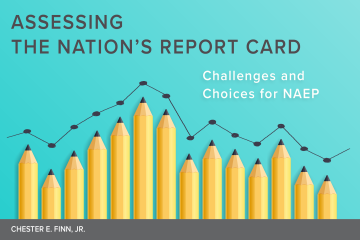
This week, Wexler turned to what she sees as the strengths and weaknesses of my own new book, Assessing the Nation’s Report Card: Challenges and Choices for NAEP.

I’m mostly grateful. She spelled my name correctly and finds merit in the book: “Finn seems to know everyone and everything NAEP-related, and he makes the intricacies of the story surprisingly engaging.”

But she really, really doesn’t like the way that NAEP tests reading, and she really, really wishes I had made a similar criticism.

Her fundamental point isn’t limited to NAEP. It’s about the way America nearly always tests reading, whether at the local, state, or national level. (PISA does the same—even more so—with its claims to test “literacy” among fifteen-year-olds around the world.)

For years, Hirsch, Willingham, Pondiscio, and others have made essentially the same point. As Robert explained it in a fine Education Next essay in 2014, back when the Common Core State Standards were hot:

Students who score well on reading tests are those who have a lot of prior knowledge about a wide range of subjects. This is precisely why Common Core calls for (but cannot impose) a curriculum that builds knowledge coherently and sequentially within and across grades. That’s the wellspring of mature reading comprehension—not “skills” like making inferences and finding the main idea that do not transfer from one knowledge domain to another.

As a practical matter, standards don’t drive classroom practice. Tests do. The first—and perhaps only—litmus test for any accountability scheme is, “Does this encourage the classroom practices we seek?” In the case of annual reading tests, with high stakes for kids and teachers, the answer is clearly “no.” Nothing in reading tests—both as currently conceived or anticipated under Common Core—encourages schools or teachers to make urgently needed, long-term investments in coherent knowledge building from grade to grade that will drive language proficiency.

In other words, reading tests that are divorced from curriculum and student knowledge encourage teachers to approach reading as a collection of disconnected skills, rather than helping students to approach “the wellspring of mature reading comprehension.” And the higher the stakes attached to those test results, the more damage they do.

Unlike state and local tests, NAEP is low-stakes. Wexler understands that, but also notes (correctly) that it has an “indirect but substantial influence” over how reading is approached. That’s why last year’s protracted, painful effort by NAEP’s governing board to come up with a new “framework” for future reading assessments triggered much controversy.

Wexler points out that the self-same governing board convened an expert reading panel a few years back, including such luminaries as Willingham, Tim Shanahan, and Marilyn Adams—which, she writes, told it that, “comprehension depends more on background knowledge than abstract skill. But instead of focusing on subjects that could build the kind of knowledge kids need to read complex text—social studies, science, the arts—elementary schools have cut back on those subjects to focus more on comprehension ‘skills.’ The result is that children from better-educated families generally score higher on reading tests—and achieve academically—because they’re able to pick up academic knowledge at home.”

The way reading is generally tested, Wexler similarly argues, leads to teaching practices that do worst by disadvantaged kids and thereby widen achievement gaps.

She’s right. But a different problem arises—an insoluble one at this point in our history, I fear—when we get to Wexler’s proposed remedy for NAEP’s failings in this realm. As she has proposed elsewhere, Wexler would have NAEP “secure congressional permission to stop giving its biannual ‘reading’ tests and instead focus on subjects like history and geography.” That, she suggests, “could send a powerful signal about what’s actually important to reading comprehension.”

My book does suggest that NAEP shift from biannual testing of reading and math to a four-year cycle, which would (inter alia) create some budgetary slack to test “subjects like history and geography more often.” That would be a fine thing to do.

But as Wexler well knows, regardless of the frequency of the assessments (currently two years for grades four and eight), testing reading qua reading via NAEP is currently mandated by Congress as part of ESSA (and previously NCLB), and those results are used for multiple purposes, including a sort of “audit” of results reported on states’ own reading assessments. Moreover, the kind of reading test that Wexler (and Hirsch et al.) favors depends on a unified curriculum with prescribed content to be learned by all students, more or less the way the Advanced Placement program works.

Imagine—just try to picture—the firestorm that would greet anyone suggesting the sort of “national curriculum” that would have to precede Wexler’s kind of nationwide reading test. I’m not aware that any state has even managed such a thing for itself, though Louisiana is inching in that direction.

Yet without uniform content in what students have read and learned, there’s no practical way to have a standardized reading test that does justice to true reading comprehension.

Test-makers make a stab in this direction by supplying test-takers with extended reading passages that are supposed to contain within themselves the information that students need to possess in order to answer the comprehension questions. But it’s never that simple, for knowledge (and vocabulary) are cumulative things and there’s no way to supply all the background—and thus level the playing field—within a test passage.

Knowing that problem cannot be solved, understanding that Congress isn’t about to do away with the testing of reading, and recognizing that NAEP does have some value—“it provides valuable information about trends in student achievement and highlights disparities between demographic groups”—Wexler ends with a small, somewhat nebulous suggestion: “NAEP officials could at least explain what ‘reading’ tests are actually assessing rather than making vague comments about how we need more time on reading ‘skills.’”

Sure, it matters how we talk about what NAEP results do and do not show. Sure, we’re certainly given to overinterpreting and overthinking them en route to (in Stephen Sawchuk’s phrase) outright misNAEPery. Sure, it would be good if everyone who presents or interprets those results would start with a dozen cautions and limits. But c’mon, folks, we’re living in a world of soundbites, headlines, and tweets. Take the thermometer out of your mouth and you’re looking at your temperature. Take the cuff off your arm and you’re looking at your blood pressure. Take the eighth grade average reading score on NAEP and you’re looking at the reading prowess of the average U.S. eighth grader on the closest thing we have to a pressure cuff. It is what it is—which means, of course, it’s only the beginning of what you really want to know about how well kids are reading and why more of them are not reading better.

One more thing that Wexler surely knows but didn’t mention. Because NAEP is a decent tracker of trends over time in reading prowess and because it does that for states as well as nation, if any state pushed hard in the curricular and pedagogical direction that Wexler and her allies favor—i.e., a knowledge-rich, statewide curriculum from kindergarten onward that’s full of history, science, civics, and such—in due course we’d see a difference in that state’s NAEP reading score! Others might want to know what that state was doing differently. Then they might even try to do it themselves.

Thank you, NAEP.

view

How does a child’s religious background affect her choices about higher education?

Nathaniel Grossman
6.2.2022
Flypaper

“From Bat Mitzvah to the Bar: Religious Habitus, Self-Concept, and Women’s Educational Outcomes,” a new study by Ilana Horwitz et al., analyzes the college-going rates of women raised by Jewish versus non-Jewish parents. Its findings shed light on how religious subgroups incubate certain habits of minds and practices that influence educational outcomes.

Horwitz—an assistant professor in the Department of Jewish Studies at Tulane University—has previously written about religious affiliation and college. Earlier this year, she published God, Grades, and Graduation, which examined the college-going rates of devout Christian teens compared to their more secular peers. The title of her newest article contains a reference to the coming-of-age ritual undertaken by Jewish women at age thirteen. While its male equivalent—the bar mitzvah—goes back to the Middle Ages, the bat mitzvah is of recent vintage. It was not until 1922 that the first bat mitzvah was performed at a New York synagogue—a particularly American blend of tradition and egalitarianism.

Horwitz’s team analyzed three sets of data: the National Study of Youth and Religion (NSYR), the National Student Clearinghouse Survey (NSCS), and qualitative interviews with students as they matured from middle school girls into college women. The NSYR is a four-wave longitudinal study of children ages thirteen to seventeen. Participants—and their parents—were asked a series of questions about their social, academic, and religious lives from 2002 to 2013. The NSCS is used to gather detailed information about college admission and graduation rates. These quantitative data were complemented by information gathered from 107 interviews with thirty-three respondents.

The study considers two dependent variables: the attainment of a bachelor’s degree by 2016 and the selectivity of the undergraduate institution attended by the respondent. Selectivity is determined by the average SAT score of an institution’s admitted students. The key independent variable is the respondent’s religious upbringing, which is separated into three categories: raised by one Jewish parent; raised by two Jewish parents; and raised by non-Jewish parents. Other independent variables—such as gender, socioeconomic status, parents’ occupational prestige, and family income—are used to more fully account for the respondents’ backgrounds.

Horwitz finds that children of any gender who were raised by at least one Jewish parent had a 52 percent predicted probability of attaining a bachelor’s degree, compared to 34 percent of children raised by non-Jewish parents (controlling for variables like socioeconomic status and parents educational attainment). The effect becomes stronger if children were raised by two Jewish parents: while children raised by one Jewish parent[1] have a 46 percent predicted probability of bachelor’s degree attainment, children raised by two Jewish parents have a 58 percent rate.

As suggested by the article’s title, the effect is most pronounced for women. Women with any Jewish upbringing (one or two parents) have a 59 percent predicted probability rate of bachelor’s degree attainment. That rate is 37 percent for their peers with no Jewish upbringing.

The effect of Jewish upbringing is also seen in the selectivity of the colleges attended by the respondents. Respondents of any gender with no Jewish upbringing attended colleges where the average SAT score for admitted students was 1084. For respondents with one Jewish parent, it was 1123, and for respondents with two Jewish parents it was 1152. For women, those with any Jewish upbringing attended colleges where the average SAT score was 1139. It was 1084 for women with no Jewish upbringing.

Why would being raised by Jewish parents make a difference in a child’s educational attainment? This advantage was present even when the study controlled for variables such as parents’ incomes, occupations, and other aspects of socio-economic status. Horwitz is quick to point out that the origin of these effects cannot be found in a genetic or racial difference between Jews and non-Jews. Instead, she proposes that the habitus of Jewish families contributes to these results.

Habitus—a term pioneered by French sociologist Pierre Bourdieu—refers to a person’s mental habits, dispositions, and practices. They are modeled and reinforced during a child’s process of socialization by parents, extended family members, and other adults in the community. Horwitz traces the habitus of American Jewish families through the centuries to ancient and medieval Europe. Traditional Jewish observance required intense study of texts such as the Torah and Talmud, meaning that literacy was an essential part of religious practice at a time when most people could not read or write. It was also typical for Jews to be barred from farming, skilled trades, and other professions by non-Jewish political authorities. This led to Jews adopting professions that required knowledge of words and numbers. After the emancipations of the Enlightenment, European Jews brought this habitus of literacy with them to America.

Through the longitudinal interviews, Horwitz’s team also finds a difference in habitus concerning roles for women and girls’ concept of their future selves. The women who were raised by at least one Jewish parent were more likely to articulate a vision of their future that centered on professional prestige. They were also more likely to have a plan to attain this prestige, which almost always included graduating from a selective university. Motherhood, while seen as desirable, came after college and career on the list of priorities. Women from non-Jewish households were more likely to prioritize marriage and family. They were also less likely to place a high importance on attending a selective college.

In the discussion section of the article, Horwitz argues that “stratification scholars should pay more attention to religious subcultures as a central factor in educational stratification.” This advice has not gone unheeded. In his new book, Ian Rowe argues that religion is essential to helping children—especially those from underprivileged backgrounds—thrive socially and academically. Timothy Carney explored the breakdown of religious institutions and its negative effects on life outcomes in Alienated America. The work of all three authors should motivate us to take a closer look at the interplay of religion and education.

SOURCE: Horwitz, I. M., Matheny, K. T., Laryea, K., & Schnabel, L. (2022). From bat mitzvah to the bar: religious habitus, self-concept, and women’s educational outcomes. American Sociological Review, 87(2), 336–372.


[1] For this study, the category of “raised by one Jewish parent” included participants raised in two-parent households (one Jewish and one non-Jewish) and one-parent households. Horwitz states that analyses of these two sub-groups yielded “equivalent results.”

view

Education Gadfly Show #822: Checker Finn: Why we need—and need to improve—NAEP

6.1.2022
Resource

On this week’s Education Gadfly Show podcast, Checker Finn, the Fordham Institute’s president emeritus and a distinguished senior fellow, discusses recommendations for the National Assessment of Educational Progress from his new book, Assessing the Nation’s Report Card. Then, on the Research Minute, Amber Northern reviews a study on how a performance-based teacher pay policy in the U.K. impacted personnel decisions and student outcomes.

Recommended content:

  • Checker’s new book, Assessing the Nation’s Report Card: Challenges and Choices for NAEP.
  • The study that Amber reviewed on the Research Minute: Simon Burgess, Ellen Greaves, and Richard Murphy, “Deregulating Teacher Labor Markets,” Economics of Education Review (March 2022).

Feedback welcome!

Have ideas or feedback on our podcast? Send them to our podcast producer Pedro Enamorado at [email protected].

view

Cheers and Jeers: June 2, 2022

The Education Gadfly
6.2.2022
Flypaper

Cheers

  • “After mastering English, bilingual students ace tests, including the MCAS.” —Boston Globe
  • GEO Academies in Indiana are preparing underprivileged students for college. —Good Morning America
  • Training teens to drive big trucks is both vocational training and a supply-chain solution. —New Yorker

Jeers

  • “Oregon risks wasting money for schools due to lack of accountability, tracking, auditors warn.” —The Oregonian/OregonLive
  • This piece wants students who are already behind academically to refuse to go to school to protest for gun control. —The Atlantic
  • Since lowering the bar for admissions, San Francisco’s Lowell High, formerly an exam-admissions school, has seen higher course-failure rates. —San Francisco Chronicle
view

What we're reading this week: June 2, 2022

The Education Gadfly
6.2.2022
Flypaper
  • Fears that private-school-choice programs will spark a public-school exodus are not supported by the data. —Education Next
  • Let’s pay students to re-enage them and address Covid learning loss. —Roland Fryer
  • Schools struggle to reliably identify gifted students, and even teachers with special training in gifted education differ on how to fix it. —Hechinger Report
Fordham Logo

© 2026 The Thomas B. Fordham Institute
Privacy Policy
Usage Agreement

National

P.O. Box 110
Burke, VA 22009

202.223.5452

[email protected]

Ohio

P.O. Box 82291
Columbus, OH 43202

614.223.1580

[email protected]

Sponsorship

130 West Second Street, Suite 410
Dayton, Ohio 45402

937.227.3368

[email protected]