Mobile Navigation

  • National
    • Policy
      • High Expectations
      • Quality Choices
      • Personalized Pathways
    • Research
    • Commentary
      • Gadfly Newsletter
      • Flypaper Blog
    • Events
    • Scholars Program
  • Ohio
    • Policy
      • Priorities
      • Media & Testimony
    • Research
    • Commentary
      • Ohio Education Gadfly Biweekly
      • Ohio Gadfly Daily
  • Charter Authorizing
    • Application
    • Sponsored Schools
    • Resources
  • About
    • Mission
    • Board
    • Staff
    • Career
Home
Home
Advancing Educational Excellence

Main Navigation

  • National
  • Ohio
  • Charter Authorizing
  • About

National Menu

  • Topics
    • Accountability & Testing
    • Advanced Education
    • Career & Technical Education
    • Charter Schools
    • Curriculum & Instruction
    • ESSA
    • Evidence-Based Learning
    • Facilities
    • Governance
    • Personalized Learning
    • Private School Choice
    • School Finance
    • Standards
    • Teachers & School Leaders
    • Think Again
  • Research
  • Commentary
    • Gadfly Newsletter
    • Flypaper Blog
    • Gadfly Podcast
  • Events
  • Scholars Program

The Education Gadfly Weekly

Sign Up to Receive Fordham Updates

We'll send you quality research, commentary, analysis, and news on the education issues you care about.
Thank you for signing up!
Please check your email to confirm the subscription.

The Education Gadfly Weekly: In defense of the humble novel

Volume 26, Number 15
4.16.2026
4.16.2026

The Education Gadfly Weekly: In defense of the humble novel

Volume 26, Number 15
view
Student reading a book in class
High Expectations

In defense of the humble novel

As novels disappear from language arts classrooms, their many distinctive benefits are disappearing, too. So argues Daughtery, a former teacher and lifelong lover of the artform. This is a civilization loss that schools should work to reverse.

Miah Daughtery 4.16.2026
NationalFlypaper

In defense of the humble novel

Miah Daughtery
4.16.2026
Flypaper

Robots won’t replace teachers but could help with other school roles

Dale Chu
4.16.2026
Flypaper

Teachers aren’t worse—the job is harder than ever

Julia Hayes
4.16.2026
Flypaper

Stormy weather for college application decisions?

Jeff Murray
4.14.2026
Ohio Gadfly Daily

Does Communities in Schools boost student outcomes?

Jill Hoppe
4.16.2026
Flypaper

College or career? The credential tradeoff | Episode 1013 of The Education Gadfly Show

4.15.2026
Podcast
view
Robot teacher

Robots won’t replace teachers but could help with other school roles

Dale Chu 4.16.2026
Flypaper
view
Stressed teacher

Teachers aren’t worse—the job is harder than ever

Julia Hayes 4.16.2026
Flypaper
view
Weather and college choices SR image

Stormy weather for college application decisions?

Jeff Murray 4.14.2026
Ohio Gadfly Daily
view
School meeting

Does Communities in Schools boost student outcomes?

Jill Hoppe 4.16.2026
Flypaper
view

College or career? The credential tradeoff | Episode 1013 of The Education Gadfly Show

Jay Plasman, Michael J. Petrilli, Amber M. Northern, Ph.D. 4.15.2026
Podcast
view
Student reading a book in class

In defense of the humble novel

Miah Daughtery
4.16.2026
Flypaper

There is a guy named Guy I think about sometimes when I see what language arts has traded. We were eighth grade students at Hally Middle School in Detroit, deep in the throes of a school-wide reading contest. We had outrun every other student, and the contest was down to the two of us, who read and recorded books weekly, neck and neck until the bitter end. Across the school, our teachers had a combination of both deep optimism and high expectations of all students, as evidenced by the ongoing opportunities to read critically, think deeply, and conquer texts on grade level. This contest was no different. Guy had become my greatest challenger, and I beat him—101 books to 99. My victory felt no smaller than the Greeks defeating the Trojans.

That public win came on the winds of a private one. In seventh grade, I wanted to read the biggest book I could find, which, at the time, was Gone with the Wind by Margaret Mitchell. I didn’t know the content, but it had heft and I wanted to read a “big” book. The weight of the book in my 12-year-old hands was the point. With dogged determination, I plowed through the story of Scarlett and Rhett, both deeply enthralled in a love story that ended in tragedy and confused beyond all comprehension of the southern blockade. I didn’t understand all of it. But I built just enough knowledge from a fictional text to anchor American history and economics when I got to high school.

Both of those experiences were pivotal in their own right, but what bonded them together was a deep regard for the humble novel and wanting, deeply, to best it, often and with great aplomb. I’ve been thinking about that instinct lately—the desire not just to read, but to conquer a novel. To walk onto the battlefield of words and emerge victorious, and to take that victory to science, to social studies, to economics, to biology, to sociology, to psychology, to anthropology—the battlefield of the novel is where knowledge is built, ideas are forged, and lives change.

It seems we’ve selectively bred out of students the drive to conquer a complex novel.

Somewhere between my 1990s middle school and now, the novel has lost its place at the center of the language arts classroom. As the novel waits patiently in the school book room, gathering dust, in its stead we’ve centered passages, excerpts, and summaries. We’ve replaced 200 pages with two—carefully leveled, devoid of context, and perfectly optimized for a standardized test that is the Final Boss of every instructional unit. While we ask central idea questions about 750 words, the 100,000 words bound by two covers wait quietly for us to remember them.

This is a civilizational loss.

The case for bringing back the novel to the classroom is not just a sentimental one, though sentiment does have value. My middle school language arts teachers were novel teachers. We were assigned and read The Pearl by John Steinbeck (bored), The Old Man and the Sea by Ernest Hemingway (really bored), Roll of Thunder, Hear My Cry by Mildred Taylor (loved), and The Giver by Lois Lowry (really loved). Regardless of my personal reactions to the novel, it’s undeniable that I grew intellectually with each one. The Pearl taught us how to read a complex fable and consider the corrupting influence of wealth. The Old Man and the Sea introduced us to existentialism, endurance, and agony over defeat. Roll of Thunder transported us 1990s Detroiters to 1930s Mississippi, where we wrestled with unflinching racism that built and maintained systemic poverty. The Giver posed dark moral dilemmas and raised questions about the ethicality of individuality versus sameness. These layers of thematic complexity carried us from the language arts classroom into the lunchroom and on walks home, where we often argued about the characters and why they did what they did.

That was my school-related experience. Outside of school, I ripped through book after book. I graduated from the Babysitters Club to Sweet Valley High, I devoured Stephen King’s Firestarter and It and I got so bold that I plodded, quite unsuccessfully, through Toni Morrison’s The Bluest Eye. I read The Bluest Eye alone in the summer between eighth and ninth grade on the recommendation of a classmate—not a teacher, a classmate—plodding through it like a mouse wading through molasses and exiting it mired in confusion. This is an argument for, not against, the novel. The novel worked exactly as intended. It made me think. And when I read it again with my class in tenth grade, I had just enough prior knowledge for it to make sense and for the disjointed thoughts in my head to fuse into coherence.

This reveals the deeper argument: cognitive development. Reading novels is not the same as reading passages or even short stories. Passages train students for processing in bursts—to identify, extract, and move on. Novels train students for mental endurance, the sustained effortful act of holding a world in your head across days and weeks. Plot threads. Subtle, slow character development. Tone shifts. Meaning that builds steadily, surely, and slowly, whose accumulation bucks summarization in margin notes.

Consider what it takes to deeply understand Hamlet’s paralysis (in a play, not a novel, in this case). You can understand, from a synopsis, that his uncle killed his father. But it is only across the full arc of acts II through V, from his cruelty toward Ophelia, his philosophical dizziness in the graveyard, that you begin to comprehend, to know, the depth of his grief. Understanding is not knowledge. The novel is where students learn the difference.

There is also the important matter of the language itself. One of my favorite language lessons emerged from Night by Elie Wiesel (a memoir). When I taught the text, I noticed that he uses a colon in a grammatically interesting way, something my tenth grade students had glossed over. Wiesel deploys the colon constantly, linking two independent clauses into a single load-bearing sentence. My students had never considered that a colon could do anything more than indicate time or begin a list. But because Night is a book with space for a pattern to emerge and repeat, the colon became an object of instruction. We studied examples across chapters. We discussed the effect. We returned to earlier sentences and reexamined them. We played with the colon as a stylistic device, writing our own sentences in Wiesel’s style, in earnest attempts to achieve the same linguist keenness, write sentences that had their own weight.

That lesson came entirely from sustained exposure. A two-page excerpt may have had the pattern, but it would not have revealed its heft. Passages struggle to provide repeated, varied, contextualized language encounters that shift how a student reads and provides clear models for how to write. Vocabulary encountered once in a passage is vocabulary that turns to grayscale. Vocabulary encountered a dozen times, across chapters, in a story with an emotional investment, remains vibrant in the mind.

And let us not ignore the question of investment. My own tenth-grade class read Richard Wright’s Native Son. We were, all of us, gripped by Bigger Thomas in a way that was compelling and uncomfortable. We argued about Bigger. We discussed the personal and social morality of the world that Bigger inhabited. We were invested. When Ms. Odham assigned Black Boy (a memoir) later that semester, we did not groan. The momentum of the first novel propelled us into the second. That kind of magical book physics—the way the momentum of one book forces the reader into the next—is invisible in data, unmeasurable by assessment, yet entirely real.

And perhaps most importantly for civic life, the novel is an entree into empathy, especially in the storm of moral ambiguity. Complex, well-written novels ask readers to inhabit the lives of others for extended periods of time, not just three paragraphs but three hundred pages. Communities require us to navigate complexity, tolerate ambiguity, and be open to ideas that are different from the ones we woke up with. The novel allows practice for the real world in a contained, low-stakes environment. Want to address bullying? Stop lecturing and start studying The 57 Bus by Daska Slater (nonfiction), Speak by Laurie Halse Anderson, and The Skin I’m In by Sharon Flake.

The practical objections to assigning novels are real, however, and I won’t wave them away. I (shamefully) admit that I contributed to the system that slowly peeled them away from instruction.

There is no definite list that every student should read. Full stop. Anyone who tells you otherwise is selling you a bridge to Brooklyn. I believe students benefit from a balanced diet of classic and contemporary texts, authors whose backgrounds span the full range of the human experience and illuminate human possibility. The classics have endured for important reasons: Their themes buck obsolescence, their syntax requires close reading, their vocabulary introduces students to words they won’t encounter in everyday speech. Contemporary texts do something different but equally necessary: They affirm students’ current experiences, they use familiar language for accessibility, and they become current cultural touchstones.[1] Choosing what novels assign is therefore difficult.

Teaching them is also hard work. It requires the teacher to understand not just the plot but the architecture of the text—how the theme develops, when and why the tone shifts, what the structure does to meaning. The teacher must first consume the book as a reader, then return to it as a teacher. You have to know the novel so deeply that you can anticipate students’ questions in advance and have the discipline to resist letting discussions drift about for weeks on end. Some students will refuse to read the text at first, and will some never start. But many will acquiesce, especially with the right hook, the right book, and the right teacher. And those who do will carry those characters, sentences, words, and worlds beyond the classroom and into their adult lives, where they’ll quietly and unexpectedly surface over dinner, at the bar, or in an Uber after a night out.

That is what the novel does. It carries us from before into the beyond. We should let it.


[1] One note of caution. I once taught The Hunger Games in eighth grade because all my students were already reading it. In retrospect, I had it backwards. They were going to read The Hunger Games anyway. They were reading it anyway. Instead of using precious instructional time on a book that they were already reading, I should have used it as a springboard from what they loved to a thematically similar novel they never would have found on their own. Teach the novel they aren’t reading, not the one they are.


view
Robot teacher

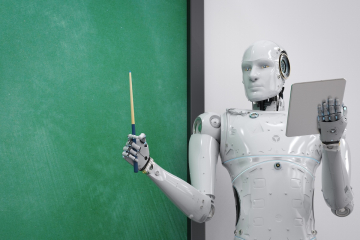
Robots won’t replace teachers but could help with other school roles

Dale Chu
4.16.2026
Flypaper

At a White House summit last month, first lady Melania Trump turned heads by entering alongside a humanoid robot, promising a future where machines might tutor children in art, philosophy, and other intellectual pursuits. “Our children will develop deeper critical thinking and independent reasoning abilities. The AI-powered [robot] will boost analytical skills and problem solving and adapt in real time to a student’s pace, prior knowledge, and even emotional state,” she said. The idea is dazzling—and it made for some striking photos—but it raises a more specific question than is often asked: not what AI can do in education, but whether humanoid robots themselves are likely to play a meaningful role in schools.

The most likely near-term use cases for robots lie in low-paid sectors and professions that are struggling to attract enough workers to meet need—like, quite sadly, elder care. They would fill gaps in such systems under the reasoning that a robot may be better than nothing at all.

There is no comparable problem in the supply of adults willing and capable of teaching children; educator shortages are more localized and uneven than is often suggested. So long as human teachers are available, it is therefore hard to imagine humanoid robots being chosen instead. That does not mean, however, that robots have no role to play in schools. It simply means that role is likely to be far more limited, and far less glamorous, than the first lady’s vision of robot philosophers and tutors suggests.

If anything, the more plausible uses for humanoid robots in education are in the kinds of jobs that are harder to staff, lower paid, or more transactional in nature. In most districts, school support staff (e.g., cafeteria workers, bus drivers, custodians, playground monitors) represent a substantial share of school employees. These roles are also subject to higher turnover. If humanoid robots can reliably take on some of these harder-to-staff positions, they could help stabilize school operations, and potentially free up resources to better compensate teachers or invest in intensive tutoring and other student supports.

To be sure, a robot that can monitor a hallway, supervise a lunchroom, or assist with routine logistics may not be ideal. But in a situation where schools struggle to hire and retain staff for these roles, it is arguably better than leaving those functions understaffed, unsupported, or shifted onto already stretched teachers. Humanoid robots are unlikely to take center stage in the classroom. Their foothold, if any, will be at the margins of how schools function.

At the same time, caution is warranted. Schools are social institutions that help shape norms, relationships, and a sense of community. The presence of adults in hallways, cafeterias, and playgrounds contributes to a culture of supervision, care, and belonging that cannot be easily replicated by machines. Replacing too many human roles risks eroding the very fabric that makes them work.

This points to a broader challenge. The question is not simply where robots can be deployed, but where they should be. The same logic that makes robots attractive in moments of scarcity can, if applied too broadly, lead to a gradual hollowing out of human institutions. What begins as a practical response to labor shortages can, without discipline, evolve into a default preference for automation, even in contexts where human interaction matters most.

For education, that would be a mistake. Schools will always need talented people to do the work of teaching well. In fact, the rise of AI may create an opportunity to do just that. As automation reshapes the labor market, more young people may find themselves searching for stable, fulfilling work. As my colleague Mike Petrilli has argued, teaching could become a more attractive option, particularly if policymakers focus on improving working conditions and compensation.

However far the technology advances, the image of a robot instructor entering a classroom captures both the appeal and the limits of the idea. It is easy to imagine machines layered into the routines of schooling, especially where tasks are repetitive and predictable. It is far harder to imagine them displacing the relationships at the center of teaching and learning. The more likely future in education is not one in which robots replace humans, but one in which they remain peripheral tools—useful in discrete ways, but never central to how children are taught or how schools are run.

view
Stressed teacher

Teachers aren’t worse—the job is harder than ever

Julia Hayes
4.16.2026
Flypaper

“If teachers can’t manage student behavior today, they must be worse than they used to be.” It’s a claim I’ve heard often, particularly from people who have never worked in a school. As a former teacher, this claim makes me furious. The belief is simplistic and wrong. Teachers are not worse than they used to be. The job has fundamentally changed—especially when it comes to student behavior—and that has made success harder for even the most skilled teachers.

What exactly are those changes? For one, teachers are constantly taking on new responsibilities that extend far beyond instruction to include academic differentiation, social-emotional learning, and increased documentation and compliance. This stands in sharp contrast to earlier expectations, which were more narrowly centered on instruction.

Teachers are also supporting a student population with more complex needs than ever before. These range from behavioral to academic to emotional and mental health challenges. Compared to pre-pandemic years, teachers are reporting that these needs are both more widespread and more intensive.

On the behavioral side, teachers report that disruptions have become more persistent and more serious. An EdWeek survey in 2023 found that 70 percent of educators said students were misbehaving more than in 2019. These challenges are now a routine part of teaching, as 58 percent of teachers report addressing behavioral issues every day in their classrooms, in addition to their teaching duties. The pandemic has only intensified these challenges, with 48 percent of teachers, school leaders, and district leaders in 2025 stating that behaviors were worse when compared to pre-pandemic behaviors.

Academically, the challenges are just as significant. Before the pandemic, teachers reported that 40 to 60 percent of students were showing signs of disengagement in learning. After the pandemic, over 80 percent of teachers said that student motivation and engagement had declined even more. Today, 47 percent of teachers say that students showing little or no interest in learning is a major problem in their classrooms. The share rises to 58 percent among high school teachers. In my experience, teachers go above and beyond to make learning both engaging and differentiated, yet many students remain disengaged. When students are disengaged, even strong instruction has limited impact, making it far more difficult for teachers to improve academic outcomes.

The mental and emotional demands are equally pressing. Since the start of the pandemic, 69 percent of public schools have reported an increase in the share of students seeking mental health services compared to pre-pandemic levels. Today, 28 percent of teachers report that they have to help students with mental health challenges daily. Additionally, 48 percent of teachers say that anxiety and depression are major problems among students who attend their school. These realities create increasingly difficult working conditions for teachers who want to help these students but often lack the time, training, or resources to do so effectively.

A major factor driving these changes in the profession is the evolution—and, in some cases, weakening—of discipline policies. National data show that discipline practices shifted dramatically during the pandemic. The number of students suspended from school fell by roughly 75 percent compared to pre-pandemic levels, reflecting both policy changes and a reduced reliance on removing students from classrooms. About 66 percent of teachers report that current discipline practices at their school are very or somewhat mild, while just 2 percent report they are very or somewhat harsh. Another 31 percent say they are neither harsh nor mild. Additionally, 67 percent of teachers say they do not have enough influence over discipline practices at their school.

As a result, many educators feel unsupported by administrators when addressing student misbehavior. Elementary and middle school teachers in particular have said they need more support in dealing with student discipline from their administrators, and that support would improve their mental health. Without consistent consequences, it becomes far more difficult for teachers to establish and maintain classroom authority, even for experienced teachers working within unclear or inconsistent systems.

Let’s consider the central question again: Are teachers worse today if they can’t manage student behaviors? After considering all the ways that the job has changed over the last decade, the answer is clear. Teachers have not forgotten how to manage classrooms, we’re just asking them to do more than they ever have before. To be not just instructors, but also counselors, behavior specialists, family mediators, and more.

We should be far more cautious in treating every classroom challenge as a teacher failure, when many of these challenges reflect a broader societal strain. This is not to say that all teachers are effective today, but it’s important to remember that there were ineffective teachers in the past, too. Most teachers today are committed, capable, and working tirelessly under increasingly difficult working conditions. Rather than asking whether teachers are worse, we should be asking whether we are setting them up to succeed.

What, then, can administrators, district leaders, and policymakers do to improve working conditions for teachers?

  1. Strengthen educator preparation programs. The way these programs train prospective teachers is outdated and does not address the most crucial things teachers run into during their careers. Teacher candidates need more preparation for classroom management, behavior systems, and navigating parent and family dynamics, and less emphasis on abstract theory. More practical, applied training would better equip candidates for today’s classrooms.

  2. Rebuild school-based support systems. Although some schools and districts offer support to teachers of all levels, the lack of consistency across schools makes it difficult to ensure that everyone receives the support needed to succeed. Given the scope and complexity of the job, all teachers should have access to meaningful supports, such as instructional coaching, mentorship for early-career teachers, and targeted professional development. While these supports may not eliminate the challenges teachers face, they can make them far more manageable.

  3. Clarify and enforce discipline policies. With student behaviors on the rise, teachers need consistent backing from their administrators when it comes to discipline. To ensure that teachers feel supported in dealing with student behaviors, administrators should establish clear discipline policies, support teachers in enforcing them, and strike a balance between fairness and accountability.

  4. Work with teachers, not against them. Rather than assuming that teachers are the issue, leaders should partner with them to improve working conditions. Teacher voices must be central to these efforts, as they are the ones navigating these challenges every day. One-size-fits-all mandates are unlikely to succeed; solutions should be responsive to local context and student needs.

  5. Acknowledge limits. Schools cannot solve every challenge alone. Cross-sector support is necessary to address the broader social and emotional issues affecting students and, in turn, teachers.

Are teachers worse today if they can’t manage student behaviors? Absolutely not. The job is harder, more complex, and less supported than ever before. If we want better classrooms, we must improve the conditions in which they work.

view
Weather and college choices SR image

Stormy weather for college application decisions?

Jeff Murray
4.14.2026
Ohio Gadfly Daily

The college visit is a time-honored tradition in the search process, and how such tours go likely plays a role in any final application decision. A new working paper looks at one college visit wildcard—the weather—to see if something so arbitrary might actually sway kids’ final decisions.

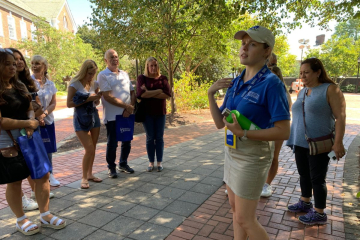
The single college under study is unnamed (dubbed “institute of higher education” or IHE), but the trio of researchers all hail from Amherst College. They look at ten years of prospective student tour data at IHE—from summer 2016 through fall 2024, excluding summer 2020 through spring 2021 due to Covid restrictions—comprising more than 47,000 individuals. Data on participants include hometown, race, and gender. A proxy for family income is based on their residential zip code, sourced from the American Community Survey for the year of their visit. Hourly weather data from all visit days come from a resource called Visual Crossing Corporation. Details on college application and matriculation (or not) come from the National Student Clearinghouse. All tours were conducted on foot along designated routes, lasted approximately one hour, were mostly outdoors (with short stops in a couple of buildings along the way), and took place regardless of weather conditions. While some colleges give brownie points to applicants who took a tour, our researchers assure us this is not the case at highly-selective IHE.

Using a set of temporal fixed effects models, they find that “bad” weather of any kind reduced tour participants’ likelihood of applying to IHE. Hot weather—relative to what are deemed “moderate” temperatures for the area—reduced applications by 10.1 percent, and cold weather reduced applications by 5.9 percent. Relative to sunny conditions, precipitation reduced applications by 8.3 percent, and cloudy conditions reduced applications by 4.9 percent. Negative impacts of cold temperatures were driven entirely by students from warmer home states, who experienced a 14.6 percent reduction in applications. Tour weather effects tended to be larger for male than for female tour participants.

White tour participants experienced near-zero effects of tour weather; while Black, Hispanic, and Asian participants experienced large-magnitude impacts. For one example, precipitation on a tour reduced application rates for Asian individuals by 18.5 percent. Results are similar whether students registered for their tour several days ahead (that is, likely without regard to a timely weather forecast) or at the last minute. Finally, having one tour in bad weather had little to no impact on students ultimately attending college in general, but of course there are no data on their tour experiences at other schools leading up to the ultimate choice.

While “immoderate” weather on a tour day does seem to sway the application decisions of prospective students, there’s no way to know whether this is a good or a bad thing. Perhaps a calm and sunny day in March is a rarity, belying weeks of unbearable swelter or torrent that a new college freshman will end up hating despite what they saw on their tour. Maybe one chilly early April downpour is just the last call of winter, driving a prospective student to avoid a school and miss out on a halcyon spring at a great college. Recruiters and parents can only hope that no matter how influential a single day of weather is, that it is only one piece of data among a large and growing set of informational sources that young people will consider before making their final, fateful decision.

SOURCE: Olivia Feldman, Joshua Hyman, and Matthew McGann, “‘Feel’ as a Determinant of College Choice: Evidence from Campus Tour Weather,” NBER Working Paper (March 2026).

view
School meeting

Does Communities in Schools boost student outcomes?

Jill Hoppe
4.16.2026
Flypaper

Communities In Schools (CIS) is a program that addresses not only academic needs but also the personal, familial, and community barriers that hinder student success. Founded in 1977, CIS has operated for nearly five decades, expanding from a small pilot program to a nationwide network that now serves more than 2 million students in 3,000 schools across 29 states and the District of Columbia.

Funded primarily through private and local sources, CIS staffs high-poverty K–12 schools with an on-site coordinator who connects students to both in-school supports and external community resources including food assistance and housing services. While all students in a CIS school can access the coordinator, a subset of students with greater needs are referred for intensive “case management.” These case-managed students meet with their coordinator nearly once per week.

A recent study conducted in partnership with Harvard’s EdRedesign Lab evaluates the program’s impact on both short-term outcomes such as test scores, absences, and suspensions, and long-term outcomes including high school graduation, college enrollment, and adult earnings. To estimate causal effects, each CIS school is compared with a demographically and academically similar school that never adopted CIS, using more than five years of pre-adoption data to ensure the schools followed similar trends before the program began.

In Texas, where nearly half of all CIS schools are located, researchers linked Texas Education Agency records with CIS administrative data for more than 16 million students enrolled in public schools between 1995 and 2019, 3.3 million of which attended a school that implemented CIS by 2019. Because most Texas programs began after 2010, earnings at age 27 are estimated using the staggered rollout of CIS programs outside Texas. Researchers linked national Census and IRS tax records to track over 689,000 children born between 1978 and 1992 who grew up in neighborhoods that ever hosted a CIS program into adulthood.

The findings indicate that CIS programs in Texas have positive academic impacts. “High-risk” students in CIS middle schools—defined by the authors as those in the top quartile of predicted need, meaning students most likely to face academic or personal barriers—experienced gains in math and reading scores (0.18 and 0.05 standard deviations, respectively) after three years of exposure to the program compared to high-risk students in non-CIS middle schools.

CIS case-managed students receive tailored support based on their needs. “Academic needs” include challenges directly related to learning, such as difficulty with coursework or literacy, while “non-academic” needs refer to barriers outside the classroom like family-related obstacles or food insecurity. Gains in math are nearly twice as large for case-managed students with primarily academic needs than for students with non-academic needs (0.103 vs. 0.056 SD). Based on the sample, case-managed students are disproportionately female (53.4 percent), from racial minority groups (87.2 percent), and low-income (71 percent).

Academically, they begin well behind their peers: Even students at the 75th percentile within this group score below the statewide average in math. Low-risk students experience no effects on their test scores, positive or negative. This finding illustrates that targeted, personalized supports, such as tutoring and housing support, are essential to the program’s success, especially for high-risk students.

In addition, three years of middle school exposure to a CIS program closed 13 percent of the gap in high school graduation rates between high- and low-risk students, with increases of roughly three percentage points for high-risk students, regardless of whether their needs were academic. Although the program had no effect on four-year college enrollment, it increased two-year college attendance by 2.9 percentage points, and raised earnings at age 27 by an average of 1.54 percentile points, or about $1,140 per student annually.

Importantly, only about half the impact on high school graduation is explained by improvements in test scores. The rest can be explained by improvements in non-cognitive measures such as absence and suspension rates. In other words, the program’s impact extends beyond academics, and purely academic metrics may understate its long-term value.

The program is also notably cost-effective compared with other interventions. The authors note that every $1,000 of investment in CIS increases annual earnings at age 27 by $406, compared with roughly $40 for class-size reductions, although critics argue that class size experiments may overestimate positive effects. These results underscore how addressing students’ out-of-school needs can complement and strengthen efforts to improve academic outcomes.

While the researchers clearly explain impacts on school-related outcomes like academics, graduation, and college enrollment, further research could explore how CIS addresses non-school related outcomes like food insecurity, housing status, and mental health. CIS does not replace federal programs like SNAP, Head Start, or TANF, but site coordinators help families access and navigate these and other community resources. During periods of inconsistent and diminished federal support for low-income students and families, the need for strong local coordination becomes even more urgent. When safety-net programs are weakened or fragmented, models like CIS may become even more critical in ensuring that vulnerable students do not fall through the cracks.

SOURCE: Benjamin Goldman and Jamie Gracie, “When Resources Meet Relationships: The Returns to Personalized Supports for Low-Income Students,” Opportunity Insights (December 2025).

view

College or career? The credential tradeoff | Episode 1013 of The Education Gadfly Show

4.15.2026
Podcast
 

Jay Plasman of The Ohio State University joins the Education Gadfly Show to discuss Fordham’s latest report on industry-recognized credentials—and whether they actually deliver for students. As Ohio has pushed more high schoolers to earn these credentials, do they lead to higher earnings down the line, or unintentionally steer students away from college pathways?

Then on the Research Minute, Amber Northern examines new evidence on goal-setting and commitment pledges—whether they help students follow through on their plans or, surprisingly, can backfire.

Recommended content: 

  • College or Career Readiness? Postsecondary and Labor Market Outcomes for Ohio High School Students Earning Industry-Recognized Credentials —Jay Plasman for the Thomas B. Fordham Institute
  • The state of career-and-technical education in Ohio: An analysis of coursework, industry-recognized credentials, and work-based learning —Jay Plasman for the Thomas B. Fordham Institute
  • The high school pathways that boost adult earnings —Aaron Churchill, Thomas B. Fordham Institute
  • I Promise to Work Hard: The Impact of a Non-Binding Commitment Pledge on Academic Performance  —Nicholas A. Wright, Puneet Arora, and Jesse Wright, Education Finance and Policy (2026)

Feedback Welcome: Have ideas for improving our show? We would love to hear them. Send them to [email protected]


Fordham Logo

© 2026 The Thomas B. Fordham Institute
Privacy Policy
Usage Agreement

National

P.O. Box 110
Burke, VA 22009

202.223.5452

[email protected]

Ohio

P.O. Box 82291
Columbus, OH 43202

614.223.1580

[email protected]

Sponsorship

130 West Second Street, Suite 410
Dayton, Ohio 45402

937.227.3368

[email protected]