The college visit is a time-honored tradition in the search process, and how such tours go likely plays a role in any final application decision. A new working paper looks at one college visit wildcard—the weather—to see if something so arbitrary might actually sway kids’ final decisions.
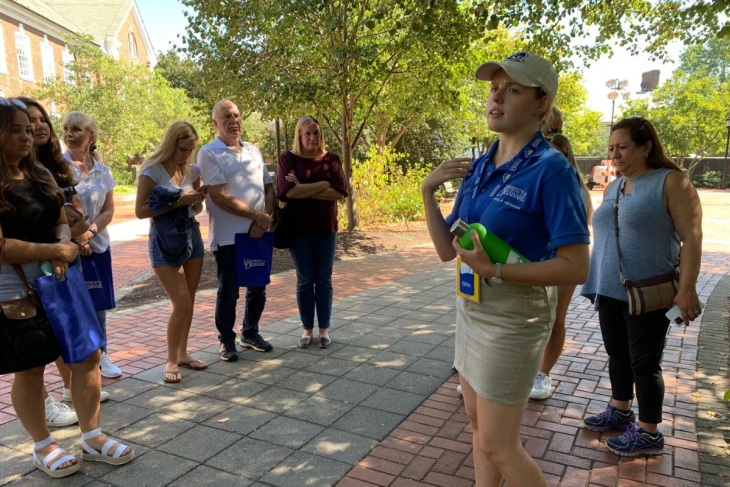
The single college under study is unnamed (dubbed “institute of higher education” or IHE), but the trio of researchers all hail from Amherst College. They look at ten years of prospective student tour data at IHE—from summer 2016 through fall 2024, excluding summer 2020 through spring 2021 due to Covid restrictions—comprising more than 47,000 individuals. Data on participants include hometown, race, and gender. A proxy for family income is based on their residential zip code, sourced from the American Community Survey for the year of their visit. Hourly weather data from all visit days come from a resource called Visual Crossing Corporation. Details on college application and matriculation (or not) come from the National Student Clearinghouse. All tours were conducted on foot along designated routes, lasted approximately one hour, were mostly outdoors (with short stops in a couple of buildings along the way), and took place regardless of weather conditions. While some colleges give brownie points to applicants who took a tour, our researchers assure us this is not the case at highly-selective IHE.
Using a set of temporal fixed effects models, they find that “bad” weather of any kind reduced tour participants’ likelihood of applying to IHE. Hot weather—relative to what are deemed “moderate” temperatures for the area—reduced applications by 10.1 percent, and cold weather reduced applications by 5.9 percent. Relative to sunny conditions, precipitation reduced applications by 8.3 percent, and cloudy conditions reduced applications by 4.9 percent. Negative impacts of cold temperatures were driven entirely by students from warmer home states, who experienced a 14.6 percent reduction in applications. Tour weather effects tended to be larger for male than for female tour participants.
White tour participants experienced near-zero effects of tour weather; while Black, Hispanic, and Asian participants experienced large-magnitude impacts. For one example, precipitation on a tour reduced application rates for Asian individuals by 18.5 percent. Results are similar whether students registered for their tour several days ahead (that is, likely without regard to a timely weather forecast) or at the last minute. Finally, having one tour in bad weather had little to no impact on students ultimately attending college in general, but of course there are no data on their tour experiences at other schools leading up to the ultimate choice.
While “immoderate” weather on a tour day does seem to sway the application decisions of prospective students, there’s no way to know whether this is a good or a bad thing. Perhaps a calm and sunny day in March is a rarity, belying weeks of unbearable swelter or torrent that a new college freshman will end up hating despite what they saw on their tour. Maybe one chilly early April downpour is just the last call of winter, driving a prospective student to avoid a school and miss out on a halcyon spring at a great college. Recruiters and parents can only hope that no matter how influential a single day of weather is, that it is only one piece of data among a large and growing set of informational sources that young people will consider before making their final, fateful decision.
SOURCE: Olivia Feldman, Joshua Hyman, and Matthew McGann, “‘Feel’ as a Determinant of College Choice: Evidence from Campus Tour Weather,” NBER Working Paper (March 2026).