Mobile Navigation

  • National
    • Policy
      • High Expectations
      • Quality Choices
      • Personalized Pathways
    • Research
    • Commentary
      • Gadfly Newsletter
      • Flypaper Blog
    • Events
    • Scholars Program
  • Ohio
    • Policy
      • Priorities
      • Media & Testimony
    • Research
    • Commentary
      • Ohio Education Gadfly Biweekly
      • Ohio Gadfly Daily
  • Charter Authorizing
    • Application
    • Sponsored Schools
    • Resources
  • About
    • Mission
    • Board
    • Staff
    • Career
Home
Home
Advancing Educational Excellence

Main Navigation

  • National
  • Ohio
  • Charter Authorizing
  • About

National Menu

  • Topics
    • Accountability & Testing
    • Advanced Education
    • Career & Technical Education
    • Charter Schools
    • Curriculum & Instruction
    • ESSA
    • Evidence-Based Learning
    • Facilities
    • Governance
    • Personalized Learning
    • Private School Choice
    • School Finance
    • Standards
    • Teachers & School Leaders
    • Think Again
  • Research
  • Commentary
    • Gadfly Newsletter
    • Flypaper Blog
    • Gadfly Podcast
  • Events
  • Scholars Program

The Education Gadfly Weekly

Sign Up to Receive Fordham Updates

We'll send you quality research, commentary, analysis, and news on the education issues you care about.
Thank you for signing up!
Please check your email to confirm the subscription.

The Education Gadfly Weekly: Of course there’s tracking in high schools. Get over it.

Volume 22, Number 6
2.10.2022
2.10.2022

The Education Gadfly Weekly: Of course there’s tracking in high schools. Get over it.

Volume 22, Number 6
view
High Expectations

Of course there’s tracking in high schools. Get over it.

Tracking in our high schools is simply a fact, and we would do well to stop pretending otherwise or believing that it could be any other way. At the very least, we should allow for diverging paths after tenth grade, and we need to completely rethink our approach for our lowest-performing kids.

Michael J. Petrilli 2.10.2022
NationalFlypaper

Of course there’s tracking in high schools. Get over it.

Michael J. Petrilli
2.10.2022
Flypaper

The pedagogy of the depressed

Robert Pondiscio
2.10.2022
Flypaper

We’re teaching mediocrity in literature classrooms

Daniel Buck
2.10.2022
Flypaper

What factors predict states’ embrace of private school choice?

Nathaniel Grossman
2.10.2022
Flypaper

How did the pandemic affect school bullying?

Julia Wolf
2.10.2022
Flypaper

The Education Gadfly Show #806: On school boards, curriculum controversies, and a Parents’ Bill of Rights

2.9.2022
Resource

Cheers and Jeers: February 10, 2022

The Education Gadfly
2.10.2022
Flypaper

What we're reading this week: February 10, 2022

The Education Gadfly
2.10.2022
Flypaper
view

The pedagogy of the depressed

Robert Pondiscio 2.10.2022
Flypaper
view

We’re teaching mediocrity in literature classrooms

Daniel Buck 2.10.2022
Flypaper
view

What factors predict states’ embrace of private school choice?

Nathaniel Grossman 2.10.2022
Flypaper
view

How did the pandemic affect school bullying?

Julia Wolf 2.10.2022
Flypaper
view

The Education Gadfly Show #806: On school boards, curriculum controversies, and a Parents’ Bill of Rights

Michael J. Petrilli, Robert Pondiscio, David Griffith, Ph.D., Amber M. Northern, Ph.D. 2.9.2022
Resource
view

Cheers and Jeers: February 10, 2022

The Education Gadfly 2.10.2022
Flypaper
view

What we're reading this week: February 10, 2022

The Education Gadfly 2.10.2022
Flypaper
view

Of course there’s tracking in high schools. Get over it.

Michael J. Petrilli
2.10.2022
Flypaper

Two weeks ago, I wrote about the vast distance between our rhetoric and reality on career and technical education. Despite our oft-voiced enthusiasm for “multiple pathways,” we force almost all high school students through what’s essentially a college-prep track. Instead, I argued, we should reserve that route for students “who like school and are good at it,” and let kids with other strengths focus on career preparation. Yet in virtually every state, numerous and exacting academic course requirements (four years of English, three years of math, etc.) make it virtually impossible for high school students to spend much time doing real work-based training.

As expected, I was attacked for calling for a return to 1950’s-style tracking. To my surprise, however, even my colleague and mentor Checker Finn criticized me on those grounds! In last week’s Education Gadfly Show podcast, he charged me with taking a “Back to the Future” approach.

And you know what? I’m guilty as charged, at least on some counts.

No, I don’t want to go back to the old way, whereby The System decided who could take college-prep courses, and who should “work with their hands.”

And hell no, I don’t want The System making those decisions based on the color of students’ skin or their zip code.

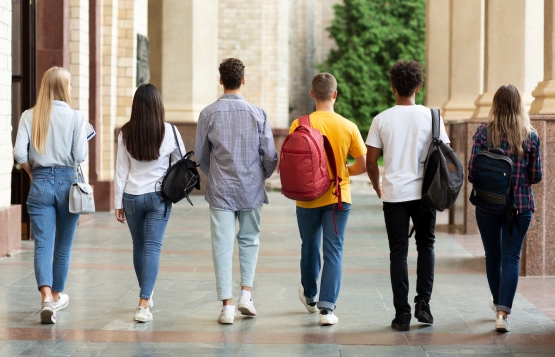
But do I think there should be tracking in American high schools? Yes. More to the point, tracking in our high schools is simply a fact and we would do well to stop pretending otherwise or believing that it could be any other way. At the very least, we should allow for diverging paths after the tenth grade. We also need to completely rethink our approach for our lowest-performing kids.

Consider this: According to the latest (pre-pandemic) data from the National Assessment of Educational Progress, the gap between the 10th and 90th percentiles of public school students in eighth grade reading was 96 points (on a 0–500 scale). In rough numbers, that equates to six grade levels. Math is even worse, at 101 points. So some kids enter high school at a fifth-grade level, others at an eleventh-grade level. Does anyone think we can effectively teach students with such extreme degrees of academic preparation (or lack thereof) in the same classroom and serve them well? Or that we can’t predict which group is likely heading for success in college and which is going to need to get a job after high school, whether immediately or when they flame out of college?

So, yes, high schools track students. It’s a practice, by the way, that a recent American Compass survey found is overwhelmingly popular with parents of all socioeconomic groups—which helps explains the fierce political reaction when policymakers go on the warpath against the advanced track, as we saw recently in Virginia.

—

In the 50s-era “James Bryant Conant High School,” as Checker called it, there were four tracks: “It had Honors, for those who thought they might want to go to Duke or Wellesley,” Checker explained. “It had College Prep for those who wanted to go to the state school nearby. It had Voc-Ed for those who were heading for a trade. And then it had something called the General Track...and frankly [those students] weren’t prepared for anything when they came out of high school.” (Of course, back then, many of the General Track students never made it to high school graduation, since they dropped out long before, and often found an acceptable job anyway.)

All these years later, after decades of “de-tracking” policies and the like, we’ve really just collapsed those four tracks into three:

  • The Honors Track. This one remains, largely untouched, though in many high schools it now features a heavy load of AP and IB course-taking, and happily serves a larger number of students. That’s because of reforms to encourage more schools to create AP programs, efforts to reduce the gatekeeping to those courses, and the growth of the American upper-middle class, which is who’s most obsessed with getting their kids into (and able to afford) selective and highly selective colleges, even those far from home. High school course requirements are generally not a problem for the students in this track because they would take four years of most academic courses anyway. Let’s estimate that this track now serves about 20 percent of all students.

  • The College and Career Ready Track. Here’s where the big change has happened. In essence, we’ve tried to collapse the old College Prep track and the old Voc-Ed track into one. And in some respects that’s for good reason, since we’ve learned that the technical jobs of today generally require at least some postsecondary education, and that means getting students to a relatively high level of preparation in reading, writing, and mathematics, as well as various social and emotional skills that are valued in the modern workplace. As I wrote two weeks ago, though, we’ve loaded up students’ schedules with so many academic course requirements that we’ve squeezed out most of the time that could be spent doing technical training. So the students in this track really do mostly college prep, sometimes including a handful of AP, IB, or dual-enrollment courses, while perhaps also taking a few CTE courses as electives. This track serves the mass of students—probably about half—generally those from the 30th to the 80th percentile of achievement nationally.

  • The Credit Recovery Track. Of course we don’t call it that, but we should. Students in this track are often enrolled in “on level” courses, but that’s a ruse. These are the kids entering high school with very low levels of academic preparation, who struggle through their academic course requirements, racking up a lot of failure along the way. Unlike the old General Track, most of these students stay in school—a success of sorts, and the result of state policies that hold schools and districts accountable for boosting graduation rates. But since many of these students were so ill-prepared to start with, we’ve had to invent workarounds, especially credit recovery programs of dubious value (except perhaps to the for-profit companies reaping juicy financial rewards, and administrators who used it to boost their graduation numbers), plus grading “reforms” that make it easier for students to earn passing grades. None of which helps these students, and it probably devalues the high school diploma to boot. I’d estimate that 30 percent of American high schoolers are in this track; that’s about the number that NAEP deems to be “below basic” in math (32 percent) and reading (28 percent) coming out of the eighth grade.

To be sure, today’s system is in some ways an improvement over yesterday’s. Collapsing the College Prep and Voc-Ed tracks means that more students are pushed toward high-level work, surely a good thing. Dual enrollment, at least when properly done, seems to show particular promise in getting more kids onto a pathway toward college. Efforts to help kids earn technical credentials while still in high school are also encouraging.

But there are trade-offs, too. It means we don’t give students the time to do bona fide career training while still in high school, the kind we see in Austria and Germany, where their equivalent of juniors and seniors might spend virtually all day in apprenticeships or technical courses. Are we so sure that career-minded students are better off spending their time taking Spanish, Fine Arts, and English IV than, say, interning at a hospital center or first-rate restaurant kitchen or electronics plant? A better approach is the one embraced by Maryland’s Kirwan commission, whereby students who demonstrate mastery of key college and career ready skills at the end of the tenth grade are allowed to proceed to either true college prep or real career training. That would split the College and Career Ready track into two again—but after tenth grade.

My biggest concern, though, is with what I’m calling the Credit Recovery track. Yes, it’s good that most of these kids aren’t dropping out. They are safe and warm and fed and cared for in high school, and are off the streets. That’s no small thing. But I wonder whether the approach we’ve backed into is the best we can do—which is to have students experience a lot of failure, then make them click through a bunch of boring computer-based make-up programs, and finally hand them a diploma they can hardly read, with no plan or training for what happens the day after graduation.

I’ll explore other options in a future post.

What’s undeniable is that we continue to track kids, and until and unless we send many more kids into high school at much higher levels of achievement, we’re going to continue to track kids until the end of time, whether or not we admit that that’s what we’re doing. The only real question is what the tracks look like, and where they head. The sooner we’re honest about that, the better.

view

The pedagogy of the depressed

Robert Pondiscio
2.10.2022
Flypaper

Editor’s note: This essay is adapted with permission from the cover story of the March issue of Commentary, “The Unbearable Bleakness of American Schooling.”

The middle school two blocks from my New York City apartment is named for Jonas Salk.

Today, teachers in that school, which honors the man who cured polio, treat children as moving, breathing, virus-shedding hot zones. In other U.S. cities, teachers have walked off the job even when fully vaccinated rather than risk contagion. Imagine the psychic toll this takes on children: The world is deadly and dangerous. I am myself a lethal threat to my teachers, my family, and my friends.

Now imagine that Covid had struck fifty or sixty years ago. It is almost certain that the arrival of life-saving vaccines less than a year into a global pandemic would have been framed for schoolchildren as a triumph of science and human ingenuity, a matter of national pride, even a cause for celebration.

By any reasonable measure, the world is safer and more stable today than at any time in the living memory of most Americans. Adults are more active in children’s lives today than in previous generations, but at the same time we play a less reassuring role. This is particularly true in schools, where curriculum and school culture seem nearly to revel in the bad and the broken, suggesting to children that they have suffered the great misfortune to have been born into a country that is racist to its core, whose founding documents were lies when written, and where democracy is hanging by a thread. Not that it matters, since we are just a few short years away from irreversible climate catastrophe, all but certain to render the world a spent and burned-out husk by the time they are grown.

Neither is it a given that American children will get the idea in school or through the media or culture at large that their country is a force for good in the world, or an engine of freedom and prosperity. In fact, quite the opposite.

Worst of all, this pedagogy of the depressed—America the Problematic—is thought to be a virtue among a significant number of professional educators who view it as a mark of seriousness and sophistication. We want children to grapple with “honest history” starting in elementary school and discover the power of their voices by writing authentic essays about their personal problems. “Socially aware” young-adult literature demonstrates a fascination with adult themes of tragedy and dysfunction bordering on fetishization. Small wonder, then, that adolescents are more depressed and medicated than ever before.

A half-century of psychological research indicates that our beliefs about the world shape behavior and our sense of well-being. Whether one views the world as good or bad, safe or dangerous, enticing or dull, is correlated with outcomes such as life satisfaction or depression. We may think that we are doing children a good service by being “real” with them, refusing to spare them from the unpleasant facts of the tired world they will soon inherit, thus inspiring them to seize the day and set the world right. But there are worrisome hints that this is all a little too much for many young people to bear.

The evidence of an accelerating mental health crisis is troubling enough. But a bracing essay published by Yuval Levin at The Dispatch late last year hinted at the emergence of a quiet crisis of despair that is changing the nature of social breakdown in America. Chaos and unruliness are yielding to a “disordered passivity,” a failure to engage or seek fulfillment that “strikes deeper and earlier than the danger of unruliness,” he writes. This places a particular burden on schools to address the problem, not to admire or indulge it. “The hallmark emotion of depression is hopelessness, and it’s on a global scale,” agrees Christine Sefein, a therapist and former professor of clinical psychology. “That continuous repetitive message, ‘There’s no reason to care because it’s all messed up. I’m always gonna feel guilty that I’m white, or I’m always gonna feel badly that my people were slaves or oppressed, there’s no way out, there’s no light’—that message is going to throw people into depression.”

There is a fine line to be walked here. Few would argue that children should grow up in a protective bubble, cosseted and coddled, insulated from history and the realities of life. It would be impossible in our information and social-media-saturated age. But there has been a change in the weather that alters how children perceive the world and their place in it. As adults and as educators, we are not merely failing in our responsibility to be a reassuring presence in their lives; we seem perversely determined to normalize and even valorize their despair.

It doesn’t matter if our intentions are good, if we see virtue in being honest with children, or seek only to “empower” students to take on and change the world. We have broken childhood. We are creating a generation of children who feel overwhelmed and powerless, lacking in agency, and who are saying to themselves, in effect, “Why bother?”

view

We’re teaching mediocrity in literature classrooms

Daniel Buck
2.10.2022
Flypaper

Since the beginning of the common school movement in the 1800s, we have valued our institutions of public education for their unifying nature, and the creation of a literate populace is an essential element of that goal. But much modern-day English instruction accomplishes neither. These middle school and high school classrooms barely resemble what you or I remember from our school years. A common approach to literary instruction, the “workshop model,” features a different novel for every student—invariably always young-adult fiction—and no collective discussion of a shared text. Its most common manifestation, Lucy Calkins’s Units of Study, permeates thousands of schools across the country, while the general model is near ubiquitous.

In fact, calling Calkins’s approach a “curriculum” is charitable. It centers no specific books or knowledge and is more a set of practices for the teacher to follow. Despite its popularity, distinguished professor of education Timothy Shanahan has written that there’s “not a single study that supports its use.”

Among the faults of the workshop model is its lack of rigorous texts. Like strength training, the mind requires tension to grow. When students self-select novels, easier books appeal, and so, like lifting a bar with no weight over and again, literacy stagnates. Shanahan writes that students need “exposure to sophisticated vocabulary, rich content, and complex language” and a workshop model does not guarantee such exposure. Like a literary buffet, one student may spend a semester with varied, rigorous literature such as Edgar Allan Poe and another with Diary of a Wimpy Kid.

I’ve spent time as an instructional coach in classrooms that use both the workshop and traditional models, where a teacher guides students through challenging books. The best teachers struggle to get students to read self-selected books, with many slipping phones between the pages, but even the worst teachers can fumble through a classroom reading of Frederick Douglass’s vivid autobiography.

In the few instances where the Units of Study does foster a shared text, it comes in two forms. In one unit, they deem a whole class novel “too long” and so encourage teachers to only read short excerpts amounting to about twenty pages total. Otherwise, the unit only asks the teacher to show clips of a movie. It’s all a heroic act of lower expectations, and a collection of unproven teaching practices, both of which leave our students floundering. With inadequate approaches to basic literacy, the stabilizing structure of public education cracks.

The curriculum also falters because it lacks a robust sequence and a shared curriculum of literature and knowledge. E.D. Hirsch has spent a career advocating for the importance of what he originally called “cultural literacy,” the common knowledge of history, science, and literature that we all take for granted. His thesis is simple: Our knowledge determines our ability to read as much as an abstract reading skill. This simple conclusion explains why an American could easily follow a paragraph about football but lack all comprehension if reading about cricket. To grasp a typical op-ed, a student needs to know about our constitutional order, chattel slavery, World War II, great American heroes, and other important historical and scientific facts.

Another shortcoming arises, perhaps even more serious, when our schools lack shared texts: It atomizes the classroom and thus contributes to the atomization of society. When my school required me to use it, the Units of Study “curriculum” amounted to five to ten minutes of whole-group instruction before students spent the rest of class cloistered off into separate corners of the room, reading their own books with little to no sense of community. We didn’t laugh together at Mercutio’s jokes or lament Tom Robinson’s verdict.

We say that we value public education because of its unifying nature—these buildings bring together members of disparate communities with varied interests for a common purpose—and then foster a hyper-individualistic classroom culture and structure. The literature classroom is the ideal place for communitarian ideals. Here, students learn to discuss controversial ideas and share aesthetic experiences. But we squander this opportunity to strengthen society and forge citizenship.

“Don’t be a Scrooge.” “All men are created equal.” We value “the content of a man’s character.” These phrases and allusions are as much a part of our language as dependent clauses and conjugations. If anything, they are what give our language life and color. However frayed our country may be otherwise, they give us a commonality and shared worldview. But that only happens when everybody encounters and reflects on them. Much as an economy requires a common currency to function, we need a common language, which in turn requires a common set of texts.

I’ve seen a common literary culture foster community even at recess of all places. I required my students to memorize a poem. One young girl, new to our school, had remained on the fringes of social circles through the beginning of the year. However, as a group of friends practiced their poems while playing four-square, she finally had something in common with them, started reciting it with them, and so had an excuse to also join the game. That shared text built community.

Our schools ought to be places that foster this common development of a robust language through both basic literacy and shared texts. Alas, as our country fractures, things will continue to fall apart if our classrooms do not create a literate public, and the center certainly will not hold if our common schools do not even work to build a center.

view

What factors predict states’ embrace of private school choice?

Nathaniel Grossman
2.10.2022
Flypaper

School choice is on the rise. In the last few decades, families have benefited from an explosion of educational options. But this growth of school choice has not been limited to charter schools or open-enrollment policies; private school choice policies and programs have also flourished in the past twenty years. By January 2021, thirty states (plus the District of Columbia and Puerto Rico) had some form of private school choice program. An additional testament to this growth is the variety of policies on offer. It’s not just vouchers, but also Educational Savings Accounts, Tax Credit Scholarships, and Individual Tax Credits.

Now, a study by two researchers from the University of Arkansas attempts to identify the factors that predict states’ adoption of these policies. Yujie Sude and Patrick J. Wolf found that different political, economic, and educational variables contribute to the adoption by states of different private school choice programs. They also tested the soundness of their models by predicting which states would be the most, and which the least, likely to adopt private school choice programs.

Sude and Wolf identified four categories of private school choice policies: 1) school vouchers, in which families use funds from the government to help pay for tuition at a private school; 2) Educational Savings Accounts (ESAs), into which the government contributes funds for families to use toward educational expenses; 3) Tax Credit Scholarships (TCSs), which allow taxpayers (individual or corporate) to earn tax credits by contributing to non-profit organizations that offer private school scholarships; and 4) Individual Tax Credits, which provide families tax relief for their own approved educational expenses. The first two programs reallocate government funds that would otherwise be sent directly to local school districts. The last two programs create incentives for individuals to use nongovernmental funds to promote private school choice.

Sude and Wolf saw such policies being adopted through the intersection of three forces—politics, resources, and educational needs. This led to the three hypotheses of their study: 1) that all three forces have some association with private school choice adoption; 2) that political factors will be the most consistent predictors of the states that adopt private school choice policies; and 3) that economic factors will be more reliable predictors of adoption than educational need factors.

To test their hypotheses, the authors analyzed data from forty-nine states over a period of seventeen years (2000 to 2016). Their models included 833 state-year observations, although missing data reduced that number to 784 in one of their models. They built several models to predict the likelihood a state without a private school choice policy would remain that way. Once a state adopted a private school choice program, it was dropped from the models.

Their findings partially confirmed their hypotheses. Political forces do play the strongest role in adoption. Not surprisingly, a Republican-controlled legislature and a Republican governor were the two most significant political factors correlated with private school choice policies. However, the authors noted that these effects faded when controlling for other social factors such as poverty and high school graduation rates. The economic factor that was the most consistent predictor of adoption was per capita GDP. Sude and Wolf found that a lower per capita GDP correlated with adoption, meaning that poorer states were more likely to adopt a private school choice program. The authors hypothesized that this resulted from less wealthy states wanting to save money. Funding private school choice options is cheaper than running traditional schools. In the same vein, the educational need factor most associated with adoption was the average per pupil expenditure of the state. The less a state spent on each public school student, the more likely it was to adopt a choice program.

The authors also analyzed which factors predict specific private school choice policies. Here, the results are less clear and consistent. Surprisingly, almost none of the above factors were significant predictors of voucher adoption. A state’s proportion of minority students was found to be a positive predictor of tax credit scholarship adoption. Having a Republican governor was a strong predictor of adopting an Individual Tax Credit policy, as was a state’s share of students already enrolled in private schools. States with lower income and high school graduation rates were more likely to adopt an Individual Tax Credit policy, but so were states with lower poverty rates, muddling the picture and defying the expectations of the authors. ESAs were too new and lacked enough data to warrant their own predictive model in the study.

To test the soundness of their models, Sude and Wolf used them to predict which of the nineteen states without private school choice policies at the end of their study would be the most likely to adopt them. Because their data ended in 2016, they had more than five years of real-world events against which to compare their predictions. They predicted that Idaho, Missouri, Kentucky, Hawaii, and Michigan would be the states most likely to adopt some form of private school choice policy. And in fact, Kentucky and Missouri did enact tax-credit funded ESA programs in 2021. While Idaho did not enact a private school choice policy via legislation, the governor did repurpose Covid relief funds into a temporary ESA program by executive order.

Sude and Wolf also predicted the states with the least likelihood of adopting a private school choice policy: New York, Connecticut, Delaware, Alaska, and California. None of those states has done so. In the authors’ analysis, Democratically-controlled legislatures and governorships, along with strong teachers unions, prevent most of these states from adopting private school choice policies. Alaska, while a Republican stronghold, has a dearth of private schools, limiting the usefulness of a private school choice program.

Advocates for school choice have long maintained that there is no effective “one-size-fits-all” model for education. As the school choice movement evolves, this adage becomes true even for different categories of school choice. Private school choice programs are no longer limited to vouchers, and now include various reallocations of governmental and nongovernmental funds. Sude and Wolf’s research shows that many factors play into states’ adoption of these policies, yielding surprising results. Hopefully, their work inspires more researchers to study this important topic and create a clearer picture of private school choice adoption in America.

SOURCE: Yujie Sude and Patrick J. Wolf, “Whose Turn Now? The Enactment & Expansion of Private School Choice Programs across the US,” EdWorkingPaper: 21-498 (2021). Retrieved from the Annenberg Institute at Brown University.

view

How did the pandemic affect school bullying?

Julia Wolf
2.10.2022
Flypaper

When schools went online at the beginning of the pandemic, it was unclear how the sudden and disruptive shift would impact student behavior. Would cyberbullying, for example, increase with students spending more time on their devices? And would time away from other students increase bullying when students returned to buildings? A new study investigates how Covid-19 has impacted these issues.

Boston University’s Andrew Bacher-Hicks and colleagues found that Google-trend state-level data on bullying-related searches—in particular, “School Bullying,” “Cyberbullying,” and “Bullying”—were strongly correlated with the amount of bullying that schools actually report. So to examine how Covid-related shifts to remote learning affected rates of bullying, the analysts examined how those Google-search trends changed across states during the pandemic. They did this in two ways: on a month-to-month basis from March 2020–May 2020, June 2020–August 2020, and September 2020–February 2021; and by looking at how the trends changed depending on the proportions of a state’s schools whose instruction, from September 2020 through February 2021, was in-person, hybrid, or remote. These instructional data came from Burbio’s K–12 School Opening Tracker.

They found that searches for “school bullying,” “bullying,” and “cyberbullying” dropped by an average of 27 percent during the pandemic months of March 2020 to February 2021. And that impact became larger over time, with the greatest drop being from September 2020 to February 2021 at 36 percent.

As for instructional methods, the researchers compared the fraction of each instructional mode in a state with that state’s bullying search intensity. This allowed them to examine the rates of bullying-related searches in states with different rates of remote and traditional instructional methods. They found that states with larger fractions of schools operating virtually had significantly lower search intensity for bullying, whereas states with higher proportions of schools offering in-person instruction had higher search intensities for bullying.

In states where the largest number of schools remained remote between September 2020 and February 2021, all bullying-related searches stayed down 42 percent compared to pre-pandemic levels. Meanwhile, for states with more schools offering in person instruction, the rate of bullying-related searches was only down by 19 percent.

The authors offer multiple factors that may be affecting these results. One is that kids are less likely to be bullied when learning online compared to in person because, well, they’re not in classrooms interacting with the peers who bully them or vice versa. Perhaps in-person schools were also stricter regarding student interactions when the students returned due to efforts to mitigate transmission of the virus. Maybe face-coverings play a role. Maybe, too, does the bonding that results from going through the same difficult experience.

However, this data represents a stark contrast to the reports that have been the focus of many recent news stories. Namely, a significant increase in student misbehavior. An Education Week survey found that two out of three teachers, principals, and district leaders say that students are misbehaving more than they did in the Fall of 2019. And rates of misbehavior are higher in districts that remained remote or hybrid last school year compared to those that offered mostly in person instruction. What could be driving students to act out in class and threaten school violence, but is also keeping them from bullying each other?

It’s unclear what the takeaway of this research should be for schools moving forward. Even though virtual instruction reduces bullying, it also reduces learning and amplifies misbehavior. As mitigation procedures like social distancing and masks phase out, schools need to implement strategies that can outlast the pandemic. Adding more structure to school days could be a step in the right direction. “No excuses” charter schools model how this strategy can produce significant learning gains for certain students. But more research is needed to know that for sure.

SOURCE: Andrew Bacher-Hicks et. al., “The COVID-19 Pandemic Disrupted Both School Bullying and Cyberbullying,” NBER Working Paper #29590 (December 2021).

view

The Education Gadfly Show #806: On school boards, curriculum controversies, and a Parents’ Bill of Rights

2.9.2022
Resource
 

On this week’s Education Gadfly Show podcast (listen on Apple Podcasts and Spotify), Robert Pondiscio, Mike Petrilli, and David Griffith discuss a school board’s controversial removal of a Holocaust book from its district’s curriculum, and whether states should create a Parents’ Bill of Rights. Then, on the Research Minute, Amber Northern examines a study of summer employment’s effect on the academic outcomes of low-income, urban high schoolers.

You can find this and every episode on all major podcast platforms, as well as share it with friends.

Recommended content:

  • Robert’s piece about the school board’s decision: “The Maus that roared: Who do you want to decide what’s best for kids?”
  • Dale Chu’s piece on Parents’ Bill of Rights: “The curriculum transparency trap.”
  • The middle-school English curriculum mentioned during the podcast: EL Education.
  • The study that Amber reviewed on the Research Minute: Alicia Sasser Modestino and Richard Paulsen, “School’s Out: How Summer Youth Employment Programs Impact Academic Outcomes,” Education Finance and Policy (January 2022).

Feedback welcome!

Have ideas or feedback on our podcast? Send them to our podcast producer Pedro Enamorado at [email protected].

view

Cheers and Jeers: February 10, 2022

The Education Gadfly
2.10.2022
Flypaper

Cheers

  • After declining in recent years, Catholic school enrollment numbers are finally rebounding in many parts of the U.S. —Catholic New Agency
  • Districts received billions in federal Covid relief with few rules. But we should require them to track student progress. —Marguerite Roza
  • Florida Governor DeSantis “announces creation of workforce training charter schools, $89M in funding.” —WFLA
  • “Our nation cannot censor its way back to cultural health.” —David French
  • In Chicago, unions put adult interests first, and parents and the district were powerless. “School choice gives power back to parents.” —Paul Vallas

Jeers

  • Research shows that the Covid achievement slide hasn’t stopped, especially for students in high-poverty communities. —Education Week
  • New York City’s new high school admissions process for supposedly selective schools barely counts grades and doesn’t count test scores. —New York Post
  • The Denver School Board is reviewing a proposal to grant union protections to teachers at autonomous innovation schools, threatening the flexibility they currently enjoy to meet student needs. —Chalkbeat
view

What we're reading this week: February 10, 2022

The Education Gadfly
2.10.2022
Flypaper
  • Parents and young adults have similar opinions about the effectiveness of K–12 and postsecondary education. —Bruno Manno
  • “Firm saw $40 million potential in Charlie Kirk’s ‘America-first’ academy. Then its plans fell apart.” —Washington Post
  • To stay competitive globally during its “Great Talent Recession,” America needs to nurture superstar talent. —Adrian Wooldridge
  • “Teachers are losing hope that this can be a catch-up year.” —Education Week
Fordham Logo

© 2026 The Thomas B. Fordham Institute
Privacy Policy
Usage Agreement

National

P.O. Box 110
Burke, VA 22009

202.223.5452

[email protected]

Ohio

P.O. Box 82291
Columbus, OH 43202

614.223.1580

[email protected]

Sponsorship

130 West Second Street, Suite 410
Dayton, Ohio 45402

937.227.3368

[email protected]