Mobile Navigation

  • National
    • Policy
      • High Expectations
      • Quality Choices
      • Personalized Pathways
    • Research
    • Commentary
      • Gadfly Newsletter
      • Flypaper Blog
    • Events
    • Scholars Program
  • Ohio
    • Policy
      • Priorities
      • Media & Testimony
    • Research
    • Commentary
      • Ohio Education Gadfly Biweekly
      • Ohio Gadfly Daily
  • Charter Authorizing
    • Application
    • Sponsored Schools
    • Resources
  • About
    • Mission
    • Board
    • Staff
    • Career
Home
Home
Advancing Educational Excellence

Main Navigation

  • National
  • Ohio
  • Charter Authorizing
  • About

National Menu

  • Topics
    • Accountability & Testing
    • Advanced Education
    • Career & Technical Education
    • Charter Schools
    • Curriculum & Instruction
    • ESSA
    • Evidence-Based Learning
    • Facilities
    • Governance
    • Personalized Learning
    • Private School Choice
    • School Finance
    • Standards
    • Teachers & School Leaders
    • Think Again
  • Research
  • Commentary
    • Gadfly Newsletter
    • Flypaper Blog
    • Gadfly Podcast
  • Events
  • Scholars Program

The Education Gadfly Weekly

Sign Up to Receive Fordham Updates

We'll send you quality research, commentary, analysis, and news on the education issues you care about.
Thank you for signing up!
Please check your email to confirm the subscription.

The Education Gadfly Weekly: Charter schools at 30: Looking back, looking ahead

The Education Gadfly Weekly: Volume 21, Number 22
6.3.2021
6.3.2021

The Education Gadfly Weekly: Charter schools at 30: Looking back, looking ahead

The Education Gadfly Weekly: Volume 21, Number 22
view
Quality Choices

Charter schools at 30: Looking back, looking ahead

Today, forty-four states—plus the District of Columbia, Puerto Rico, and Guam—have public charter school laws on their statute books, laws that have led to more than 7,500 schools employing 200,000-plus teachers and serving 3.3 million students.

Chester E. Finn, Jr., Bruno V. Manno 6.3.2021
NationalFlypaper

Charter schools at 30: Looking back, looking ahead

Chester E. Finn, Jr. | Bruno V. Manno
6.3.2021
Flypaper

Tennessee’s excellent plan to address unfinished learning

Dale Chu
6.3.2021
Flypaper

Zombie ideas in education

Bryan Goodwin
6.3.2021
Flypaper

The Education Gadfly Show #772: What’s going to happen to the NAEP reading test?

6.3.2021
Podcast

Cheers and Jeers: June 3, 2021

The Education Gadfly
6.3.2021
Flypaper

What we're reading this week: June 3, 2021

The Education Gadfly
6.3.2021
Flypaper
view

Tennessee’s excellent plan to address unfinished learning

Dale Chu 6.3.2021
Flypaper
view

Zombie ideas in education

Bryan Goodwin 6.3.2021
Flypaper
view

The Education Gadfly Show #772: What’s going to happen to the NAEP reading test?

Michael J. Petrilli, Chester E. Finn, Jr., David Griffith, Ph.D., Amber M. Northern, Ph.D. 6.3.2021
Podcast
view

Cheers and Jeers: June 3, 2021

The Education Gadfly 6.3.2021
Flypaper
view

What we're reading this week: June 3, 2021

The Education Gadfly 6.3.2021
Flypaper
view

Charter schools at 30: Looking back, looking ahead

Chester E. Finn, Jr. | Bruno V. Manno
6.3.2021
Flypaper

Today, forty-four states—plus the District of Columbia, Puerto Rico, and Guam—have public charter school laws on their statute books, laws that have led to more than 7,500 schools employing 200,000-plus teachers and serving 3.3 million students. The thirtieth anniversary of the nation’s first charter law on June 4 inspires us to recall their fundamental purpose and bipartisan political origins; their contributions to advancing educational opportunity; and the lessons we’ve learned over these three decades that should inform what happens going forward. While recognizing its remarkable accomplishments, its impressive growth, and its immense promise, we also do well to acknowledge that the charter movement has ample room to improve.

Purpose, politics, and results

Why chartering?

The purpose was clearly stated in 1990 by Ted Kolderie, Senior Associate at the Minnesota-based Center for Policy Studies. Kolderie is arguably the foremost theoretician of chartering, and that year he authored a policy report for the D.C. based (and center-left) Progressive Policy Institute. Two paragraphs bear quoting:

It is time to say this: our system of public education is a bad system. It is terribly inequitable. It does not meet the nation's needs. It exploits teachers' altruism. It hurts kids. Instead of blaming people…we need to fix the system [and] organize public education in America on a new basis. The proposal outlined in this report is designed to introduce the dynamics of choice, competition and innovation into America's public school system.

How can we use the powerful idea of choice to improve our schools while retaining the essential purposes of public education? This report proposes a simple yet radical answer: allowing enterprising people—including teachers and other educators—to... create new public schools, and ultimately a new system of public education, [by having] the states...simply withdraw the local districts' exclusive franchise to own and operate public schools. [We need to undertake] divestiture, or allowing the districts to get out of running and operating public schools altogether.

One year later, Minnesota Republican Governor Arne Carlson signed bipartisan legislation creating the nation’s first charter school law, introduced by Democrat Farm Labor Senator Ember Reichgott. A year after that, California enacted the second such law, also bipartisan. It was introduced by Democratic State Senator Gary K. Hart, a former teacher, and signed into law by Republican Governor Pete Wilson.

In 1994, President Bill Clinton signed legislation creating the federal Charter School Program, co-sponsored by Connecticut’s Democratic Senator Joe Lieberman and Minnesota’s Republican Senator Dave Durenberger. Pro-charter bipartisanship continued in Washington with Presidents George W. Bush, Barack Obama, and Donald Trump and was paralleled in almost every statehouse that engaged in chartering. That’s because this education reform addresses important priorities on both the left and right. It allows families the choice of a free K–12 public school that meets their child’s needs, rather than forced assignment to a district school. It has created an alternative delivery system that affords long-neglected families access to potentially higher-quality schools than they find within the traditional structure of public education. Yet charters remain public schools: open to all, tuition-free, and accountable for their results to duly-constituted public authorities.

The best charters consistently make greater student achievement gains than traditional public schools. They show what University of Michigan economist Susan Dynarski calls “a consistent pattern” of improvement “[with] students [who] are overwhelmingly low-achieving, poor and nonwhite.” Additionally, analysts at Stanford University’s CREDO and the National Bureau of Economic Research show that a sizable subset of charters—sometimes termed “high expectations/high support” schools—have significant positive achievement impacts, especially for students of color and those from low-income communities.

Chartering has also pioneered new forms of governance for public education, including statewide Recovery School Districts that restart low-performing schools as charter or charter-like schools, with post-Katrina Louisiana the most prominent example.

The District of Columbia is another example, where almost equal numbers of its over 94,000 students are enrolled in separately governed district and charter sectors, both ultimately answerable to the mayor.

Other charter-inspired governance models include “portfolio” districts and partner-run schools where districts transfer school governance to independent nonprofit organizations like Innovation Schools in Indianapolis, Luminary Learning Network in Denver, and District Campus Charter Schools in Texas. There are also district-run schools operating with waivers from policies like collective bargaining agreements, as in the Fulton County Georgia Charter System, which converted twenty-two of its own schools to charters.

Lessons learned

The first thirty years of chartering have taught us key lessons about what should happen going forward. With the benefit of hindsight, we must acknowledge that placing a charter sign on a school building actually reveals surprisingly little—mostly just that it’s a “school of choice” with some freedom to be different. Early advocates, ourselves included, were eager, earnest, and sometimes effective, but we were also naïve about a few things. These include:

Authorizing: Not enough attention was paid to authorizing, governance, and quality control. We’ve focused on quantity rather than quality, assuming that a barely regulated marketplace would provide more assurance of school quality than it has in reality. That’s partly because—another admission—we’ve learned that not everyone who wants to start a school knows (or cares) how to do it well and that not every parent choosing a school for their child places academic achievement at the top of their priorities.

Financing: Supporters did not demand sufficient funding (or facilities) for charters. Solid bricks need more straw. And while we welcomed the infusions of capital and entrepreneurialism that have accompanied private sector participation in the charter venture, we didn’t take seriously enough the risk of profiteering.

School autonomy: The many forms of governance and operational autonomy that charters enjoy allowed them to respond more quickly and effectively to the challenges created by Covid 19. Yet policymakers and advocates in most places never insisted on sufficient autonomy for their charters—nailed into place, not just vaguely promised. The result has been too many schools that are still fighting for crucial operational, financial, and governance freedoms.

Accountability: Charters are doubly accountable, both to the parent marketplace and—via their inclusion in ESSA and other statewide accountability regimes—to public authorities. Yet one tenet of the original charter bargain—if a school doesn’t produce the desired results, don’t renew its charter—has been a mixed success. Even mediocre charter schools are usually cherished by those attending them, and often the available alternatives for those children are worse. So the bargain needs some work—and authorizers need more flexibility when schools don’t perform.

Minority student focus: The laudable impulse to concentrate first on poor and minority kids trapped in abysmal inner-city schools contributed to a perception of charters as merely schools for impoverished urban dwellers. At the same time, despite much improvement on this front, not enough charter schools and networks are yet founded or led by people who “look like” the youngsters that they seek to serve.

Research and development: Though many charters have innovated in various ways, there’s still a regrettable sameness across the sector, which hasn’t functioned as well as an “R & D” center for public education as many early supporters hoped. Neither has it fulfilled the vision of the late Albert Shanker that charters would emerge as teacher-created, teacher-run schools. At the same time, we must add, the district sector and teacher unions have generally shunned chartering rather than seeking to engage with and learn from it.

Educational pluralism: Thirty years ago, few imagined how many different forms of educational choice would take root and grow in so many states and communities. Today, in addition to charters, we have school vouchers or scholarships, education savings accounts, tax credit scholarships, individual tax credits and deductions, micro schools, and more, including far more choices within and between traditional districts. While charter waiting lists are still long, the proliferation of these other options has no doubt lessened the demand for more charters while creating additional opportunities for many families.

What next?

Not everyone is thrilled, but chartering is now a durable part of the public education landscape. It’s not going away however much its foes would like it to. But it ought not stand pat, for we see plenty of fresh challenges and unresolved questions for the future. These include:

Those “left behind”: As charters come to serve a sizable fraction of schoolchildren in a given community, who is responsible for the “education safety net” by which every kid has access to some school that can satisfactorily address her educational needs? Must every individual charter school be expected to accommodate the singular challenges of every child, no matter how difficult or esoteric?

Open to all: How to handle the challenges of pupil discipline and the related question of whether charters must retain every youngster they admit, regardless of behavior or academic performance? Even the traditional district sector allows for some exceptions.

More than poor and urban: What about encouraging more charters to serve other populations that would benefit from school alternatives: middle class kids, gifted children, just girls or just boys, children of military personnel, etc.? Why not select students for some charters—gifted kids, future violinists, Mandarin learners, for example, rather than conduct random lotteries? Why not open the sticky door to religious charters?

Learning outcomes: As important as reading and math scores are to understanding what a young person is learning, other student outcomes also matter. What about charters that want to deviate from state academic standards to focus on particular specialties, including some that opt to concentrate on high-quality career and technical education rather than college prep? 

Unbundling school services: How can charters form relationships with other education providers, including those spawned by the pandemic? What can be done to build bridges with micro schools, homeschooling, private schools, PODs, etc.? What does this mean for relationships with parents? What is the role of authorizers in fostering (and monitoring) these partnerships?

Closing schools: Because it’s really hard to shut down bad charters just because of low achievement, what about developing more mechanisms for transferring students to successful operators through methods like mergers? Or transferring responsibility for the school itself to a proven operator? Let’s put some more arrows in the authorizing quiver.

Collapse of bipartisanship: The longstanding support for charters from both center left and center right has all but collapsed. On the right, some see charters as an overly regulated marketplace of faux choice. On the left, some see charters as elitist, exclusive, or otherwise inequitable. Rebuilding that coalition is an important political task for ensuring that the advances in educational opportunity spurred by charters continue to grow. 

—

Through a combination of choice, competition, and innovation, chartering has bettered the academic and life outcomes of K–12 students, thereby reducing inequality, widening opportunity, strengthening parents, and enhancing civil society. These are remarkable accomplishments for a thirty-year period, worth protecting and cultivating.

Yet charter promoters have sometimes been naïve, occasionally self-interested, and often set in their ways. Because many of today’s challenges could not have been anticipated, there’s no embarrassment in acknowledging shortcomings while also welcoming recalibration and further innovation.

This is not the first time—and surely won’t be the last—that a grand policy initiative has encountered bumps, surprises, and some backlash. As Kolderie foresaw in 1990, “Resistance [to chartering] will be fierce.”

When dealing with so many complex institutions across so many different jurisdictions, the challenges of politics, resources, talent, and implementation were sure to be profound. And when what’s being changed contains as many ingrained practices, hidebound regulatory regimes, and vested interests as American public schooling, these trials are even greater.

As the charter movement looks to decade number four, can it adapt and respond with the creativity and nimbleness that the present situation requires? We surely hope so.

view

Tennessee’s excellent plan to address unfinished learning

Dale Chu
6.3.2021
Flypaper

Nearly three months have passed since the third round of ESSER funding was signed into law as part of the American Rescue Plan (ARP). These dollars can be used for almost anything under the education sun, and most of them will flow directly to districts, but the limited set aside for states merits attention if only for the staggering scale of Uncle Sam’s total outlay. Indeed, ARP alone provides $12 billion to state education agencies—a quarter of which can be used at their own discretion. To put that into context, Race to the Top was a paltry $4.35 billion, and with plenty of strings attached. For better or worse, no such conditions exist this time around, and a quick scan of plans thus far reveals a strong inclination among states to spread that $12 billion so thinly as to accommodate a potpourri of political and substantive demands.

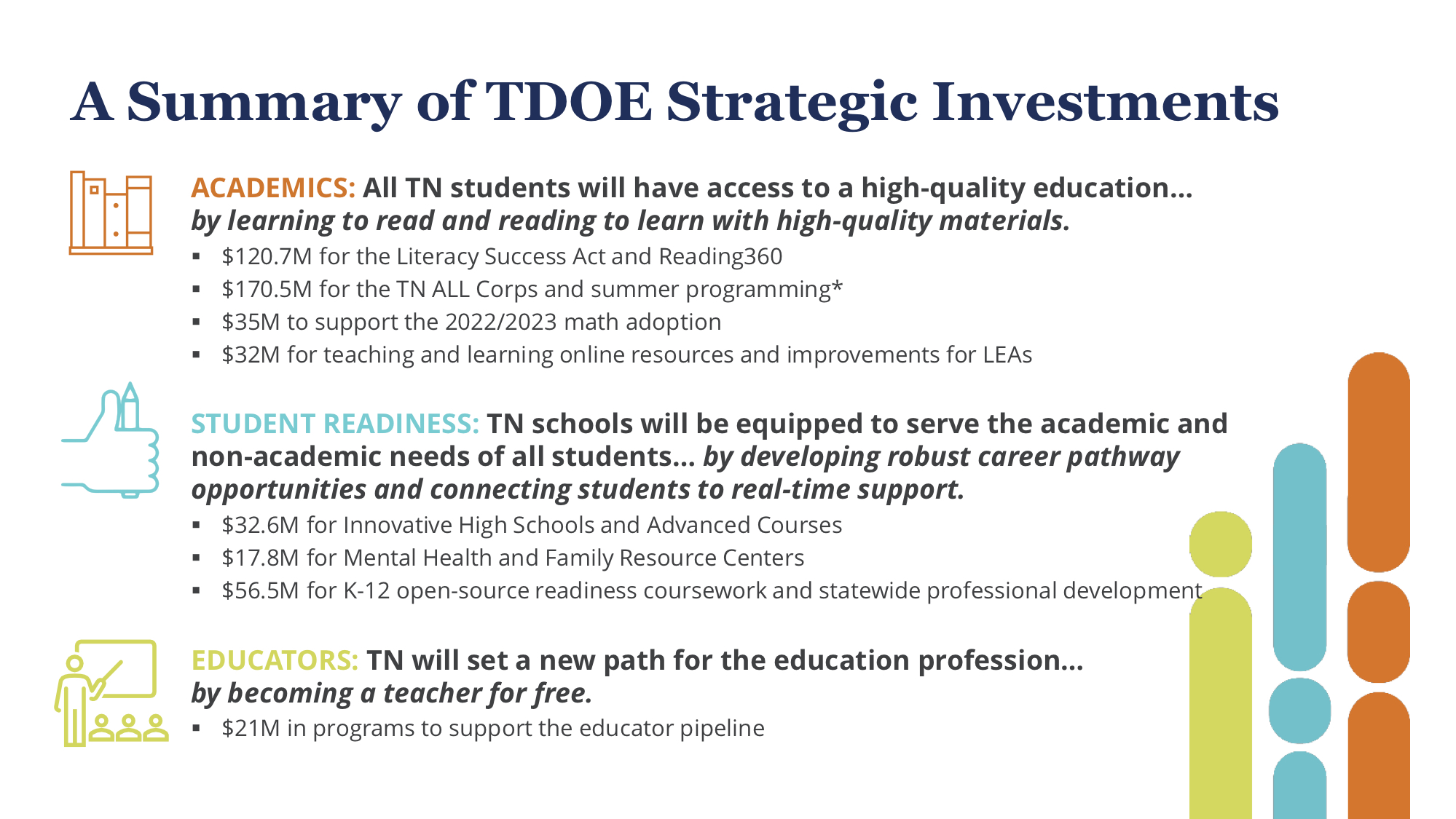
History and experience suggest that we’ll regret that decision down the road, especially if there’s little impact on student learning to show for it. But Tennessee’s smart strategy for spending offers reason for encouragement. Its plan for the state’s portion of the federal stimulus takes square aim at accelerating student achievement by investing in three key areas: academics, student readiness, and professional learning—including $120.7 million for reading and $170.5 million for tutoring and summer programming (see chart below). Tennessee’s approach is very much in line with Fordham’s model recovery plan, The Acceleration Imperative, in that the provision of “extras” like tutoring and mental health supports accompanies the improvement of core instructional programs via high-quality curricula and curriculum-based professional development.

dc

Source: Tennessee Department of Education.

Of course, a plan is only as good as the leaders charged with seeing it through (more on that below), but the greater risk for states newly awash in cash is the lack of planning. To wit, Tennessee will have five times the amount it received from Race to the Top, and just half the time to spend it. Fortunately, it’s been ahead of the curve in figuring out how to leverage the extraordinary bonanza. Governor Bill Lee kicked things off in January when he called for a special legislative session focused on education recovery. State lawmakers rose to the challenge and passed the Tennessee Learning Loss Remediation and Student Acceleration Act, which requires districts and schools to implement three extended learning programs, called “camps,” designed to get students back on track.

At the same time, Lee and his highly capable education commissioner, Penny Schwinn, recognized that the extra help provided by these camps would not replace what students get from schools’ core programs. This understanding is reflected in another piece of stellar legislation passed during the special session, the Tennessee Literacy Success Act, which incentivizes schools and teachers to focus on early childhood literacy. Notably, Tennessee now requires its forty-four teacher prep programs to provide training on sound literacy practices, and all of the Volunteer State’s 147 districts must adopt a phonics-based approach to reading instruction. Thus unapologetically clear-eyed view of reading starts at the very top, a posture that many education observers living elsewhere can only envy.

What’s more, Tennessee’s spending plan builds upon Schwinn’s “Best for All” blueprint, which was developed long before Covid-19 extended its claws. Rather than starting from scratch, Schwinn reaffirmed the three main priorities in her strategic plan, and appropriately reframed a focus on the “whole child” to a post-pandemic emphasis upon “student readiness.” Taken together, Tennessee has eschewed a “peanut butter approach” to spending—spreading a little bit everywhere in an attempt to satisfy everyone—opting instead to follow the sage advice from former governor Phil Bredesen: “A hundred dollars spent to address a problem is often more effective than one dollar spent a hundred times.”

Tennessee’s plan follows the science not only on reading, but also for large-scale assessments. Although not strictly a part of the state’s spending plan, Tennessee’s General Assembly, to its credit, stood firm on the administration of state exams this spring. Last week, I had the opportunity to speak with Schwinn, along with two of her colleagues, on how Tennessee plans to use assessment data to guide its education recovery efforts. (You can watch the entire conversation here). Schwinn minced no words in underscoring the importance of measurement as part of the state’s overall strategy:

We’ve got to know how our kids are doing... We need to be able to have longitudinal data over time. We need to be able to see how our kids did five years ago, three years ago, this year, and then moving forward to know the impact of the pandemic. We need to be able to really emphasize how our investments with this new federal funding are aligned to the needs of the students in our state in this moment. And that has to be on a consistent measure.

It’s a compelling argument, and one that raises the question of how any state can have a viable plan for recovery absent the information provided by statewide testing.

With summer upon us, Tennessee and its neighbors will soon be submitting their ARP ESSER state plans to the federal government. Preparations for next fall are kicking into high gear in schools and systems nationwide as part of the broader effort to address the enormous challenges faced by students, educators, and families during the last fifteen months. Much uncertainty remains, but policymakers and practitioners would do well to follow Tennessee’s lead and seize this rare opportunity for real change—by pausing to set clear goals and figuring out how to make the most of this one-time federal windfall.

view

Zombie ideas in education

Bryan Goodwin
6.3.2021
Flypaper

Editor’s note: This was first published in Educational Leadership.

It can be hard to spot them at first. Those dispelled education theories that research shot down long ago. They creep up in studies, shuffling around mumbling in the reference lists, or moan loudly in blog posts. Often, while I’m sifting through studies to write my regular column for Educational Leadership, I stumble across these “zombie ideas” that keep returning to life, despite researchers’ best efforts to put them six feet under.

I’m guessing you’ll have heard of a few. Let’s take a look at some of these (un)dead ideas and why we need to stop giving them authority.

(Un)dead idea #1: Students have different learning styles

This particular idea might be better characterized as a mutant idea—an innocuous idea that fused with another and has been running amok ever since. In the early 1980s, Harvard researcher Howard Gardner (2011) advanced a rather straightforward theory of multiple intelligences. Basically, it says people are “intelligent” in different ways. Some excel at music; others pick up foreign languages quickly. Some have a knack for math, and others have a gift for relationship building. As educators, we ought to appreciate and encourage students’ diverse gifts. Fair enough.

Yet almost from the beginning, Gardner’s theory of multiple intelligences morphed with another theory: that students have unique learning styles. They can be visual, auditory, or kinesthetic. For example, some students might learn best through movement, so teachers should allow them to understand the solar system by dancing around like orbiting planets; others may be auditory learners, so they might best learn geography through music. Or so the theory goes.

Serious research, however, has found little evidence students use so-called “intelligences” in one field (like dance) to learn another (like astronomy), or that people learn best with experiences that match their learning style (Pashler et al., 2008). In an interview with the Washington Post, Howard Gardner himself cautioned against using learning styles to label students, since that might imply deficits in other areas, rendering such labels “unhelpful, at best, and ill-conceived at worst” (Strauss, 2013).

Nonetheless, a cursory internet search yields a dizzying array of people still blogging about, offering courses in, surveying for, and encouraging the use of “learning styles” in classrooms—advocating for teachers to individualize students’ learning experiences to match these styles.

The reality is far simpler. Yes, (news flash) kids are different. And yes, we sometimes prefer one way of learning over another (group vs. independent work, for instance), but that does not mean we learn better with a particular modality. At best, research shows benefits from learning in multiple ways—for example, reading about a scientific phenomenon, seeing it in a video, and experiencing it.

We might put this zombie idea to rest by substituting the word preference for the word style and noting that preferences are just that. Preferences.

(Un)dead idea #2: Students learn best through unguided discovery

Like many zombie ideas, this one contains a germ of truth: Lectures can be boring and ineffective. A study of college students, for example, found they had higher grades and were less likely to fail courses with elements of active learning vs. straight lectures (Freeman et al., 2014). In response to the tedium of long-winded lecturing, theorists in the 1960s began to espouse a different approach called “discovery learning,” which said students learn and retain more when they discover new insights for themselves. That, too, is partially true—a meta-analysis of forty-three studies of problem-based learning found that encouraging students to extend and apply learning by independently solving complex problems supports better long-term retention of learning (Dochy et al., 2003).

Over the years, though, purists took these ideas to an illogical extreme—namely, that teachers should be minimally involved in learning and students should “learn by doing,” such as by conducting experiments, engaging in research, or solving complex problems with minimal guidance from teachers. A meta-analysis of 164 studies, however, found students learned significantly more from direct instruction than from unassisted discovery learning (Alfieri et al., 2011). Further, this kind of minimally guided learning—that is, giving students a complex problem to solve with little prior instruction—is particularly ineffective for lower-performing and younger students, as they tend to learn skills incorrectly and develop misconceptions (Kirschner, Sweller, & Clark, 2006).

Empirical research, in fact, makes a strong case for direct instruction—such as modeling a practice for students (showing them how to balance a chemistry equation) before students attempt the practice on their own (Pashler et al., 2007). Often, the shortest route to learning is a straight line: telling and showing students what they need to learn.

In many ways, this zombie idea emerges from a false dichotomy that pits direct instruction against discovery learning, when really the two strategies work better together. The best approach (even better than direct instruction) is “guided discovery”—providing students with learning objectives, direct instruction, modeled examples, and feedback during the process of discovery, thus ensuring they develop accurate conclusions and proper skills (Alfieri et al., 2011).

(Un)dead idea #3: Students should learn to read through authentic reading

This zombie idea continues to shamble out of teacher colleges, where a surprising number of instructors appear to eschew systematic, explicit use of phonics in favor of giving students interesting choices of reading materials, focusing on meaning making, and unpacking the sound-symbol code in a more incidental way. Decades of research, however, point to a more straightforward approach to teaching reading, based on these key principles:

  • The fundamental building block of reading is being able to make sound-symbol connections (Castles, Rastle, & Nation, 2018).

  • There is nothing intuitive about the connections between symbols (letters) and sounds (phonemes), so we must teach them directly to students (Moats, 1999).

  • Students must practice making these connections through reading and writing practice until they become automatic in their brains, allowing them to read fluently (Castles, Rastle, & Nation, 2018).

  • Ultimately, fluency is the key to comprehension; only when students read with automaticity can they comprehend what they’re reading (Castles, Rastle, & Nation, 2018).

The good news is that when we provide students with direct instruction in decoding, most can learn to read on grade level. A study of low-income 1st grade students of color, for example, found that students given direct instruction in decoding could attain decoding and comprehension abilities on par with national averages—far higher than students with little or no direct instruction in decoding (Foorman et al., 1998).

Although this has been settled science for years, it does not appear to be taught in many pre-service programs. A study by the National Council on Teacher Quality (Ross, 2018), for example, found that only 37 percent of U.S. pre-service education programs actually teach the science of reading to aspiring teachers.

So, does this mean “phonics” works and “whole language” doesn’t? Well, not exactly. Some whole-language practices, such as giving students interesting reading materials and encouraging a love of reading, are sensible and constructive. At the same time, some so-called phonics practices, such as asking students to decode nonsense syllables, fail to translate into authentic reading skills (Allington, 2013). In short, making students decode nonsense syllables is, well, nonsense. Not to mention tedious.

(Un)dead idea #4: Students don’t need facts, just critical thinking skills

We can summon Siri or Google to answer nearly any factual question these days. So, what’s the point of teaching facts? Isn’t it more important to learn to be a critical consumer of information?

Yes—and no. Certainly, critical thinking skills are important. The number of job postings referencing “critical thinking” doubled between 2009 and 2014 (Korn, 2014), and studies find that college graduates with better critical thinking skills land higher-paying jobs (Zahner & James, 2015). However, student critical thinking isn’t a skill in the typical sense of the word—something learned in one area that transfers easily to another (Abrami et al., 2015). Rather, it tends to be interwoven with domain-specific knowledge. Students employ scientific thinking with science knowledge, textual analysis with literature, quantitative reasoning in mathematics, and so on. Students must think critically about something—namely, facts and content knowledge.

That said, we cannot simply teach content knowledge and expect students to develop critical thinking skills via osmosis. A meta-analysis of critical thinking approaches (Bangert-Drowns & Bankert, 1990), for example, found that simply exposing students to literature, history, or logical proofs did little to help them develop critical thinking skills; only when students were taught how to employ critical thinking (e.g., learning how to parse correlation from causation) and provided opportunities to practice these skills within a subject area could they develop them.

(Un)dead idea #5: If it’s worth teaching, it’s worth grading

Many teachers are in the habit of slapping a grade on everything that moves—every scrap of homework, every quiz, every draft assignment, every classroom discussion—with the idea that if it’s worth doing, it should be graded. That habit can be hard to kick because the idea contains some truth—namely, what you measure is what you get. It’s easier to stick to a diet if we count calories.

Grades, however, have a finality to them. They imply something is finished and hence ready to be certified with a number or a letter. Yet learning is iterative—it’s less a process of learning and more one of re-learning from mistakes and experimentation. You wouldn’t grade an artist in the midst of creating a masterpiece (“Looks like a block of marble to me, Michelangelo”), but that is, in effect, what we do when we grade learning at every step along the way.

Moreover, all those grades can make students construe that the goal of learning is to rack up points in a gradebook instead of to master important knowledge and skills. As Carol Dweck (2000) found in her series of classroom studies, students who see the purpose of schooling as earning a grade do not grow richer as learners, tend to be less motivated, and demonstrate lower overall performance.

Consider, too, the common practice of grading homework assignments. A McREL meta-analysis of research on instructional practices (Beesley & Apthorp, 2010) found only a small effect size for homework but a significant one (four times as large, in fact) for practice. In short, homework should be practice. So, why grade it? Some teachers insist that students won’t do their homework if it’s not graded, which begs another question: Do students understand the benefits of homework—namely, to practice, learn from mistakes, and move toward mastery?

Perhaps most important, shoehorning more scores into a gradebook doesn’t make grades any more fair or accurate. To the contrary, an examination of hundreds of teacher grades for thousands of students found that most were a “hodgepodge” of subjective (and likely inequitable) measures, including attitude and effort (Cross & Frary, 1999, p. 52). As a result, grades may not actually reflect whether students have met their expectations for learning, which should be the real purpose of grades. Everything else is superfluous.

(Un)dead idea #6: Smaller classes are better

This last zombie idea is hard to kill because it’s true—at least in theory. Students are better off in small classes. A comprehensive review of class-size research (Whitehurst & Chingos, 2011), for example, concluded that significant reductions in class size (shrinking classes by as much as seven to ten students per class) can result in significant, positive effects on achievement—equivalent to three months of improvement in learning over a nine-month school year.

The trouble lies, though, in applying this finding in the real world. California learned that the hard way in the late 1990s when it spent $22 billion to reduce average K–3 class sizes from 30 to 20, hiring 25,000 new teachers and constructing thousands of new classrooms. The results? Students benefitted from smaller classes, but the benefits were wiped out by an influx of seemingly less capable teachers (Jepsen & Rivkin, 2009).

In the end, teacher quality has far more effect on student learning than smaller class sizes. Students can gain as much as a year’s worth of additional learning in a classroom with a highly effective teacher than with a highly ineffective one (Hanushek, 2011). In fact, school systems might actually be better off increasing class sizes to be able to recruit and retain great teachers with higher pay. By one estimate, adding five students per class could translate into 34 percent raises for teachers (assuming all savings were passed on to teachers) (Whitehurst & Chingos, 2011). That’s a trade-off many teachers might accept, putting this zombie idea to rest once and for all.

Let’s use our “braaaaains”!

Zombie ideas remind me, in many ways, of a quip attributed to Will Rogers and, alternately, Mark Twain: “It isn’t what we don’t know that gets us into trouble, it’s what we know to be true that ain’t so.” As it turns out, neither man actually said this, yet it seems plausible that either of them might have. Therein lies the trouble with many zombie ideas. No matter how many times we bury them, they crawl back out of the grave because they seem so darn plausible, often because they contain an ounce of truth. The good news, though, is that each of these zombies has a real-life converse that points toward better classrooms and schools—often with less complexity, less effort, and fewer resources. Let’s work to keep those theories alive and kicking.

References

Abrami, P. C., Bernard, R. M., Borokhovski, E., Waddington, D. I., Wade, C. A., & Persson, T. (2015). Strategies for teaching students to think critically: A meta-analysis. Review of Educational Research, 85(2), 275–314.

Alfieri, L., Brooks, P. J., Aldrich, N. J., & Tenenbaum, H. R. (2011). Does discovery-based instruction enhance learning? Journal of Educational Psychology, 103(1), 1.

Allington, R. L. (2013). What really matters when working with struggling readers. The Reading Teacher, 66(7), 520–530.

Bangert-Drowns, R. L., & Bankert, E. (1990, April). Meta-analysis of effects of explicit instruction for critical thinking. Paper presented at the annual meeting of the American Educational Research Association, Boston, MA.

Beesley, A. D., & Apthorp, H. S. (2010). Classroom instruction that works: Research report (2nd ed.). Denver, CO: Mid-continent Research for Education and Learning.

Castles, A., Rastle, K., & Nation, K. (2018). Ending the reading wars: Reading acquisition from novice to expert. Psychological Science in the Public Interest, 19(1), 5–51.

Cross, L. H., & Frary, R. B. (1999). Hodgepodge grading: Endorsed by students and teachers alike. Applied Measurement in Education, 12, 53–72.

Dochy, F., Segers, M., Van den Bossche, P., & Gijbels, D. (2003). Effects of problem-based learning: A meta-analysis. Learning and Instruction, 13(5), 533–568.

Dweck, C. (2000). Self-theories: Their role in motivation, personality and development. Lillington, NC: Taylor & Francis.

Foorman, B. R., Francis, D. J., Fletcher, J. M., Schatschneider, C., & Mehta, P. (1998). The role of instruction in learning to read: Preventing reading failure in at-risk children. Journal of Educational Psychology, 90(1), 37.

Freeman, S., Eddy, S. L., McDonough, M., Smith, M. K., Okoroafor, N., Jordt, H., et al. (2014). Active learning increases student performance in science, engineering, and mathematics. Proceedings of the National Academy of Sciences, 111(23), 8410–8415.

Gardner, H. E. (2011). Frames of mind: The theory of multiple intelligences. London, UK: Hachette.

Hanushek, E. A. (2011). Valuing teachers: How much is a good teacher worth? Education Next, 11(3), 40–45.

Jepsen, C., & Rivkin, S. (2009). Class size reduction and student achievement the potential tradeoff between teacher quality and class size. Journal of Human Resources, 44(1), 223–250.

Kirschner, P. A., Sweller, J., & Clark, R. E. (2006). Why minimal guidance during instruction does not work: An analysis of the failure of constructivist, discovery, problem-based, experiential, and inquiry-based teaching. Educational Psychologist, 41(2), 75–86.

Korn, M. (2014, October 21). “Bosses seek ‘critical thinking,’ but what is that?” The Wall Street Journal.

Moats, L. C. (1999). Teaching reading is rocket science: What expert teachers of reading should know and be able to do. New York: American Federation of Teachers.

Pashler, H., McDaniel, M., Rohrer, D., & Bjork, R. (2008). Learning styles: Concepts and evidence. Psychological Science in the Public Interest, 9(3), 105–119.

Pashler, H., Rohrer, D., Cepeda, N. J., & Carpenter, S. K. (2007). Enhancing learning and retarding forgetting: Choices and consequences. Psychonomic Bulletin and Review, 14, 187–193.

Ross, E. (2018). NCTQ databurst strengthening reading instruction through better preparation of elementary and special education teachers. Washington, D.C.: National Council on Teacher Quality.

Strauss, V. (2013, October 16). Howard Gardner: ‘Multiple intelligences’ are not ‘learning styles.’ The Washington Post.

Whitehurst, G. J., & Chingos, M. M. (2011). Class size: What research says and what it means for state policy. Washington, D.C.: Brookings Institution.

Zahner, D., & James, J. K. (2015). Predictive validity of a critical thinking assessment for post-college outcomes. New York: Council for Aid to Education.


view

The Education Gadfly Show #772: What’s going to happen to the NAEP reading test?

6.3.2021
Podcast
 

On this week’s podcast, Checker Finn joins Mike Petrilli and David Griffith to discuss the current kerfuffle over the NAEP reading assessment. On the Research Minute, Amber Northern examines whether alternative certification policies increase the number of new teachers of color.

Amber's Research Minute

Christopher Redding, "Changing the Composition of Beginning Teachers: The Role of State Alternative Certification Policies," Educational Policy (May 19, 2021). 

If you listen on Apple Podcasts, please leave us a rating and review - we'd love to hear what you think! The Education Gadfly Show is available on all major podcast platforms.

view

Cheers and Jeers: June 3, 2021

The Education Gadfly
6.3.2021
Flypaper

Cheers

  • George Parker: “I served as president of the Washington Teachers Union.... I’m still a union member. But I now work on behalf of charter schools.” —WSJ
  • After a long search, the Maryland state school board chooses Mohammed Choudhury, known for his transformational leadership in San Antonio schools, as the next superintendent. —Baltimore Sun
  • “Covid-19 cases will likely rise again in the fall. Here’s how to keep schools open.” —Washington Post
  • Colorado’s state assembly stopped a bill in committee that would have hindered charter school expansion. —Chalkbeat Colorado

Jeers

  • Teacher bonuses in recognition of pandemic service are a poor use of limited stimulus funds and unlikely to improve teacher or student outcomes. —Chalkbeat
  • Progressive measures to diversify selective-admission high schools are a veiled form of anti-Asian racism. —George F. Will
view

What we're reading this week: June 3, 2021

The Education Gadfly
6.3.2021
Flypaper
  • A RAND report finds that fully remote students were more likely to fail courses and be absent than peers who attended in person, among other adverse effects. —Education Week
  • Forbidding remote learning: Why some schools won’t offer a virtual option this fall. —Education Week
  • The Varsity Blues admissions scandal shows how the admissions process wrongly encourages students to fit unhealthy and idiosyncratic molds. —New Yorker
  • Here’s a rundown of 2021 charter legislation, both good and bad. —NAPCS
Fordham Logo

© 2026 The Thomas B. Fordham Institute
Privacy Policy
Usage Agreement

National

P.O. Box 110
Burke, VA 22009

202.223.5452

[email protected]

Ohio

P.O. Box 82291
Columbus, OH 43202

614.223.1580

[email protected]

Sponsorship

130 West Second Street, Suite 410
Dayton, Ohio 45402

937.227.3368

[email protected]