Mobile Navigation

  • National
    • Policy
      • High Expectations
      • Quality Choices
      • Personalized Pathways
    • Research
    • Commentary
      • Gadfly Newsletter
      • Flypaper Blog
    • Events
    • Scholars Program
  • Ohio
    • Policy
      • Priorities
      • Media & Testimony
    • Research
    • Commentary
      • Ohio Education Gadfly Biweekly
      • Ohio Gadfly Daily
  • Charter Authorizing
    • Application
    • Sponsored Schools
    • Resources
  • About
    • Mission
    • Board
    • Staff
    • Career
Home
Home
Advancing Educational Excellence

Main Navigation

  • National
  • Ohio
  • Charter Authorizing
  • About

National Menu

  • Topics
    • Accountability & Testing
    • Advanced Education
    • Career & Technical Education
    • Charter Schools
    • Curriculum & Instruction
    • ESSA
    • Evidence-Based Learning
    • Facilities
    • Governance
    • Personalized Learning
    • Private School Choice
    • School Finance
    • Standards
    • Teachers & School Leaders
    • Think Again
  • Research
  • Commentary
    • Gadfly Newsletter
    • Flypaper Blog
    • Gadfly Podcast
  • Events
  • Scholars Program

The Education Gadfly Weekly

Sign Up to Receive Fordham Updates

We'll send you quality research, commentary, analysis, and news on the education issues you care about.
Thank you for signing up!
Please check your email to confirm the subscription.

The Education Gadfly Weekly: And the winner of the 2022 Wonkathon is…

Volume 22, Number 51
12.12.2022
12.12.2022

The Education Gadfly Weekly: And the winner of the 2022 Wonkathon is…

Volume 22, Number 51
view

Teacher certification and uniform salary schedules hinder CTE staffing

Many professions require specialized training and, when done well, career-technical education programs can create post-secondary pathways for the growing percentage of students who are not college bound. A key component of effective CTE is employing top-tier subject matter experts with real-world professional experience in the industry rather than just book knowledge. But teacher certification and uniform salary schedules make this more difficult than it should be.

Keri Ingraham 12.12.2022
NationalFlypaper

Teacher certification and uniform salary schedules hinder CTE staffing

Keri Ingraham
12.12.2022
Flypaper

To reinvent high school, look beyond education policy

Kunjan Narechania | Jessica Baghian
12.12.2022
Flypaper

Pull back the curtain on the real-life outcomes of high school graduates

Christi Martin
12.12.2022
Flypaper

Would capturing student growth in grades K–2 lead to different school ratings?

Amber M. Northern, Ph.D.
12.22.2022
Flypaper

The state of play in open enrollment policies

Jeff Murray
12.20.2022
Ohio Gadfly Daily

Education Gadfly Show #850: 2022’s most important education stories, with Marc Porter Magee

12.20.2022
Podcast

Cheers and Jeers: December 22, 2022

The Education Gadfly
12.22.2022
Flypaper

What we're reading this week: December 22, 2022

The Education Gadfly
12.22.2022
Flypaper
view

To reinvent high school, look beyond education policy

Kunjan Narechania, Jessica Baghian 12.12.2022
Flypaper
view

Pull back the curtain on the real-life outcomes of high school graduates

Christi Martin 12.12.2022
Flypaper
view

Would capturing student growth in grades K–2 lead to different school ratings?

Amber M. Northern, Ph.D. 12.22.2022
Flypaper
view
Reason open enrollment SR image

The state of play in open enrollment policies

Jeff Murray 12.20.2022
Ohio Gadfly Daily
view

Education Gadfly Show #850: 2022’s most important education stories, with Marc Porter Magee

Michael J. Petrilli, Amber M. Northern, Ph.D., Marc Porter Magee 12.20.2022
Podcast
view

Cheers and Jeers: December 22, 2022

The Education Gadfly 12.22.2022
Flypaper
view

What we're reading this week: December 22, 2022

The Education Gadfly 12.22.2022
Flypaper
view

Teacher certification and uniform salary schedules hinder CTE staffing

Keri Ingraham
12.12.2022
Flypaper

Editor’s note: This essay is an entry in Fordham’s 2022 Wonkathon, which asked contributors to address a fundamental and challenging question: “How can states remove policies barriers that are keeping educators from reinventing high schools?” Learn more.

As our world rapidly changes and advances, K–12 education largely remains the same as in decades past. The important debate about redesigning schools has mainly focused on preparing students for college. Yet roughly 40 percent or higher of high school graduates do not enter college. The one-size-fits-all college preparatory track is doing a disservice to students and jeopardizing their future career opportunities.

Often overlooked in the discussion is critically important career-technical education (CTE), which prepares students to enter the workforce directly. There is no shortage of demand for skilled and knowledgeable workers in the fields of plumbing, electrical, welding, carpentry, masonry, electronic fabrication, agriculture, landscaping, and culinary. These professions require specialized training, and when done well, CTE programs can create post-secondary pathways for the growing percentage of students who are not college bound.

A key component of creating an outstanding CTE preparation track in today’s K–12 schools is employing top-tier subject matter experts with real-world professional experience in the industry rather than just book knowledge. Furthermore, students need CTE instructors with not only a passion for but also advanced skills in the particular area of study.

However, policy barriers keep educators from reinventing K–12 schools. Two significant obstacles make recruiting and retaining seasoned CTE instructors in high school classrooms exceedingly difficult. First are certification requirements that create an obstacle to highly skilled and knowledgeable subject-matter experts entering the teaching profession. Second are uniform salary schedules that overlook qualifications, subject matter expertise, and experience outside of K–12 classrooms.

Teacher certification barrier

Teacher certification laws create a rigid and deficient process for selecting and employing CTE teachers. Though intended to ensure competent teachers lead our classrooms, in reality, they frequently keep highly qualified people out of the profession. By requiring a retired professional or mid-career switcher to attend an expensive and time-intensive college or state alternative certification program, a pipeline of potential candidates is cut off.

Additionally, teacher certification has not been proven to equate to success in promoting student learning. On the contrary, data has consistently revealed that, on average, private schools, charter schools, and schools that hire Teach For America non-certified teachers produce superior student learning outcomes compared to traditional public schools employing primarily certified teachers.

Teacher certification laws should be reformed to provide districts with more flexibility in hiring CTE teachers. This should include employing adjunct teachers, who could teach on a limited-term contract rather than as full-time employees. The use of adjunct teachers would allow industry professionals to bring their valuable content-area knowledge and direct field experience to the classroom as contractors, teaching subjects in which they specialize.

The adjunct teacher concept has been well-tested in U.S. colleges and universities. The advantages of employing independent contractors as teachers are considerable. These include more flexible staffing as enrollment numbers change, cost savings since expensive benefits are usually not included, and the ability to attract a wider pool of candidates, including those seeking less than full-time employment.

High-quality teachers with strong subject matter expertise are foundational to quality student learning, whether with core curriculum content or CTE instruction. District and school leaders should be free to attract and hire CTE teachers who will best fit their programs and student learning needs.

Teacher compensation barrier

The current pay structure is another barrier that prevents highly-qualified CTE professionals from entering the teaching profession. Teacher compensation systems reward seniority, regardless of performance or experience outside the teaching field. With the ability to only offer an entry-level salary while ignoring a professional’s years of honing skills and obtaining knowledge in a particular field, administrators have little to entice individuals to leave their career field and enter the classroom. The need is particularly acute because the teachers graduating from schools of education rarely have professional background experience in CTE fields.

Teacher compensation rules should be reformed to allow administrators to determine compensation on an individual basis—for initial hire as well as for yearly adjustments based on performance—within their allocated staffing budget. High-caliber professionals are attracted to jobs that recognize their expertise and reward their on-the-job performance—both of which the current system fails to do.

Concluding thoughts

Recognizing that the teacher is the number one at-school factor of student learning, it’s essential to open the pipeline to the K–12 teaching field for highly qualified subject matter experts working in specific industries rather than relying on a dwindling and less qualified supply from schools of education.

This is especially true for CTE. With today’s labor shortage in many professions that fall within CTE, coupled with teacher shortages as well as high student disengagement and absenteeism rates, attractive CTE offerings are a strategic solution. More students need to be engaged and equipped to enter high-demand CTE careers.

A major step forward would be for states to remove outdated teacher certification requirements and compensation structures that hinder recruiting high-caliber candidates from their industries. Performance-based pay should be added to incentivize and reward teachers who produce high-level learning results among their students. And adjunct teachers offer an exciting, new, highly-flexible, and lower-cost staffing solution. CTE, reinventing high school by effectively preparing students to enter the workforce directly, should lead the way in these new education policy approaches.

view

To reinvent high school, look beyond education policy

Kunjan Narechania | Jessica Baghian
12.12.2022
Flypaper

Editor’s note: This essay is an entry in Fordham’s 2022 Wonkathon, which asked contributors to address a fundamental and challenging question: “How can states remove policies barriers that are keeping educators from reinventing high schools?” Learn more.

Imagine if, by fourteen or fifteen years old, you’d sat down with a counselor who could not only teach you about high-paying, high-demand careers in your area, but connect you with real opportunities to try them out. If you were supported in setting a graduation plan based on your career interests and then guided toward classes, credentials, and hands-on training accordingly. Imagine heading off to college or the workforce having not only studied math, English, and social studies, but also apprenticed under a local electrician, earned a pharmacy tech credential, or taken engineering classes while interning at Google.

Of course, that’s not the experience for the vast majority of high school students in the United States. Despite nearly half a century dedicated to “reinventing” high school, we’re still far from delivering engaging, relevant experiences that enable young people to explore, plan, and prepare for their life after school. In fact, according to a recent Burning Glass analysis of thirty states, only 18 percent of the credentials earned by K–12 students are demanded by U.S. employers. And no state has successfully matched its supply of credentials K–12 students with demand in the job market.

Our inability to transform the high school experience has been billed as a generational failure of education policy. But what if that failure isn’t wholly or even mostly about education policy at all?

Instead, if we want to remake high schools, we have to start with the tangled web of policies and programs that comprise America’s “workforce development” field.

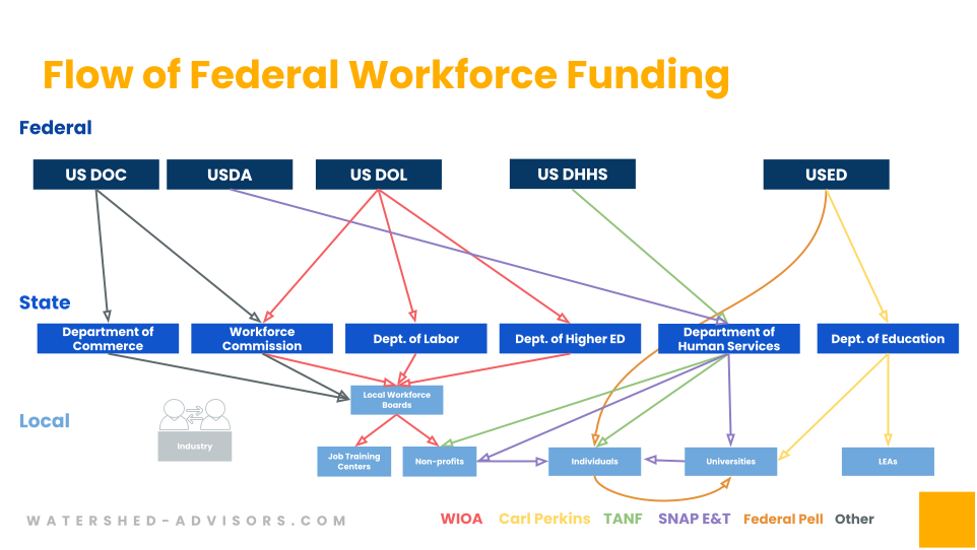
Today, workforce improvement efforts are funded by a variety of federal agencies and spread across a potpourri of state bureaucracies (departments of economic development, education, higher education, and social services), public institutions (community colleges and K–12 school systems), nonprofit organizations, and industry groups.

The U.S. Department of Labor, for example, allocates $3.6 billion through the Workforce Innovation and Opportunity Act to local job training programs. But because the money passes through regional, state, and local workforce boards, much is lost to administrative costs. The same agency runs an entirely separate, $120 million Registered Apprenticeship program to connect apprenticeship seekers with employers. And the Department of Commerce’s Good Jobs Challenge recently gave states $500M to reduce barriers to training in fifteen growing industries. The Department of Education’s Pell grants are a significant source of funding for low-income undergraduates, yet they fund just a fraction of yearly tuition, and policy restrictions prevent them from being used for shorter-term training programs that could lead to valuable industry credentials.

These are just a few examples, but they point to a system so fragmented that it’s hard to navigate for state and local agencies, let alone a high school guidance counselor or rising sophomore. In fact, our team recently mapped out these funding streams and requirements. The resulting graphic was so convoluted that we’ve started calling it the “spaghetti chart.”
1

The upshot is that while great apprenticeship and certificate programs do crop up, they reach far too few students.  

To be sure, there are promising pockets of innovation at the state and local levels. States have reworked high school graduation requirements to include completion of an industry-based certification, partnered with community colleges to expand career and technical coursework, and attempted to use the Perkins funds to align their offerings to regional economies. But these examples remain the exception rather than the rule because there are limits to what the K–12 field can accomplish without addressing the convoluted workforce system surrounding it.

And so the status quo largely persists. The vast majority of college-bound students fill their days with coursework to meet admission requirements, leaving few opportunities for hands-on career learning opportunities. Those who are not planning on college tend to complete their required coursework by junior or senior year, leaving significant flexibility in their schedules. The free time could be spent earning industry-valued credentials in well-paying, fast-growing fields that do not require a college degree. Yet far more high schools offer extra study halls or early release than a chance to earn the skills and certification for in-demand jobs. 

We can and must do better. For years, we’ve looked to superintendents and principals to single handedly reimagine high school. That’s not realistic. We can’t expect local educators alone to reorganize a system that stretches outside of education and beyond city and state lines.

It’s not a perfect analogy, but our work at the Louisiana Department of Education to streamline the state’s once-fragmented early childhood system points to some potential solutions. There, we created regional planning structures, allowing families to more easily access the seats available to them. The state established regional intermediaries that governed the various state and federal funding streams, administered a single application to ease families access to that money, and supported classroom-level improvement. The goal is simple: to ensure that the end users—whether it’s young families or high school students—can easily make programs meet their unique needs.

In the high school context, that could mean creating regional planners that are accountable to mapping future careers, aligning training resources with those careers, and creating multiple pathways that help high school students understand and access their options.

But as specialists in the education policy space, we also know our knowledge on this issue is limited. In fact, that’s kind of the point here. Perhaps setting students up for postsecondary success will require changing the structure of Pell, so that it unlocks a broader range of learning and career opportunities. Maybe WIOA can be streamlined to more directly put money to work for trainees. Or the Good Jobs Challenge could be used as a template for governors to incentivize regional partnerships. Whatever the specifics, we firmly believe that our best shot at reimagining high school requires deep partnership between policymakers in both education and workforce policy. It’s time to get moving. We don't have another fifty years to waste.


view

Pull back the curtain on the real-life outcomes of high school graduates

Christi Martin
12.12.2022
Flypaper

Editor’s note: This essay is an entry in Fordham’s 2022 Wonkathon, which asked contributors to address a fundamental and challenging question: “How can states remove policies barriers that are keeping educators from reinventing high schools?” Learn more.

Despite many proclamations over many decades, neither the average educator nor the public at large thinks American high schools are obsolete. In fact, satisfaction with local schools is at a five-decade high. Until perceptions shift, the potential for policy solutions to catalyze “transformative action” will be severely constrained. In order to get traction, we’ve got to get grounded in reality. Public will, however, can only take us so far. To move the needle, secondary educators must be informed by and rewarded for the real-world, postsecondary achievements of their students.

Sharing the truth

Graduation rates are at historic highs, and incremental improvements fuel optimism that high schools are changing with the times. In fact, of course, the real world is changing at a decidedly different pace. College and career readiness, measured by traditional metrics, remains the holy grail. The class of 2022, however, is entering postsecondary life at a time when demand for academic credentials is rapidly giving way to a craving for actual competence and AI is surprising us daily. The reverberations of these shifts should be shaking the foundations of old institutions. Adult America remains unmoved.

Parents and educators will continue believing that current institutions suffice unless we dignify their love and ambitions for students with the truth. We know what lies in store for most high school graduates today and can foresee where the trajectories are headed. Hundreds of millions of dollars invested in P20W longitudinal data systems over the last twenty years enable us to know.

We know, for example, that in the years preceding the pandemic, approximately 12 percent of Houston ISD graduates earned a four-year degree within six years of graduation and 6 percent earned a two-year degree. We know that the median income of Houston ISD graduates without a two- or four-year degree (82 percent of graduates) was about $29,000. We know that in Harris County, where Houston ISD is located, a living wage for a family of four with two children in child care is $76,824. So, we know that the great majority of Houston ISD graduates are struggling mightily after they leave the care of their high school teachers.  

We also know that teachers do not go to their classrooms every day in service of such a future. Families do not envision such a future when they enroll their child in a district to which the state awards a “B” rating. Students do not walk across the stage expecting such a future. Yet, year after year, we permit the illusion to continue rather than pulling back the curtain to show what the future holds.

Longitudinal data systems in over half the states enable visibility into student trajectories from K–12 into postsecondary and the workforce. Another ten link K–12 and postsecondary. These numbers are growing. Even California, a perennial laggard, is poised to leapfrog into the P20W future.

Sharing, indeed shouting, the truth about the lives students lead after high school is the first step toward building the public will required to let go of outdated structures and norms. High school “feedback reports” and subsidized access to National Student Clearinghouse (NCS) data are two ways states have begun to raise awareness, but these are relatively feeble measures in view of the possibilities. Feedback reports tend to be passively available rather than pushed to stakeholders and provide only a small subset of postsecondary information collected. NCS data are useful but do not include employment outcomes and are typically visible to only a few central office staff.

Align incentives with real-world goals

Public will can get us started down the road, but we’re dependent on K–12 system leaders to keep driving toward the goals that matter in the lives of students. If policymakers continue rewarding achievement of postsecondary “readiness” metrics only, then leaders will continue to calibrate their systems to those metrics without regard to actual outcomes. This would be fine if postsecondary readiness indicators corresponded tightly to postsecondary success. We know, however, that they do not. Compare the percentage of any high school’s “college-ready” graduates with the percentage of its graduates who go on to secure a postsecondary credential. The disconnect will be plain.

Instead, policymakers should incentivize and enable K–12 educators to grapple with the postsecondary realities of their students. Some states are moving in this direction. Texas awards outcome bonuses to districts based in part on college enrollment. Louisiana commissioned a Mathematica study that evaluates the “promotion power” of its high schools. The report assesses a high school’s impact on the long-term success of its students (including success in the job market). Massachusetts recently published a new report that clearly presents employment and earnings of high school graduates (at the district level for now). The state board is contemplating implications for accountability. Nationally, efforts toward enhanced UI wage records will produce a richer picture in coming years.

These advances are encouraging, reflective of principles that have driven large-scale success in other contexts. The systems guru Donella Meadows laid out the formula:

The most effective way of dealing with policy resistance is to find a way of aligning the various goals of the subsystems, usually by providing an overarching goal that allows all actors to break out of their bounded rationality. If everyone can work harmoniously toward the same outcome (if all feedback loops are serving the same goal), the results can be amazing. The most familiar examples of this harmonization of goals are mobilizations of economies during wartime, or recovery after war or natural disaster. (Meadows, D. H. (2015). Thinking in Systems, p. 115. Chelsea Green Publishing.)

In our context, the formula requires that we envision one P20W system with component subsystems. For all our talk of seamless pathways on the ground, we should, in the spirit of JFF’s Big Blur, work to conceive a seamless system in state policy. This shift can be accomplished without consolidating state administrative structures. We can achieve many of the advantages of a unitary system by piping information across systems and arranging incentives within each component in a way that all are driving toward common goals. Meadows puts it this way:

Change comes first from stepping outside the limited information that can be seen from any single place in the system and getting an overview. From a wider perspective, information flows, goals, incentives, and disincentives can be restructured so that separate, bounded, rational actions do add up to results that everyone desires. It’s amazing how quickly and easily behavior changes can come, with even slight enlargement of bounded rationality, by providing better, more complete, timelier information. (Thinking in Systems (p. 108).)

These ideas are dressed up in language befitting a Wonkathon, but are really quite straightforward. In sum: Pull back the curtain to reveal the real-life outcomes of students graduating from legacy institutions so that policymakers have the political capital to allow (and fund) data-driven experiments; provide K–12 educators with timely information about the postsecondary success of their students so that they can regularly improve preparation and transition support; and reward K–12 educators for improvement in postsecondary outcomes, as well as for progress on readiness indicators.

view

Would capturing student growth in grades K–2 lead to different school ratings?

Amber M. Northern, Ph.D.
12.22.2022
Flypaper

In the wake of dismal NAEP reading scores released earlier this year, calls for stronger education policies have grown louder. Test scores from third grade (which is likely already too late for intervention) are the earliest indication of whether students are on track or falling behind. But do third grade test scores serve as a true indication of the quality of students’ early education? Obviously, since federally-mandated standardized testing begins in grade three, school accountability ratings don’t account for student progress in grades K–2. The question is whether that fact unfairly penalizes schools that are making commendable gains with youngsters in those early grades. A recent study from Mathematica’s Walter Herring investigates.

The study leverages NWEA MAP Growth test scores from ten states from the 2013–14 through 2018–19 school years, containing millions of test events across those five years. Still, it is not a nationally-representative sample, in part because education leaders choose to opt in and partner with NWEA for testing. Within those limits, Herring has access to spring MAP test scores and school-level demographic data and is able to calculate separately achievement and growth scores for each school. NWEA uses student growth percentiles, or SGPs, which assess the growth that a student exhibits in a given year relative to his or her peers with a similar test history. Although SGPs do not adjust for differences in student characteristics beyond prior achievement, they are commonly used in state accountability systems.

Herring calculates a school’s average test scores in grades K–2 on MAP and their average test scores in grades 3–5 on standardized assessments. He evenly weights achievement and growth to produce a combined score. To compare the combined scores in grades 3–5 with the scores they would have received if the reporting included K–2 results, he calculates achievement and growth scores based on MAP Growth results in grades K–5, then ranks schools based on their combined scores across two different grade bands (3–5 and K–5) within each state and year. Finally, he assesses the degree to which school rankings changed based on the proportion of schools that changed their quintiles (dependent on the grade levels included in the achievement and growth distributions). He also looks at whether the rankings changed based on the bottom 5 percent of achievement ratings, which are the schools in which (per ESSA) many states intervene in order to turn them around.

Results show that achievement scores in grades 3–5 were highly correlated with achievement scores in grades K–2. Not surprisingly, schools serving more low-income students tend to have lower average test scores, including in the early grades: Specifically, a 10 percentage-point increase in the proportion of students receiving free and reduced-price lunch is associated with one-tenth of a standard deviation decrease in average test scores in grades K–2. By contrast, schools’ growth scores in the upper elementary grades tended to be very different than their scores in the lower elementary grades, revealing a much weaker relationship between SGP measures across grade levels. But that’s not good news for high-poverty schools either, as schools with more low-income students had lower growth scores in the untested early grades after controlling for their growth scores in the tested grades.

In terms of how rankings might change, Herring compares the combined achievement/growth measure in grades 3–5 against schools’ rankings after incorporating scores for all students in grades K–5. Results show that 42 percent of schools change quintiles after accounting for test scores in K–2, with 5 percent moving multiple quintiles. And 38 percent of schools that fall in the bottom 5 percent based on results in grades 3–5 no longer appear in that lowest level when grades K–2 are accounted for. Schools that decreased quintiles served larger proportions of low-income students and Black children; likewise, schools that fell below the 5 percent threshold after including early elementary scores served more Black children.

So yes, including K–2 results could make a difference in school ratings. But the more unfortunate takeaway is that, because most high-poverty schools see slower growth in grades K–2 than other schools do, including these early grades in state accountability systems would tend to exacerbate the ratings gap between rich and poor schools. Is this an argument for more testing in the early grades? Or for putting the very best teachers in the lowest grade levels along with solid curricula? Or for identifying low-performing schools early and providing them with strong supports for their youngest learners? How about trying all of the above?

SOURCE: Walter Herring, “The Other Half of the Story: Does Excluding the Early Grades from School Ratings Matter?” Annenberg Institute at Brown University (August 2022).

view
Reason open enrollment SR image

The state of play in open enrollment policies

Jeff Murray
12.20.2022
Ohio Gadfly Daily

Open enrollment—when students are allowed to enroll in district schools other than the one to which they would be assigned based on their residence—is one of the oldest school choice options in the country. It is also widely available (forty-three states have some form of it) and utilized heavily by parents looking for alternatives to their zoned district school. However, program rules and operations can differ widely from state to state, including features that inhibit use or favor systems over families. A new report from the Reason Foundation analyzes the various versions of open enrollment and ranks them based on observed best practices in state policy.

First up, analyst Jude Schwalbach spells out the difference between intradistrict open enrollment—where students can choose other schools within their district of residence—and interdistrict open enrollment—where students are allowed to attend schools in a different district than the one in which they reside. Both are considered best practices, but only if districts are required by the state to offer such options (on a space-available basis) rather than given the option to do so. Additional identified best practices include transparent state- and district-level reporting of seat availability and open enrollment utilization; simple and readily-available information for parents on how, when, and where to apply; and zero tuition or fee charges for application and participation. (Interestingly, transportation is not on the radar here, even though the Reason Foundation has touted its importance to school choice previously.)

Unsurprisingly, no state hits all of these best practices, but several are close. Arizona, Florida, and Utah top the list, lacking only the state-level reporting requirements. Also among the high-flyers are Kansas and Oklahoma, which meet all of Reason’s best practices save for requiring intradistrict open enrollment. The list drops off quickly from there. The most-common best practice among states is zero tuition for family participation, in force in twenty-four states.

Twenty-three states hit none of the best practices, which is troubling, but that’s not to say that they don’t offer some form of open enrollment. One such state was Fordham’s home state of Ohio. Here, more than 83,000 students utilized the interdistrict variety in 2021, even though the state does not mandate it and participation is driven more by districts’ own financial interests than a state requirement. Intradistrict open enrollment is similarly voluntary and spotty, which leads Ohio to a zero on the best practices chart. We have seen again and again the inequitable outcomes which result from giving districts discretion to open their borders voluntarily. Thus, Ohio’s zero here is warranted. Nevertheless, it is telling that, even without concise information, easy access, or specific prohibition of tuition charges, thousands of Ohio families have sought out open enrollment each year. Were Ohio to adopt Reason’s best practices, even more doors would open to families and students looking for a public school option that meets their needs. 

Schwalbach closes the report by providing a checklist for each state of the steps required to boost their best practices score to 100 percent. Here’s hoping more states will take advantage of open enrollment to help families access more and better educational options.

SOURCE: Jude Schwalbach, “Public schools without boundaries: Ranking every state’s K-12 open enrollment policies,” Reason Foundation (November 2022).

view

Education Gadfly Show #850: 2022’s most important education stories, with Marc Porter Magee

12.20.2022
Podcast
 

On this week’s special, year-end Education Gadfly Show podcast, Mike Petrilli looks back on 2022’s most important education stories with 50CAN founder and CEO Marc Porter Magee. Then, on the Research Minute, Amber counts down the year’s top academic studies on education.

Recommended content:

  • “Nation’s Report Card shows largest drops ever recorded in 4th and 8th grade math” —The 74
  • “Gov. Bill Lee unveils new school funding formula aimed at focusing money directly on students” —Tennessean
  • “Arizona’s school choice revolution” —Washington Examiner
  • Emily Hanford’s podcast series, Sold a Story —American Public Media

Amber’s top five studies of the year:

5. Paul T. von Hippel and Ana P. Cañedo, “Is Kindergarten Ability Group Placement Biased? New Data, New Methods, New Answers,” American Educational Research Journal (2021).

4. Owen Thompson, “Gifted & Talented Programs and Racial Segregation” NBER Working Paper #29546 (December 2021).

3. Rune Vammen Lesner, Anna Piil Damm, Preben Bertelsen, and Mads Uffe Pedersen, “The Effect of School-Year Employment on Cognitive Skills, Risky Behavior, and Educational Achievement,” Economics of Education Review (March 2022); Alicia Sasser Modestino and Richard Paulsen, “School’s Out: How Summer Youth Employment Programs Impact Academic Outcomes,” Education Finance and Policy (January 2022).

2. Young Hwang and Cory Koedel, “Holding Back to Move Forward: The Effects of Retention in the Third Grade on Student Outcomes,” Retrieved from Annenberg Institute at Brown University (December 2022).

1. Kenneth Shores, Hojung Lee, and Elinor Williams, “The Distribution of School Resources in The United States: A Comparative Analysis Across Levels of Governance, Student Sub-groups, And Educational Resources,” Social Science Research Network (August 2021).

Feedback Welcome:

Have ideas for improving our podcast? Send them to our producer Nathaniel Grossman at [email protected].

view

Cheers and Jeers: December 22, 2022

The Education Gadfly
12.22.2022
Flypaper

Cheers

  • There’s a lack of intellectual rigor and job preparedness in America’s ed school programs. —Robert Pondiscio
  • “Alabama charter school enrollment soars as more schools open.” —AL.com
  • Color-blindness is neither racist nor backwards. It’s “the belief that we should strive to treat people without regard to race in our personal lives and in our public policy.” —Free Press
  • School districts are using learning pods and federal funds to better accommodate student learning. —Hechinger Report

Jeers

  • A grand jury report reveals how former Loudon County superintendent Scott Ziegler grossly mishandled multiple sexual assaults against students and a teacher in his district. —The 74
  • Black and Hispanic children have a much harder time accessing services for dyslexia and other reading problems. —Hechinger Report
view

What we're reading this week: December 22, 2022

The Education Gadfly
12.22.2022
Flypaper

What we’re reading

  • “Assessing the Nation’s Report Card with Chester E. Finn, Jr.” —Trending in Education
  • Fourteen charts paint a devastating picture of learning loss and our schools’ lackluster response to it. —The 74
  • Instead of lamenting their impact on learning, we should integrate new technologies like ChatGPT into education purposefully. —Zeynep Tufekci
  • Richmond, Virginia’s superintendent could not overcome opposition to his plan to extend the school year, while a similar plan succeeded in nearby Hopewell. —Associated Press
  • Schools boards that flipped to conservative majorities in this year’s election are wasting no time in making big changes, with some boards firing superintendents. —Wall Street Journal
  • The Democrats’ preferred version of an expanded child tax credit would reduce work and marriage in the long term, and thus increase intergenerational poverty. —Scott Winship
Fordham Logo

© 2026 The Thomas B. Fordham Institute
Privacy Policy
Usage Agreement

National

P.O. Box 110
Burke, VA 22009

202.223.5452

[email protected]

Ohio

P.O. Box 82291
Columbus, OH 43202

614.223.1580

[email protected]

Sponsorship

130 West Second Street, Suite 410
Dayton, Ohio 45402

937.227.3368

[email protected]