Mobile Navigation

  • National
    • Policy
      • High Expectations
      • Quality Choices
      • Personalized Pathways
    • Research
    • Commentary
      • Gadfly Newsletter
      • Flypaper Blog
    • Events
    • Scholars Program
  • Ohio
    • Policy
      • Priorities
      • Media & Testimony
    • Research
    • Commentary
      • Ohio Education Gadfly Biweekly
      • Ohio Gadfly Daily
  • Charter Authorizing
    • Application
    • Sponsored Schools
    • Resources
  • About
    • Mission
    • Board
    • Staff
    • Career
Home
Home
Advancing Educational Excellence

Main Navigation

  • National
  • Ohio
  • Charter Authorizing
  • About

National Menu

  • Topics
    • Accountability & Testing
    • Advanced Education
    • Career & Technical Education
    • Charter Schools
    • Curriculum & Instruction
    • ESSA
    • Evidence-Based Learning
    • Facilities
    • Governance
    • Personalized Learning
    • Private School Choice
    • School Finance
    • Standards
    • Teachers & School Leaders
    • Think Again
  • Research
  • Commentary
    • Gadfly Newsletter
    • Flypaper Blog
    • Gadfly Podcast
  • Events
  • Scholars Program

The Education Gadfly Weekly

Sign Up to Receive Fordham Updates

We'll send you quality research, commentary, analysis, and news on the education issues you care about.
Thank you for signing up!
Please check your email to confirm the subscription.

The Education Gadfly Weekly: America’s high achievers are stuck

Volume 26, Number 26
7.2.2026
7.2.2026

The Education Gadfly Weekly: America’s high achievers are stuck

Volume 26, Number 26
view
Student thinking math

America’s high achievers are stuck

The newest Long-Term-Trend NAEP results bring some welcome news: Lower-performing nine-year-olds made substantial gains in reading and math. But it also brought unwelcome news: students at the top barely moved, while high-performing thirteen-year-olds remain well below their pre-pandemic marks. For the country’s highest achievers, progress remains elusive.

Brandon L. Wright 7.2.2026
NationalFlypaper

America’s high achievers are stuck

Brandon L. Wright
7.2.2026
Flypaper

How to raise a grateful American

Robert Pondiscio
7.2.2026
Flypaper

Reorganizing the Education Department requires more than moving programs

Bruno V. Manno
7.2.2026
Flypaper

A school-closure study that does not support its own conclusions

Brian R. Fitzpatrick, Ph.D.
7.2.2026
Flypaper

Who suffers when classrooms are disruptive

Jill Hoppe
7.2.2026
Flypaper

Beyond fireworks: America 250 and civic renewal | Episode 1024 of The Education Gadfly Show

6.30.2026
Podcast
view
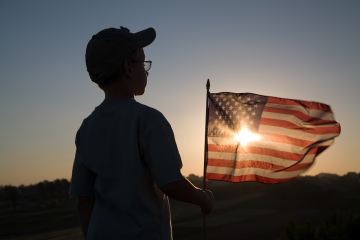
Child holding an American flag

How to raise a grateful American

Robert Pondiscio 7.2.2026
Flypaper
view
Moving puzzle pieces

Reorganizing the Education Department requires more than moving programs

Bruno V. Manno 7.2.2026
Flypaper
view
Empty classroom

A school-closure study that does not support its own conclusions

Brian R. Fitzpatrick, Ph.D. 7.2.2026
Flypaper
view
Sad student

Who suffers when classrooms are disruptive

Jill Hoppe 7.2.2026
Flypaper
view

Beyond fireworks: America 250 and civic renewal | Episode 1024 of The Education Gadfly Show

Stefanie Sanford, Michael J. Petrilli, Amber M. Northern, Ph.D. 6.30.2026
Podcast
view
Student thinking math

America’s high achievers are stuck

Brandon L. Wright
7.2.2026
Flypaper

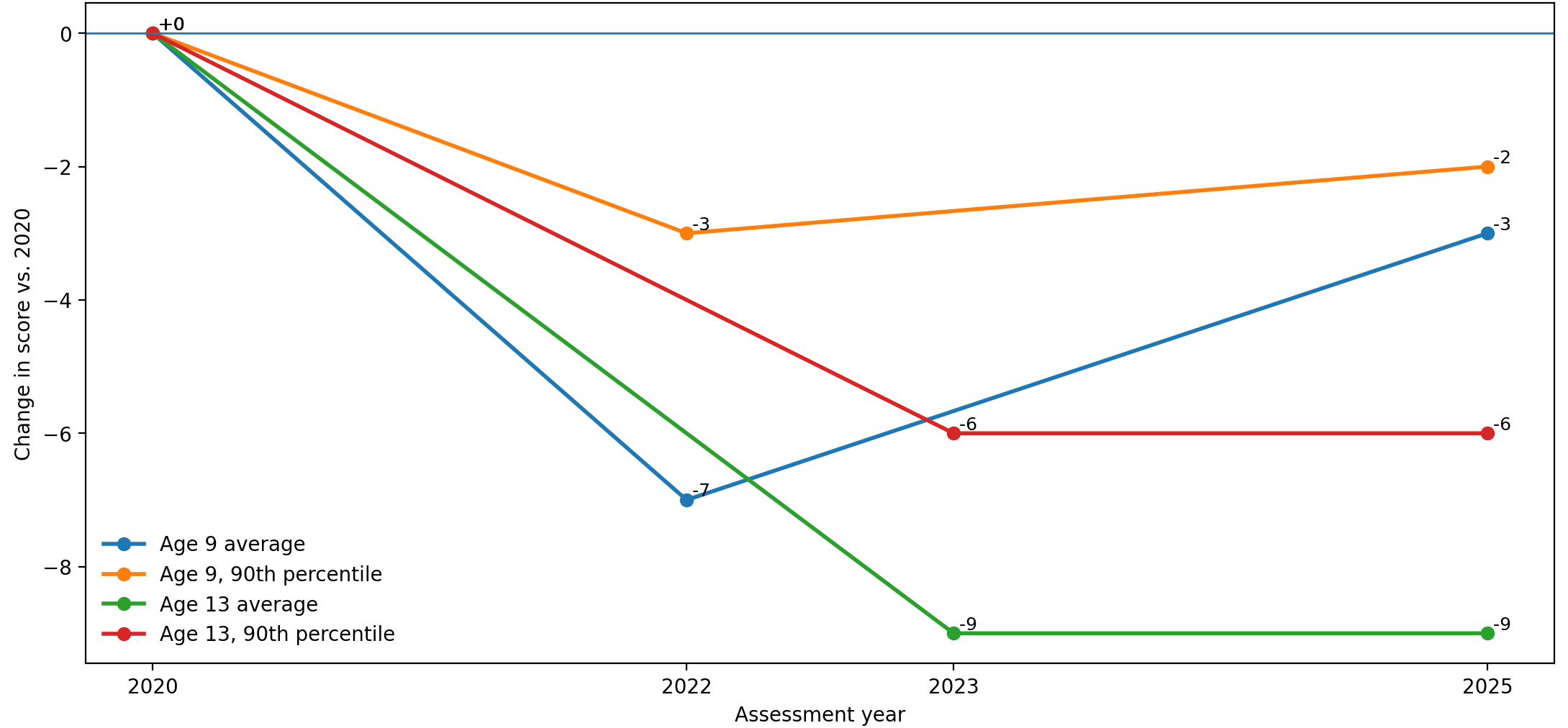
The newest results from the National Assessment of Educational Progress’s Long-Term Trend assessments offer sharply different pictures, depending on students’ age and where they fall in the achievement distribution (see Figure 1 below).

Among nine-year-olds, there is some welcome news. Scores rose four points in both reading and math since 2022, with the gains concentrated among lower-performing students. The gap between the top and bottom of the distribution also narrowed for the right reason: Students at the bottom improved, rather than those at the top declining further.

These gains are genuinely encouraging and deserve to be treated as such. There were already signs of deterioration among lower-performing students before the pandemic, and Covid compounded those problems enormously. Four-point increases do not repair all the damage, of course, but they are substantial, statistically significant, and a welcome indication that an academic recovery is underway for some who badly need it.

Less encouraging is what happened to scores for students near the top of the distribution, which showed no statistically significant changes between 2022 and 2025. This after scores for the top students declined only slightly between 2020 and 2022 (which itself was remarkable, given the closures and other disruptions of the pandemic).

The basic story is simpler than the statistics make it sound. Scores for high-performing nine-year-olds fell much less than those for their lower-performing peers during the pandemic, but they have barely rebounded. While students further down the distribution made sizable gains, those at the top remained in roughly the same place.

The picture among thirteen-year-olds is worse, both for students at the high end and for the age-group as a whole. Average reading and math scores for the entire age group were statistically unchanged from 2023 and remained below their pre-pandemic levels.

At the high end, scores fell three to four points in reading and six to eight points in math between 2020 and 2023. Those declines were substantial, even if they received less attention than the severe losses among lower performers. When thirteen-year-olds were assessed again in 2025, there was no statistically significant improvement at the 90th percentile in either subject.

In short, no recovery. Scores may have stopped falling, and that is not nothing. But a low plateau remains a low plateau. The top 10 percent of thirteen-year-olds are still performing significantly below their pre-pandemic predecessors—by about three points in reading and six points in math.

Figure 1 illustrates these trends, comparing changes in average math scores with changes at the 90th percentile for both age groups. Reading showed the same broad pattern: a stronger age-nine recovery below the top but no age-thirteen rebound.

Figure 1. Changes in average and 90th-percentile NAEP Long-Term Trend math scores for 9- and 13-year-olds, 2020–2025

1

Note: Age 9 was tested in 2020, 2022, and 2025; age 13 was tested in 2020, 2023, and 2025. Source: U.S. Department of Education, National Center for Education Statistics, National Assessment of Educational Progress, Long-Term Trend Reading and Mathematics Assessments, 2020–2025. Scores are rounded, and not all apparent differences are statistically significant.

Recall that students tested at a given age in different years experienced the pandemic at different stages of childhood. The nine-year-olds assessed in 2022 were already in the early elementary grades when Covid began, while those assessed in 2025 were mostly preschool-aged. Likewise, the thirteen-year-olds tested in 2023 were roughly two grades further along in school at the start of the pandemic than the thirteen-year-olds tested in 2025. These results therefore reflect separate groups whose schooling was disrupted at varying ages and under varying circumstances, not successive readings of a single cohort’s recovery. Those differences may help explain some of the variation across ages and assessment years, though NAEP data cannot tell us how much.

The fairest interpretation of all of this is more complicated than either “top students are still collapsing” or “high achievers have recovered.” The first assertion overstates the age-nine results, where relatively modest pandemic-era losses left top-end scores close to their earlier marks. The second ignores the lack of significant progress at the top since the first post-pandemic assessments and the much larger, still-unrecovered losses at age thirteen. Among nine-year-olds, the scores show smaller initial declines followed by little movement at the top. For thirteen-year-olds, they show larger declines followed by no significant rebound. Neither pattern offers much evidence that high-performing students are moving forward.

Few will view this as the most pressing problem in American education. Students who cannot read fluently, perform basic arithmetic, or do grade-level work face more immediate and severe consequences. Schools are right to concentrate substantial attention and resources on these students, and the strong gains among lower-performing nine-year-olds offer welcome evidence that an academic recovery may be underway.

Yet a child who begins the year already knowing much of the material and ends it having learned little more has not necessarily received a good education. Assigning more of what he already knows does little besides occupy his time. Strong grades and proficiency can conceal years of limited academic growth, particularly in schools where teachers are expected to address an enormous range of readiness within the same classroom. And if these deficits persist, highly selective colleges could eventually be drawing from a pool of students whose academic skills are weaker than those of comparable students before the pandemic.

Schools should keep helping the children who are furthest behind, urgently and for as long as necessary. They should also ensure that students who have already mastered the work in front of them encounter something harder. Otherwise, even a broadly successful recovery will remain incomplete.

view
Child holding an American flag

How to raise a grateful American

Robert Pondiscio
7.2.2026
Flypaper

In nearly every part of the country, the school year is over. The final bell has rung; report cards have been issued; summer vacation has begun. For teachers and schools, the clock has run out. Whatever lessons students were going to learn about their country in the days leading up to its 250th birthday—our history, our ideals, our achievements, and our failures—have already been taught (or not taught).

But there is still time for parents. As I’ve written elsewhere, anticipation for the approaching Semiquincentennial pales in comparison to the 1976 Bicentennial, but if schools have failed to cultivate students’ gratitude, civic affection, and love of country, parents can still do so. In fact, they must.

A few weeks ago, in an episode of the Commentary podcast, John Podhoretz invoked John Rawls’s famous “veil of ignorance,” a thought experiment where you design a just society without knowing your future wealth, race, gender, or social status. The forced blindness encourages participants to create rules that protect and benefit everyone, especially the most disadvantaged members of society. Podhoretz put a patriotic spin on it, asking where you would choose to be born if you could know nothing about the circumstances of your future life.

For all our political divisions, cultural anxieties, and a litany of daily complaints, I suspect most of us would choose America. Not because America is perfect. Not because it is free from injustice, conflict, or disappointment. Simply because if you had to place a bet on which nation offered you the greatest likelihood of living your life in safety, prosperity, dignity, and freedom, you would be hard-pressed to make a better wager. Needless to say, this is not how many Americans think about their country. Nor, alas, is it the way many children learn about it.

I confess I’ve found the lack of enthusiasm for America’s approaching 250th birthday more than a little dispiriting. A nation preparing to mark a quarter millennium of self-government should be eagerly anticipating the occasion. We seem reluctant to celebrate, or we peevishly deny there is anything worth celebrating. Which is why I’ve been unexpectedly cheered by the flood of social media videos posted by foreign visitors who have come to the U.S. for the World Cup. They wander through Buc-ee’s with the awe of pilgrims entering a cathedral. They marvel at well-stocked supermarket aisles and wander through Bass Pro Shops like they’ve stumbled upon a lost civilization. They are astonished by public restrooms, vast highways, air conditioning, abundant food—with free refills!—and countless features of everyday life we have long since stopped regarding as remarkable.

We watch these videos and we’re charmed and amused. Well, of course there are 50 kinds of breakfast cereal! But that is precisely the point. One of the blessings of living in a prosperous and successful society is that you stop noticing it. Abundance becomes ordinary. Stability becomes invisible. Freedom is background noise. On the eve of a frankly desultory 250th and with impeccable timing, visitors from other countries have arrived to remind us of all we take for granted.

To be sure, consumerism is merely a surface-level indicator of our good fortune, not the soul of it. But our guests’ refreshing lens invites a summer civic education challenge for parents. Our children are growing up in a culture that is exceptionally good at teaching criticism. Young people learn to identify injustice, inequity, hypocrisy, and failure. Children reliably learn what America got wrong, but do they learn what we got right? Do they learn why billions of people around the world would gladly trade places with them? Do they learn why generations of immigrants crossed oceans, deserts, and borders for the chance to become Americans? Do they learn why our imperfect nation remains even now the destination of choice for millions seeking freedom, opportunity, and a better life?

To be clear, the nation needs citizens capable of seeing its shortcomings. Criticism teaches us what needs improving. Gratitude teaches us what is worth preserving. A healthy civic education requires both.

Parents grasp this intuitively. We teach children to say “thank you” because gratitude is essential to character. A grateful person understands that much of what makes his life possible was built, protected, or handed down by others. Gratitude fosters humility, stewardship, and a sense of obligation to future generations.

Citizenship requires precisely these virtues. Every American is the beneficiary of gifts he or she did not create. A constitutional order that has endured for two and a half centuries. Freedom of speech and religion. The rule of law. A vibrant civil society. The most creative and productive economy in human history. Scientific and technological advances that previous generations would have regarded as wizardry. Most of all, we inherit a country that millions of people throughout history have chosen, often at great personal risk, to join.

None of this requires viewing America through rose-colored glasses. Among the features of American life for which we should be grateful is our capacity for self-correction. Frederick Douglass, Abraham Lincoln, Susan B. Anthony, Martin Luther King Jr., and countless reformers appealed not to anti-American ideals but to American ones. They criticized the nation because they believed it was capable of becoming better. They called on America to live up to its promises. Love of country and honest criticism are not conflicting values, but love must come first. No child is likely to preserve or seek to improve what he has never learned to value.

Imagine raising a child in a grand old house. Every day you point out the peeling paint, the drafty windows, the leaky faucet, and the repairs that remain undone. You never mention the shelter it provides, the craftsmanship that built it, or the generations who maintained it before you arrived. Eventually the child will know every flaw in the house. But he may never understand why it was worth preserving. America is no different.

The school year is over, but cultivating gratitude does not require a district initiative or curriculum mandate. Patriotism is not a government program. It is an inheritance. Parents can lead it themselves. This summer, read a biography with your children. Visit a battlefield. Take them to a presidential library. Read the Declaration of Independence aloud. Attend a Fourth of July parade. Visit a national park. Tell family stories about grandparents and great-grandparents. Attend a naturalization ceremony and watch new Americans pledge allegiance to a country many native-born citizens take for granted. Teach your children not only what America got wrong but what America got right.

Schools have never been solely responsible for forming citizens. Families, churches, scouting organizations, libraries, youth sports leagues, civic associations, and countless other institutions helped cultivate a sense of belonging and obligation. They still can, and, indeed, they may have to. As I’ve noted elsewhere, schools have become demonstrably less interested in their founding purpose of preparing children for responsible citizenship. The school year is over. The opportunity is not.

There is still time to raise a grateful American.

As the nation approaches its 250th birthday, perhaps the most important lesson we can teach children is that, while America is not perfect, they have inherited something rare, precious, and unfinished.

Editor’s note: This was first published on Pondiscio’s Substack, The Next 30 Years.

view
Moving puzzle pieces

Reorganizing the Education Department requires more than moving programs

Bruno V. Manno
7.2.2026
Flypaper

The Trump administration is in the midst of a sweeping reorganization of the U.S. Department of Education. Its stated goal is to “return education to the states.” But the more immediate question is whether the new structure will make the federal education system clearer and more accountable—or leave states, schools, and families facing a maze of agencies and unclear lines of responsibility.

The administration is carrying out the overhaul through 14 interagency agreements that move at least 148 K–12 and higher education programs to six other federal agencies. Some transfers could place programs within agencies better equipped to manage them. Others—especially those involving special education and civil rights—could make it harder to determine who is responsible when services are delayed, rights are violated, or problems arise.

Interagency agreements are typically used to share services or funds without duplicating work. Here, they are being used to redistribute much of the ED’s Congressionally-assigned work across the federal government. The department is not being abolished in one stroke, as some had feared. Rather, it is being rewired and shrunk, agreement by agreement.

The administration frames the agreements as breaking up federal bureaucracy and improving program delivery. Critics see a federal agency being dismantled by administrative means, with Congress sidelined, and families and other K–12 stakeholders left to navigate a more complicated government arrangement.

Both reactions contain part of the truth. The old structure has real problems. But replacing one department with scattered agency partnerships isn’t constructive unless it makes the system clearer, more accountable, and more useful to the people it serves.

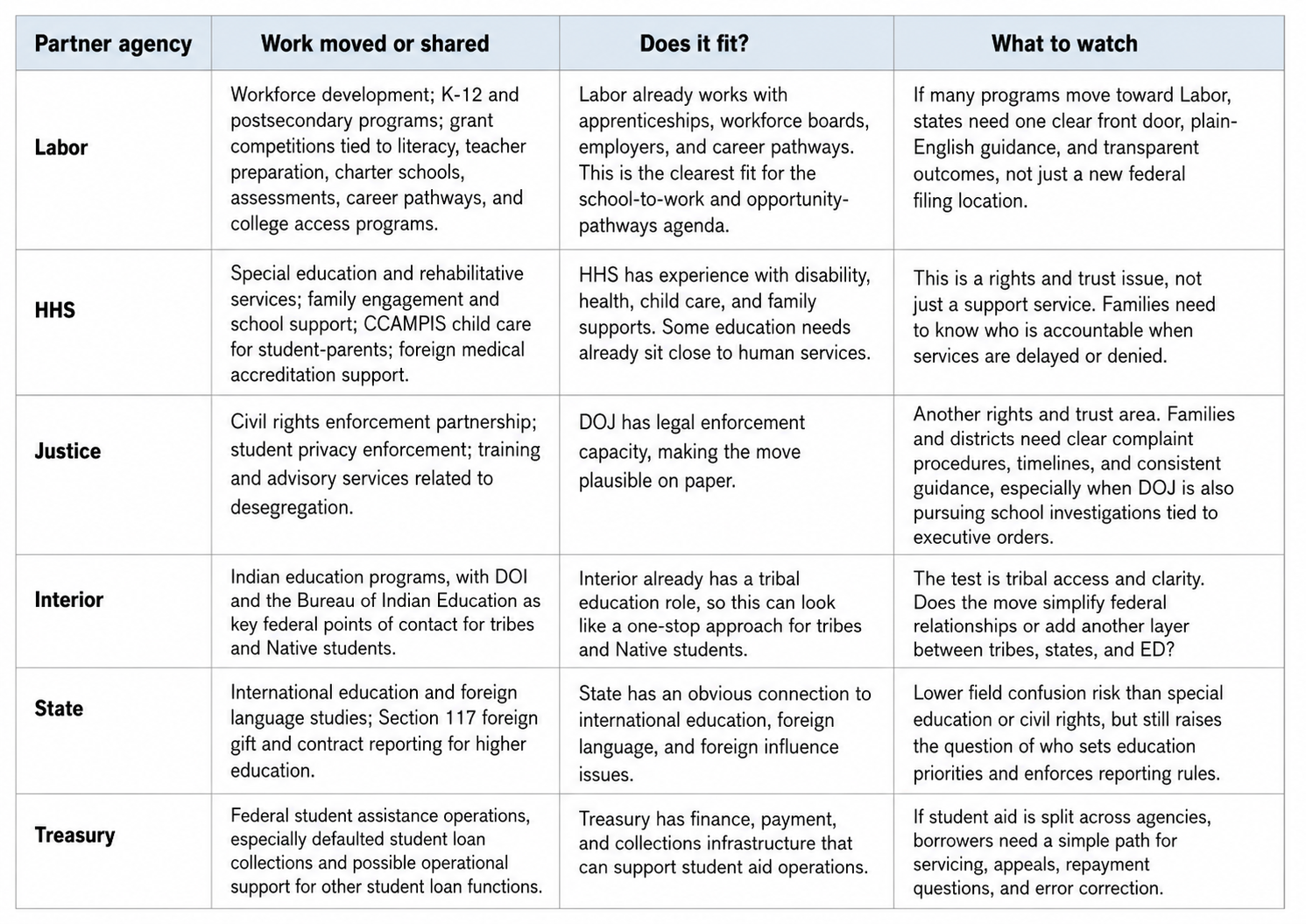
Chart 1, below, makes the pattern easier to see. I’ve compiled it with assistance from ChatGPT and Claude, based on publicly available information from Education Week and K–12 Dive. For each of the six partner agencies, it identifies what Education Department work has moved or is moving, why the administration believes the fit makes sense, and the issues that I believe are worth watching as implementation occurs.

Chart 1. Where ED’s programs are going, whether it fits, and what to watch

1

The case for these transfers varies by program. Some functions may fit naturally within agencies that already handle workforce development, finance, tribal affairs, or international relations. But relocation alone does not guarantee better coordination or service. The real test is whether the new arrangement is easier to navigate, preserves clear accountability, protects students’ rights, and produces better results.

The administration's underlying rationale isn’t baseless. Education has never fit inside one government box. Many students move through systems that extend beyond K–12 education. A young person might take career courses in high school, enter an apprenticeship, earn a short-term credential at a community college, and rely on workforce agencies or employers along the way.

Additionally, when the Education Department was created in 1979, a number of programs that would have fit into the new Department, such as Head Start and Indian Education, were not transferred to it. Interest groups fought vigorously to keep their particular program out of the new Department.

Special education and civil rights present a harder case. These functions involve more than coordinating services and are functions Congress assigned to the Education Department. They require enforcing legal obligations and giving students and families a clear place to turn when those obligations are not met. Moving special education administration to HHS and civil-rights enforcement to Justice could blur those lines of responsibility. The civil-rights transfer is especially sensitive given that DOJ is already pursuing school investigations tied to the administration’s civil rights priorities, including probes of sexual orientation, gender identity instruction, parental opt-out rights, and access to sex-separated facilities.

So yes, the system needs a coherent redesign. But “less bureaucracy” is not a high enough bar. Families need a system they can navigate and officials they can hold accountable. And the danger with the administration’s approach is that it could replace one front door with six side doors, creating a maze and not a map.

That danger is sharpest in special education and civil rights, where federal agencies administer substantial funding and enforce legal protections. These are trust functions, not just administrative assignments. Special education alone sends roughly $15 billion a year to states and schools, supporting services for students whose rights are protected under federal law. Moving special education administration to HHS and civil rights enforcement to Justice raises practical questions, such as whether families will know where to turn if funds are delayed, services are denied, or complaints go unresolved.

Those concerns are not confined to Democrats. Sen. Bill Cassidy of Louisiana, the Republican chair of the Senate Health, Education, Labor and Pensions Committee, has objected to moving special education to HHS and argued that Labor would be the better fit, if it must move at all. He’s agreed to hold a vote on Democrat sponsored legislation that would block the transfer.

The Labor agreements may offer a more promising model. Better alignment among K–12 schools, apprenticeship programs, and colleges could strengthen pathways from school to work.

But moving programs to a new agency will matter only if it produces better coordination for students. That is why these agreements should be judged by five practical questions:

1. Do they make the system easier to navigate? If a state, district, family, or community organization needs help, is there a clear place to start, with public points of contact, plain-English responsibilities, and clear timelines and appeals?

2. Do they preserve accountability? The Education Department may retain legal responsibility for many programs while other agencies handle day-to-day operations, which can work only if someone is clearly answerable when problems arise. Shared responsibility often sounds efficient until something goes wrong, when it can become no one’s responsibility.

3. Do they protect rights? Civil rights, disability protections, student privacy, and services for vulnerable students must not become casualties of administrative redesign. A smaller federal role still needs strong guardrails.

4. Do they improve outcomes? The measure should not be whether Washington moved boxes on an organizational chart. The measure should be whether students read better, graduate at higher rates, find stronger pathways to work, receive promised services, and have their rights protected.

5. Do they help states build capacity rather than simply shift burdens? Returning authority to states can be healthy. But state flexibility without state capacity is an invitation to unevenness. Some states will innovate. Others may struggle. The federal government’s job should be to create room for state leadership while ensuring transparency, comparability, and basic protections.

This is where the slogan “return education to the states” needs more content. States don’t need Washington to micromanage every decision, but they need coherent rules, reliable data, and a federal partner that helps connect education to work and opportunity. Families need a clear sense of what they’re entitled to, where to go, and who’s accountable.

The administration is right that education policy now spans schools, colleges, employers, workforce boards, and other agencies (though one can argue that it always has). Reorganizing the department could improve coordination and give states more room to lead. But dispersing programs across Washington will help only if states and families can still tell who is responsible, where to go for help, and how students’ rights will be enforced.

That is the standard by which this effort should be judged. A smaller federal role may be sensible, but it should produce clearer pathways and unmistakable lines of accountability. States and families should have a map they can follow, not a maze they must navigate.

view
Empty classroom

A school-closure study that does not support its own conclusions

Brian R. Fitzpatrick, Ph.D.
7.2.2026
Flypaper

A new white paper from NWEA, and its accompanying op-ed in The Hill, claim that districts are more likely to permanently shutter schools with a high proportion of poor and/or Black students, even after controlling for enrollment patterns. Which made me think: Here we go again. As with previous analyses from other scholars, it plays the greatest hits: document that Black and poor students are overrepresented in some unfortunate circumstance (in this case, school closures), control for one or two non-discrimination explanations, watch the Black/poor coefficient not quite go to zero, and conclude that bias is the culprit. In 2024, Vladimir Kogan published a tour de force explaining why that interpretive move fails, along with a phenomenal review of research on school closure. I won’t retread where he walked, but it’s well worth a read.

The new paper asks four questions. The first two—Did closure rates change post-Covid? And are Black and poor schools overrepresented among closures?—are answered with clean, descriptive statistics. Unsurprisingly, disadvantaged students disproportionately attend schools at risk of closure: School closure stems from declining enrollment, and disadvantaged students are more likely to attend schools that parents of all backgrounds would rather their students not attend. Also, closure rates dipped right after Covid, likely due to the infusion of federal funds, but are trending back towards pre-Covid rates. The interesting questions are the last two: Do those racial disparities in exposure to school closure hold after accounting for enrollment declines? And what about poverty discrepancies?

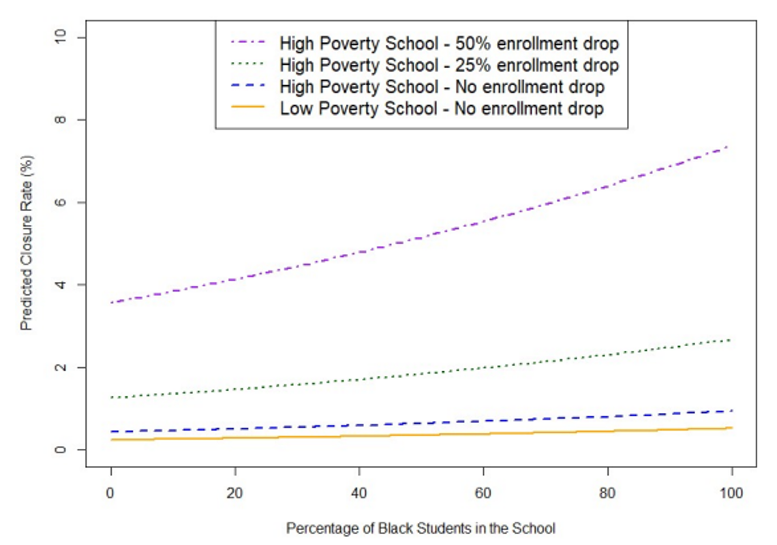
On the racial disparity question, the authors argue that schools serving larger shares of Black students are more likely to close even after differences in enrollment decline are taken into account. They offer Figure 3, below, as evidence for that claim. What it actually shows is that the predicted closure rate rises as the share of Black students increases. Moreover, three of the four lines are nearly flat, while the one that rises sharply likely represents a very small and unusual group of schools. How small? The authors do not say. The figure includes no ranges showing how uncertain these estimates are, and the authors do not provide the underlying statistical results (no coefficients, no standard errors, no p-values). Readers therefore cannot tell whether the differences are statistically significant or could simply be due to chance. Nor do the authors explain how they measured enrollment decline. Did they divide schools into groups based on the size of their decline, or did they treat enrollment decline as a continuous measure and simply choose 50 percent as an extreme example for the graph? Each approach would raise their own questions, but the reader is left guessing. Showing a figure with rising lines and calling it evidence of a disparity, while hiding the model behind it, is insufficient. The racial disparity question is not answered. It is gestured at.

Figure 3: Predicted likelihood of a school closure in 2024–25 by the percentage of Black students under various scenarios

1

Note: The presented results are the predicted probability of a school closing in 2024–25 conditional on (a)  percent of Black students in the school, (b) school-poverty level, and (c) degree of enrollment drop between 2020 and 2024.

The poverty question is worse. The abstract and conclusion both state that poverty disparities “hold after accounting for enrollment declines.” This claim does not appear in the methods section, is not tested in any model presented in the paper, and has no corresponding figure. Figure 3 holds school poverty level constant and looks at how closure risk changes with the share of Black students. It therefore cannot tell us whether high-poverty schools remain more likely to close after enrollment decline is taken into account. The finding simply does not exist in the paper that supposedly produced it.

It is difficult to avoid the conclusion that the authors are driven by an aversion to school closure, especially since they show their hand in their op-ed summarizing the paper. Here, their only reference to school closure as necessary part of fiscal responsibility is to wave this concern away: “What’s more, school closures do not always achieve their end goal of cost savings. A growing body of national evidence shows that the fiscal benefits of school closures can vary.” The results of daily exercise can “vary”; there is a chance, for example, you will get hit by a bus while out on a run. This is a textbook case of focusing on the downside risk of the policy one dislikes while ignoring the downside risk of one’s preferred policy. On that note: When school districts overspend on under-capacity schools, it costs disadvantaged families money. Everyone pays sales and property taxes!

They conclude by saying, “Finally, policymakers must address the root causes that make closures appear inevitable in the first place. These include gentrification that displaces families, declines in state public education funding and broader housing and economic patterns that reduce school enrollment.” This is a pretty transparent indication that the authors assume that schools only lose enrollment due to structural forces rather than the fact that a small subset of U.S. schools are miserable places where most parents of attending students are constantly looking for an alternative—hence the declining enrollment. These are often schools with daily fights, chaotic classrooms, despondent teachers, and scared students. When families avoid a school, they are telling us something, and we should listen.

When a district is operating below capacity to the detriment of its finances, it should prioritize closing schools that have experienced the largest and most sustained enrollment declines—something data can show directly. That may mean closures fall disproportionately on schools serving Black and poor students, but the disparity alone does not establish that those students were treated unfairly. Closing them is not a symptom of bias against those students, but a sign that the district has finally come around to caring about them. The politicians and district leaders willing to act on this and preserve the financial integrity of struggling districts are few and far between. Studies like this one make that case harder to win. And given the weakness of the evidence marshaled here, that is unfortunate.

SOURCE: Jazmin Isaacs, Megan Kuhfeld, Sofia Postell, and Ayesha K. Hashim, Post-Pandemic School Closure Trends: Schools Serving Black Students Disproportionately Closed (NWEA, 2025).

view
Sad student

Who suffers when classrooms are disruptive

Jill Hoppe
7.2.2026
Flypaper

A recent study in the Journal of Educational Psychology examines the extent to which disruptive classroom environments contribute to children’s experiences of victimization (i.e., bullying) in elementary school.

Using data from the Early Childhood Longitudinal Study, Kindergarten Class of 2010–11, researchers tracked a cohort of 11,373 students from kindergarten through fifth grade, focusing on student and teacher survey data from the end of the students’ third-, fourth-, and fifth-grade years. The student questions explored their perceived experiences with verbal, relational (e.g., social exclusion), reputational (e.g., spreading rumors), and physical victimization. Teachers reported on levels of classroom disruptiveness (for example, the concentration of students displaying dysregulated, oppositional, inattentive, or off-task behaviors). Teachers also provided information about their classroom composition, including class size, absenteeism rates, the percentage of students with disabilities, the percentage of English language learners, and other demographic and academic characteristics.

To estimate the relationship between classroom disruptiveness and victimization, the researchers compared changes in students’ classroom environments with changes in their reported experiences of victimization. The study yields three main findings.

First, exposure to classroom disruptiveness was not evenly distributed across student groups. Black students, boys, students with disabilities, and students from low- and middle-income families were more likely than White students, girls, students without disabilities, and students from high-income families to be assigned to disruptive classrooms. The gap was especially large for Black students.

Second, classroom disruptiveness was associated with higher levels of reported victimization. A one-standard-deviation increase in classroom disruptiveness corresponded to increases of approximately 0.03 standard deviations in total, verbal, and reputational victimization and a 0.04 standard deviation increase in physical victimization. While these effects are modest, they were statistically significant across each form of victimization.

Finally, the researchers examined whether classroom disruptiveness affected some student groups more than others. The answer was essentially no. While Black students, boys, and students with disabilities appeared to experience somewhat larger increases in victimization associated with classroom disruptiveness, these results were not statistically significantly different from those for White children, girls, and students without disabilities. The effects were also consistent across different socioeconomic subgroups.

Taken together, the three findings suggest that disruptive classroom environments increase the risk of victimization broadly, affecting students across demographic groups—and that marginalized students are more likely to be in disruptive classrooms, and therefore more likely to victimized.

It is worth noting several limitations of this study. First, measures of victimization relied on student self-reports, which may be influenced by differences in perception or willingness to disclose experiences. In addition, classroom disruptiveness was measured through teacher reports rather than direct observation. Teachers may differ in what they consider disruptive behavior, and ratings may be influenced by classroom context, teaching experience, or individual expectations.

Still, the link between classroom environment and victimization makes sense. Disruptive classrooms strain teachers’ ability to manage peer interactions effectively. Teachers must simultaneously maintain academic rigor, manage behavior, monitor student relationships, and support students’ social and emotional development. When disruptive behavior consumes a disproportionate share of teachers’ attention, harmful peer interactions may be more likely to go unnoticed.

This study relies on data collected more than a decade ago. Since then, the Covid pandemic and the rise of smartphones, social media, and cyberbullying has fundamentally altered how students interact with one another, potentially changing the relationship between classroom climate and victimization. It is worth replicating this research, perhaps expanding to cover middle and high schools where peer dynamics become more complex and interactions increasingly extend beyond the classroom and into online spaces.

While efforts to prevent bullying often focus on individual students or targeted interventions, this study suggests that reducing classroom disruptiveness should also be considered part of a broader, multilevel strategy to reduce victimization.

SOURCE: Qingqing Yang, Eric Hengyu Hu, Jiho Park, Yoonkyung Oh, and Paul L. Morgan, “Are Elementary School Children Bullied More When They Attend Disruptive Classrooms? A Child-Fixed-Effects Analysis,” Journal of Educational Psychology (March 2026).

view

Beyond fireworks: America 250 and civic renewal | Episode 1024 of The Education Gadfly Show

6.30.2026
Podcast
 

Stefanie Sanford, president of Civic Ventures at Alithi Consulting and Humanitae Philanthropy Advisors and a trustee of the Thomas B. Fordham Institute, joins Mike Petrilli to discuss how America’s 250th anniversary could help renew civic life. They explore why civic formation must extend beyond the classroom, how schools can teach both the achievements and failures of American history, and what young people need in order to develop a sense of civic responsibility in an increasingly polarized and digital society.

Then, on the Research Minute, Amber Northern reviews a new study examining gaps in how schools are adopting artificial intelligence, including differences in training, policies, and guidance for students and teachers.

Recommended content:

  • Civic Life in the Information Age —Stefanie Sanford
  • Civics, citizenship, and America 250 — Chester E. Finn, Jr., Thomas B. Fordham Institute
  • Civic Profile —Hoover Institution
  • America at 250: Surveying Change and Continuity on Civic Values — by Karlyn Bowman and Nicole Penn, AEI
  • AI Diffusion Gaps: Unequal Integration of AI Across K-12 Schools —Christopher Campos and John D. Singleton, NBER (2026)

Feedback Welcome: Have ideas for improving our show? We would love to hear them. Send them to [email protected]


Transcript

This transcript was generated with the assistance of AI and lightly edited for clarity and readability.

Introduction

Mike Petrilli [00:02]

Welcome to The Education Gadfly Show. I'm your host, Mike Petrilli of the Thomas B. Fordham Institute. This week, Stefanie Sanford joins us to discuss America's 250th anniversary and how schools and communities can help renew civic life. Then, on the Research Minute, Amber Northern examines gaps in how schools are adopting and managing artificial intelligence. All that and more this week on The Education Gadfly Show.

[Show opening and theme music]

Mike Petrilli [00:39]

Hello, this is your host, Mike Petrilli of the Thomas B. Fordham Institute, here at The Education Gadfly Show and online at FordhamInstitute.org. Now, please join me in welcoming our special guest for this week, Stefanie Sanford. Stefanie, welcome to the show.

Stefanie Sanford [00:55]

Thanks, Mike. Great to be here. I've been a fan for a long time. I think this is my first appearance.

Mike Petrilli [00:59]

I cannot believe it is your first appearance. We will definitely make sure it is not your only, but it is great to have you on.

For those of you who somehow do not know the great Stefanie Sanford, let me introduce her properly. She is president of Civic Ventures at Alithi Consulting. Did I say that right, Stefanie?

Stefanie Sanford [01:17]

You did. Alithi, very good.

Mike Petrilli [01:18]

Okay, very good. She is chair of the board of Citizens & Scholars, an advisor to the National Constitution Center, author of Civic Life in the Information Age, and, most importantly, a trustee at the Thomas B. Fordham Institute. Again, I hope I got all that right. It's a long resume you have here.

Stefanie Sanford [01:37]

Well, thanks, Mike. As one friendly amendment, I'm actually an advisor to the National Constitution Center, not a board member.

Mike Petrilli [01:42]

Oh, not a board member. Okay. Thank you very much for that.

People may notice a theme here: You do a lot of work and have thought a great deal about civic education. It is, of course, America 250, our big birthday party, and everybody is thinking about civic education today. So let's talk about that on Ed Reform Update.

Ed Reform Update: Civic formation beyond schools

Mike Petrilli [02:05]

Stefanie, I have noticed, as you have as well, that for the past decade there has been this renewed interest in civic education. Like a lot of people, you and I are not big fans of where our politics are.

After all, we know that schools have long had a civic purpose, going back to Horace Mann and certainly John Dewey. This is why we fund education in a democracy: We believe we need citizens who are well informed. I worry, though, that sometimes we are expecting too much. The problems we're living through don't have a whole lot to do with our schools, and I'm not sure our schools can do much to fix them. What do you think?

Stefanie Sanford [03:12]

Thanks for that setup. Civic education, civic engagement, and patriotism have been passions of mine throughout my career and even since I was a little kid.

It is gratifying to see renewed attention to civic education, the civic purpose of school, and the idea of preparing young people for democracy. I share your concern that, amid many of the problems you laid out, we're hearing, "The schools will fix it," or, "Civic education will fix that."

I don't think schools got us into this, and I don't think schools alone will get us out of it. Schooling and preparation for democracy certainly have a part to play, but schools can't do it alone. The idea that passing a bill, adopting a requirement, or offering a high school class is somehow going to meet the moment is misguided. Schools already have a lot on their plates and face many challenges. Saying, "The world is in a lot of trouble, schools fix this," probably isn't a productive posture.

As we gather during Independence and America 250 week, I think there are some lessons and images for us. In a democracy, civic formation is central to all of us. I think of it as intergenerational civic formation. These things happen first in families, communities, and civic institutions. Yes, they also happen in schools because of the amount of time young people spend there and the central place schools play in communities. But civic formation is a lifelong development of knowledge, skills, and capabilities.

In that sense, I welcome the attention to civic education, civic formation, knowledge, skills, and capacities. But the answer isn't simply, "Let's pass a bill and add more civics classes." It is to renew our commitment to the civic formation of young people and our citizenry, which is a much broader proposition.

Even looking at what is happening for America 250, it isn't confined to civics classes. I'm going to spend the end of this week in Philadelphia, where they have a wonderful array of activities day after day: parades, the National Constitution Center's Liberty Medal, and all kinds of indoor and outdoor events in that beautiful historic space. I almost think of that as a better picture to hold in our heads.

Mike Petrilli [06:26]

I like that a lot, especially because we see this in other issues that intersect with education. Family matters, community matters, and it has to be more than just the school.

Stefanie Sanford [06:39]

Absolutely.

Teaching the whole American story

Mike Petrilli [06:40]

By the way, there is a lot of hand-wringing today, but there has also been this great celebration around the World Cup happening in America. And guess what? It has been lovely. People from all over the world have come and appreciated how great our country is.

Stefanie Sanford [06:56]

Hasn't that been fascinating?

Mike Petrilli [06:58]

It's great. Visitors are noticing how friendly and generous the people are. They're also noticing how affluent we are and how lucky we are to live in air-conditioned spaces and enjoy all the rest. It is reminding us that we are fortunate to live in a very blessed country, and that is a nice note to go with the anniversary.

One of my big worries, Stefanie, is that when I hear people talk about civics classes in schools, it sometimes sounds like people on the left are thinking, "If we could just teach kids the true history of America, they would understand the inequities and racism." On the right, you hear the exact opposite: "If students understood the history of the country in the context of the rest of the world, they would appreciate how fortunate we are to have a country that is not perfect but is so much better than what came before it." Or they would appreciate our free-market system and capitalism.

It is almost as though civic education is supposed to persuade or defeat the other side of the aisle. That seems crazy. It isn't going to happen. But should we at least try to persuade young people in favor of democracy? Democratic backsliding is concerning. Young people answer surveys indicating that they aren't always sure about democracy versus other systems, and they are cynical about it. Is there a role for schools to put a thumb on the scale in favor of our system?

Stefanie Sanford [08:48]

There is a lot of territory there. On the left, there can be a focus only on America's flaws and on America at its worst. On the right, there can be a focus only on America at its best. But if you look at the numbers, overwhelming majorities believe you ought to teach both. Rick Hess has written about this, and there is good polling on it.

I don't even like to divide it that way because it is a rich and complicated story. We should teach the good and the bad, and we should teach it sequentially. Civic education has sometimes become thematic, but I have come to believe that the American story is an epic story. Like every story, a story that is all bad or all good is boring.

We should teach that story starting much earlier, including through children's books. That doesn't have to become indoctrination. We can teach the history of this place and the history of its ideas, not because they are perfect, but because they matter. I don't know that this is putting a thumb on the scale. Perhaps the thumb on the scale is simply teaching the grand story of America in age-appropriate and community-embedded ways. Do we need to end by saying, "And not only that, it is the most awesome country ever"? Probably not.

But it has been striking, returning to your point about the World Cup, to read accounts from people, particularly Europeans, who come here and say, "Whoa." I can only imagine someone going to the Cheesecake Factory and thinking, "You get this much in one order?" It has been fun to see people visit America, which admittedly is in a rough patch right now, and say, "Wow, this place looks pretty good."

It has also been fun to watch the social side of the World Cup. When we were together at dinner, Dave Driscoll was talking about the Scots, and I had read many accounts about them. An underexplored value of civic engagement is sports. We see it during the Olympics, but that is only every couple of years. With the World Cup, people from many different backgrounds have come together around this sport, and, as best I can tell, it has been joyful. There are ways we can come together and be happy about things.

So it isn't about teaching all the good stuff or all the bad stuff. It is about teaching and engaging over time. There are ways to make this experiential and less about Schoolhouse Rock, although what is the one thing anyone remembers from the bicentennial? I was in fourth grade. Everybody remembers Schoolhouse Rock.

As we think about the experiences young people will remember, what will today's fourth graders remember at the tricentennial? They will remember experiences, whether those are connected to the World Cup, being on Independence Mall in Philadelphia, or something else. CBS Sunday Morning did a terrific episode and visited towns around the country to look at their histories and how they were marking the 250th.

Rather than focusing only on a technical explanation of a system, which is important, we should tell the story of us: how this place began and how it is today. If things are bad now, they have been good before and we have made them better. They have also been worse than they are now.

That can create a sense of agency, starting in your own community and extending outward, and a belief in your ability to make a difference. That sense of agency and resilience, grounded in knowledge and capability, is integral to this moment.

A civic decade and democratic backsliding

Stefanie Sanford [14:07]

As we focus on the country at 250, as we did 50 years ago, we should see this as the beginning of a civic decade. We haven't paid much attention to civic education for a long time. People are paying attention now partly because of the rise of populism and polarization, and now because of this great commemoration.

We can say that this is the beginning of a spectacular ten years. What happened 250 years ago unfolded over a massive civic decade. We should engage with the deep resonance and complexity of that story.

Mike Petrilli [14:48]

I love that. I hadn't really thought about it that way. We are marking the Declaration of Independence, of course, but we will have many other anniversaries leading up to the Constitution. This is not the end of it.

Maybe I'm too online, too much in the bubble, and too obsessed with this stuff. You point that out to me sometimes. You're asking how normal Americans, children, and families will celebrate this milestone.

Knowing that I'm in the bubble, I still worry about democratic backsliding. It is happening on the left and the right, including post-liberalism and the questioning of core Enlightenment principles embedded in the Declaration of Independence and the Constitution. You hear people question free speech or even whether they believe in democracy or a republic. Sometimes even the vice president says things are going to have to get pretty wild if we are going to change things.

There is concerning material in the ether, and surveys seem to indicate that young people may not be as wedded to some of these basic ideas. Believe whatever you want on policy. Consider yourself left, right, center, far left, or far right. But are you committed to the ideas in the Declaration of Independence? Am I wrong to worry? Can schools do anything? Lecturing teenagers has probably never worked.

Stefanie Sanford [16:40]

A few things. First, I do think you're in the bubble, and I don't think it is dumb to worry. Both can be true.

I've been looking at polling to understand where the electorate is on these questions. More in Common has done work examining different segments of the public. One byproduct of being in the bubble is that the extremes, whether the hard right, MAGA right, super-woke left, identitarian left, or whatever terms you use, punch above their weight precisely because you see so much of them online. On the left, they also have influence in elite institutions and media organizations. So you may be seeing a distorted view.

That said, depending on the poll, the super-woke left might be around 15 percent of the electorate, while the hard-right, anti-woke segment is larger, perhaps around 30 percent. That is not nothing. You could still be talking about 30 to 40 percent of the electorate flirting with illiberalism. Those also tend to be the people paying the most attention. The good news and bad news is that some of the most engaged people can be the worst on this stuff.

But that still leaves a large center of normies. On what schools can do, lecturing teenagers has never worked. There is also a lesson here, and I say this gently, my friend: The more time people spend online, particularly in political spaces, the more social media algorithms push them toward extremes.

I have been thinking a lot about how to meet people where they are, which is on their screens, whether we like it or not, especially for young people. What can happen on that screen that then makes them put it down, go into real life, and do something?

Algorithms and ideologically homogeneous spaces, whether online or in real life, tend to make people more extreme. More in Common has found that, and Cass Sunstein has 30 years of research on it. The more we can break up those dynamics, the better off we will be.

In real life, I don't remember who said it, but it is hard to hate up close. There is nothing farther away than the abstracted pixels you see while reading posts on a screen.

Schools as institutions of civic formation

Stefanie Sanford [19:46]

Schools should help young people learn how to become responsible citizens of their school, community, town, state, country, and world. That needs to be part of the experience.

There is a knowledge component that turns up in social studies and coursework, and I am a civic-knowledge person. But there are also behaviors, sensibilities, and norms transmitted from human to human. We should think of schools as places of that kind of formation.

We are starting to hear similar thinking in career exploration. Because the economy and jobs are changing so much due to AI, people argue that career awareness needs to begin earlier, perhaps even in middle school. To my mind, the logic is the same.

We have fallen into thinking that schools are schools because they are schools, rather than seeing them as institutions of formation that prepare young people to be responsible and self-sufficient in our free-market liberal democracy. We should be more intentional about that.

As for young people, they have always tended to be further left than older people. Remember that many of today's senior citizens who are supposedly so right-wing were holding signs and screaming at people at Berkeley in the late 1960s. There is an arc to these things.

I wonder whether socialism is, right now, a fashionable concept. You have Mamdani and all of his charisma. Free stuff also sounds very good, particularly when rents, interest rates, and inflation are high. Young people being seduced by that promise isn't irrational.

Then there is cynicism. I think cynicism has become a proxy for sophistication: "I'm too cool to believe in anything." I wrote about this in my book on civic life 20 or 25 years ago. My youngest respondents, who were millennial undergraduates, were by far the most cynical.

You could argue that they were trying to appear sophisticated and stick it to the man. You could also say that they didn't understand the system. They saw older people running it and didn't feel they had access to it or knew what was happening. And guess what? That was true.

The thing about being young and then working within a system is that you get older. People may become more conservative not because they become right-wingers, but because they come to understand how the system works. Even if it hasn't worked especially well for them, they understand it. A small-c conservatism then says, "I understand how this works, and I'd like to keep it the same." Young people say, "I don't understand how this works. It doesn't work for me. I want it to be different." Generational effects can sometimes be boiled down to something almost that simple.

Mike Petrilli [23:24]

Schools are one of the first institutions, if not the first, outside the home and family in which young people are truly embedded. How do we make that experience as positive as possible and help them feel connected to it in a way that can later carry over into other institutions?

Stefanie, we could do this all day or all week, but we have to end it there. I hope you have a wonderful time in Philadelphia and enjoy this great America 250 celebration. I really enjoyed having you on the show.

Stefanie Sanford [23:58]

I loved it, Mike. Thanks so much for the invitation.

Mike Petrilli [24:01]

Thanks so much, Stefanie.

Amber's Research Minute

Mike Petrilli [24:03]

Now it's time for everyone's favorite, Amber's Research Minute. Amber, welcome back to the show.

Amber Northern [24:12]

Thanks, Mike.

Mike Petrilli [24:14]

Do you have any big Fourth of July or America 250 plans?

Amber Northern [24:18]

We have a lot going on here in Richmond. I have friends and family coming in, so we're going to catch some fireworks. The Virginia Museum of Fine Arts, which is this highfalutin art museum here, also has a bunch of July Fourth activities, so we'll probably catch some of those.

I haven't looked at the weather. Are we going to have good weather?

Mike Petrilli [24:42]

Oh my gosh, you haven't looked at the weather? It's going to be 101 degrees.

Amber Northern [24:47]

Okay. I had heard it was going to be really hot. I just didn't know it was that hot.

Mike Petrilli [24:51]

It is going to be toasty all up and down the Eastern Seaboard.

Amber Northern [25:01]

What about you?

Mike Petrilli [25:02]

We have our annual crab feast at the swimming pool on Saturday. Of course, as the president of the swimming pool board, I need to be there, as you know.

Amber Northern [25:17]

That's an expensive little event. Crabs have gotten quite pricey.

Mike Petrilli [25:24]

That's interesting. I didn't notice that the price was higher than usual. We get them by the bushel or whatever.

Amber Northern [25:31]

Hopefully they'll have some size on them. I feel like people start catching them before they're fully baked, and they're smaller than they used to be.

Mike Petrilli [25:38]

This is definitely a Virginia, Maryland, and D.C. kind of problem. They have to be five inches across, right? And they're still kind of small. Don't they all come from Vietnam now or something?

Amber Northern [25:59]

We used to catch them with chicken necks and string, Mike.

Mike Petrilli [26:03]

I did that with the kids when they were little. It was great, although my dear niece was very upset when, after we caught them, we started to boil them. She was very young, and I had not fully explained the plan. She had thought of them as pets.

Amber Northern [26:23]

Well, at least you pour beer on them before you drown them. They get to die drinking some beer.

Mike Petrilli [26:30]

Okay. We should probably talk about some research studies, shouldn't we?

Amber Northern [26:37]

We should.

How schools are adopting generative AI

Amber Northern [26:38]

We have an NBER paper from Chris Campos and John Singleton examining generative AI and how it is being integrated into K-12 schools. They surveyed principals, which gives us a new perspective, and asked whether schools have the policies, training, guidance, and instructional supports needed to use AI well.

The researchers designed and fielded a survey that they describe as nationally representative. They ended up with 1,250 K-12 principals surveyed between December 2025 and February 2026, including principals from traditional public, charter, and private schools.

The invitations went out to 73,000 schools, so the response rate was approximately 1.7 percent. They did not use a panel, which can be pricey. They attempted to address the low response rate by weighting the data to account for differences between those who were and were not likely to respond, which is fairly common.

They also conducted a randomized incentive experiment in which they offered a little cash during a second round to attract some of the nonresponding principals. That mitigated some of the nonresponse bias from the first round.

The study is still observational and correlational, so take it with a grain of salt, but the researchers also merged the survey responses with data from other public sources about districts.

They created an AI integration index, which is the main outcome they explore. It combines seven dimensions of what they consider effective AI implementation: whether a school has AI policies, how teachers use AI, how principals use it, whether professional development has been provided, whether the school uses AI tutoring tools, how it encourages student use, and its future integration plans.

We could debate whether all those things are necessarily good. I'm not sure what encouraging student use means in this context, but we'll leave that aside.

First, they find that AI adoption has been remarkably fast. That isn't surprising. Principals report that teacher AI use jumped from just 6 percent of schools in 2022 to roughly 90 percent by mid-2025, which seems quite high.

The infrastructure surrounding AI has not kept pace. Sixty-four percent of schools had provided professional development by mid-2025, but most still lacked a written AI policy. Relatively few had licensed AI tutoring platforms, which may or may not be a problem.

Principals say AI is used primarily as a productivity tool. They are reporting what they think students and teachers are doing. They say students commonly use AI for homework help and essay drafting.

Mike Petrilli [30:20]

Oh, I bet they're using it for homework help. You better believe it. A whole lot of help.

Amber Northern [30:26]

How is that a productivity tool, Mike? That's kind of a positive spin.

Mike Petrilli [30:30]

Mm-hmm.

Amber Northern [30:32]

Students also use it for study guides, which I will accept as a productivity tool. Teachers primarily use AI for lesson planning, administrative work, and grading. Nearly 90 percent of principals say AI rarely or never replaces direct classroom instruction.

Principals themselves report using AI to streamline meetings and paperwork and to help with data analysis. When asked whether AI has a positive or negative impact on learning, about one-quarter say it is improving student learning, while one-third say it is not.

AI integration gaps

Amber Northern [31:13]

Finally, the researchers examine AI diffusion gaps using the integration index. Schools serving larger shares of disadvantaged students consistently score lower on the index, meaning they are less likely to have the infrastructure conditions the researchers associate with using AI well.

A one-standard-deviation increase in student disadvantage was associated with roughly a 0.07 to 0.11 standard-deviation decline in the AI integration index. Charter and private schools lagged traditional public schools by roughly 0.23 to 0.44 standard deviations on the integration measure.

The researchers explored what might explain these gaps, including ESSER funding and technology policies. Several factors predicted higher integration within schools but did not explain the differences across schools.

The only factor they found that reduced the disadvantage gap was district size. Larger districts accounted for about one-third of the difference. The authors think larger districts may be better able to coordinate the people, systems, and expertise needed to make AI implementation hang together.

The bottom line is that AI adoption is nearly universal, according to principals, but the policies, training, governance, and instructional supports that could determine whether AI is helpful for learning remain very uneven across schools.

Mike Petrilli [33:02]

Interesting. When you read the paper, did it feel as though the authors had a fairly pro-AI-in-education perspective?

Amber Northern [33:11]

I think that's fair. I didn't see as much skepticism. The paper's posture was essentially, "Let's try to make this work. What pieces do schools need to have in place for AI to enhance learning?"

What schools should do with AI

Mike Petrilli [33:28]

The findings on private and charter schools are interesting. That could partly reflect school size. Those schools tend to be smaller and are not part of larger systems. If you're a huge school system, you probably have one or several people in charge of AI and thinking about it. A tiny charter or private school doesn't have that luxury.

On the other hand, it could reflect parents' interests. There is a huge backlash right now against technology in general and AI in particular. Schools of choice may be responding to parental demand for children to touch grass and not do anything too focused on AI, although some of the uses described in the paper happen in the background.

On student use, we clearly know students are using AI to cheat. It has made cheating much easier. If you're not worried about that as a teacher or principal, in my opinion, you're totally out to lunch.

Amber Northern [34:37]

I'm thinking of Michael Horn, who talked with us recently. He suggested that perhaps generative AI should not be allowed in high schools, but I think he referred to purpose-driven AI, perhaps something like an AI tutoring application, differently.

This study focuses on generative AI and how it is being integrated. It made me wonder whether we should distinguish between generative AI and other AI tools built for a specific purpose.

Mike Petrilli [35:23]

Right. It is one thing to say we're going to use ChatGPT, Claude, Gemini, and the other general-purpose tools. It is another to use something built specifically for schools with data protections, FERPA protections, and so forth.

I've probably said this before to you, Amber, and may have said it on the show, but I feel like we should be able to find out what is happening from real-world data. School systems have learning management systems, often Google Classroom, Canvas, PowerSchool, or something similar. They can probably see what students and teachers are doing, at least on a screen, and gather information about the degree to which they access AI while doing it.

Researchers could potentially gain access to those systems. We could learn so much. Surveys are fine, but they are imperfect.

Amber Northern [36:24]

I'm a big fan of that. You're making me wonder how much of this information is shared at the school and district levels and how much providers retain for proprietary reasons.

When I was working on the IES report, I said this was a treasure trove of data. Some small groups are working on it. The AIMS group is one that the Gates Foundation supports. There is also SEERNet at IES. Some learning-management-system providers are voluntarily coming together and sharing their data in an enclave while still owning their individual pieces.

I don't know how we incentivize wider sharing so these data aren't kept by individual vendors. To your point, we also need to find out what is accessible at the school or district level so researchers might be able to work around the vendor.

AI feedback for teachers

Mike Petrilli [37:22]

One last question. Did the researchers ask whether principals are using AI to provide feedback to teachers about their instructional practices? There are new tools that use cameras or even just audio recordings to transcribe what happens in a classroom and give real-time feedback to teachers.

Amber Northern [37:42]

Not in much detail. Looking at my notes, the principals say teachers use it for lesson planning, administrative work, and grading as a productivity tool, but not in the classroom for instructional purposes.

Mike Petrilli [37:56]

Even if you're doing old-fashioned classical education, you could record the classroom. Principals can conduct only so many observations per year. You could have a camera on for every class period and ask AI to provide basic feedback, such as, "You're forgetting to call on the students on the left side of the room," "You could improve your questioning in this way," or, "You are doing too much of the talking and the students aren't talking enough."

Amber Northern [38:32]

Mike, you've been talking about this for years, since before generative AI, and we all thought you were a little off your rocker. But I'm going to admit on this podcast that I think you were prescient because I can now see it happening.

It is much more likely now that we have AI and all these tools, and now that we can put privacy protections around the technology better than we knew how to in the past. We can ask AI to de-identify the teachers, students, and voices. The material can become much more anonymized than it was before. I don't think you're crazy about that anymore.

Mike Petrilli [39:20]

Thank you, Amber. Victory.

Just a quick anecdote: A couple of weeks ago, my younger son was at a wrestling tournament. I recorded his match and fed the video into Claude. I asked, "Can you give him some tips? What is he doing well, and what does he need to work on?" The feedback was shockingly good. Of course, I don't know anything about wrestling, so perhaps I only thought it was good.

I've also fed in some of the podcasts we do and asked for feedback. It gives good advice. At some point, teachers could use this as professionals. I understand the danger of using it to evaluate teachers or make personnel decisions, but a teacher could simply ask, "Give me feedback on my latest lesson." And this is just Claude. It isn't even a specialized tool. It is remarkable what these systems can do.

Amber Northern [40:22]

It is. I have a feeling we're going to start seeing some of that here and there, so we'll keep our eyes open.

Closing

Mike Petrilli [40:30]

Sounds good. Thank you, Amber. I hope you have a wonderful long weekend and holiday. Celebrate America.

Amber Northern [40:38]

You too.

Mike Petrilli [40:40]

That is all the time we have for this week. Until next week, I'm Mike Petrilli of the Thomas B. Fordham Institute.

Amber Northern [40:46]

And I'm Amber Northern.

Mike Petrilli [40:47]

Signing off.

The Education Gadfly Show is a production of the Thomas B. Fordham Institute, located in Washington, D.C. For more information, visit us online at FordhamInstitute.org.


Fordham Logo

© 2026 The Thomas B. Fordham Institute
Privacy Policy
Usage Agreement

National

P.O. Box 110
Burke, VA 22009

202.223.5452

[email protected]

Ohio

P.O. Box 82291
Columbus, OH 43202

614.223.1580

[email protected]

Sponsorship

130 West Second Street, Suite 410
Dayton, Ohio 45402

937.227.3368

[email protected]