
The newest results from the National Assessment of Educational Progress’s Long-Term Trend assessments offer sharply different pictures, depending on students’ age and where they fall in the achievement distribution (see Figure 1 below).
Among nine-year-olds, there is some welcome news. Scores rose four points in both reading and math since 2022, with the gains concentrated among lower-performing students. The gap between the top and bottom of the distribution also narrowed for the right reason: Students at the bottom improved, rather than those at the top declining further.
These gains are genuinely encouraging and deserve to be treated as such. There were already signs of deterioration among lower-performing students before the pandemic, and Covid compounded those problems enormously. Four-point increases do not repair all the damage, of course, but they are substantial, statistically significant, and a welcome indication that an academic recovery is underway for some who badly need it.
Less encouraging is what happened to scores for students near the top of the distribution, which showed no statistically significant changes between 2022 and 2025. This after scores for the top students declined only slightly between 2020 and 2022 (which itself was remarkable, given the closures and other disruptions of the pandemic).
The basic story is simpler than the statistics make it sound. Scores for high-performing nine-year-olds fell much less than those for their lower-performing peers during the pandemic, but they have barely rebounded. While students further down the distribution made sizable gains, those at the top remained in roughly the same place.
The picture among thirteen-year-olds is worse, both for students at the high end and for the age-group as a whole. Average reading and math scores for the entire age group were statistically unchanged from 2023 and remained below their pre-pandemic levels.
At the high end, scores fell three to four points in reading and six to eight points in math between 2020 and 2023. Those declines were substantial, even if they received less attention than the severe losses among lower performers. When thirteen-year-olds were assessed again in 2025, there was no statistically significant improvement at the 90th percentile in either subject.
In short, no recovery. Scores may have stopped falling, and that is not nothing. But a low plateau remains a low plateau. The top 10 percent of thirteen-year-olds are still performing significantly below their pre-pandemic predecessors—by about three points in reading and six points in math.
Figure 1 illustrates these trends, comparing changes in average math scores with changes at the 90th percentile for both age groups. Reading showed the same broad pattern: a stronger age-nine recovery below the top but no age-thirteen rebound.
Figure 1. Changes in average and 90th-percentile NAEP Long-Term Trend math scores for 9- and 13-year-olds, 2020–2025
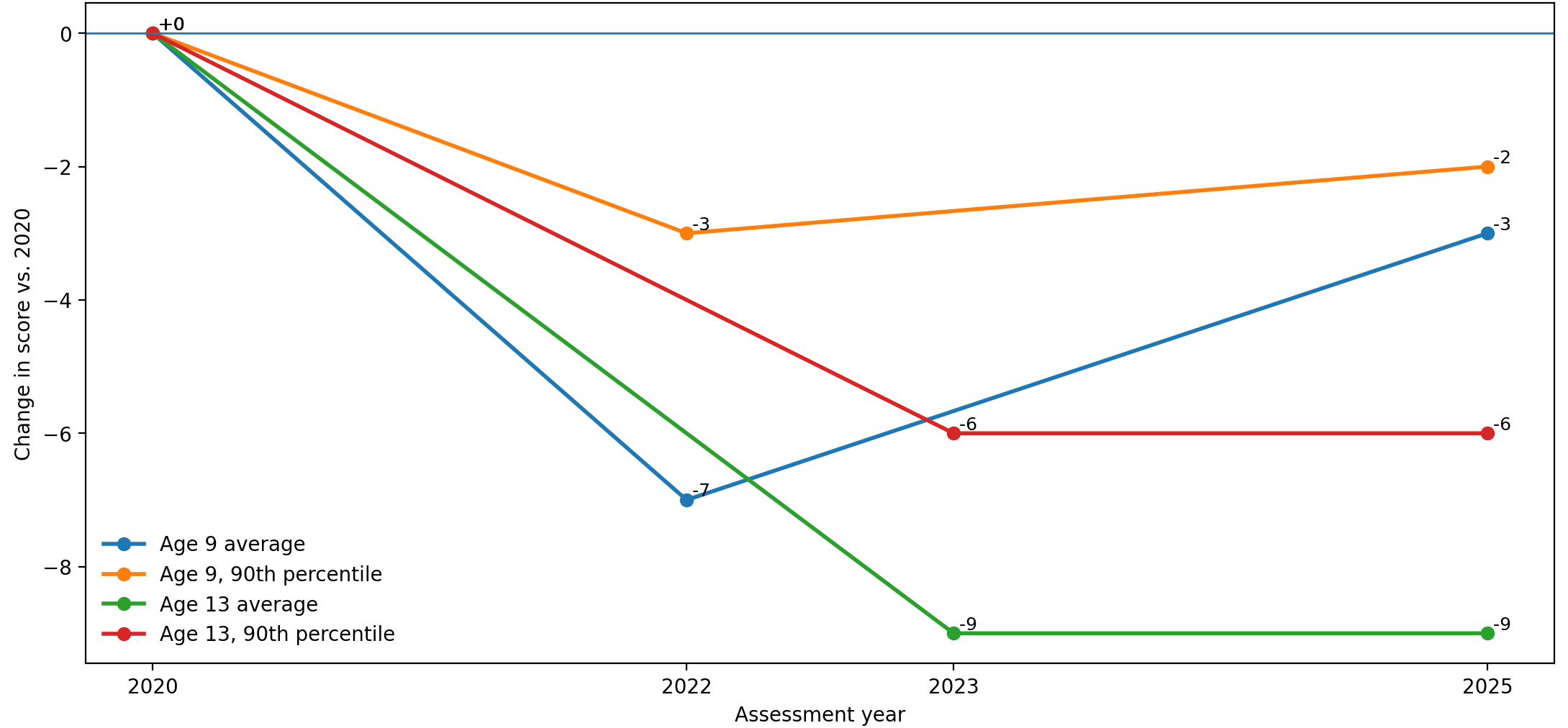
Note: Age 9 was tested in 2020, 2022, and 2025; age 13 was tested in 2020, 2023, and 2025. Source: U.S. Department of Education, National Center for Education Statistics, National Assessment of Educational Progress, Long-Term Trend Reading and Mathematics Assessments, 2020–2025. Scores are rounded, and not all apparent differences are statistically significant.
Recall that students tested at a given age in different years experienced the pandemic at different stages of childhood. The nine-year-olds assessed in 2022 were already in the early elementary grades when Covid began, while those assessed in 2025 were mostly preschool-aged. Likewise, the thirteen-year-olds tested in 2023 were roughly two grades further along in school at the start of the pandemic than the thirteen-year-olds tested in 2025. These results therefore reflect separate groups whose schooling was disrupted at varying ages and under varying circumstances, not successive readings of a single cohort’s recovery. Those differences may help explain some of the variation across ages and assessment years, though NAEP data cannot tell us how much.
The fairest interpretation of all of this is more complicated than either “top students are still collapsing” or “high achievers have recovered.” The first assertion overstates the age-nine results, where relatively modest pandemic-era losses left top-end scores close to their earlier marks. The second ignores the lack of significant progress at the top since the first post-pandemic assessments and the much larger, still-unrecovered losses at age thirteen. Among nine-year-olds, the scores show smaller initial declines followed by little movement at the top. For thirteen-year-olds, they show larger declines followed by no significant rebound. Neither pattern offers much evidence that high-performing students are moving forward.
Few will view this as the most pressing problem in American education. Students who cannot read fluently, perform basic arithmetic, or do grade-level work face more immediate and severe consequences. Schools are right to concentrate substantial attention and resources on these students, and the strong gains among lower-performing nine-year-olds offer welcome evidence that an academic recovery may be underway.
Yet a child who begins the year already knowing much of the material and ends it having learned little more has not necessarily received a good education. Assigning more of what he already knows does little besides occupy his time. Strong grades and proficiency can conceal years of limited academic growth, particularly in schools where teachers are expected to address an enormous range of readiness within the same classroom. And if these deficits persist, highly selective colleges could eventually be drawing from a pool of students whose academic skills are weaker than those of comparable students before the pandemic.
Schools should keep helping the children who are furthest behind, urgently and for as long as necessary. They should also ensure that students who have already mastered the work in front of them encounter something harder. Otherwise, even a broadly successful recovery will remain incomplete.