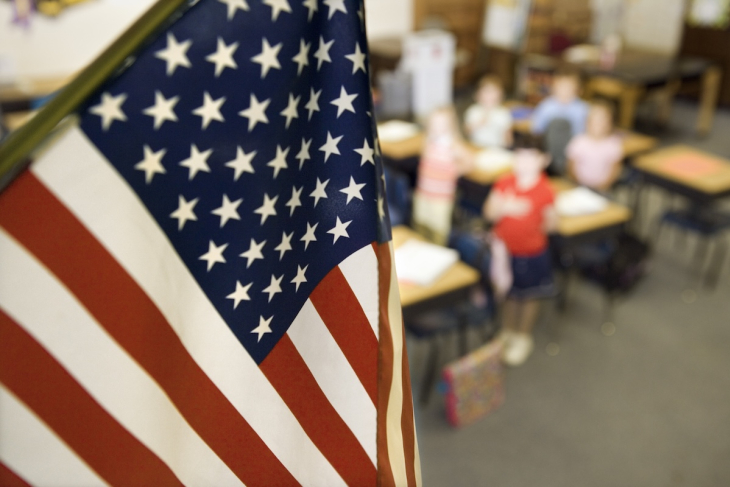
With July 4 around the corner and amid mounting anxiety that its observance in the nation’s capital may consist of little more than parades, flyovers, and whoop-de-dos, mounting numbers of people who are serious about civics, citizenship, democracy, and history are doing their best to ensure that we commemorate the audacious events of July 1776 in ways that those events and their aftermath deserve.
This includes a boatload of revealing (and mostly worrying) opinion-and-attitude surveys, including a terrific new release from AEI (see below), as well as an Ipsos poll conducted in April and a fascinating change-over-time analysis sponsored by More Perfect and conducted by Hart Research Associates for NBC.
People are also absorbed by Ken Burns’s spectacular documentary on the American Revolution, the timing of which is hardly a coincidence, and which has deepened my own understanding of that complex, perilous, and momentous period.
In the scholarly world, Harvard’s Danielle Allen has just published a major book on antecedents to the Declaration and the Revolution that, wrote the Wall Street Journal reviewer:
…is a major work of interpretation. The Age of Revolutions is usually narrated around America and France, but Ms. Allen argues that its initial chapter unfolded in England during the 1760s, the turbulent first decade of George III’s reign. The ideas of “the rights of man, the theory of revolution, and calls for popular sovereignty—all of these developed earlier in London than in the colonies,” she writes. Revolution spread from the imperial center to the colonial periphery, rather than the reverse.
I’m pleased also to report widening attention to the Hoover Institution’s new Civic Profile, an online self-assessment of one’s own citizenship, and its widening use by educators and organization leaders to stimulate thoughtful discussion among their students and members. (Anyone can take it and learn more about themselves. Check out CivicProfile.org.)
In the education sphere, iCivics’s Louise Dube reports that “we are witnessing the rise of civic seals, formal credentials that recognize student excellence in civic readiness upon high school graduation. Seventeen states, spanning the political spectrum, have now adopted civic seal programs, reaching nearly half of all K–12 students in the United States. In just the last few months, seven states have taken action on civic seals.”
In higher education, the new Alliance for Civics in the Academy has grown to some 300 members on 85 campuses, attesting to the revival of civics education as an important college subject.
The new release from the American Enterprise Institute that I flagged above incorporates a perceptive analysis by Karlyn Bowman, AEI Distinguished Senior Fellow Emeritus, and Nicole Penn, assistant director of AEI’s Social, Cultural, and Constitutional Studies department. Titled America at 250: Surveying Change and Continuity on Civic Values, most of it consists of data from a February survey of more than 5,000 Americans, which asked 30 wide-ranging questions about values, attitudes, historical knowledge, rights, immigration, American exceptionalism, the qualities of good and bad citizens, and more. The analysis is particularly telling in its age-difference comparisons, especially Gen Z versus “baby boomers,” as well as comparisons by political affiliation, race, education, and more.
Substantial differences emerged. For example, “Barely half of the Gen Z cohort (52 percent) described the United States as unique, compared with 80 percent of baby boomers.” As to whether “schools should make a special effort to teach new immigrants about American values and beliefs,” the answer was yes from 63 percent of Gen Z versus 84 percent from my generation. Often-wide partisan divergences include a “roughly 40-point difference between Democrats and Republicans on whether the Founding Fathers deserve respect for what they created, and, separately, whether we have made substantial progress in addressing past wrongs.”
Especially interesting to me, the authors unearthed a 1998 survey of parents, conducted by Public Agenda, sponsored by the Thomas B. Fordham Foundation (!), which for once was teamed up with the two national teacher unions, and authored by my friend, the late Steve Farkas. This enabled them to replicate a number of the same questions on parental attitudes toward civics education, and these, too, led to some fascinating comparisons over nearly three decades. Probably the most significant change is somewhat diminished enthusiasm among parents for schools and teachers emphasizing the positive side of American history:
Eighty-four percent of these parents in 1998 felt America was a unique country that stands for something special in the world; 62 percent gave that response in the new survey. Sixty-seven percent in 1998 and 42 percent in 2026 said it was absolutely essential for schools to teach that America is a fundamentally good country.... Eighty-five percent of parents in 1998 said it was absolutely essential for public schools to teach that we are all one nation regardless of background, compared with 70 percent of parents in 2026.
Seventy percent is still a huge share—but not as huge as 85! What’s more problematic for civics educators is that today’s parents aren’t quite as sure that civics education itself is essential:
Although parents in both surveys agreed that civic education requirements in schools are necessary, parents in 2026 feel less strongly about this. Eighty-six percent in 1998 supported making it a graduation requirement for students to show they understand the common history and ideas that tie all Americans together. A lower but still solid majority (66 percent) gave that response in the new survey.
There’s plenty more to be examined, both in the over-time comparisons of parents and in the new data assembled by Bowman and Penn, who have also written separate commentaries that bear attention, as have others, including Matthew Continetti, cautioning that the decline in patriotism among Gen Zers is a major problem.
I agree. What’s somewhat reassuring, however, in this semiquincentennial year is the attention being paid to these challenges, to civic education, and to the requisites of good American citizenship at a time when we’re not seeing nearly enough examples of it and when we must resolve to alter that situation both in the run-up to July 4 and long thereafter.