
The Trump administration is in the midst of a sweeping reorganization of the U.S. Department of Education. Its stated goal is to “return education to the states.” But the more immediate question is whether the new structure will make the federal education system clearer and more accountable—or leave states, schools, and families facing a maze of agencies and unclear lines of responsibility.
The administration is carrying out the overhaul through 14 interagency agreements that move at least 148 K–12 and higher education programs to six other federal agencies. Some transfers could place programs within agencies better equipped to manage them. Others—especially those involving special education and civil rights—could make it harder to determine who is responsible when services are delayed, rights are violated, or problems arise.
Interagency agreements are typically used to share services or funds without duplicating work. Here, they are being used to redistribute much of the ED’s Congressionally-assigned work across the federal government. The department is not being abolished in one stroke, as some had feared. Rather, it is being rewired and shrunk, agreement by agreement.
The administration frames the agreements as breaking up federal bureaucracy and improving program delivery. Critics see a federal agency being dismantled by administrative means, with Congress sidelined, and families and other K–12 stakeholders left to navigate a more complicated government arrangement.
Both reactions contain part of the truth. The old structure has real problems. But replacing one department with scattered agency partnerships isn’t constructive unless it makes the system clearer, more accountable, and more useful to the people it serves.
Chart 1, below, makes the pattern easier to see. I’ve compiled it with assistance from ChatGPT and Claude, based on publicly available information from Education Week and K–12 Dive. For each of the six partner agencies, it identifies what Education Department work has moved or is moving, why the administration believes the fit makes sense, and the issues that I believe are worth watching as implementation occurs.
Chart 1. Where ED’s programs are going, whether it fits, and what to watch
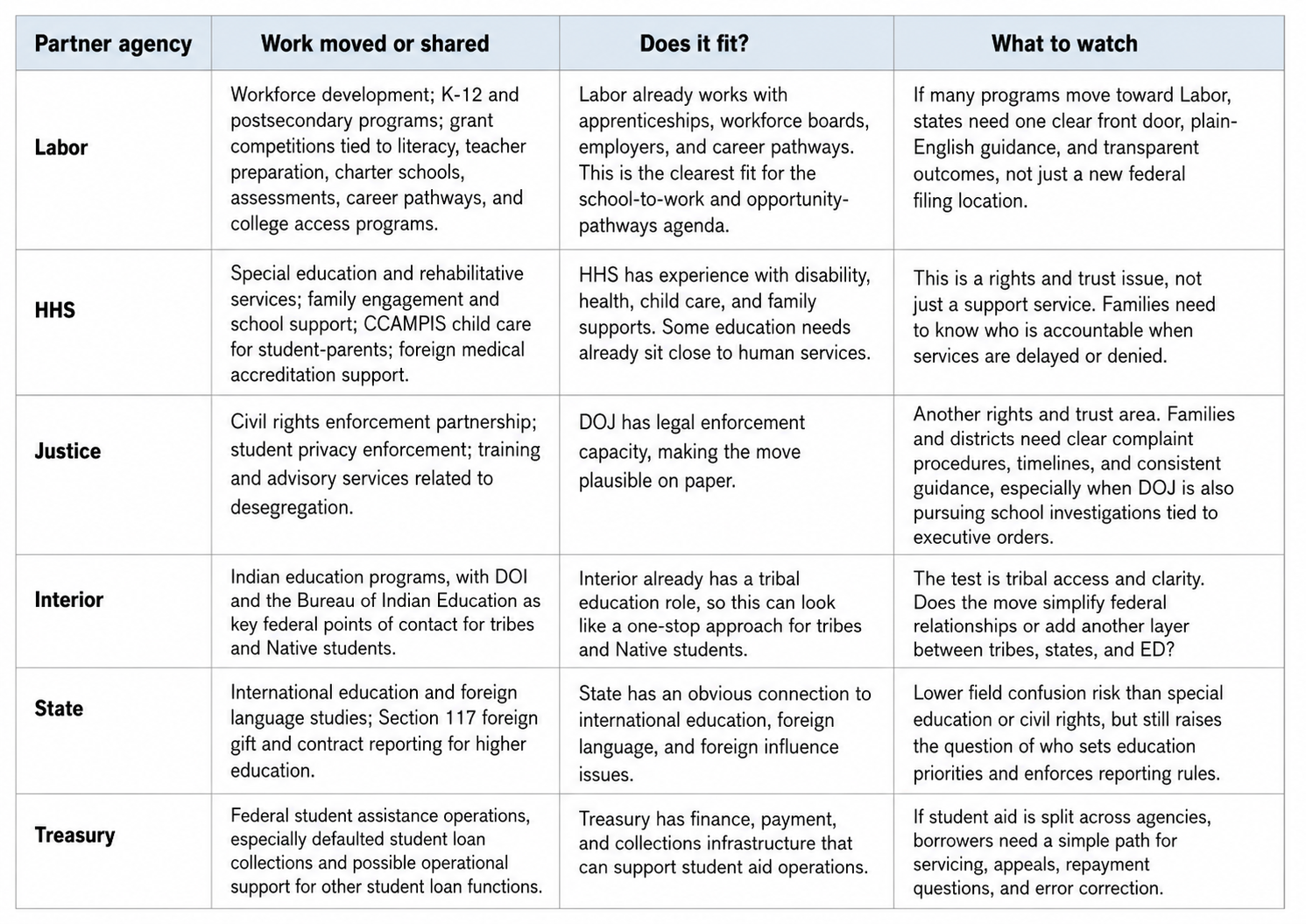
The case for these transfers varies by program. Some functions may fit naturally within agencies that already handle workforce development, finance, tribal affairs, or international relations. But relocation alone does not guarantee better coordination or service. The real test is whether the new arrangement is easier to navigate, preserves clear accountability, protects students’ rights, and produces better results.
The administration's underlying rationale isn’t baseless. Education has never fit inside one government box. Many students move through systems that extend beyond K–12 education. A young person might take career courses in high school, enter an apprenticeship, earn a short-term credential at a community college, and rely on workforce agencies or employers along the way.
Additionally, when the Education Department was created in 1979, a number of programs that would have fit into the new Department, such as Head Start and Indian Education, were not transferred to it. Interest groups fought vigorously to keep their particular program out of the new Department.
Special education and civil rights present a harder case. These functions involve more than coordinating services and are functions Congress assigned to the Education Department. They require enforcing legal obligations and giving students and families a clear place to turn when those obligations are not met. Moving special education administration to HHS and civil-rights enforcement to Justice could blur those lines of responsibility. The civil-rights transfer is especially sensitive given that DOJ is already pursuing school investigations tied to the administration’s civil rights priorities, including probes of sexual orientation, gender identity instruction, parental opt-out rights, and access to sex-separated facilities.
So yes, the system needs a coherent redesign. But “less bureaucracy” is not a high enough bar. Families need a system they can navigate and officials they can hold accountable. And the danger with the administration’s approach is that it could replace one front door with six side doors, creating a maze and not a map.
That danger is sharpest in special education and civil rights, where federal agencies administer substantial funding and enforce legal protections. These are trust functions, not just administrative assignments. Special education alone sends roughly $15 billion a year to states and schools, supporting services for students whose rights are protected under federal law. Moving special education administration to HHS and civil rights enforcement to Justice raises practical questions, such as whether families will know where to turn if funds are delayed, services are denied, or complaints go unresolved.
Those concerns are not confined to Democrats. Sen. Bill Cassidy of Louisiana, the Republican chair of the Senate Health, Education, Labor and Pensions Committee, has objected to moving special education to HHS and argued that Labor would be the better fit, if it must move at all. He’s agreed to hold a vote on Democrat sponsored legislation that would block the transfer.
The Labor agreements may offer a more promising model. Better alignment among K–12 schools, apprenticeship programs, and colleges could strengthen pathways from school to work.
But moving programs to a new agency will matter only if it produces better coordination for students. That is why these agreements should be judged by five practical questions:
1. Do they make the system easier to navigate? If a state, district, family, or community organization needs help, is there a clear place to start, with public points of contact, plain-English responsibilities, and clear timelines and appeals?
2. Do they preserve accountability? The Education Department may retain legal responsibility for many programs while other agencies handle day-to-day operations, which can work only if someone is clearly answerable when problems arise. Shared responsibility often sounds efficient until something goes wrong, when it can become no one’s responsibility.
3. Do they protect rights? Civil rights, disability protections, student privacy, and services for vulnerable students must not become casualties of administrative redesign. A smaller federal role still needs strong guardrails.
4. Do they improve outcomes? The measure should not be whether Washington moved boxes on an organizational chart. The measure should be whether students read better, graduate at higher rates, find stronger pathways to work, receive promised services, and have their rights protected.
5. Do they help states build capacity rather than simply shift burdens? Returning authority to states can be healthy. But state flexibility without state capacity is an invitation to unevenness. Some states will innovate. Others may struggle. The federal government’s job should be to create room for state leadership while ensuring transparency, comparability, and basic protections.
This is where the slogan “return education to the states” needs more content. States don’t need Washington to micromanage every decision, but they need coherent rules, reliable data, and a federal partner that helps connect education to work and opportunity. Families need a clear sense of what they’re entitled to, where to go, and who’s accountable.
The administration is right that education policy now spans schools, colleges, employers, workforce boards, and other agencies (though one can argue that it always has). Reorganizing the department could improve coordination and give states more room to lead. But dispersing programs across Washington will help only if states and families can still tell who is responsible, where to go for help, and how students’ rights will be enforced.
That is the standard by which this effort should be judged. A smaller federal role may be sensible, but it should produce clearer pathways and unmistakable lines of accountability. States and families should have a map they can follow, not a maze they must navigate.